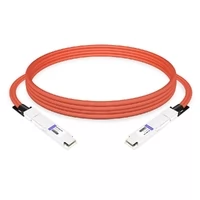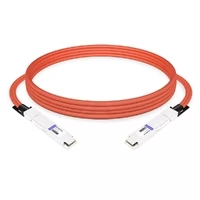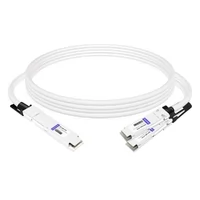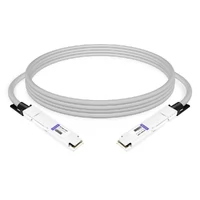

High-performance computing (HPC) environments require networking solutions that can handle massive data throughput with near-zero delay. Enter the infiniband cable, a critical component that provides the extremely high data rates and superior availability vital for modern, data-intensive workloads. Designed for seamless connection and maximum throughput, the infiniband cable serves a foundational purpose in nearly every advanced technological field, from enterprise data storage systems to highly sophisticated supercomputing and research units.
The demand for bandwidth has now reached a point where it requires more than the existing 400G networks to accommodate. As data centers evaluate their infrastructure, deciding when and how to upgrade is a difficult challenge that network architects must solve. This comprehensive article will examine Infiniband technology in terms of its architecture, the benefits of its deployment, how it contrasts with conventional networking solutions like Ethernet, and the cutting-edge transceiver form factors powering its future. By investigating the specifics of the infiniband cable, network engineers can better understand how these solutions contribute to increased data communication speed and network resilience.
What is Infiniband and How Does it Compare to Ethernet?
Defining the Infiniband Architecture
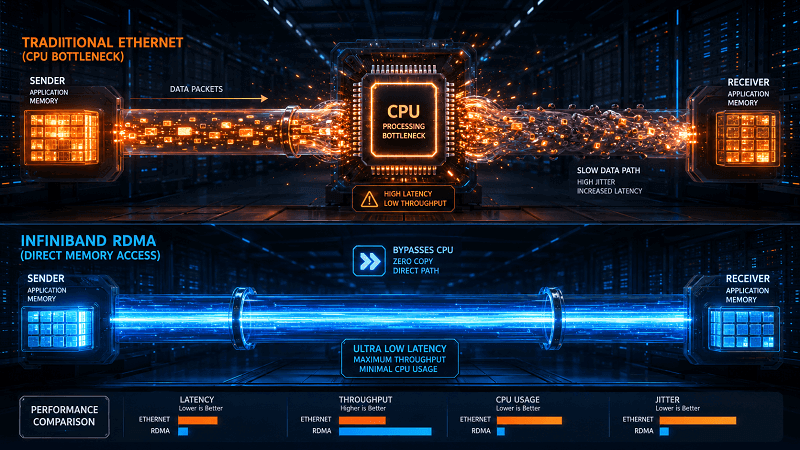
Infiniband refers to a specialized, high-speed computer networking protocol utilized primarily within embedded system environments, supercomputing, and enterprise data centers that demand exceptionally low latency and massive bandwidth. Due to the great bandwidths it can deliver combined with its ultra-low latency, the infiniband cable is widely considered the ultimate high-performance solution for data-intensive applications.
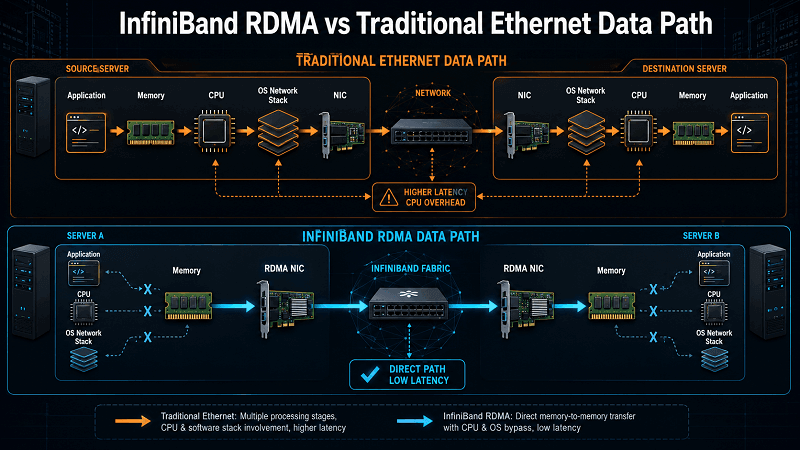
This interconnect standard is tailor-made for the complex requirements of computing networks, providing the scale and strength necessary for maximum throughput. One of its defining features is its reliance on the Remote Direct Memory Access (RDMA) protocol. RDMA enables the network to skip central processing unit (CPU) processes entirely, allowing direct copying of memory regions from one computer’s memory to another. This hardware-level offloading drastically reduces latency while simultaneously increasing data transfer speeds, ensuring that CPU resources are reserved for actual computational tasks rather than network overhead.
Infiniband Cable vs. Ethernet
While Ethernet was first developed as a general-purpose inter-connection solution and is heavily relied upon for its adaptability and cost-effectiveness, the infiniband cable is purpose-built for high-performance computing.
In micro-centric, purpose-built machines, an infiniband cable represents a significant improvement over Ethernet due to its capacity for higher data throughputs, seamless transmission rates, and RDMA capabilities. The cost perspective certainly favors Ethernet for standard, broader applications, but when top-notch performance and stability are required—such as scaling bandwidth up to 400 Gbps, 800 Gbps, or beyond—the infiniband cable becomes mandatory. The elimination of CPU bottlenecks makes the infiniband cable the superior choice for machines requiring the highest performance per unit cost.
Exploring Different Infiniband Cable Types
When outfitting a network, selecting the correct type of infiniband cable depends heavily on performance requirements, distance, and the physical constraints of the data center.
1. Direct Attach Copper (DAC) and Active Copper Cables
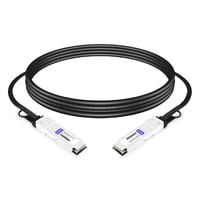
Copper cables are economically reasonable and possess excellent signal quality for short distances within data centers. Direct Attach Copper (DAC) cables are incredibly energy-efficient and perfectly suited for low-latency infiniband links, making them ideal for short-reach applications (typically under 7 meters). They transfer data with very little latency and require no extra power for embedded signal processing. Conversely, active copper cables incorporate active electronics to boost and balance the signal, reducing power loss and allowing for reliable transmission over slightly longer, medium-range distances.
2. Active Optical Cables (AOC)
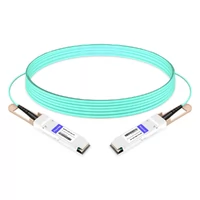
For longer distances, optical fiber cables are essential. Infiniband AOCs (Active Optical Cables) utilize active fiber optic technology, coming equipped with integrated optical transceivers on either end without necessitating separate, standalone transceivers. These cables allow for much greater distances to be covered without the signal attenuation issues that are common to copper wiring. Additionally, AOCs operate at excellent data rates, consume less power, and exhibit immunity to electromagnetic interference, ensuring data integrity across large distances.
3. Splitter/Breakout Cables
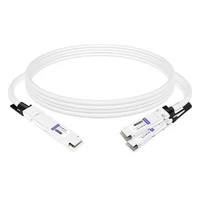
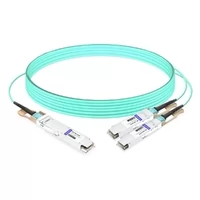
A splitter cable (or breakout cable) is used to break a single high-speed port into numerous lower-speed ports. For example, in Infiniband networks, it is normal to see a splitter cable linking a high-capacity QSFP port with multiple SFP ports to better distribute bandwidth and arrange network topology effectively.
The Role of Transceiver Form Factors: QSFP-DD vs. OSFP
As infiniband cable technology evolves to support incredible speeds, the transceivers at the ends of these cables must evolve as well. For those designing advanced networks, there is a file you can reference named “OSFP transceiver.docx”. This document sheds light on the next-generation components driving high-speed networks forward.
The OSFP (Octal Small Form-factor Pluggable) form factor was developed by the OSFP MSA group to solve thermal and density problems that earlier designs could not manage. Understanding the physical connectors is crucial when selecting an infiniband cable.
- QSFP-DD (Quad Small Form-factor Pluggable Double Density): QSFP-DD offers backward compatibility with older QSFP28 and QSFP56 modules, making it a compelling choice for upgrading existing infrastructure. It features an 18.35mm form factor, higher port density, and lower power consumption for 400G applications.
- OSFP: Measuring 22mm x 107mm, the OSFP design is slightly larger, but this extra surface area offers significantly better heat dissipation capacity than the 18.35mm QSFP-DD design. OSFP is becoming the standard for 800G deployments, particularly in new data center builds where thermal design can be optimized from the ground up. OSFP provides superior thermal headroom for high-power modules, future scalability to 3.2T, and better signal integrity.
When choosing between them, new data center builds almost always choose OSFP, while upgrades tend to stick with QSFP-DD for backward compatibility.
Speed Evolution: HDR, NDR, and 1.6T Connections
The infiniband cable ecosystem is categorized by its data rate standards. Estimating your needed data rate requires determining the intended data transfer task and evaluating your network cards and interfaces to prevent overreliance on outdated systems.
Infiniband HDR (High Data Rate)
Introduced in late 2019, Infiniband HDR essentially involves a data transfer rate of 200 Gbps per single link. This standard significantly boosted the capacity to conduct complex data-intensive tasks and utilizes better signaling strategies than earlier versions, drastically improving latency and throughput. HDR typically utilizes QSFP56 connectors.
Infiniband NDR (Next Data Rate)
NDR represents a leap to 400 Gbps per port. It allows data to be transferred at extreme speeds, making it the preferred choice for interconnecting complex computational tasks. Like HDR, NDR heavily utilizes QSFP56 connectors, but with enhanced signaling protocols to double the bandwidth without sacrificing reliability.
The Push for 800G and 1.6T
Modern workloads require even more. 800G OSFP is rapidly approaching price parity with 400G on a per-Gbps basis, accelerating its adoption. At the absolute cutting edge, 1.6T OSFP represents the current state of the art, pushing 200G per electrical lane using advanced PAM4 signaling and DSP technology. Crucially, InfiniBand XDR compatibility makes 1.6T OSFP particularly valuable for HPC environments, maintaining low latency while delivering massive bandwidth.
To achieve these speeds across different distances, various optical module specifications are used:
- SR8 (Short Reach): Uses multi-mode fiber (OM4 or OM5) and 850nm VCSEL lasers to achieve up to 100m reach, which is cost-effective for intra-data center connections.
- DR8 (Datacenter Reach): Uses single-mode fiber and 1310nm silicon photonics for a 500m reach, perfect for data center interconnects.
- FR8 (Framing Reach): Extends the 1310nm single-mode reach to 2km, covering most enterprise campus requirements.
- LR8 (Long Reach): Designed for metropolitan networks, pushing signals up to 10km over single-mode fiber.
Thermal Management: The Critical Challenge
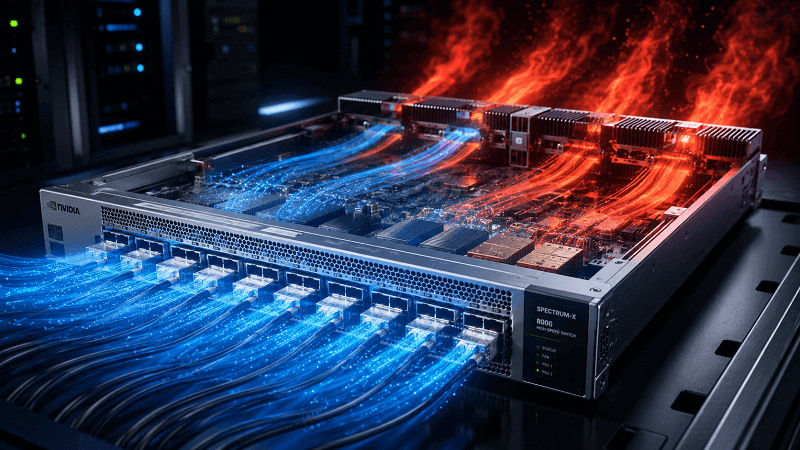
As the data rates of an infiniband cable increase, so does the power consumption and heat generation of its transceivers. Thermal management can make or break a high-speed deployment.
At the 400G tier, modules typically consume between 8W and 12W of power. However, at the 800G and 1.6T levels, the thermal load spikes dramatically. Real deployments show power consumption hitting 15W to 20W per module. For a typical 32-port 800G switch, the optics alone can generate 480W of heat, which, combined with the switch ASIC, brings the total heat dissipation to nearly a kilowatt in a 1RU or 2RU package.
Proper cooling strategies are mandatory for a modern infiniband cable infrastructure:
- Airflow Optimization: Data centers must maintain an airflow velocity of 3-4 m/s through the switch, aiming to keep intake temperatures below 25°C.
- Heat Sink Designs: Utilizing a Riding Heat Sink (RHS) that integrates with the switch’s cooling design generally provides better thermal performance for high-power applications compared to an Integrated Heat Sink (IHS).
- Liquid Cooling: For extreme density, such as 1.6T OSFP deployments in AI clusters, data centers may need to evaluate cold plate cooling, immersion cooling, or rear door heat exchangers.
Additionally, utilizing Digital Diagnostics Monitoring (DOM) allows network engineers to proactively track real-time temperatures, supply voltages, and laser bias currents to catch airflow degradation early.
Applications in High-Performance Computing and AI
The unique characteristics of the infiniband cable make it the backbone of the world’s most advanced computing environments.
Revolutionizing Artificial Intelligence (AI) Workloads
AI and machine learning clusters are the primary drivers for 800G and 1.6T networks. Training massive AI models requires rapid communication among distributed GPU components. Traditional links create bottlenecks in distributed training workloads, a problem that high-speed infiniband cables solve. The bandwidth density of OSFP connections keeps GPU data pipelines completely full, while the protocol’s sub-microsecond latency enables rapid parallel computing.
The Impact of NVIDIA and Mellanox
The synergy between NVIDIA’s parallel processing GPUs and Mellanox’s advanced infiniband solutions has revolutionized HPC. FiberMall’s 1.6T OSFP InfiniBand modules, for example, support NVIDIA Quantum-2 switches, providing the connectivity backbone for modern AI infrastructure. Mellanox has continuously improved Infiniband performance through adaptive routing algorithms that steer traffic along optimal paths and advanced hardware offloading techniques. Together, NVIDIA and Mellanox are targeting greater scalability and building networks capable of facilitating data movement with near-zero latency.
Hyperscale Data Centers & Financial Services
Hyperscale cloud providers (like AWS, Azure, and Google Cloud) are driving massive OSFP adoption at scale because they require massive bandwidth between compute and storage with deterministic performance. When hyperscalers standardize on this technology, the entire supply chain follows, lowering costs. Similarly, high-frequency trading infrastructure heavily relies on the infiniband cable for its deterministic latency, where a microsecond advantage can yield millions in profit.
Best Practices for Infiniband Cable Deployment
To ensure maximum performance and avoid hardware damage, strict deployment guidelines must be followed:
- Pre-Deployment Verification: Confirm that the switch OS supports the specific modules, the firmware handles the target speed (400G/800G/1.6T), and the cooling capacity is sufficient for the thermal load.
- Physical Handling: Always use ESD protection, as static electricity can destroy advanced optics. Never force a connection; push firmly until the latch clicks, and verify seating with a gentle tug.
- Cable Management: Maintain a minimum bend radius (typically 30mm for patch cables) to prevent signal degradation, and ensure cables are secured to prevent strain on the MPO-16 or LC connectors.
- Testing: After installation, verify the link comes up at the target speed, check DOM readings for healthy temperatures, and run a bit error rate test over a 24-hour burn-in period to ensure an error rate of <1×10^-12 BER.
Frequently Asked Questions (FAQs)
Q1: What is an infiniband cable, and why is it better than Ethernet for HPC?
A: An infiniband cable is a networking medium that uses the Infiniband protocol, designed specifically for low latency and high bandwidth. Unlike standard Ethernet, Infiniband utilizes Remote Direct Memory Access (RDMA), which allows data to move directly between the memory of different computers, bypassing the CPU. This results in drastically lower latency and highly efficient parallel processing.
Q2: What is the difference between HDR and NDR infiniband cables?
A: HDR (High Data Rate) Infiniband supports data transfer rates of 200 Gbps per port, while the newer NDR (Next Data Rate) standard doubles that capacity to 400 Gbps per port. Both standards typically utilize QSFP56 connectors, but NDR offers superior throughput for more complex computational tasks.
Q3: When should I choose an OSFP transceiver over a QSFP-DD for my infiniband cable network?
A: Data center construction, AI/ML cluster installations, and new 800G+ deployment projects should use OSFP because its larger size offers highly effective thermal solutions and heat dissipation. Conversely, if you are upgrading an existing infrastructure that needs backward compatibility with older QSFP28 modules, you should maintain that environment by using QSFP-DD.
Q4: Can I use OSFP modules in QSFP-DD ports?
A: The answer to your question about using OSFP modules with QSFP-DD ports is no, because OSFP modules and QSFP-DD ports have different physical sizes, and their electrical components do not work together. You need switches with native OSFP ports to use OSFP modules.
Q5: What power consumption and cooling requirements exist for 800G and 1.6T OSFP modules?
A: Actual measurements show that while 400G modules use 8-12W, 800G modules use 12-15W, and cutting-edge 1.6T modules use 15-20W of power. The thermal design requirement for 800G plus dense deployments needs a 20W allocation for each module. You must design your system to maintain 3-4 m/s airflow through switches and operate at intake temperatures that stay under 25°C.
Q6: What is an Active Optical Cable (AOC), and when should I use it?
A: An Infiniband AOC integrates active fiber optic technology with built-in optical transceivers on both ends. You should use an AOC when you need to cover larger distances (up to 100 meters or more) within a data center, as they suffer no electromagnetic interference, consume relatively low power, and prevent the signal attenuation issues found in long-range copper cables.
Q7: What distinguishes SR8, DR8, and FR8 optical modules?
A: SR8 uses multi-mode fiber for short reaches up to 100m, making it highly cost-effective for intra-rack connections. DR8 uses single-mode fiber for reaches up to 500m, ideal for data center interconnects. FR8 extends that single-mode reach up to 2km for campus and edge networks.
Q8: Why is the infiniband cable so critical for AI and Machine Learning?
A: AI systems require massive, distributed computing power, often clustering thousands of GPUs together. Infiniband networks, particularly those utilizing 800G or 1.6T OSFP modules and NVIDIA Quantum-2 switches, provide the massive bandwidth density and deterministic, sub-microsecond latency required to keep GPU data pipelines full during complex model training workloads.
Related Products:
-
 NVIDIA MCA4J80-N004 Compatible 4m (13ft) 800G Twin-port 2x400G OSFP to 2x400G OSFP InfiniBand NDR Active Copper Cable
$650.00
NVIDIA MCA4J80-N004 Compatible 4m (13ft) 800G Twin-port 2x400G OSFP to 2x400G OSFP InfiniBand NDR Active Copper Cable
$650.00
-
NVIDIA MCA4J80-N005 Compatible 5m (16ft) 800G Twin-port 2x400G OSFP to 2x400G OSFP InfiniBand NDR Active Copper Cable
$700.00
-
NVIDIA MCP7Y60-H002 Compatible 2m (7ft) 400G OSFP to 2x200G QSFP56 Passive Direct Attach Cable
$125.00
-
NVIDIA MCP4Y10-N00A Compatible 0.5m (1.6ft) 800G Twin-port 2x400G OSFP to 2x400G OSFP InfiniBand NDR Passive Direct Attach Copper Cable
$105.00
-
NVIDIA MCP7Y60-H001 Compatible 1m (3ft) 400G OSFP to 2x200G QSFP56 Passive Direct Attach Cable
$99.00
-
NVIDIA MFS1S00-H003V Compatible 3m (10ft) 200G InfiniBand HDR QSFP56 to QSFP56 Active Optical Cable
$350.00
-
NVIDIA(Mellanox) MCP1650-H003E26 Compatible 3m (10ft) Infiniband HDR 200G QSFP56 to QSFP56 PAM4 Passive Direct Attach Copper Twinax Cable
$80.00
-
NVIDIA MFA7U10-H003 Compatible 3m (10ft) 400G OSFP to 2x200G QSFP56 twin port HDR Breakout Active Optical Cable
$750.00