


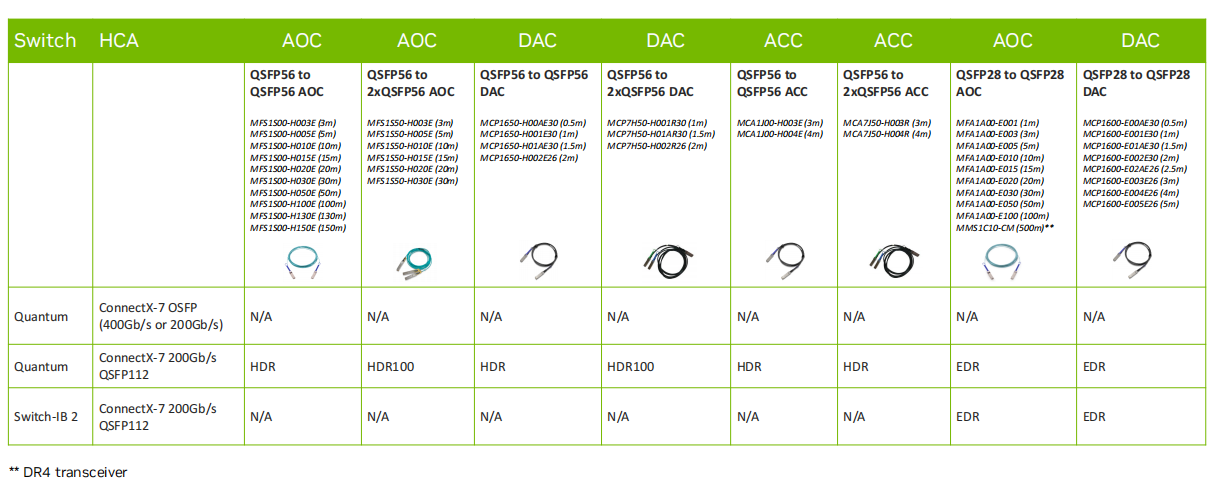
It can be compatible with HDR/EDR cables, but you need to be aware that using HDR/EDR cables will reduce the connection speed because the maximum bandwidth of HDR/EDR cables are 200 Gb/s and 100 Gb/s respectively. Therefore, if you want to fully utilize the performance of CX7 NDR 200 QSFP112, it is recommended that you use NDR cables, which can provide 400 Gb/s of bandwidth.
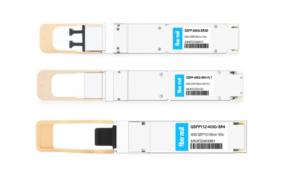
800G SR8 and 400G SR4 Optical Transceiver Modules Compatibility and Interconnection Test Report
Version Change Log Writer V0 Sample Test Cassie Test Purpose Test Objects:800G OSFP SR8/400G OSFP SR4/400G Q112 SR4. By conducting corresponding tests, the test parameters meet the relevant industry standards, and the test modules can be normally used for Nvidia (Mellanox) MQM9790 switch, Nvidia (Mellanox) ConnectX-7 network card and Nvidia (Mellanox) BlueField-3, laying a foundation for
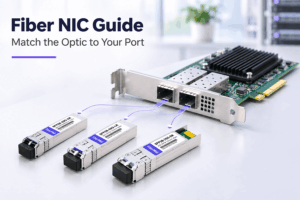
Fiber NIC Guide: Match the Optic to Your Port
A fiber NIC is an Ethernet network card with optical interfaces, typically using pluggable cages such as SFP, SFP+, SFP28, QSFP+ or QSFP28. On an open-cage card, the port accepts a compatible transceiver or direct-attach cable. The port form factor, NIC hardware, firmware and configuration determine what can be used,
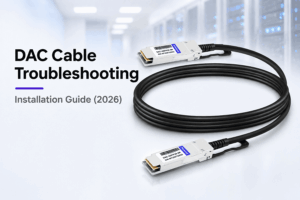
DAC Cable Troubleshooting & Installation Guide (2026)
Most DAC cable failures aren’t caused by defective cables. Common causes include unseated connectors, mismatched speed or FEC settings, rejected EEPROM codes, or an electrical channel operating too close to its signal integrity limits. That’s the frustrating part of DAC cable troubleshooting: the cable is often the last thing to
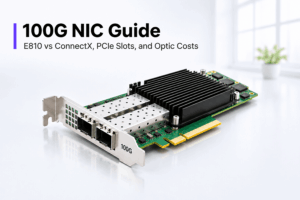
100G NIC Guide: E810 vs ConnectX, PCIe Slots, Optic Cost
A single 100G NIC port needs sufficient PCIe host bandwidth, typically PCIe Gen3 x16 or Gen4 x8, to support 100GbE throughput. However, the required lane width and physical port type depend on the specific adapter model. A 100G NIC may use a QSFP28 or QSFP56 port. Beyond bandwidth, the card
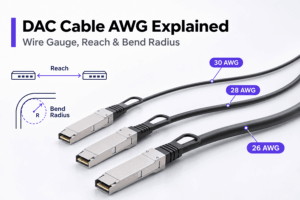
DAC Cable AWG Explained: Wire Gauge, Reach & Bend Radius
The AWG of a direct attach copper (DAC) cable refers to the wire gauge of the copper conductors inside its twinax pairs. It plays an important role in determining signal attenuation, transmission distance, flexibility, and cable weight. Lower AWG values indicate thicker copper conductors, which generally support longer reach at
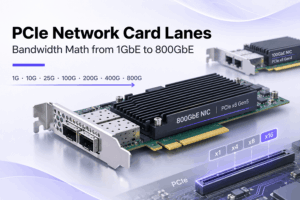
PCIe Network Card Lanes: Bandwidth Math From 1GbE to 800GbE
A PCIe network card may use an x1, x4, x8, or x16 interface, but the lane count alone does not determine its available bandwidth. The PCIe generation and negotiated link width together determine whether the host interface can support the card’s aggregate network throughput. For example, a dual-port 25GbE NIC
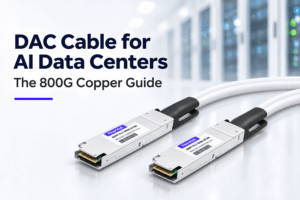
DAC Cable for AI Data Centers: The 800G Copper Guide
Choosing a DAC cable for an AI data center starts with reach. DAC stands for direct attach copper: a factory-terminated twinax cable assembly with fixed, pluggable ends. It is not an audio digital-to-analog converter or an optical cable. At 800G, passive DAC typically covers about 1 to 2 m, depending