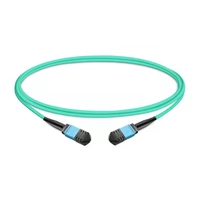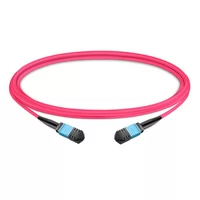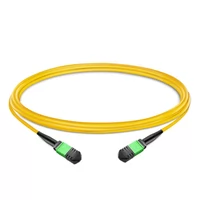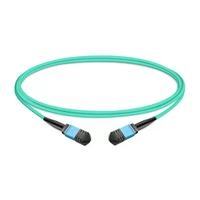

The delivery contained twelve boxes of MPO connectors, which Marcus observed. He had requested MTP connectors but received something different. The project deadline was Friday. The standard connectors required him to choose between two options, which would either postpone his work or permit him to continue.
More than you might expect, data centers experience this situation. The confusion is understandable. MPO and MTP look identical. The two systems can connect. The wrong choice affects your performance, reliability, and budget.
This guide cuts through the confusion. The document shows you essential technical differences between systems, which determine actual costs, and provides a decision-making process for your particular needs.
What Are MPO and MTP Connectors?
Let’s start with the relationship. The standard definition for generic systems is described through MPO. The MTP system functions as a trademarked system that provides enhanced capabilities.
MPO (Multi-fiber Push-On) refers to the industry standard defined by IEC 61754-7 and TIA-604-5. Any manufacturer can build MPO connectors meeting these specifications. You will find multiple suppliers who provide these products at different price ranges.
MTP (Multi-fiber Termination Push-on) is a registered trademark of US Conec. The system provides an upgraded version of MPO through its unique design features. Think of it as MPO taken further.
The main point states that MTP connectors function as MPO connectors, whereas only specific MPO connectors can achieve MTP performance requirements. They have complete compatibility. An MTP connector will click into an MPO adapter without issue. The difference shows up in performance over time, especially under demanding conditions.
US Conec developed the MTP design in the late 1990s to address limitations they saw in early MPO implementations. The improvements they made to their system focused on three areas, which included alignment precision and durability, and field serviceability.
The distinction matters in practical applications. When you order “MPO connectors” from a generic supplier, you receive the standard implementation. The customer receives the enhanced product, which includes performance guarantees when they select “MTP” or “US Conec MTP” as their specifications.
The two systems use the same adapter connections. The two systems operate according to IEC 61754-7 standards. The two systems permit 8, 12, 16, or 24 fiber configurations. The difference between the two systems becomes visible through three specific conditions, which include stress testing, endurance testing, and high-performance usage.
For a complete foundation on MPO technology, see our complete MPO connector guide.

Key Technical Differences
The performance gap exists because engineers selected particular design options. Understanding these helps you evaluate whether the premium is worth it for your deployment.
Ferrule Design: Fixed vs Floating
The ferrule is the precision component that holds the fiber ends. Standard MPO uses a fixed ferrule rigidly attached to the housing. It works fine in stable conditions.
MTP uses a floating ferrule design. The ferrule can move slightly within the housing, maintaining better physical contact under load. This matters when:
- Thermal expansion shifts components
- Vibration affects the connection
- Direct pressure is applied to mated connectors
The floating design maintains consistent optical performance across temperature ranges and mechanical stress.
Guide Pin Engineering
The two parts of a connection need guide pins, which function as alignment tools. Standard MPO connections use chamfered plastic pins as their default connector type. The connectors function correctly, but they produce tiny waste particles because their materials are softer.
MTP uses elliptical stainless steel guide pins. The tighter tolerances improve alignment precision. The steel design prevents any debris waste during operation. The system achieves performance maintenance through debris elimination across multiple mating cycles.
Housing and Field Serviceability
Standard MPO housings are typically fixed molded units. The entire connector needs replacement when you want to switch between different connector genders or different polarity modes.
MTP housings provide users with the ability to detach them from their installed position. Field technicians can swap polarity or pin configuration without specialized termination equipment. The MTP PRO variant even allows tool-free changes in seconds.
The importance of this serviceability aspect exceeds your initial expectations. Technicians achieved maintenance time reductions from hours to minutes because they could reconfigure existing cables instead of needing to replace them.
Spring and Mechanical Design
The spring maintains contact pressure between mated ferrules. The standard MPO system operates with traditional spring mechanisms. MTP employs an optimized oval spring design that clears fiber ribbons more effectively while maintaining consistent pressure.
The result is fewer crushed ribbons during assembly and more reliable contact over the connector’s lifetime.
Durability and Mating Cycles
One specification that people typically ignore stands as the mating cycle rating. Every time you connect and disconnect a fiber connector, microscopic wear occurs. The ferrule endface shows a minimal decrease in quality. The alignment system experiences minor changes because of the testing procedure.
Standard MPO connectors are typically rated for 200-300 mating cycles. The system experiences increased insertion loss while its reliability decreases after that point. The data center reaches its capacity limit because cables need to be moved during system upgrades and network reconfigurations.
MTP connectors can handle between 500 and over 1000 mating cycles. The stainless steel guide pins demonstrate greater resistance to wear than plastic materials. The floating ferrule design helps to decrease the strain that affects the interface. Organizations that operate in environments where employees routinely handle materials will experience cost savings through extended product life and reduced unanticipated breakdowns.
Performance Comparison: The Numbers That Matter
Specifications tell part of the story. Let’s look at what these numbers mean for real deployments.
| Performance Metric | MPO Standard | MTP Standard | MTP Elite |
| Insertion Loss (Multimode) | 0.35-0.75 dB | 0.20-0.35 dB | 0.10-0.20 dB |
| Insertion Loss (Single-mode) | 0.50 dB max | 0.35 dB max | 0.25 dB max |
| Mating Cycles | 200-300 | 500-1,000+ | 1,000+ |
| Operating Temperature | Standard | -25°C to +70°C | Extended options |
| Return Loss (SM APC) | ≥60 dB | ≥65 dB | ≥65 dB |
That 0.15-0.35 dB difference in insertion loss seems small. It isn’t. In high-speed networks with multiple connection points, it compounds significantly.
Consider a typical spine-leaf architecture:
Four-connection scenario (patch panel to switch):
- MPO total loss: ~2.0-3.0 dB
- MTP total loss: ~1.2-1.4 dB
- Difference: 0.8-1.6 dB saved
Eight-connection scenario (complex fabric path):
- MPO total loss: ~4.0-6.0 dB
- MTP total loss: ~2.4-4.8 dB
- Difference: 1.6-2.4 dB saved
Modern 400G and 800G transceivers have tight link budgets. Sometimes that extra decibel determines whether your link comes up or stays down. For high-speed applications, check our guide on 400G and 800G transceivers.
Cost Analysis and ROI
Let’s talk numbers. MTP commands a premium. Whether it’s justified depends on your specific situation.
Real Market Pricing (2025)
| Assembly Type | MPO | MTP Standard | MTP Elite |
| 3m OM4 12-fiber | $18-32 | $30-50 | $45-70 |
| 3m OS2 APC 12-fiber | $25-40 | $40-65 | $60-90 |
| 10m OM4 24-fiber | $55-85 | $90-120 | $130-180 |
Volume discounts (10,000+ units): typically 15-30% off these prices
The premium is 30-60% over standard MPO. MTP Elite adds another 40-50% on top of standard MTP.
When the Math Works
Sarah ran the numbers for her 400G data center refresh. She needed 2,400 fiber connections across the fabric.
Option A – Standard MPO:
- Initial cost: 67,200(at67,200(at28 average)
- Troubleshooting budget: 3% of connections need rework = 72 incidents
- Estimated troubleshooting cost: $14,400
- Total first-year cost: $81,600
Option B – MTP Elite:
- Initial cost: 144,000(at144,000(at60 average)
- Troubleshooting budget: 0.5% need rework = 12 incidents
- Estimated troubleshooting cost: $2,400
- Total first-year cost: $146,400
The MTP option costs $64,800 more upfront. But Sarah also considered:
- Reduced downtime risk (reputation cost)
- Faster deployment (less testing time)
- Future-proofing for 800G migration
- Field serviceability savings on changes
For her mission-critical environment, the premium was justified. Your calculation may differ.
Decision Framework: Which Should You Choose?
Here’s a practical framework for your decision.
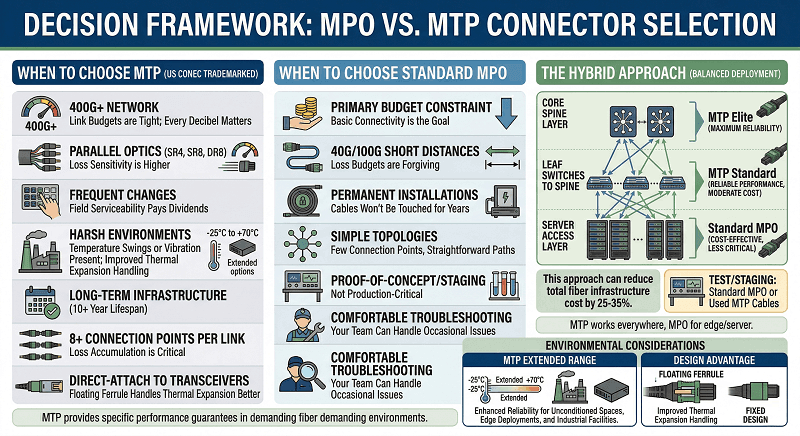
Choose MTP When:
- Deploying 400G or faster – Link budgets are tight; every decibel matters
- Running parallel optics (SR4, SR8, DR8) – Loss sensitivity is higher
- Expecting frequent changes – Field serviceability pays dividends
- Operating in harsh environments – Temperature swings or vibration present
- Building long-term infrastructure – 10+ year lifespan expected
- Running 8+ connection points per link – Loss accumulation becomes critical
- Direct-attaching to transceivers – Floating ferrule handles thermal expansion better
Choose Standard MPO When:
- Budget is the primary constraint – Basic connectivity is the goal
- Running 40G/100G with short distances – Loss budgets are forgiving
- Permanent installations – Cables won’t be touched for years
- Simple topologies – Few connection points, straightforward paths
- Proof-of-concept or staging – Not production-critical
- Comfortable troubleshooting – Your team can handle occasional issues
The Hybrid Approach
Many data centers use both. MTP for the critical spine fabric. Standard MPO for edge connections and server access. This balances reliability where it matters with cost savings where it doesn’t.
Typical hybrid deployment:
- Core spine layer: MTP Elite – maximum reliability for mission-critical paths
- Leaf switches to spine: MTP Standard – reliable performance with moderate cost
- Server access layer: Standard MPO – cost-effective for less critical connections
- Test/staging: Standard MPO or used MTP cables – non-critical environment
This approach can reduce total fiber infrastructure cost by 25-35% compared to using MTP everywhere, while maintaining performance where it counts.
Environmental Considerations
Your selection needs to be determined by temperature conditions and physical conditions that exist in the environment. MTP connectors work across a standard temperature range of -25°C to +70°C while allowing for extended temperature options. The floating ferrule design enables improved thermal expansion handling compared to fixed design systems.
The temperature stability and mechanical strength of MTP connectors provide extra reliability to three specific environments, which include unconditioned spaces, edge computing deployments, and industrial facilities.
For high-speed transceiver compatibility considerations, see our high-speed optical modules guide.
Common Mistakes to Avoid
We’ve seen these errors cost projects time and money.
Mixing MTP Elite with standard MPO.
The MTP Elite system shows reduced signal loss when compared to standard MPO. The combination of the two systems creates difficulties for your link budget calculations. The system establishes a connection yet produces inconsistent loss measurements throughout the network.
Ordering the wrong gender.
The equipment requires female connectors. Male connectors serve to extend trunk connections. The system requires adapters or replacement cables when you make this mistake. You should verify your port types again before you make your purchase.
Ignoring link budget in design.
The 0.3 dB per connector rule creates increasing total expenses. Standard MPO systems become more expensive in complex environments which have 6-8 patch points, while MTP systems maintain budget control. You should perform calculations at the start of your project instead of waiting until installation completion.
Specifying “MTP” in RFPs without defining grade.
The RFPs require you to define “MTP,” but you must also specify the grade. Vendors may quote standard MTP when you need Elite performance. Be specific: “MTP Elite, 0.25 dB max insertion loss, single-mode APC.”
Assuming all MTPs are equal.
Only US Conec manufactures genuine MTP. Other vendors use “MTP-compatible” marketing. The performance may be close, but it’s not the same. Specify “US Conec MTP” for critical applications.
FAQ
Can I mix MPO and MTP in the same link?
The two systems can function together because they maintain complete compatibility. Your link budget calculations should use the worst-case insertion loss of the standard MPO component. MTP performance does not apply to mixed link systems.
Is MTP worth the extra cost for 40G?
Most of the time MTP does not provide value for 40G systems. The 40G SR4 system operates successfully because it provides an adequate power budget of 7.1 dB. Standard MPO works fine for most 40G deployments under 100 meters. The premium is better justified for 100G+ or long-distance applications.
What distinguishes MTP from MTP Elite?
MTP Elite is a premium grade with tighter manufacturing tolerances. Standard MTP: 0.35 dB max loss. MTP Elite: 0.25 dB max single-mode, 0.20 dB max multimode. Elite distinguishes itself from all other products because it delivers superior performance for essential tasks.
How do I specify MTP in an RFP?
The MTP specification requires you to choose US Conec MTP connectors together with their Standard or Elite grade and their single-mode APC or multimode UPC designation and their 8 or 12 or 16 or 24 fiber count and their male or female gender and their Method A or B or C polarity. The document needs to include insertion loss specifications together with IEC 61754-7 compliance requirements.
What information exists about MTP-16 and upcoming industry standards?
The MTP-16 connector system allows users to connect 16 optical fibers through a single ferrule design which engineers created to meet 400G SR8 and 800G network requirements. The system uses TIA-604-18 offset keys to create connectors that will not connect with 12-fiber systems.
The industry now recognizes MTP-16 as the standard connector for 800G network installations. The performance benefits of genuine US Conec MTP-16 connectors follow the same quality standards as the US Conec MTP-16 connectors, which operate according to this guide.
Do I need special cleaning tools for MTP?
Standard cleaning devices that work with LC connectors cannot effectively clean MTP/MPO connectors that contain 12-fiber or 24-fiber systems. The system requires cassette-style cleaners that operate with multi-fiber ferrules. The good news: the same cleaner works for both MPO and MTP since they share the same ferrule geometry.
You must inspect your equipment first before proceeding to clean it. You must clean your equipment first before proceeding to connect it. The rule applies to all connector grades that you select.
Conclusion
The MPO vs MTP decision isn’t about good versus bad. It’s about fit for purpose.
Key takeaways:
- MTP is enhanced MPO, not a different category
- The premium (30-60%) is justified for 400G+, frequent changes, or complex fabrics
- Standard MPO works fine for basic 40G/100G with simple topologies
- Calculate your link budget before deciding
- Mixing grades complicates your loss calculations
Your specific application drives the right choice. MTP provides advantages for high-speed networks that operate in extreme conditions and deliver essential services. Standard MPO works well for budget-constrained projects that need basic functionality.
Need help selecting the right connector for your deployment? Contact our fiber connectivity experts for specification guidance tailored to your network requirements.
Related Products:
-
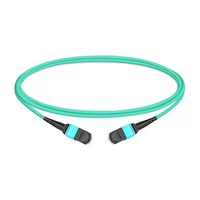
 1m (3ft) 12 Fibers Female to Female MPO Trunk Cable Polarity B LSZH OM3 50/125 Multimode Fiber
$20.00
-
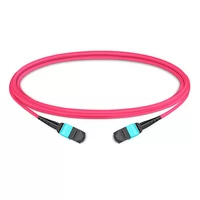
1m (3ft) 12 Fibers Female to Female MPO Trunk Cable Polarity B LSZH Multimode OM4 50/125
$21.00
-
1m (3ft) 12 Fibers Female to Female MPO Trunk Cable Polarity B LSZH OS2 9/125 Single Mode
$26.00
-
1m (3ft) 12 Fibers Low Insertion Loss Female to Female MPO Trunk Cable Polarity B LSZH OM3 50/125 Multimode Fiber
$32.00
-
1m (3ft) 12 Fibers Female to Female Elite MTP Trunk Cable Polarity B LSZH OM3 50/125 Multimode Fiber
$35.00
-
1m (3ft) 12 Fibers Female to Female Elite MTP Trunk Cable Polarity B LSZH Multimode OM4 50/125
$36.00
-
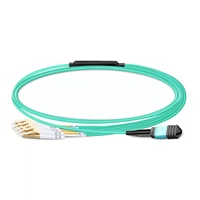
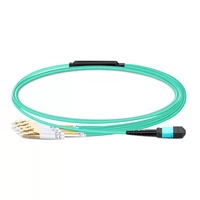
1m (3ft) MPO UPC Female to 4 LC UPC Duplex OM3 50/125 Multimode Fiber Breakout Cable, 8 Fibers, Type B, LSZH, Aqua
$20.00
-
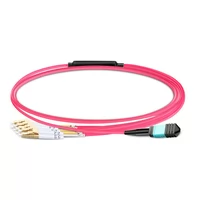
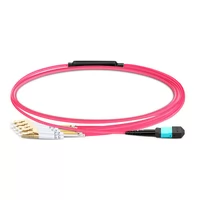
1m (3ft) MPO UPC Female to 4 LC UPC Duplex OM4 50/125 Multimode Fiber Breakout Cable, 8 Fibers Type B, LSZH, Aqua/Violet
$23.00
-
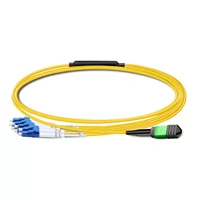
1m (3ft) MPO APC Female to 4 LC UPC Duplex OS2 9/125 Single Mode Fiber Breakout Cable, 8 Fibers Type B, LSZH, Yellow
$24.00
-
1m (3ft) MTP Female to 4 LC UPC Duplex OM3 50/125 Multimode Fiber Breakout Cable, 8 Fibers, Type B, Elite, Plenum (OFNP), Aqua
$28.00
-
1m (3ft) MTP Female to 4 LC UPC Duplex OM4 50/125 Multimode Fiber Breakout Cable, 8 Fibers, Type B, Elite, Plenum (OFNP), Aqua/Violet
$30.00
-
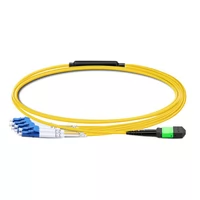
1m (3ft) MTP APC Female to 4 LC UPC Duplex OS2 9/125 Single Mode Fiber Breakout Cable, 8 Fibers, Type B, Elite, Plenum (OFNP), Yellow
$32.00