
- Brian
John Doe
Answered on 7:32 am
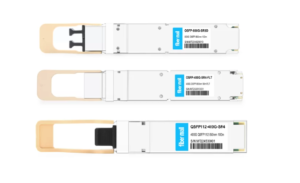
In general, the letters refer to reach or optics technology, and the number refers to the number of optical channels:
SR8: Short Range 8. This transceiver supports 400G transmission over multimode fiber (MMF) with a maximum reach of 100 meters. It uses a MPO-16 connector and PAM4 modulation.
SR8-C: Short Range 8 Copper. This transceiver supports 400G transmission over copper cable with a maximum reach of 3 meters. It uses a QSFP-DD connector and PAM4 modulation.
SRBD: Short Range Bidirectional. This transceiver supports 400G transmission over MMF with a maximum reach of 70 meters. It uses a duplex LC connector and PAM4 modulation.
SR4: Short Range 4. This transceiver supports 400G transmission over MMF with a maximum reach of 100 meters. It uses a MPO-12 connector and PAM4 modulation.
DR4 / XDR4 / PLR4: Data Center Reach 4 / eXtended Data Center Reach 4 / Parallel Long Reach 4. These transceivers support 400G transmission over single-mode fiber (SMF) with a maximum reach of 500 meters / 2 kilometers / 10 kilometers respectively. They use a MPO-12 connector and PAM4 modulation.
FR4 / LR4: Fiber Reach 4 / Long Reach 4. These transceivers support 400G transmission over SMF with a maximum reach of 2 kilometers / 10 kilometers respectively. They use a duplex LC connector and PAM4 modulation.
2FR4: Two Fiber Reach 4. This transceiver supports 400G transmission over SMF with a maximum reach of 2 kilometers. It uses two duplex LC connectors and coherent modulation.
People Also Ask
In-Depth Analysis Report on 800G Switches: Architectural Evolution, Market Landscape, and Future Outlook
Introduction: Reconstructing Network Infrastructure in the AI Era Paradigm Shift from Cloud Computing to AI Factories Global data center networks are undergoing the most profound transformation in the past decade. Previously, network architectures were primarily designed around cloud computing and internet application traffic patterns, dominated by “north-south” client-server models. However,
Global 400G Ethernet Switch Market and Technical Architecture In-depth Research Report: AI-Driven Network Restructuring and Ecosystem Evolution
Executive Summary Driven by the explosive growth of the digital economy and Artificial Intelligence (AI) technologies, global data center network infrastructure is at a critical historical node of migration from 100G to 400G/800G. As Large Language Model (LLM) parameters break through the trillion level and demands for High-Performance Computing (HPC)
Key Design Constraints for Stack-OSFP Optical Transceiver Cold Plate Liquid Cooling
Foreword The data center industry has already adopted 800G/1.6T optical modules on a large scale, and the demand for cold plate liquid cooling of optical modules has increased significantly. To meet this industry demand, OSFP-MSA V5.22 version has added solutions applicable to cold plate liquid cooling. At present, there are
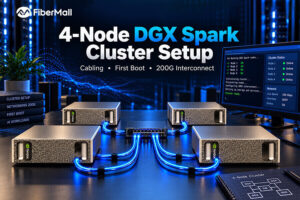
NVIDIA DGX Spark Quick Start Guide: Your Personal AI Supercomputer on the Desk
NVIDIA DGX Spark — the world’s smallest AI supercomputer powered by the NVIDIA GB10 Grace Blackwell Superchip — brings data-center-class AI performance to your desktop. With up to 1 PFLOP of FP4 AI compute and 128 GB of unified memory, it enables local inference on models up to 200 billion parameters and fine-tuning of models
RoCEv2 Explained: The Ultimate Guide to Low-Latency, High-Throughput Networking in AI Data Centers
In the fast-evolving world of AI training, high-performance computing (HPC), and cloud infrastructure, network performance is no longer just a supporting role—it’s the bottleneck breaker. RoCEv2 (RDMA over Converged Ethernet version 2) has emerged as the go-to protocol for building lossless Ethernet networks that deliver ultra-low latency, massive throughput, and minimal CPU
Related Articles

800G SR8 and 400G SR4 Optical Transceiver Modules Compatibility and Interconnection Test Report
Version Change Log Writer V0 Sample Test Cassie Test Purpose Test Objects:800G OSFP SR8/400G OSFP SR4/400G Q112 SR4. By conducting corresponding tests, the test parameters meet the relevant industry standards, and the test modules can be normally used for Nvidia (Mellanox) MQM9790 switch, Nvidia (Mellanox) ConnectX-7 network card and Nvidia (Mellanox) BlueField-3, laying a foundation for
In-Depth Analysis Report on 800G Switches: Architectural Evolution, Market Landscape, and Future Outlook
Introduction: Reconstructing Network Infrastructure in the AI Era Paradigm Shift from Cloud Computing to AI Factories Global data center networks are undergoing the most profound transformation in the past decade. Previously, network architectures were primarily designed around cloud computing and internet application traffic patterns, dominated by “north-south” client-server models. However,

Why Is It Necessary to Remove the DSP Chip in LPO Optical Module Links?
If you follow the optical module industry, you will often hear the phrase “LPO needs to remove the DSP chip.” Why is this? To answer this question, we first need to clarify two core concepts: what LPO is and the role of DSP in optical modules. This will explain why

Global 400G Ethernet Switch Market and Technical Architecture In-depth Research Report: AI-Driven Network Restructuring and Ecosystem Evolution
Executive Summary Driven by the explosive growth of the digital economy and Artificial Intelligence (AI) technologies, global data center network infrastructure is at a critical historical node of migration from 100G to 400G/800G. As Large Language Model (LLM) parameters break through the trillion level and demands for High-Performance Computing (HPC)

Key Design Constraints for Stack-OSFP Optical Transceiver Cold Plate Liquid Cooling
Foreword The data center industry has already adopted 800G/1.6T optical modules on a large scale, and the demand for cold plate liquid cooling of optical modules has increased significantly. To meet this industry demand, OSFP-MSA V5.22 version has added solutions applicable to cold plate liquid cooling. At present, there are

NVIDIA DGX Spark Quick Start Guide: Your Personal AI Supercomputer on the Desk
NVIDIA DGX Spark — the world’s smallest AI supercomputer powered by the NVIDIA GB10 Grace Blackwell Superchip — brings data-center-class AI performance to your desktop. With up to 1 PFLOP of FP4 AI compute and 128 GB of unified memory, it enables local inference on models up to 200 billion parameters and fine-tuning of models

RoCEv2 Explained: The Ultimate Guide to Low-Latency, High-Throughput Networking in AI Data Centers
In the fast-evolving world of AI training, high-performance computing (HPC), and cloud infrastructure, network performance is no longer just a supporting role—it’s the bottleneck breaker. RoCEv2 (RDMA over Converged Ethernet version 2) has emerged as the go-to protocol for building lossless Ethernet networks that deliver ultra-low latency, massive throughput, and minimal CPU
Related posts:
- What is the Difference Between UFM Telemetry, Enterprise and Cyber-AI?
- Any Specific Requirements for the Latency Performance of CX7 NIC?
- What do QSFP28, QSFP56, and SFP56 Mean? What Nomenclature Should be Used to Describe the Different Types of QSFP and SFP Ports?
- Which Arista 100G Transceivers and Cables Can Be Used in Breakout Mode?