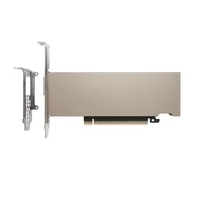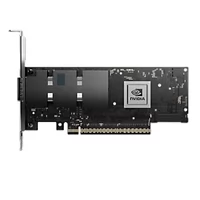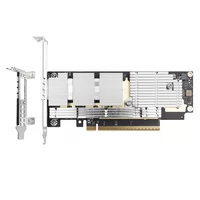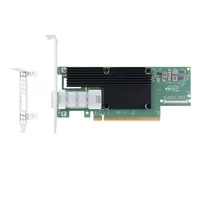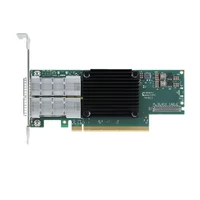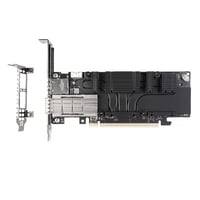

Marcus, a data center architect in Frankfurt, watched his team’s new H100 cluster hit a wall during distributed training. The GPUs were fast. The storage was fast. But the network could not keep up. His 200G links were the bottleneck, and the CFO had just asked whether the next refresh should jump straight to 800G. That question is landing on engineering desks everywhere: ConnectX-7 vs ConnectX-8, which generation actually makes sense?
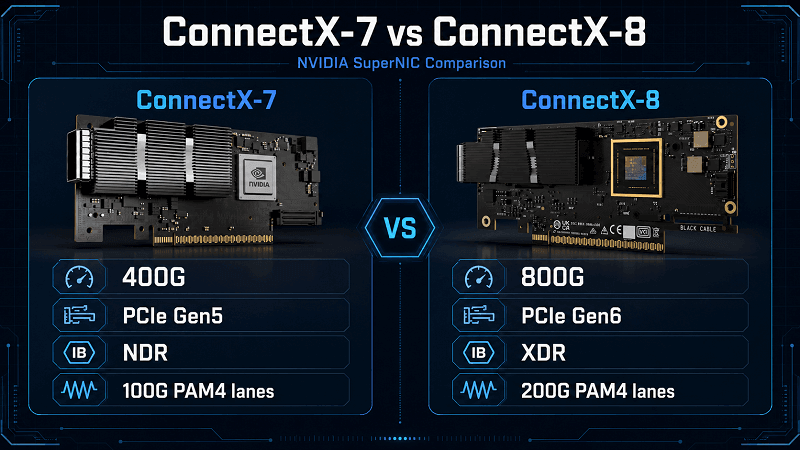
You probably already know the headline numbers. ConnectX-7 delivers 400Gb/s. ConnectX-8 doubles that to 800Gb/s. But the real decision depends on PCIe generations, transceiver compatibility, cable form factors, and whether your workloads can even use the extra bandwidth.
In this guide, we compare ConnectX-7 vs ConnectX-8 side by side. You’ll get a clear spec breakdown, a cable-compatibility reality check, and a decision matrix that maps each NIC to real infrastructure scenarios. If you’re planning an AI or HPC cluster refresh, this is the comparison you’ll wish you had before signing the PO.
What ConnectX-7 and ConnectX-8 Have in Common
Both cards are NVIDIA/Mellanox Virtual Protocol Interconnect (VPI) adapters. That means each one can run either InfiniBand or Ethernet from the same hardware, depending on firmware and transceiver choice. This flexibility matters for shops that standardize on InfiniBand for HPC but occasionally need Ethernet for management or cloud integration.
They also share the core feature set that defines modern SmartNICs:
RDMA/RoCEv2 for low-latency, CPU-offloaded remote memory access
GPUDirect RDMA and GPUDirect Storage for direct GPU-to-GPU and GPU-to-storage data paths
SR-IOV and hardware virtualization offloads for bare-metal performance inside virtualized environments
ASAP² accelerated switching and packet processing
VXLAN, GENEVE, and NVGRE tunnel offloads
Inline IPsec/MACsec/PSP encryption on select SKUs
So if you’re comparing ConnectX-7 vs ConnectX-8, you’re not choosing between two different philosophies. You’re choosing between two generations of the same platform. The differences show up in bandwidth ceiling, host interface, and the physical layer that connects them to the fabric.
ConnectX-7 vs ConnectX-8: Side-by-Side Specifications
This is where most buyers start. The spec table below captures the technical deltas that drive every other decision.
| Specification | ConnectX-7 | ConnectX-8 |
| Max bandwidth | 400 Gb/s | 800 Gb/s |
| InfiniBand generation | NDR | XDR |
| Ethernet speed | Up to 400GbE | Up to 800GbE / 2×400GbE |
| PAM4 lane rate | 100 Gb/s per lane | 200 Gb/s per lane |
| Host interface | PCIe Gen5 x16 | PCIe Gen6 x16 (up to 48 lanes via switch) |
| Bidirectional PCIe bandwidth | ~128 GB/s | ~384 GB/s |
| In-network computing | SHARPv3 | SHARPv4 |
| Congestion control | Fixed algorithms (DCQCN, etc.) | DOCA PCC (programmable) |
| Typical port options | Single OSFP or dual QSFP112 | Single OSFP-RHS (C8180) or dual QSFP112 (C8240) |
| Target GPU platforms | H100, H200, B200 | B300, GB300, next-gen AI factories |
The bandwidth jump is the obvious headline. ConnectX-8 moves from 400Gb/s to 800Gb/s by doubling the PAM4 lane rate from 100Gb/s to 200Gb/s. That lane-rate change is not just a number on a datasheet. It changes the transceivers, cables, and signal-integrity requirements that sit in front of the NIC.
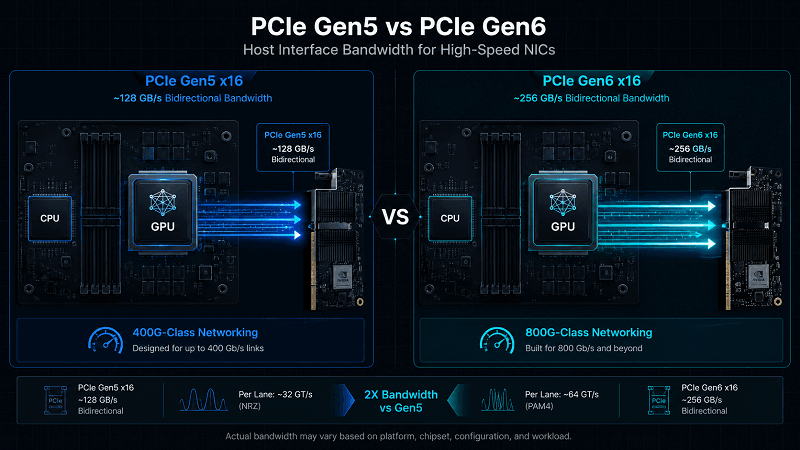
The PCIe jump is just as important. ConnectX-7 uses PCIe Gen5 x16, which is roughly 128GB/s of bidirectional bandwidth. ConnectX-8 uses PCIe Gen6 x16, roughly 384GB/s. In practical terms, ConnectX-8 can feed its 800Gb/s network pipe without choking on host bandwidth. ConnectX-7 cannot.
Performance and Workload Fit
Numbers on a spec sheet do not always translate to real application speedups. The right question is whether your workloads can saturate the link.
AI Training and Large Language Models
This is where ConnectX-8 earns its keep. Trillion-parameter models distribute training across thousands of GPUs, and the gradient synchronization step can consume a large share of total training time. More inter-node bandwidth directly reduces that overhead.
NVIDIA quotes up to 2× NCCL All-to-All performance and a 60% reduction in AI training step time for GPU-Direct RDMA paths on ConnectX-8-class fabrics. Whether your cluster sees the full benefit depends on model parallelism strategy, message size, and switch topology. But the direction is clear: if you’re building a large AI training farm, 800G is the new baseline.
HPC and Cloud Data Centers
For traditional HPC, CFD, molecular dynamics, weather modeling, ConnectX-7 remains highly competitive. Many MPI workloads are latency-sensitive rather than bandwidth-starved, and 400Gb/s NDR is already more than most clusters can use.
Cloud data centers with mixed workloads often see the same pattern. A virtualization host, a storage node, or a generic compute instance rarely pushes a 400Gb/s pipe continuously. In those cases, ConnectX-8 adds little practical value beyond future-proofing.
Inference, Storage, and Virtualization
Inference at scale can benefit from 800G, especially when large batches are served across many nodes. But single-node inference or modest serving clusters usually do not. NVMe-oF and distributed storage can push high throughput, yet 400Gb/s per NIC is still plenty for most storage fabrics today.
The pattern is consistent: ConnectX-8 shines when the network is the bottleneck. ConnectX-7 is the smarter buy when it is not.
Cable, Transceiver, and Compatibility Considerations
Here is where the ConnectX-7 vs ConnectX-8 conversation gets expensive. The NIC is only one line item. The cables, optics, and switch ports around it often cost more than the adapter itself.
NDR vs XDR Transceivers
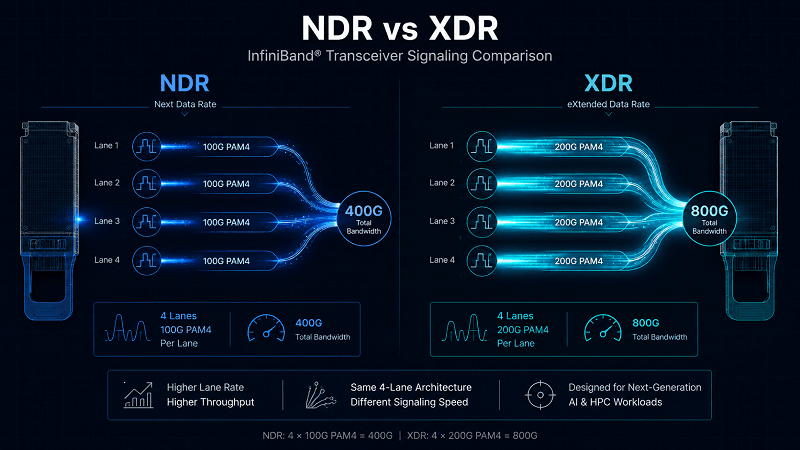
ConnectX-7 runs InfiniBand NDR. That is 100Gb/s per lane over four lanes, using 100G-PAM4 signaling. ConnectX-8 runs XDR, which is 200Gb/s per lane over four lanes, using 200G-PAM4.
The form factor may look the same; both can use OSFP, but the electrical signaling is different. You can’t plug an NDR transceiver into an XDR port and expect 800Gb/s. The NIC and transceiver negotiate down to a common speed, which means a mixed-generation fabric will run at the lowest common denominator unless you replace the optics.
OSFP-RHS vs OSFP-IHS
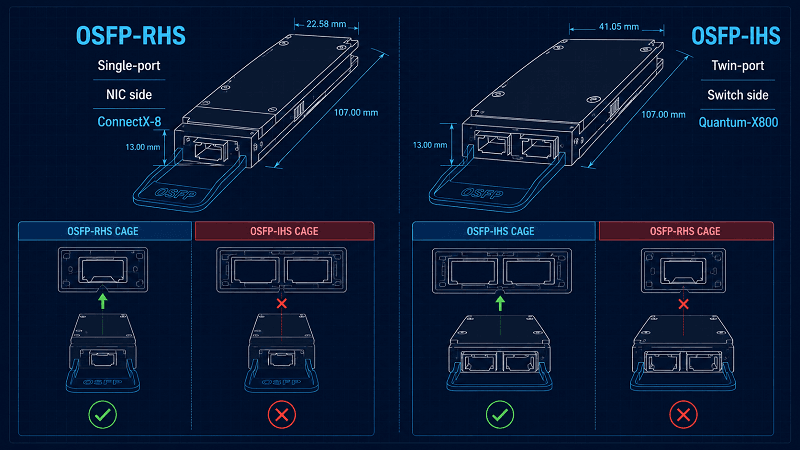
This detail trips up a lot of buyers. The ConnectX-8 NIC uses a single-port OSFP-RHS (flat-top) cage. Many 800G modules built for Quantum-X800 switches use twin-port OSFP-IHS modules. Those twin-port modules will not physically fit into a ConnectX-8 NIC.
If you are sourcing 800G optics for ConnectX-8, confirm the module is single-port RHS. FiberMall’s InfiniBand cables guide covers the form-factor differences in more detail.
Backward Compatibility and Reuse
ConnectX-8 can run at 400Gb/s, 200Gb/s, and 100Gb/s. So in theory, you can deploy ConnectX-8 into an existing 400G fabric and reuse some ConnectX-7-era OSFP-RHS or QSFP112 cables and optics. But the card only justifies its premium when you run it at 800G, and 800G needs XDR-rated modules.
The practical takeaway: ConnectX-8 is backward compatible at the protocol level, but a mixed-generation data center requires careful inventory management. Do not assume an OSFP module labeled “800G” will work in every OSFP port.
PCIe Gen6 Requirement
ConnectX-8 will physically slot into a PCIe Gen5 server. It’ll even work. But you won’t get the full 800Gb/s because the host bus becomes the bottleneck. For a true 800Gb/s NIC, you need PCIe Gen6 hosts. That typically means new servers built around NVIDIA B300 or GB300 platforms.
If your current fleet is H100/H200 or older, ConnectX-8 probably does not belong there unless you are also refreshing the servers.
ConnectX-8 C8180 vs C8240: Which Variant Is Right for You?
Even after choosing ConnectX-8, you still have two main form-factor variants to sort through.
| Feature | C8180 | C8240 |
| Port configuration | Single OSFP-RHS | Dual QSFP112 |
| Max InfiniBand speed | 800Gb/s XDR | 400Gb/s NDR per port |
| Max Ethernet speed | 2×400GbE | 400GbE per port |
| Best for | Maximum single-link throughput | Redundancy and dual-homed designs |
| Common OPNs | 900-9X81E-00EX-ST0 / DT0 | 900-9X81Q-00CN-ST0 |
The C8180 is the flagship. One OSFP cage, 800Gb/s, maximum bandwidth density. It is the right choice for GPU-to-leaf links in a large AI training cluster where every rack unit matters.
The C8240 splits the bandwidth across two QSFP112 ports. That is useful for dual-homed servers, redundant fabrics, or environments that already standardize on QSFP112 cabling and want a smoother transition. You give up the 800Gb/s single-link headline, but you gain operational flexibility.
FiberMall stocks the NVIDIA C8180 ConnectX-8 SuperNIC for buyers who need the full 800G variant.
ConnectX-8 vs ConnectX-7 Price and TCO
The ConnectX-8 vs ConnectX-7 price gap is real, but it is only part of the story. As of mid-2026, typical reseller pricing looks roughly like this:
ConnectX-7: 1,600-2,700 per adapter, depending on port count and SKU
ConnectX-8: 2,500-2,800+ per adapter
That is roughly a 600-1,200 premium per NIC. In a 1,000-node cluster, that adds up to a six-figure delta before you buy a single cable.
But the hidden costs are bigger. To use ConnectX-8 at full speed, you typically need:
New PCIe Gen6 servers
XDR-rated switches like Quantum-X800
Single-port OSFP-RHS transceivers or AOCs
Potentially new fiber infrastructure
Those line items usually dwarf the NIC premium. So the TCO case for ConnectX-8 rests on whether the workload actually needs 800G. If it does, the upgrade pays for itself in faster training and better GPU utilization. If it doesn’t, ConnectX-7 is the cheaper and more mature option.
Third-party compatible optics can soften the blow. FiberMall’s InfiniBand-compatible cables, optics, and transceivers offer MSA-compliant alternatives to OEM optics without the OEM markup.
Decision Matrix: Should You Choose ConnectX-7 or ConnectX-8?
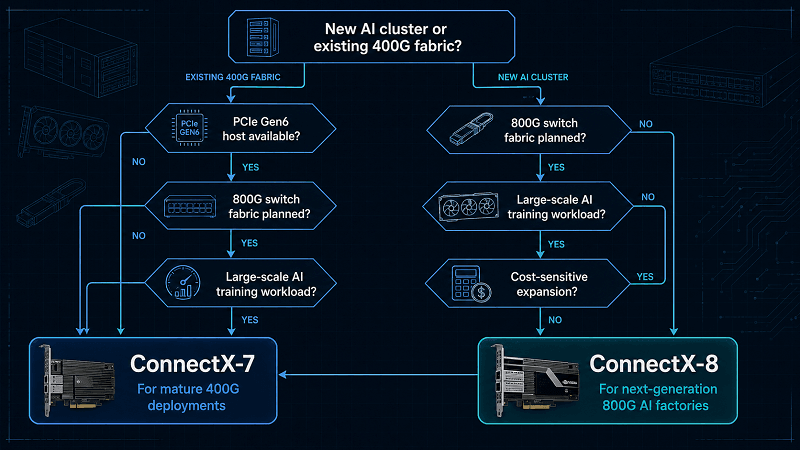
The table below maps common scenarios to a recommendation. Use it as a starting point, then validate against your actual workload profiles and budget.
| Scenario | Recommendation | Why |
| Building a new B300/GB300 AI factory | ConnectX-8 C8180 | PCIe Gen6 and 800G match the platform. |
| Refreshing an H100/H200 400G fabric | ConnectX-7 | Proven, cost-effective, no host upgrade needed. |
| Cost-sensitive expansion of an existing NDR fabric | ConnectX-7 | Avoids new optics, switches, and servers. |
| Need dual-homed 400G redundancy | ConnectX-8 C8240 or ConnectX-7 | Both support dual 400G paths. |
| Only PCIe Gen5 servers available | ConnectX-7 | ConnectX-8 will not reach 800G on Gen5. |
| Training trillion-parameter LLMs at scale | ConnectX-8 C8180 | Bandwidth directly reduces synchronization overhead. |
| Inference, storage, or virtualization cluster | ConnectX-7 | 400G is enough; save the premium. |
| Future-proofing a 3–5 year deployment | ConnectX-8 | Aligns with next-gen AI fabric roadmaps. |
One more practical note: if you are buying today for delivery next quarter, check lead times. ConnectX-8 supply is tightening around new Blackwell platform launches, while ConnectX-7 availability is more predictable.
Conclusion
ConnectX-7 vs ConnectX-8 is not really a technology debate. It is a matching exercise. Match the NIC generation to your GPU generation, your fabric speed, your host PCIe bus, and your workload’s actual bandwidth appetite.
ConnectX-7 remains a strong choice for 400G InfiniBand or Ethernet fabrics built around H100/H200/B200 servers. It is proven, widely available, and cost-effective. ConnectX-8 is the right call for new B300/GB300 AI factories that need 800Gb/s scale-out bandwidth and PCIe Gen6 headroom.
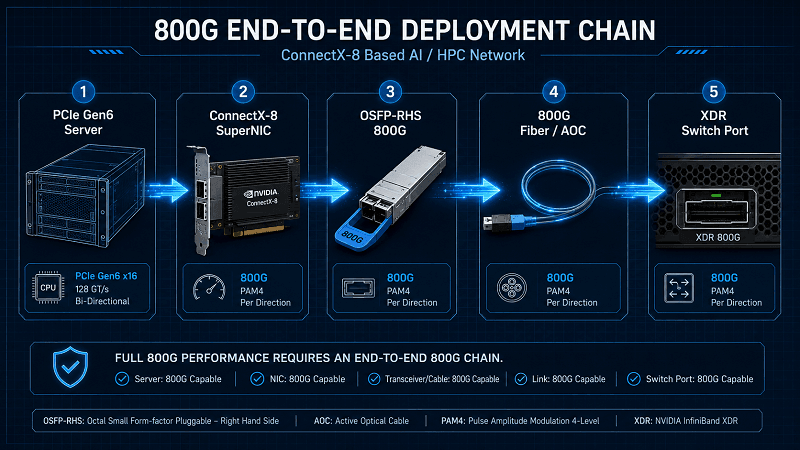
The detail most buyers overlook is the physical layer. NDR and XDR transceivers are not interchangeable. OSFP-RHS and OSFP-IHS modules do not fit the same cages. And full 800G performance demands a full 800G chain, from server PCIe to switch port.
If you are still deciding, start with the workload. Then check the host. Then price the optics. The NIC is the easy part.
Ready to build out the interconnect side? Browse FiberMall’s InfiniBand-compatible cables, optics, and transceivers for cost-effective, MSA-tested options that work with both ConnectX-7 and ConnectX-8 deployments.
FAQ
What is the difference between ConnectX-7 and ConnectX-8?
ConnectX-8 doubles the network bandwidth from 400Gb/s to 800Gb/s, upgrades the host interface from PCIe Gen5 to PCIe Gen6, and moves from InfiniBand NDR to XDR. It also adds programmable congestion control (DOCA PCC) and SHARPv4 in-network computing.
Is ConnectX-8 backward compatible with ConnectX-7?
Protocol-level compatibility exists, and ConnectX-8 can run at 400Gb/s and 200Gb/s. However, NDR and XDR transceivers use different lane signaling, so mixed-generation fabrics require careful module selection. Existing OSFP-RHS or QSFP112 400G modules can often be reused at 400G speeds.
Does ConnectX-8 require PCIe Gen6?
To reach the full 800Gb/s, yes. ConnectX-8 will work in PCIe Gen5 servers, but the host bus becomes a bottleneck before the NIC reaches 800Gb/s.
What cables does ConnectX-8 use?
ConnectX-8 C8180 uses single-port OSFP-RHS modules. Options include 800G SR8 for multimode fiber and single-port 800G DR4 for single-mode fiber. The C8240 uses standard QSFP112 modules at 400Gb/s per port.
Is ConnectX-8 worth the upgrade over ConnectX-7?
It depends on the workload. For large AI training clusters on PCIe Gen6 hosts, yes. For existing 400G HPC, storage, or inference clusters, the upgrade usually does not justify the cost unless you are also refreshing servers, switches, and optics.
Related Products:
-
 NVIDIA ConnectX-8 C8180 (900-9X81E-00EX-ST0) HHHL SuperNIC, 800Gbs XDR IB & Ethernet, Single-cage OSFP, PCIe 6 x16 with x16 PCIe Socket Direct,Tall bracket
$1980.00
NVIDIA ConnectX-8 C8180 (900-9X81E-00EX-ST0) HHHL SuperNIC, 800Gbs XDR IB & Ethernet, Single-cage OSFP, PCIe 6 x16 with x16 PCIe Socket Direct,Tall bracket
$1980.00
-
NVIDIA NVIDIA(Mellanox) MCX75510AAS-NEAT ConnectX-7 InfiniBand/VPI Adapter Card, NDR/400G, Single-port OSFP, PCIe 5.0x 16, Tall Bracket
$1650.00
-
NVIDIA NVIDIA(Mellanox) MCX75310AAS-NEAT ConnectX-7 InfiniBand/VPI Adapter Card, NDR/400G, Single-port OSFP, PCIe 5.0x 16, Tall Bracket
$2200.00
-
NVIDIA NVIDIA(Mellanox) MCX653105A-HDAT-SP ConnectX-6 InfiniBand/VPI Adapter Card, HDR/200GbE, Single-Port QSFP56, PCIe3.0/4.0 x16, Tall Bracket
$1400.00
-
NVIDIA NVIDIA(Mellanox) MCX653106A-HDAT-SP ConnectX-6 InfiniBand/VPI Adapter Card, HDR/200GbE, Dual-Port QSFP56, PCIe3.0/4.0 x16, Tall Bracket
$1600.00
-
NVIDIA B3140H BlueField-3 8 Arm-Cores SuperNIC, E-series HHHL, 400GbE (Default Mode)/NDR IB, Single-port QSFP112, PCle Gen5.0 x16, 16GB Onboard DDR, Integrated BMC, Crypto Disabled
$4390.00