

USFP vs CPO is a choice between two ways to move data inside an AI data center. USFP (Ultra-Dense Small Form Factor Pluggable) is a pluggable 400G-per-lane optical module you can swap in the field. CPO (co-packaged optics) integrates the optical engine directly into the switch chip to save power, at the cost of field replaceability.
Here’s the twist: the industry may not pick a single winner. Most signs point to both paths running in parallel for years.
What Is USFP? The New 400G-Per-Lane Pluggable Standard
USFP is a new optical module form factor announced jointly by NVIDIA and Cisco at the OCP Global Summit in October 2026. It is designed to become the industry’s first pluggable form factor supporting 400 Gb/s per lane electrical signaling, doubling the 200 Gb/s per lane rate used by the latest generation of high-speed pluggable modules.
Think of it as the pluggable industry’s response to the front-panel bandwidth-density challenge. As switch ASIC bandwidth increases, systems need more high-speed lanes and greater port capacity, while available front-panel space remains limited. USFP addresses this constraint by combining higher per-lane signaling rates with increased lane density in a compact module footprint.
USFP Specifications: 16 to 32 Lanes, 6.4T to 12.8T
The announced USFP design targets are ambitious:
- Lane rate: Up to 400 Gb/s per electrical lane using next-generation SerDes technology, with support also planned for 200 Gb/s per lane systems.
- Lane count: Initial designs target 16 full-duplex electrical lanes, with a roadmap to 32 lanes or more.
- Aggregate bandwidth: 6.4 Tb/s with 16 lanes at 400 Gb/s per lane, potentially increasing to 12.8 Tb/s with 32 lanes. These capacities refer to one direction of transmission.
- Footprint: Designed around an OSFP-sized form factor, enabling higher bandwidth density without proportionally increasing front-panel space. However, its new connector and electrical interface mean it is not automatically compatible with existing OSFP ports.
- Thermals: Designed to support up to 100 W of module power dissipation without requiring a separate, dedicated cooling circuit embedded within the transceiver. Actual cooling requirements will depend on the host system’s thermal architecture.
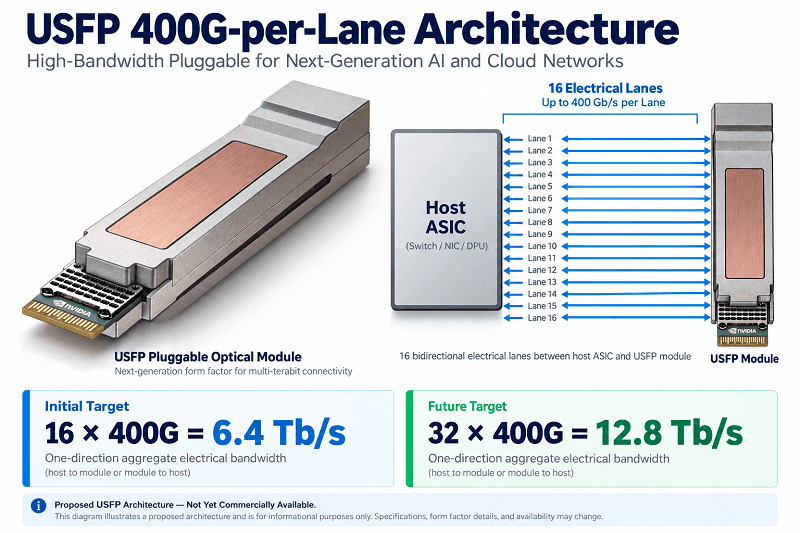
The connector is also new. USFP uses a two-dimensional array connector with a two-step insertion mechanism. High-speed contacts engage after the module is inserted, a design intended to reduce contact wear, improve signal integrity, and provide more predictable insertion force at 400 Gb/s per lane.
One caveat matters more than the specifications themselves: USFP remains at an early development stage. NVIDIA and Cisco have announced design plans and intend to establish an open specification through a community-led Multi-Source Agreement (MSA), but no general sampling or commercial availability date has been confirmed. The reported 4× bandwidth-density improvement and approximately 1.3× power-efficiency improvement over 200 Gb/s per lane pluggables should be treated as vendor-announced performance targets rather than independently verified production results.
USFP vs the Older “Ultra Small Form Factor Pluggable”
There is a naming detail worth clarifying. Some third-party materials use “Ultra Small Form Factor Pluggable” as an alternative expansion of the USFP acronym. However, this terminology should not be confused with the official name announced by NVIDIA and Cisco, and it does not establish the existence of a separate, widely adopted legacy USFP standard.
The new USFP introduced by NVIDIA and Cisco stands for Ultra-Dense Small Form Factor Pluggable. When reviewing documentation or vendor materials, confirm the intended form factor, connector design, electrical interface, and supported signaling rates rather than relying on the acronym alone. Throughout this article, USFP refers specifically to the Ultra-Dense form factor designed for 400 Gb/s per lane electrical signaling.
USFP vs XPO, OSFP-XD, and Open CPX
USFP enters an increasingly competitive landscape of high-density pluggable and package-adjacent optical interconnect technologies:
- XPO (Arista-led MSA): A 64-channel, liquid-cooled pluggable architecture targeting 12.8 Tb/s at 200 Gb/s per lane, with a potential path toward 25.6 Tb/s at 400 Gb/s per lane. Arista’s initial announcement specified an integrated cold plate capable of handling up to 400 W of module heat dissipation.
- OSFP-XD: A higher-density pluggable form factor with 16 high-speed electrical lanes, supporting configurations up to 3.2 Tb/s at 200 Gb/s per lane under its published specifications. Future higher-speed implementations will depend on further interface development and qualification.
- Open CPX: An open, socketed optical-engine architecture designed for co-packaged and near-package optical interconnects. Its published specification supports high-density connectivity while introducing a more modular approach to optical-engine integration and serviceability.
USFP’s distinction lies in its combination of an OSFP-sized footprint, a high-density connector designed for 400 Gb/s per lane signaling, and the operational flexibility of front-panel pluggable optics. For operators already using OSFP-based 800G or 1.6T networks, USFP represents a potential future density upgrade path rather than a directly interchangeable replacement. Deploying USFP will require compatible host ports, electrical interfaces, firmware, and thermal designs.
What Is Co-Packaged Optics (CPO)?
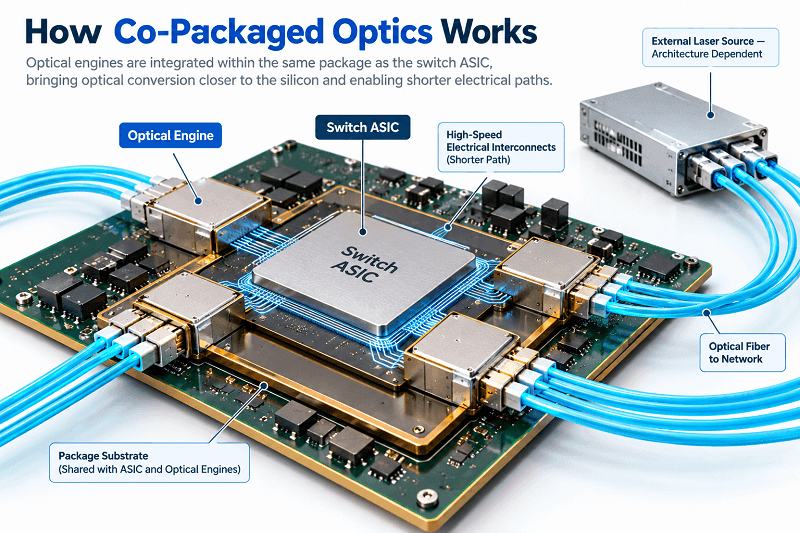
Co-packaged optics takes a different architectural approach. Instead of placing the optical transceiver on the front panel, CPO integrates optical engines into the same package as the switch ASIC, bringing optical conversion much closer to the switching silicon.
That change has significant implications for power efficiency, bandwidth density, maintainability, and the supply chain.
How CPO Integrates Optical Engines Into the Switch ASIC
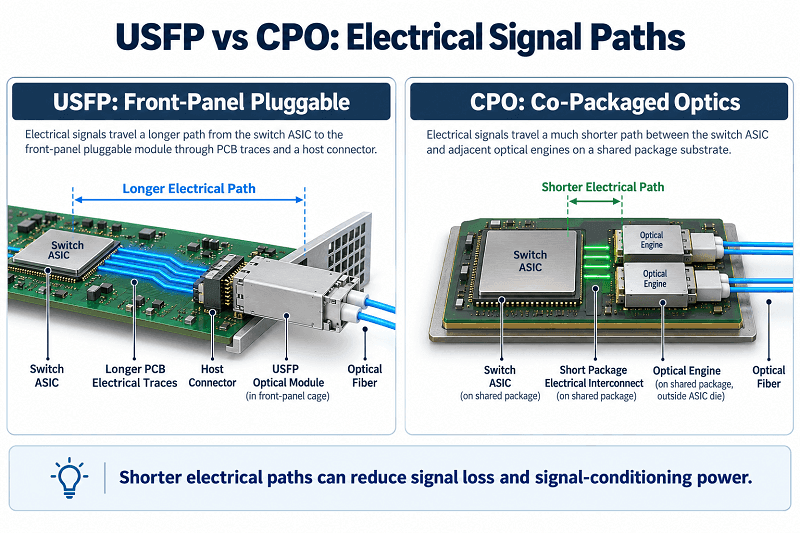
In a traditional pluggable optical system, electrical signals travel from the switch ASIC across printed circuit board traces, through a host connector, and into the optical module, where they are converted into optical signals. These electrical paths can extend over several centimeters or more, creating signal-integrity challenges and often requiring additional signal conditioning.
CPO significantly shortens this electrical path by placing optical engines next to the ASIC within the same package, often reducing critical connections to millimeter-scale distances. Shorter electrical paths can reduce signal loss, limit the need for power-intensive signal conditioning, and improve energy efficiency per transmitted bit.
CPO Advantages: Power Efficiency and Bandwidth Density
Power efficiency is one of the main reasons CPO continues to attract attention in AI data center networking. Some CPO implementations report optical interconnect energy consumption in the range of approximately 5–10 picojoules per bit, although actual figures depend on system architecture, signaling technology, and which components are included in the measurement.
Broadcom has reported approximately 70% lower optical interconnect power consumption for certain CPO designs compared with conventional pluggable transceiver solutions. NVIDIA has also reported approximately 3.5× lower optical transceiver power consumption for its co-packaged silicon photonics architecture compared with traditional pluggable optics. These vendor figures refer to specific implementations and comparison baselines, not universal system-level savings.
For hyperscale AI training clusters, where power availability can limit fabric expansion, the potential savings are substantial. Reduced optical interconnect power consumption can help improve overall network efficiency and support higher switching bandwidth within a constrained power budget.
CPO Challenges: Thermal, Maintainability, and Yield
CPO’s challenges are closely linked to its higher level of integration:
- Thermal density: Integrating optical engines close to high-power ASICs creates demanding thermal conditions. Depending on the architecture, systems may require advanced heat dissipation or liquid cooling. Some designs use external laser sources to improve thermal management and serviceability.
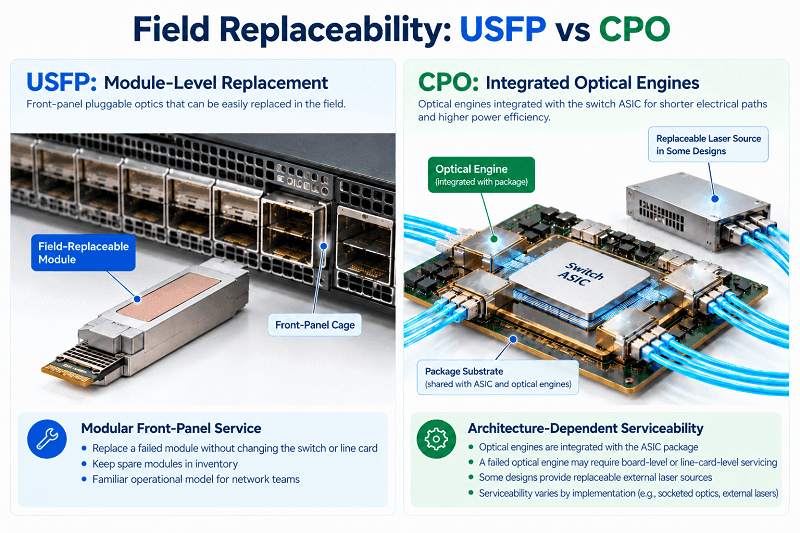
- Field replaceability: In conventional CPO architectures, optical engines are integrated into the switch package and may not be individually field-replaceable. A failed optical engine could require board-level or line-card-level servicing. However, some implementations provide field-replaceable external laser sources, while emerging socketed approaches offer additional serviceability options.
- Cost and yield: Optical-engine manufacturing, precise optical alignment, advanced packaging, and system-level testing introduce complexity. Production yields, component availability, and packaging capacity remain important factors affecting cost and the pace of wider deployment.
USFP vs CPO: Side-by-Side Comparison
The two approaches involve different trade-offs. Here is the comparison at a glance.
| Dimension | USFP (Pluggable) | CPO (Co-Packaged) |
| Form factor | Front-panel pluggable, OSFP-sized footprint | Optical engines integrated within the ASIC package |
| Lane rate | Up to 400 Gb/s per electrical lane (planned) | Architecture-dependent |
| Field replaceability | Designed for module-level replacement | Depends on architecture; integrated optical engines are generally less accessible |
| Power efficiency | Approximately 1.3× vs. 200G-per-lane pluggables (vendor target) | Significant potential savings; some implementations report 5–10 pJ/bit |
| Thermal design | Up to 100 W module dissipation capability; host cooling required | Advanced thermal management; air or liquid cooling depending on design |
| Supply chain | Open, multi-vendor MSA ecosystem planned | Vendor-specific solutions alongside emerging open initiatives |
| Maturity | Announced design; no confirmed general availability date | Early commercial deployments and production ramp-up underway |
The table highlights the core difference: USFP is designed to preserve the flexibility and maintainability of pluggable optics while increasing bandwidth density. CPO prioritizes shorter electrical paths and improved energy efficiency, with serviceability depending on the specific implementation.
Form Factor and Field Replaceability
Pluggable optical modules are designed for field replacement. Operators can stock spare modules and replace failed units without changing the entire switch or line card. This is the operating model most network teams already use today.
USFP aims to preserve this advantage as electrical lane speeds increase to 400 Gb/s.
CPO changes that model by integrating optical engines into the switch package. In conventional implementations, the optical engines cannot be replaced as easily as front-panel modules, potentially shifting some maintenance operations toward board-level or factory-level servicing.
However, CPO serviceability is not uniform across all implementations. Designs with external laser sources allow those components to be replaced independently, while socketed optical-engine initiatives may improve repairability. Spare-parts strategies and maintenance costs therefore need to be evaluated at the system level.
Power Efficiency and Thermal Design
From a power-efficiency perspective, CPO has a significant architectural advantage. Shortening the electrical path between the ASIC and optical engines reduces transmission losses and can eliminate or simplify signal-conditioning components that conventional pluggable modules require.
USFP aims to narrow part of that efficiency gap by increasing per-lane bandwidth and improving bandwidth density. Moving from 200 Gb/s to 400 Gb/s per electrical lane can allow more data to be transferred through a compact module interface. NVIDIA and Cisco have announced a target of approximately 1.3× greater power efficiency compared with 200 Gb/s per lane pluggables.
However, higher lane rates do not automatically translate into lower power consumption per bit. Actual efficiency depends on SerDes power, DSP architecture, optical technology, cooling overhead, and operating conditions.
At very large scales, CPO may offer greater power savings in suitable applications, but meaningful comparisons require consistent measurement boundaries and equivalent link capabilities.
Ecosystem, Standards, and Supply Chain
This is an area where USFP could have a structural advantage. NVIDIA and Cisco intend to publish USFP as an open specification through a community-led Multi-Source Agreement, with TE Connectivity and Amphenol collaborating on cages, connectors, and related hardware. A successful multi-vendor ecosystem could allow multiple optical module suppliers to compete and support interoperability.
However, that ecosystem is still under development, and interoperability will depend on completed specifications, compatible host platforms, and qualification testing.
CPO has traditionally involved more tightly integrated, vendor-specific optical packaging, which can increase dependence on switch and system suppliers. This creates potential vendor lock-in and sourcing challenges for procurement teams seeking second-source options.
At the same time, initiatives such as Open CPX are working to standardize optical-engine interfaces and improve multi-vendor sourcing for co-packaged and near-package solutions. The supply-chain distinction between pluggable optics and CPO may therefore become less pronounced as these ecosystems mature.
Maturity and Time-to-Deployment
USFP remains at an early development stage. Although NVIDIA and Cisco announced the form factor in October 2026, a finalized public specification, sampling schedule, and general availability date have not yet been confirmed.
CPO is further along in hardware development and commercialization. Broadcom delivered its 51.2T Bailly CPO switch platform to customers in 2024 and announced shipments of its 102.4T Tomahawk 6 Davisson CPO switch in 2025. NVIDIA has also begun delivering selected CPO-based networking systems, with production expansion progressing through 2026.
Nevertheless, widespread CPO adoption still faces challenges related to optical-engine yield, advanced packaging capacity, manufacturing costs, and ecosystem readiness.
The practical result is that operators requiring immediate deployment should generally evaluate commercially available pluggable technologies such as OSFP and QSFP-DD, alongside qualified CPO platforms where appropriate. USFP is better viewed as a future upgrade option until compatible systems and production modules become available. For networks planned toward 2029 and beyond, both USFP and CPO deserve consideration, depending on their commercial maturity and performance at that time.
When to Choose USFP vs CPO
There is no universal answer, but a structured evaluation can help identify the most suitable approach.
Decision Factors: Scale, Cooling, Lifecycle, and Lock-In
Four factors drive most decisions:
- Scale and power efficiency: CPO’s potential power advantage becomes increasingly valuable in hyperscale environments. For operators deploying very large numbers of high-bandwidth connections, reductions in energy consumption per bit can have a significant impact. At smaller scales, the benefits may not outweigh integration and operational costs.
- Cooling infrastructure: Facilities with advanced liquid-cooling infrastructure may be better positioned to support high-density CPO systems. Pluggable optics can offer greater deployment flexibility, although high-power USFP modules will still require host platforms with adequate cooling capacity. A 100 W module dissipation capability does not guarantee compatibility with existing air-cooled switches.
- Lifecycle and maintainability: If the operations team depends on rapid front-panel module replacement, pluggable optics have an established advantage. If the organization can accommodate more integrated maintenance procedures, CPO may be viable. Designs with replaceable laser sources or socketed optical engines should be evaluated separately.
- Vendor lock-in: If multi-vendor sourcing is a priority, open pluggable ecosystems provide a familiar procurement model. USFP aims to extend that model to higher bandwidths, while emerging CPO and NPO standards are also working to improve sourcing flexibility and interoperability.
What This Means for AI Data Center Networking
The USFP announcement is more than a proposal for a new optical module. It signals the industry’s continued investment in extending the performance and scalability of pluggable optical interconnects.
Why Pluggable Optics Aren’t Going Away
Every few years, advances in optical networking raise questions about whether pluggable modules will eventually be replaced by more integrated architectures. Yet pluggable optics continue to evolve, supporting higher lane speeds, greater module bandwidth, and improved thermal designs.
USFP is the latest example of this evolution. Rather than abandoning the front-panel pluggable model as bandwidth requirements rise, NVIDIA and Cisco are proposing a higher-density form factor capable of supporting 400 Gb/s per electrical lane.
That matters because pluggable optics benefit from an established operational ecosystem. They are relatively easy to replace, can be sourced from multiple qualified suppliers, and fit into familiar network maintenance workflows. These advantages remain important even as integrated optical technologies gain traction.
The Roadmap: 400G Per Lane, 800G, and Beyond
The direction of high-speed optical interconnect development is becoming clearer. USFP targets 400 Gb/s per electrical lane, while XPO and OSFP-XD pursue higher module bandwidth and density through increased lane counts and evolving signaling technologies.
Further advances toward higher per-lane rates and multi-terabit optical modules are possible, but developments beyond 400 Gb/s per lane will require progress in SerDes technology, optical modulation, signal integrity, power efficiency, and thermal management. Future 800 Gb/s per lane implementations should therefore be considered a longer-term possibility rather than a confirmed near-term commercial roadmap.
CPO is progressing along a parallel path, targeting similar bandwidth-scaling challenges through closer optical and electrical integration.
The two approaches are likely to coexist: pluggable optics will continue to serve applications that prioritize deployment flexibility, modularity, and field maintenance, while CPO is expected to gain traction in high-bandwidth, power-constrained systems where its integration benefits justify the additional complexity.
Frequently Asked Questions
What is the difference between USFP and CPO?
USFP is an emerging pluggable optical module form factor designed to support up to 400 Gb/s per electrical lane while preserving front-panel field replaceability. CPO integrates optical engines into the same package as the switch ASIC to shorten electrical signal paths and improve energy efficiency. USFP prioritizes modularity and deployment flexibility, while CPO emphasizes power efficiency and bandwidth density through tighter integration.
Is USFP better than CPO?
Neither architecture is universally better. USFP aims to offer higher bandwidth density while preserving the operational benefits of pluggable optics, but it is not yet a generally available commercial product. CPO can provide substantial power-efficiency advantages in suitable applications, although its serviceability, cost, and integration requirements vary by design. The better choice depends on deployment scale, cooling capacity, operational needs, and product availability.
When will CPO and USFP be available?
CPO has already entered early commercial deployment, with selected platforms delivered or shipped by suppliers such as Broadcom and NVIDIA. Broader adoption is expected to expand as manufacturing capacity, optical-engine yields, and supporting ecosystems mature. USFP was announced in October 2026, but no confirmed general sampling or commercial availability date has been published.
Does USFP replace OSFP?
No. USFP is designed around an OSFP-sized footprint, but it introduces a new high-density connector and electrical interface. It is not automatically compatible with existing OSFP cages or host ports. Instead, USFP is intended to complement the broader pluggable optics ecosystem by providing a potential path toward higher bandwidth density in future compatible switching and computing platforms. For more information, see our OSFP roadmap.