
At 11 PM on a Thursday, the platform team at DeepCompute finally pushed their 512-GPU training cluster into production. They had chosen 400G Ethernet with RoCEv2 to save roughly $180,000 in port costs. Six weeks later, three senior network engineers were still tuning Priority Flow Control, Explicit Congestion Notification, and NIC congestion-control settings. During congestion events, p99 all-reduce latency was 18% above target. Their time-to-convergence was 23% longer than projected. The savings on switches had evaporated into payroll and delayed training schedules.
This scenario plays out more often than vendors admit. The choice between InfiniBand and Ethernet is not simply a bandwidth decision. It is a decision about operational complexity, latency predictability, congestion behavior, and what your operations team is actually prepared to deploy and maintain.
If you are designing an AI cluster, HPC fabric, or high-performance storage network, you already know both technologies can move bits at high speed. In this guide, you will get a practical decision framework for InfiniBand vs Ethernet. We will compare latency, RDMA behavior, congestion control, operations, cost, and cloud availability. By the end, you will know which fabric fits your workload and whether the premium for InfiniBand is worth it.
New to InfiniBand? Read the complete InfiniBand guide first →
What Is InfiniBand?
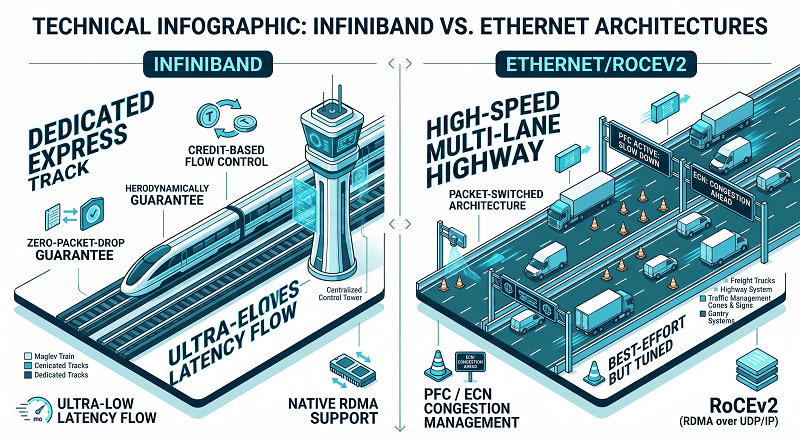
InfiniBand is a switched interconnect architecture built for low-latency, lossless communication between servers, storage, and GPUs. It was designed as a channel-based fabric rather than a packet network. That means senders do not transmit unless the receiver has buffer space. Packets are not dropped due to congestion.
The modern InfiniBand ecosystem is dominated by NVIDIA after its acquisition of Mellanox. ConnectX host channel adapters and Quantum switches are the standard hardware. InfiniBand natively supports Remote Direct Memory Access, which lets applications read and write memory on remote machines without involving the remote CPU or kernel.
For AI training clusters, the combination of microsecond latency, lossless transport, and RDMA is why InfiniBand has become the default choice at scale.
What Is Ethernet?
Ethernet is the universal packet-switched networking technology used in nearly every data center, office, and home. It is best-effort by design. Switches forward packets, and when buffers fill up, packets drop. TCP handles retransmissions. That design is reliable and flexible for general-purpose traffic.
For high-performance workloads, Ethernet can be extended with RDMA over Converged Ethernet v2, commonly called RoCEv2. RoCEv2 runs RDMA over UDP/IP and uses Priority Flow Control and Explicit Congestion Notification to create a lossless environment. It works. But it also adds configuration complexity that standard Ethernet does not have.
Ethernet’s biggest strength is its ecosystem. Almost every switch vendor, NIC vendor, and cloud provider supports it. That interoperability matters when you want choice and competition.
InfiniBand vs Ethernet: Head-to-Head Comparison
| Factor | InfiniBand | Ethernet / RoCEv2 |
| Latency | ~0.5-1.5 µs end-to-end | TCP/IP 10-100+ µs; RoCEv2 ~2-5 µs |
| Loss behavior | Lossless by design (credit-based) | Best-effort unless PFC/ECN tuned |
| RDMA | Native, built into transport | RoCEv2 adds RDMA over UDP |
| Congestion control | Credit-based flow control | PFC + ECN + DCTCP tuning required |
| Management | Subnet Manager programs fabric | Decentralized, operator-driven |
| Vendor ecosystem | NVIDIA-dominated | Broad, multi-vendor |
| Cost per port | ~20-30% premium | Lower upfront |
| Operational complexity | Lower day-to-day after setup | Higher due to tuning needs |
| Best for | AI training, HPC, low-latency storage | General cloud, web, many enterprise apps |
The table tells part of the story. The rest is operational. InfiniBand gives you a controlled environment where the fabric manager handles path programming and quality of service. Ethernet gives you freedom and cost savings, but only if your team can implement and maintain the lossless extensions.
Latency and Performance
Latency is where InfiniBand distances itself from standard Ethernet. A well-tuned InfiniBand RDMA path delivers end-to-end latency under 1.5 microseconds. TCP/IP over Ethernet typically lands in the 10 to 100+ microsecond range. RoCEv2 can get Ethernet down to roughly 2-5 microseconds, which is competitive, but that assumes everything is configured correctly.
The reason microseconds matter is all-reduce. During distributed training, GPUs constantly synchronize gradients. If one packet is delayed, the entire GPU cluster waits. A few microseconds of extra latency per operation, multiplied across thousands of operations and hundreds of GPUs, becomes measurable training time. NVIDIA reports that InfiniBand with SHARP in-network computing can reduce all-reduce traffic by up to 9x in some topologies.
For web services, streaming, and general compute, those microseconds are irrelevant. For AI training and tightly coupled HPC simulations, they dominate performance.
RDMA: Native vs RoCEv2
Remote Direct Memory Access is the feature that makes modern AI networking possible. It lets one server access another server’s memory directly, bypassing the CPU and kernel. InfiniBand has native RDMA. Ethernet gets RDMA through RoCEv2.
RoCEv2 is effective, but it is not automatic. To make Ethernet lossless for RDMA, you must configure:
Priority Flow Control to pause traffic before buffers overflow
Explicit Congestion Notification to signal congestion before drops occur
Data Center TCP or equivalent congestion response
Consistent buffer sizing and QoS policies across every switch
One misconfigured switch can introduce tail latency spikes that are hard to diagnose. Engineers on Reddit and HPC forums often describe this as “PFC/ECN hell.” It is not that RoCEv2 is bad. It is that RoCEv2 requires a level of network engineering discipline that InfiniBand abstracts away through the Subnet Manager.
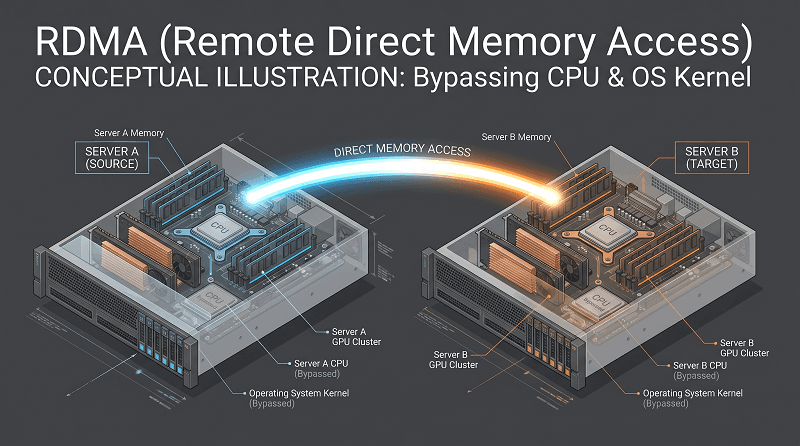
InfiniBand also supports GPUDirect RDMA out of the box, allowing GPUs to exchange data across servers without touching host memory. That is harder to achieve reliably on Ethernet unless your entire stack is carefully tuned.
Lossless Transport and Congestion Control
InfiniBand uses credit-based flow control. Receivers advertise available buffer space. Senders only transmit what the receiver can accept. The result is a fabric that does not drop packets due to congestion. This is simple in concept and reliable in practice.
Ethernet traditionally uses drop-based congestion control. When buffers fill, packets drop. TCP retransmits. That works well for elastic traffic but poorly for tightly coupled workloads where every packet must arrive on time.
RoCEv2 attempts to make Ethernet lossless by adding PFC and ECN. PFC pauses the entire priority class on a link. ECN marks packets before congestion becomes severe. DCTCP responds to those marks by reducing sending rates. When tuned correctly, this combination mimics lossless behavior. When tuned incorrectly, it causes pause storms, unfair throughput, or persistent tail latency.
The practical difference is that InfiniBand gives you lossless behavior by default. Ethernet gives it to you only after careful configuration.
Management and Operations
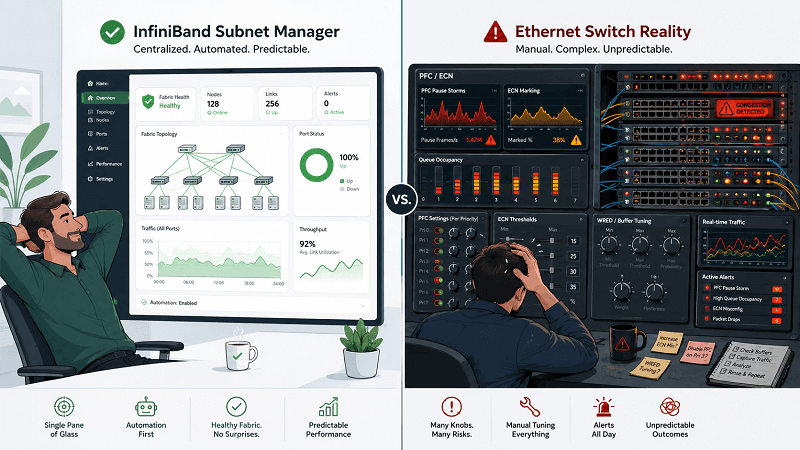
InfiniBand fabrics are managed by a Subnet Manager. The Subnet Manager discovers all adapters and switches, assigns addresses, calculates forwarding paths, and configures virtual lanes and quality of service. It is centralized, which makes the fabric predictable.
Ethernet management is decentralized. Each switch makes independent forwarding decisions based on MAC tables, IP routing protocols, or SDN controllers. That flexibility is great for complex enterprise networks. It also means that creating a lossless, RDMA-ready Ethernet fabric requires coordinated configuration across many devices.
Day-to-day operations differ too. An InfiniBand fabric with a healthy Subnet Manager mostly runs itself. An Ethernet fabric with RoCEv2 requires ongoing attention to PFC/ECN settings, firmware consistency, and buffer tuning. The operational cost gap can be as significant as the hardware cost gap.
Cost Comparison
InfiniBand typically costs 20-30% more per port than equivalent Ethernet. NVIDIA-branded optics and cables carry a further premium. That is real money, especially at thousands of ports.
But the total cost picture is more nuanced. InfiniBand reduces CPU overhead because RDMA bypasses the kernel. It improves GPU utilization by reducing synchronization wait time. It can shorten training convergence, which improves the return on expensive GPU hardware.
At DeepCompute, the $180,000 they saved on Ethernet ports was partially offset by six weeks of senior engineering time. More importantly, their 23% slower convergence meant each training run took longer, delaying model iterations. For a team running large-scale training, that delay can cost more than the fabric premium.
Third-party MSA-compliant optics from suppliers like FiberMall can reduce InfiniBand cabling costs while maintaining compatibility. The key is qualification. Test samples in your actual switch and HCA firmware before placing a large order.
When to Choose InfiniBand
Choose InfiniBand when:
You are running distributed AI training across more than roughly 256 GPUs.
Your workload is tightly coupled, such as large language model training or molecular dynamics.
Tail latency matters more than average latency.
You need GPUDirect RDMA without spending weeks tuning.
You want lossless behavior by default.
You are building a dedicated AI or HPC fabric, not a general-purpose network.
A research lab we spoke with deployed InfiniBand for a 128-node HPC cluster. The fabric came up in two days, and MPI wait time dropped by 40% compared to their previous Ethernet setup. The Subnet Manager was the biggest conceptual shift, but once understood, day-to-day operations were simpler than they expected.
When to Choose Ethernet
Choose Ethernet when:
Your workloads are general-purpose cloud, storage, web, or inference serving.
You need interoperability across many switch and NIC vendors.
Your team has deep Ethernet operations expertise and time to tune RoCEv2.
Capital cost per port is the primary constraint.
You can tolerate occasional tail-latency variation.
Ethernet is not a compromise. It is the right tool for most networking. Many successful AI inference clusters run on Ethernet. Smaller training clusters with forgiving synchronization patterns can too. The mistake is choosing Ethernet to save money and then discovering your workload needed InfiniBand’s guarantees.
InfiniBand vs Ethernet in the Cloud (2026)
Cloud providers now offer both. If you rent GPUs, the fabric choice is partially made for you by the instance family.
| Cloud | InfiniBand Instances | Ethernet Notes |
| AWS | P5 (H100), Hpc6a | Default VPC networking is Ethernet |
| Azure | ND H100 v5, HBv3 | Most general instances use Ethernet |
| Google Cloud | A3 (H100) with H100 SXM5 | Standard compute uses Ethernet |
| Oracle Cloud | BM.GPU.H100 | Bare metal GPU uses InfiniBand |
For teams that cannot build their own fabric, cloud InfiniBand is the fastest way to get RDMA-scale performance. You do not manage the Subnet Manager or cable plan. You just pick the right instance family. The trade-off is cost per GPU-hour and vendor lock-in.
If your workload runs on cloud, the question is less “InfiniBand or Ethernet?” and more “which instance family exposes the network my workload needs?”
Can You Mix InfiniBand and Ethernet?
Yes, and many clusters do. A common pattern is:
InfiniBand for the tier-0 AI training fabric between GPUs
Ethernet for management, storage, and general data movement
This hybrid approach keeps the expensive InfiniBand fabric dedicated to what benefits most from it. Storage and management traffic, which is less latency-sensitive, runs over cheaper Ethernet. Some organizations also use Ethernet as a migration path, adding InfiniBand only to the nodes that need it.
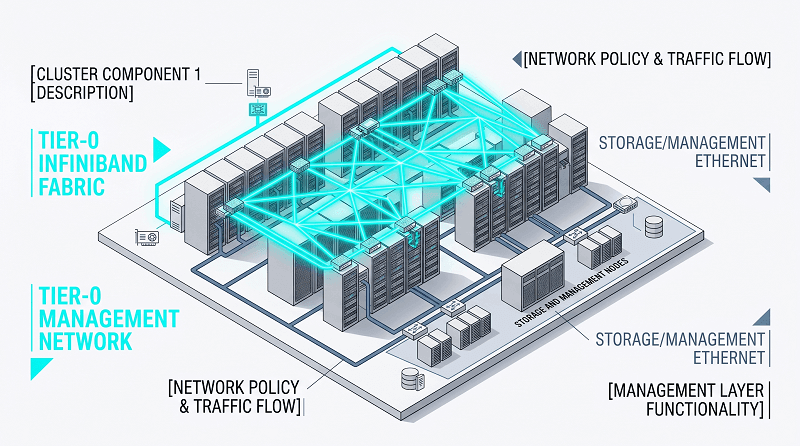
The two networks can be bridged through gateways or routers where needed, though most deployments keep them logically separate.
FAQ
Is InfiniBand faster than Ethernet?
InfiniBand delivers lower latency, typically under 1.5 microseconds versus 10-100+ microseconds for TCP/IP over Ethernet. RoCEv2 can narrow the gap to roughly 2-5 microseconds. For tightly coupled workloads, InfiniBand’s predictable latency makes it faster in practice.
Can I use Ethernet for AI training?
Yes. Smaller clusters and less latency-sensitive training workloads can use Ethernet, especially with RoCEv2. Large-scale distributed training with thousands of GPUs usually benefits significantly from InfiniBand.
Is RoCEv2 as good as InfiniBand?
RoCEv2 can deliver similar bandwidth and competitive latency, but it requires careful tuning of PFC, ECN, and congestion control. InfiniBand provides equivalent performance with less operational complexity.
Why is InfiniBand more expensive?
InfiniBand costs more because it is a specialized, lossless fabric with native RDMA and centralized management. The premium also reflects NVIDIA’s dominant ecosystem and the guarantees the technology provides.
Do I need InfiniBand for a small GPU cluster?
Not necessarily. Clusters below roughly 64 to 128 GPUs often do fine with Ethernet or RoCEv2, depending on workload sensitivity. The benefit of InfiniBand grows with cluster size and communication intensity.
Can I mix InfiniBand and Ethernet in the same cluster?
Yes. Many deployments use InfiniBand for the AI training fabric and Ethernet for management and storage networks.
What cable does InfiniBand use?
InfiniBand uses DAC, AOC, and optical transceivers with form factors including QSFP56, QSFP112, and OSFP depending on generation.
Conclusion
InfiniBand and Ethernet are not enemies. They are different tools for different jobs. InfiniBand gives you a lossless, low-latency, RDMA-native fabric that is ideal for large-scale AI training and tightly coupled HPC. Ethernet gives you flexibility, interoperability, and lower upfront cost for general-purpose workloads.
The right choice depends on your workload, your team’s expertise, and whether you are building on-premises or in the cloud. If you are training large models across hundreds or thousands of GPUs, InfiniBand’s guarantees usually justify the premium. If you are running web services, storage, or smaller AI clusters, Ethernet is often the smarter economic choice.
A hyperscale AI lab we know runs InfiniBand for its GPU training fabric and Ethernet for everything else. The result is a balanced design where each network does what it does best. That is the decision framework in practice: match the fabric to the workload, not the other way around.
If you need help sourcing MSA-compliant InfiniBand transceivers, cables, and breakout options tested for NVIDIA compatibility, FiberMall can support your specification and procurement.
Related Products:
-
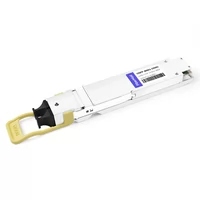
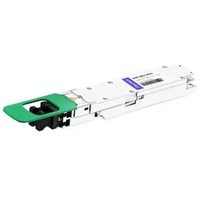
 NVIDIA MMA4Z00-NS400 Compatible 400G OSFP SR4 Flat Top PAM4 850nm 30m on OM3/50m on OM4 MTP/MPO-12 Multimode FEC Optical Transceiver Module
$400.00
NVIDIA MMA4Z00-NS400 Compatible 400G OSFP SR4 Flat Top PAM4 850nm 30m on OM3/50m on OM4 MTP/MPO-12 Multimode FEC Optical Transceiver Module
$400.00
-
NVIDIA MMS4X00-NS400 Compatible 400G OSFP DR4 Flat Top PAM4 1310nm MTP/MPO-12 500m SMF FEC Optical Transceiver Module
$450.00
-
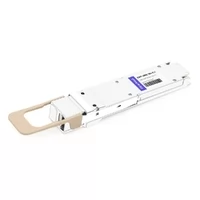
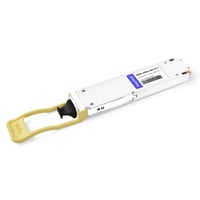
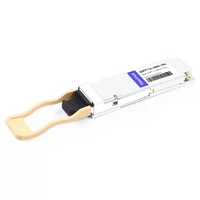
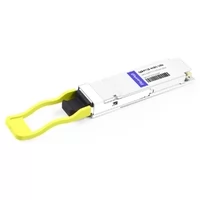
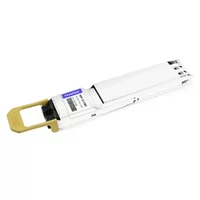
NVIDIA MMA1Z00-NS400 Compatible 400G QSFP112 VR4 PAM4 850nm 50m MTP/MPO-12 OM4 FEC Optical Transceiver Module
$385.00
-
NVIDIA MMS1X00-NS400 Compatible 400G NDR QSFP112 DR4 PAM4 1310nm 500m MPO-12 with FEC Optical Transceiver Module
$500.00
-
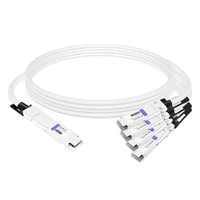
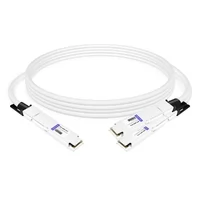
NVIDIA MCP7Y70-H001 Compatible 1m (3ft) 400G Twin-port 2x200G OSFP to 4x100G QSFP56 Passive Breakout Direct Attach Copper Cable
$120.00
-
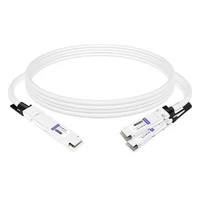
NVIDIA MCP7Y60-H001 Compatible 1m (3ft) 400G OSFP to 2x200G QSFP56 Passive Direct Attach Cable
$99.00
-
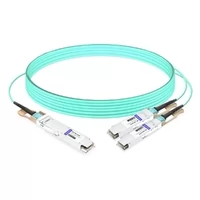
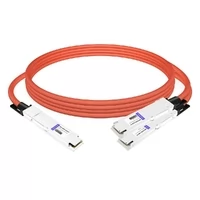
NVIDIA MFA7U10-H003 Compatible 3m (10ft) 400G OSFP to 2x200G QSFP56 twin port HDR Breakout Active Optical Cable
$750.00
-
NVIDIA MMA4Z00-NS Compatible 800GBASE 2 x SR4/SR8 OSFP PAM4 850nm 100m DOM Dual MPO-12 MMF Optical Transceiver Module
$550.00
-
NVIDIA MMA4Z00-NS-FLT Compatible 800GBASE 2 x SR4/SR8 OSFP RHS/Flat Top PAM4 850nm 100m DOM Dual MPO-12 MMF Optical Transceiver Module
$600.00
-
NVIDIA MMS4X00-NM Compatible 800GBASE 2 x DR4/DR8 OSFP IHS/Closed Finned Top PAM4 1310nm 500m DOM Dual MTP/MPO-12 SMF Optical Transceiver Module
$600.00
-
NVIDIA MMS4X00-NM-FLT Compatible 800GBASE 2 x DR4/DR8 OSFP Flat Top PAM4 1310nm 500m DOM Dual MTP/MPO-12 SMF Optical Transceiver Module
$650.00
-
NVIDIA MMS4X50-NM Compatible 800G 2x FR4 OSFP IHS/Closed Finned Top PAM4 1310nm 2km DOM Dual Duplex LC SMF InfiniBand NDR Optical Transceiver Module
$1000.00
-
NVIDIA MCP7Y00-N001 Compatible 1m (3ft) 800Gb Twin-port OSFP to 2x400G OSFP InfiniBand NDR Breakout Direct Attach Copper Cable
$160.00
-
NVIDIA MCA7J60-N004 Compatible 4m (13ft) 800G Twin-port OSFP to 2x400G OSFP InfiniBand NDR Breakout Active Copper Cable
$800.00
-
NVIDIA MMS4A00 (980-9IAH1-00XM00) Compatible 1.6T 2 x DR4/DR8 OSFP224 PAM4 1311nm 500m IHS/Finned Top Dual MPO-12 SMF Optical Transceiver Module
$1500.00
-
NVIDIA MMS4X50-NM Compatible 1.6T 2xFR4/FR8 OSFP224 PAM4 1310nm 2km IHS/Finned Top Dual Duplex LC SMF Optical Transceiver Module
$1800.00
-
NVIDIA MMS4A00-RHS Compatible 1.6T 2xDR4/DR8 OSFP224 PAM4 1311nm 500m RHS/Flat Top Dual MPO-12/APC InfiniBand XDR SMF Optical Transceiver Module
$2000.00
-
NVIDIA MCA7K20-X001 Compatible 1m (3ft) Twin-port 2x800Gb/s OSFP224 IHS/Finned Top to 4x400Gb/s OSFP224 RHS/Flat Top InfiniBand XDR Active Copper Splitter Cable
$2059.00