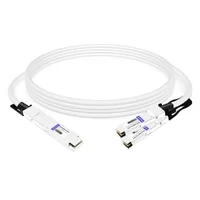

NVLink is NVIDIA’s high-speed chip-to-chip interconnect, and NVSwitch is the switch fabric that scales it across many GPUs. Together they are the reason modern AI systems can train and serve trillion-parameter models: a single GPU domain can now move data between 72 GPUs at terabyte-per-second speeds, which is roughly 800 times more aggregate bandwidth than the first NVLink generation delivered in 2016. Their evolution tracks nearly every step of the AI compute boom.
This article explains how NVLink and NVSwitch evolved generation by generation, how the network topology changed as GPU counts grew, and what the bandwidth and cabling look like at each stage. It also covers the current 2026 landscape, including the GB300 Blackwell Ultra generation and the incoming Vera Rubin platform with NVLink 6. If you design, build, or buy the connectivity layer for NVIDIA AI infrastructure, the final sections map each NVLink generation to the transceivers, DAC cables, and optical modules it actually needs.
What Are NVLink and NVSwitch?
NVLink is a wire-based serial interconnect developed by NVIDIA for GPU-to-GPU and GPU-to-CPU communication. It exists because PCIe became a bottleneck in multi-GPU systems: with NVLink, GPUs share memory and pass data directly instead of round-tripping through the CPU, the host memory, and the PCIe bus. Each NVLink generation has raised per-lane speed and added links per GPU, so the aggregate bandwidth has grown from 160 GB/s on the first generation to 3.6 TB/s on NVLink 6.
NVSwitch solves a different problem. Direct NVLink links connect a GPU to a handful of neighbors, but a fully connected mesh of many GPUs quickly consumes too many physical links. NVSwitch is a switch ASIC that creates an all-to-all fabric, so any GPU can reach any other GPU at full NVLink bandwidth. NVIDIA introduced NVSwitch with the DGX-2 in 2018, and today a rack-scale NVLink domain such as the GB200 NVL72 treats up to 72 GPUs as one large GPU.
Two terms recur throughout this article, so it helps to fix them now:
- NVLink domain: a group of GPUs that share coherent memory through NVLink and can be programmed as one logical device.
- NVSwitch tray: a hardware module holding NVSwitch ASICs that stitches the GPUs in a domain together.
NVLink and NVSwitch Generations at a Glance
The table below consolidates the evolution across all six NVLink generations. Per-GPU bandwidth is bidirectional aggregate (transmit plus receive). NVIDIA’s official per-generation specifications are also tracked in the Wikipedia article on NVLink.
| Generation | Year | GPU / Architecture | Links per GPU | Aggregate bandwidth per GPU | Signaling |
| NVLink 1.0 | 2016 | Tesla P100 (Pascal) | 4 | 160 GB/s | 20 Gb/s per lane |
| NVLink 2.0 | 2017 | Tesla V100 (Volta) | 6 | 300 GB/s | 25 Gb/s per lane |
| NVLink 3.0 | 2020 | A100 (Ampere) | 12 | 600 GB/s | 50 Gb/s per lane |
| NVLink 4.0 | 2022 | H100 / H200 (Hopper) | 18 | 900 GB/s | 100 Gb/s per lane |
| NVLink 5.0 | 2024 | B200 / GB200 / GB300 (Blackwell) | 18 | 1.8 TB/s | 200 Gb/s per lane |
| NVLink 6.0 | 2026 | Vera Rubin | up to 36 | 3.6 TB/s | Bidirectional SerDes |
The signaling trend is easy to spot. Early NVLink generations used NRZ encoding and modest per-lane rates, then NVIDIA moved to PAM4 signaling at NVLink 4.0 and kept raising the rate per lane. NVLink 6 doubles the per-GPU link count to as many as 36 and moves to bidirectional SerDes, the same high-speed electrical signaling class now appearing across 1.6T Ethernet optics. That is why the physical layer of NVLink now overlaps directly with the optical transceiver industry.
Topology Evolution: How GPU Networks Grew
The most important change across generations is not raw speed; it is topology. Every generation changed how GPUs are wired together.
Direct GPU-to-GPU Mesh (No Switch)
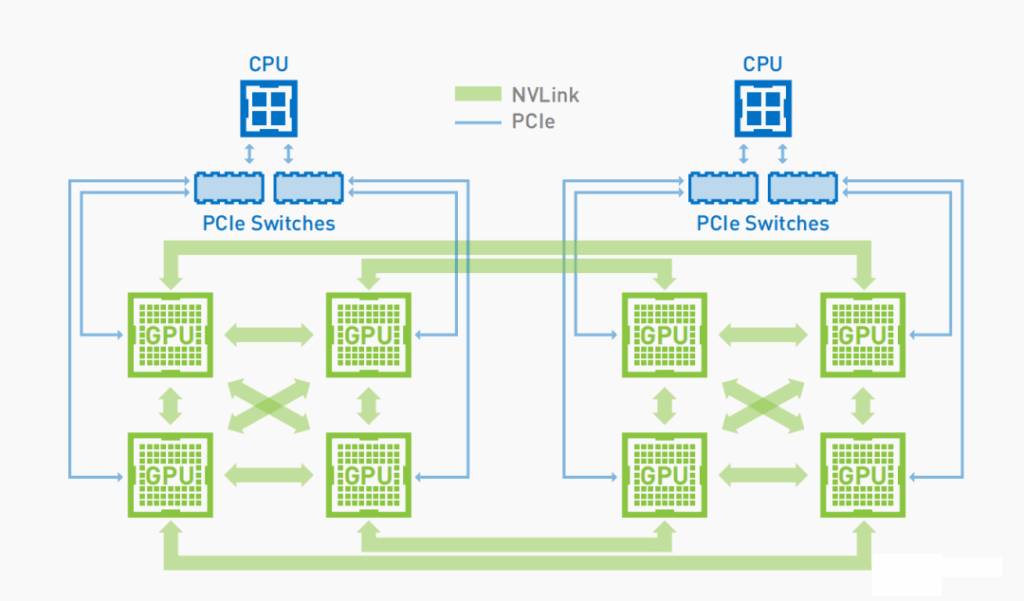
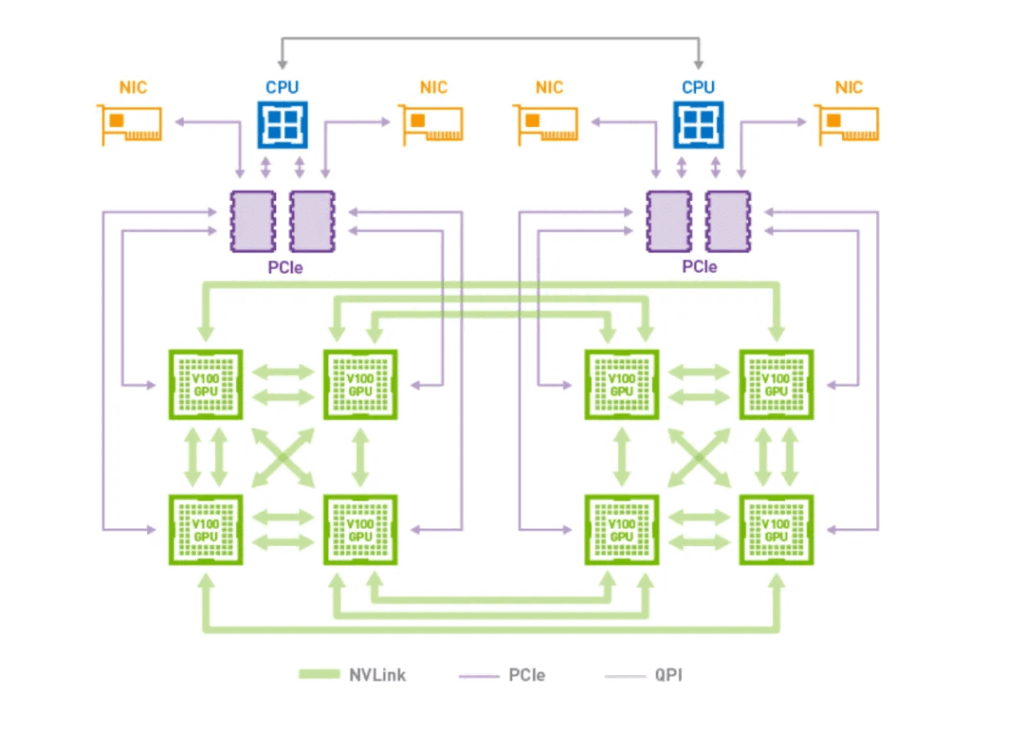
The first NVLink products connected GPUs directly to their neighbors. The Tesla P100 and Volta V100 attached up to four and six links respectively to nearby GPUs, forming a small mesh. This worked for systems with a handful of GPUs but could not scale, because adding GPUs forces each one to carry more links. The DGX-1, which held eight V100 GPUs, used a hybrid cube-mesh arrangement that kept all eight GPUs connected without a switch.
The First NVSwitch Fabric (2018)
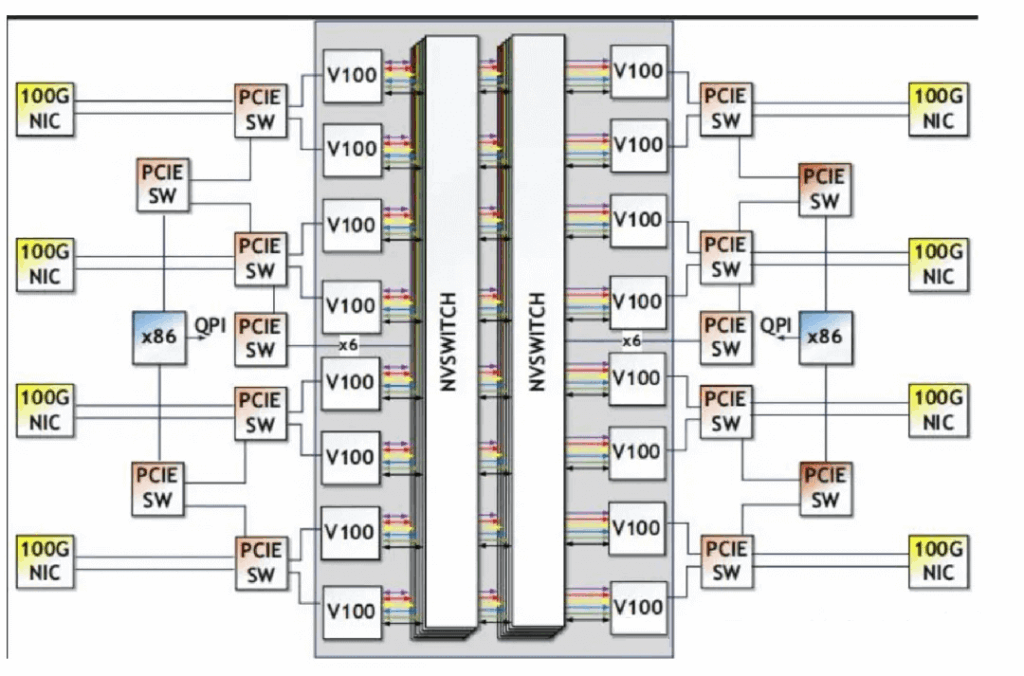
NVIDIA reached the scaling limit of direct meshes with the DGX-2 in 2018, which packed 16 V100 GPUs. Instead of wiring every GPU to every other GPU, NVIDIA introduced NVSwitch. The DGX-2 carried six first-generation NVSwitch ASICs on each of its two baseboards, and each GPU talked to the switch fabric instead of to every peer. Every GPU pair could then communicate at full NVLink speed, and the system behaved as a single 16-GPU domain.
The 8-GPU Standard Domain (2020 to 2022)
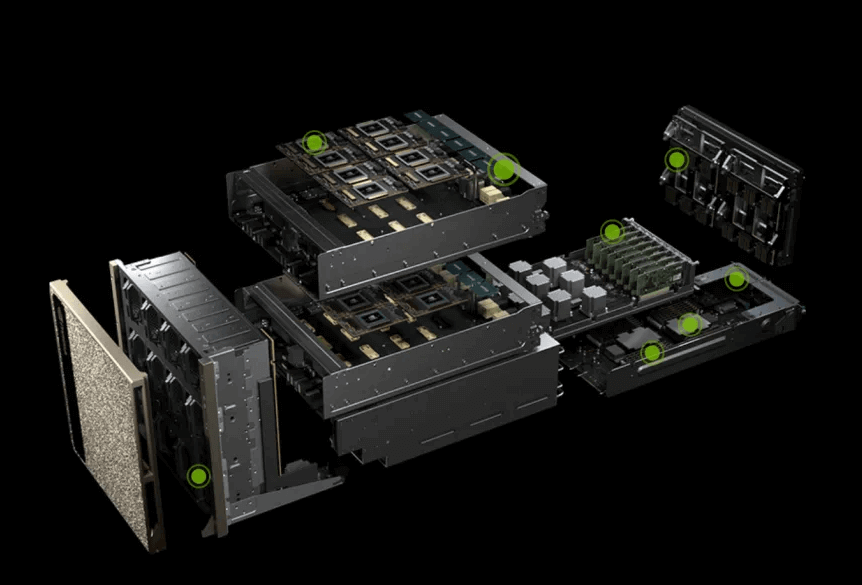
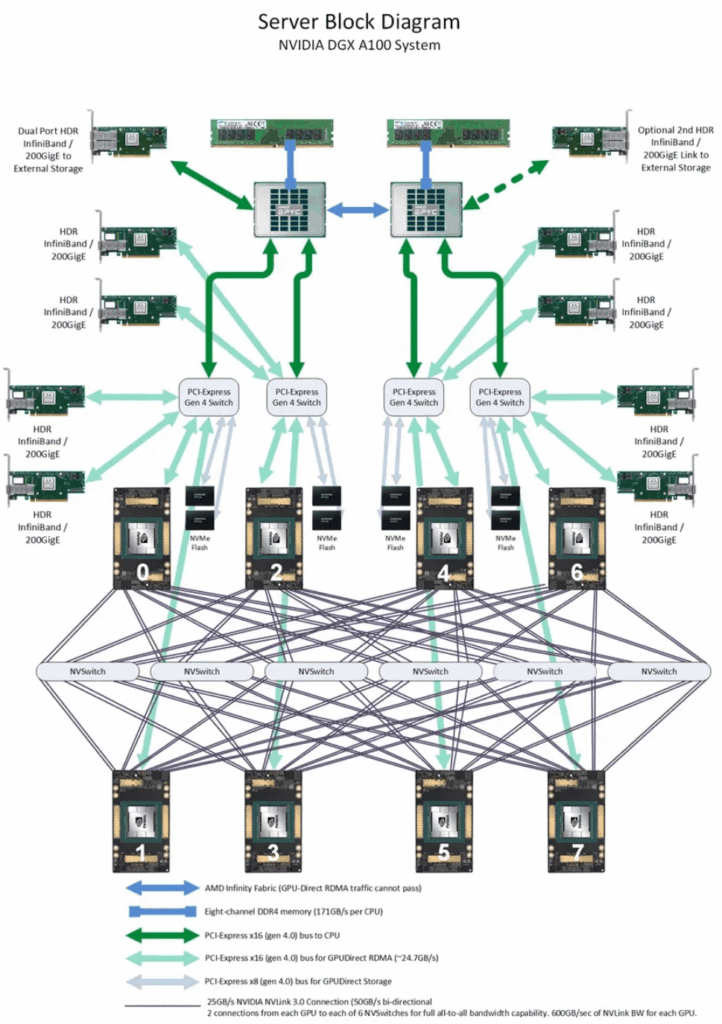
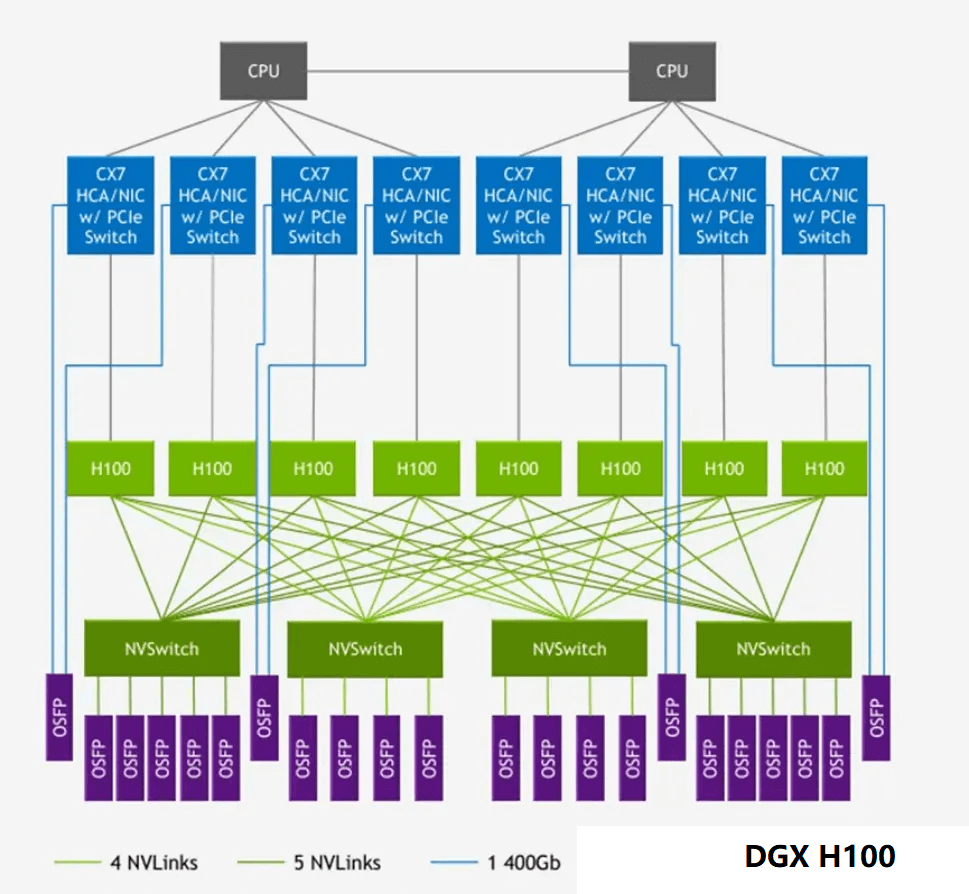
From the A100 onward, NVIDIA standardized on an 8-GPU building block. A DGX A100 system contains eight A100 GPUs wired to six second-generation NVSwitch ASICs, creating a full-mesh domain in which any GPU reaches any other at 600 GB/s. The DGX H100 did the same with four third-generation NVSwitch chips, and each H100 keeps its full 900 GB/s to the fabric.
Rack-Scale All-to-All Domains (2024)
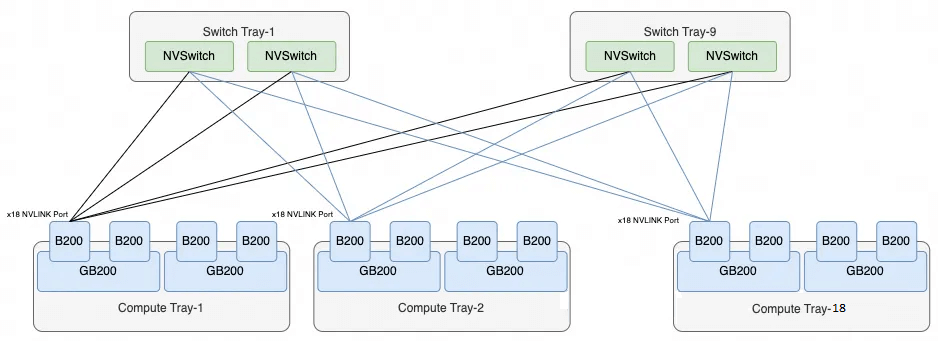
The Blackwell generation changed the unit of scale again. A GB200 NVL72 rack holds 72 GPUs and 36 Grace CPUs, and its nine NVSwitch trays create one 72-GPU NVLink domain. Each GPU in the rack talks to all the others at 1.8 TB/s, and the fabric aggregates to roughly 130 TB/s. NVIDIA ships the same 72-GPU domain in two physical layouts: the single-rack NVL72 and the two-rack NVL36x2, which spreads the domain across two cabinets connected by 1.6T OSFP links.
External NVLink Domains Beyond One Rack
NVLink does not stop at the rack boundary. NVIDIA sells external NVLink Switch modules, 1U units that each hold two NVSwitch chips and expose OSFP cages, so operators can stitch 8-GPU or 72-GPU domains into larger fabrics. On the DGX H100 generation, external NVLink switches connected up to 256 GPUs at 57.6 TB/s of aggregate bandwidth. On the Blackwell generation, external NVLink switches link NVL72 racks into even larger NVLink domains for models that will not fit in one rack. These scale-up fabrics are where the biggest and most expensive optical connections appear.
The Evolution of NVLink and NVSwitch
2016: Pascal and Tesla P100, First-Generation NVLink
NVIDIA first announced NVLink in 2014, and the technology reached its first product in 2016 with the Tesla P100, built on the Pascal architecture. NVLink 1.0 gave the P100 four links with a bidirectional aggregate of 160 GB/s, about five times the bandwidth of a PCIe 3.0 x16 slot. This made four- or eight-GPU configurations practical without turning the PCIe bus into the bottleneck. There was no NVSwitch yet; the GPUs talked to each other directly.
2017: Volta and Tesla V100, Second-Generation NVLink
The 2017 Tesla V100, based on Volta, doubled the interconnect story. NVLink 2.0 raised each V100 to six links for 300 GB/s of bidirectional bandwidth. The DGX-1 with V100 GPUs scaled to eight GPUs using a hybrid mesh, and for the first time NVLink supported GPUs on different PCIe switches, so a single coherent memory space could span a whole node.
2018: DGX-2 and the First NVSwitch
The 16-GPU DGX-2 marked the arrival of NVSwitch. Six first-generation NVSwitch ASICs sat on each baseboard to connect the GPUs, and the switch fabric let any two GPUs in the system exchange data at full NVLink speed. This is the topology that every later NVIDIA system inherits. NVSwitch turned a network of point-to-point links into a real switched fabric.
2020: Ampere and A100, Third-Generation NVLink
The A100 generation standardized the 8-GPU domain. NVLink 3.0 gave each A100 12 links for 600 GB/s of bidirectional bandwidth, and second-generation NVSwitch chips in the DGX A100 connected eight GPUs into a full-mesh domain. The HGX baseboard that carriers the A100s and their NVSwitches became the reference design that server makers build around, and it is the module a host server plugs into over PCIe.
2022: Hopper and H100, Fourth-Generation NVLink
NVLink 4.0 on the H100 was the first to use PAM4 signaling, jumping per-lane speed to 100 Gb/s and giving each H100 900 GB/s across 18 links, roughly 14 times a PCIe 5.0 x16 slot. Third-generation NVSwitch chips brought the SHARP in-network reduction engine to the fabric, so collective operations such as all-reduce run inside the switches. For larger clusters, NVIDIA introduced external NVLink Switch modules that let operators build up to 256-GPU domains, as in the DGX H100 SuperPOD.
2024: Blackwell B200, Fifth-Generation NVLink
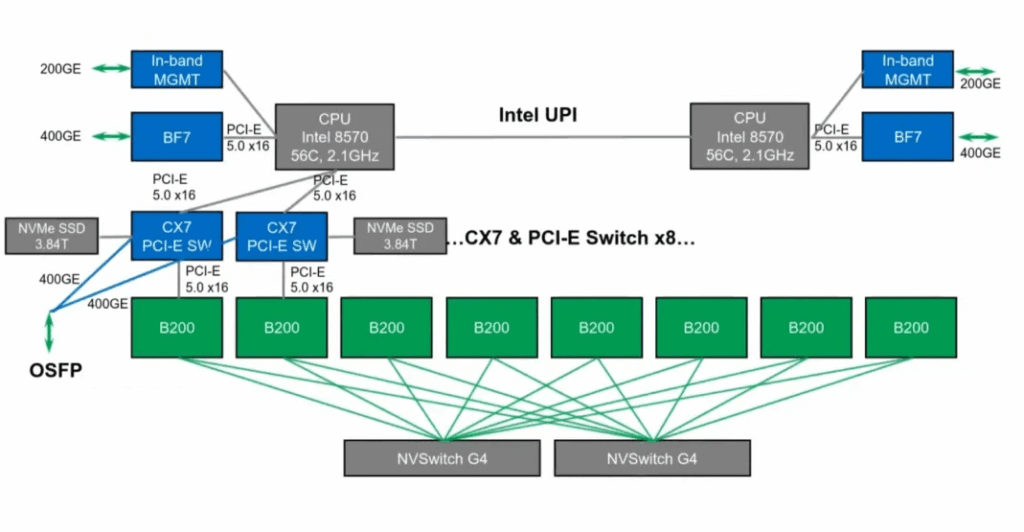
The Blackwell generation moved NVLink from a node interconnect into a rack interconnect. NVLink 5.0 gives each B200 1.8 TB/s across 18 links, and the GB200 NVL72 rack creates a single 72-GPU domain with about 130 TB/s of fabric bandwidth. NVIDIA also kept improving the NVSwitch: each NVL72 switch tray carries two next-generation NVSwitch ASICs, and the domain spans an entire rack while staying on copper inside the cabinet.
2025 to 2026: GB300 Blackwell Ultra
Blackwell Ultra, the GB300 generation, is the volume platform through 2026. The B300 GPU raises memory to 288 GB of HBM3e and pushes the NVL72 rack to roughly 132 kW, and the scale-out network moves to 800G ConnectX-8 network cards. For NVLink itself, GB300 stays on the fifth generation, but the system introduces the copper and optical split that now defines rack design: copper NVLink inside the rack, and optical links wherever the distance grows.
2026: Vera Rubin, Sixth-Generation NVLink
The Vera Rubin platform brings NVLink 6.0. Announced by NVIDIA in 2025 and detailed through early 2026, NVLink 6 doubles the per-GPU bandwidth to 3.6 TB/s across up to 36 links per GPU, while the accompanying NVSwitch generation lifts rack-scale fabric bandwidth to roughly 260 TB/s. The first flagship system, Vera Rubin NVL144, is scheduled to ship in the second half of 2026, and Rubin Ultra (NVL576) follows with co-packaged optics on the roadmap. For anyone buying cables and optics today, this is the transition to watch, because NVLink 6 systems shift more of the fabric to high-speed optical and active electrical cabling.
NVLink vs PCIe: Bandwidth Comparison
It is easier to appreciate NVLink rates when you compare them to PCIe, the general-purpose bus NVLink was built to bypass. The table uses bidirectional numbers.
| Interconnect | Typical peak bidirectional bandwidth | Role |
| PCIe 4.0 x16 | ~64 GB/s | General-purpose I/O |
| PCIe 5.0 x16 | ~128 GB/s | General-purpose I/O |
| NVLink 3.0 (A100) | 600 GB/s per GPU | Scale-up within a node |
| NVLink 4.0 (H100) | 900 GB/s per GPU | Scale-up within a node |
| NVLink 5.0 (B200) | 1.8 TB/s per GPU | Scale-up within a rack |
| NVLink 6.0 (Rubin) | 3.6 TB/s per GPU | Scale-up across racks |
The practical consequence is that tensor parallelism and other model-parallel patterns depend on NVLink. When GPUs must exchange weight gradients every training step, an NVLink domain moves that traffic orders of magnitude faster than PCIe could, which is why large-model training effectively requires it.
Why NVLink and NVSwitch Matter for AI and HPC
Three capabilities explain why every major AI cluster now depends on NVLink and NVSwitch:
- Coherent shared memory. GPUs in an NVLink domain share a unified memory space, so software can treat many accelerators as one large device instead of managing message passing.
- Near-linear scale-up. A switch fabric gives every GPU-to-GPU pair full bandwidth, so adding GPUs does not throttle communication the way a ring or mesh would.
- In-fabric acceleration. Modern NVSwitch generations reduce or eliminate network traffic inside collective operations, cutting the time spent synchronizing across hundreds of GPUs.
The design trade-off is that this power comes with physical constraints. As NVLink bandwidth climbs past 900 GB/s per GPU, signal integrity and reach start to dictate the design, which is exactly where the cabling and optics decisions in the next section come from.
Cabling and Connectivity: What an NVLink GPU Domain Needs
For network architects and buyers, the interesting part of the NVLink story is the physical layer, because each generation changed what kind of copper and optical products the fabric uses. This is also where NVLink and the FiberMall portfolio of NVIDIA-compatible transceivers and cables connect.
In-Rack NVLink: Copper Wins
Inside a single rack, NVIDIA uses copper for NVLink wherever possible. The GB200 NVL72 runs copper NVLink at the rear of the cabinet, which saves roughly 20 kW per rack compared with optical links and keeps latency low. Those copper runs are high-speed twin-axial cables, essentially large DAC assemblies, that plug into the compute trays and the NVSwitch trays. Copper dominates for NVLink because the distances are short (under a few meters) and the power savings are large.
Rack-to-Rack NVLink: Optics and AECs
Once NVLink crosses between racks, copper reach runs out. The GB200 NVL36x2, for example, spreads one 72-GPU domain across two racks, and the NVSwitch trays connect the pair through 1.6T OSFP cages. Those links carry real NVLink traffic, so they need high-performance OSFP optics or 1.6T active electrical cables (AECs) and low-loss cabling. The same applies to external NVLink Switch networks that join racks into larger domains.
Scale-Out Networking: InfiniBand and Ethernet
Alongside NVLink scale-up, every NVIDIA cluster has a scale-out network for jobs, storage, and multi-rack traffic. DGX H100 systems use 400G ConnectX-7 InfiniBand, GB300 moves to 800G ConnectX-8, and the fabric is built on Quantum-X800 (InfiniBand) or Spectrum-X800 (Ethernet) switches. This layer is where NVIDIA-compatible 400G and 800G OSFP modules and QSFP-DD optics attach to the network cards.
Practical Selection Guide
| Fabric layer | Typical link | Recommended connectivity |
| In-rack NVLink (NVL72) | Copper NVLink | High-speed DAC cables, short copper runs |
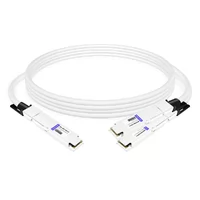
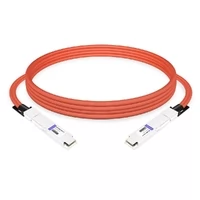
| Rack-to-rack NVLink (NVL36x2) | 1.6T OSFP cages | 800G OSFP optics or twin-port DAC / AEC |
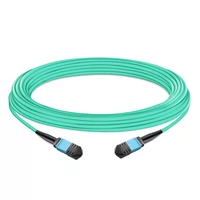
| External NVLink domains | OSFP on NVLink Switch | OSFP optical modules, MPO fiber trunks |
| Scale-out InfiniBand (GB300) | 800G ConnectX-8 | 800G OSFP SR8 / DR8 transceivers, NDR DAC |
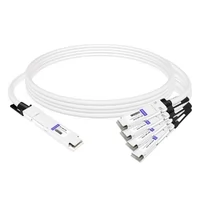
FiberMall builds NVIDIA-compatible modules for exactly these links. The 800G OSFP SR8 module serves short-reach NVLink and scale-out fabrics, the 800G OSFP flat-top family covers DR8 single-mode runs, and 800G NDR DAC cables handle the short copper hops inside racks. For rack-to-rack pairs and external NVLink domains, twin-port OSFP breakout DACs and MPO fiber trunks are the practical building blocks. To learn how NVIDIA splits NVLink scale-up from the Ethernet scale-out architecture, and which copper and OSFP products that scale-out fabric needs, see our analysis of 400G NDR splitter cables and 800G OSFP copper.
One rule of thumb ties it together: keep NVLink on copper where distances are short and power budgets are tight, switch to optics where reach or density demands it, and treat 800G and 1.6T OSFP as the forward-looking standard so your cabling carries across the GB300 and Vera Rubin generations.
NVLink Fusion and the Optical Future
The next major shift in NVLink is optical. In 2025 NVIDIA introduced NVLink Fusion, an approach that extends NVLink over optical interconnect so a single NVLink domain can span racks rather than ending at the cabinet edge. NVLink Fusion uses co-packaged optics and high-speed optical modules to carry NVLink traffic across the longer distances that separate GPU racks, which matters as domains grow past what one rack can hold.
For the optical industry, this is a direct expansion of the market. Every NVLink Fusion link and every next-generation NVSwitch tray that talks optically needs the same class of transceivers, AECs, and structured cabling that 800G and 1.6T Ethernet already use. NVIDIA’s own developer content on NVLink Fusion frames NVLink Fusion as a way to make scale-up networking more flexible, giving operators the reach of optics with the low-latency memory semantics of NVLink. On the roadmap, Rubin Ultra (NVL576) and its co-packaged optics are the clearest sign that NVLink and optical networking are converging, and FiberMall’s optical expertise is built for exactly this transition. For background on the high-density interconnect architectures these systems rely on, read our data center interconnect guide.
Frequently Asked Questions
What is NVLink?
NVLink is NVIDIA’s high-speed chip-to-chip interconnect for GPUs. It connects GPUs to each other and to CPUs with far more bandwidth than PCIe, enabling coherent shared memory and direct peer-to-peer transfers. NVLink has evolved through six generations, from 160 GB/s on the Tesla P100 to 3.6 TB/s per GPU on Vera Rubin.
What is NVSwitch?
NVSwitch is NVIDIA’s switch ASIC for NVLink. It creates an all-to-all fabric so that any GPU in a domain can reach any other GPU at full NVLink bandwidth. NVIDIA introduced NVSwitch in 2018 with the DGX-2, and it now scales GPU domains from eight GPUs up to entire racks such as the 72-GPU GB200 NVL72.
How fast is NVLink 6?
NVLink 6 delivers 3.6 TB/s of bidirectional bandwidth per GPU, double the 1.8 TB/s of NVLink 5 on the Blackwell generation. It supports up to 36 links per GPU and debuts with the Vera Rubin platform, whose NVL144 system is expected to ship in the second half of 2026.
What is the difference between NVLink and PCIe?
NVLink is a dedicated GPU interconnect with per-GPU bandwidth measured in terabytes per second, while PCIe is a general-purpose I/O bus that peaks around 64 to 128 GB/s for a x16 slot. NVLink bypasses the CPU and host memory for GPU-to-GPU traffic, which is essential for large-model training.
Does NVLink use copper or optical cables?
Both. NVLink runs on copper inside a rack, as in the GB200 NVL72 where copper saves roughly 20 kW per cabinet. NVLink crosses racks through 1.6T OSFP optical modules and active electrical cables, and NVIDIA’s NVLink Fusion roadmap extends NVLink over optical interconnect to span even more racks.
What cables does an NVL72 rack need?
An NVL72 rack needs short, high-speed copper NVLink cables between compute trays and NVSwitch trays inside the cabinet, plus 800G OSFP optics and DAC or AEC cables for rack-to-rack and scale-out links. FiberMall carries NVIDIA-compatible options across all of these.
Conclusion
NVLink and NVSwitch evolved from a four-link GPU interconnect in 2016 into a rack-scale fabric that connects 72 GPUs as one device, and the roadmap now extends NVLink across racks with optics. Understanding the generations helps you make better buying decisions today. The key takeaways are:
- NVLink bandwidth grew from 160 GB/s (NVLink 1.0, P100) to 3.6 TB/s per GPU (NVLink 6, Vera Rubin), roughly a 22x increase over a decade.
- Topology moved from direct GPU meshes to NVSwitch fabrics, 8-GPU domains, rack-scale NVL72 domains, and external NVLink networks that span racks.
- The physical layer split between in-rack copper NVLink and optical links for rack-to-rack and scale-out traffic, which is where 800G and 1.6T OSFP connectivity matters.
- NVLink 6 on Vera Rubin and NVLink Fusion are the next chapters, and planning optics for 800G and 1.6T now protects your cabling investment through GB300 and into Rubin.
If you are sourcing the connectivity layer for an NVIDIA GPU cluster, browse FiberMall’s NVIDIA-compatible OSFP modules and cables. For help matching modules to your switches, network cards, and NVLink fabric, ask our engineers on the FiberMall questions page.
Related Products:
-
 NVIDIA MMA4Z00-NS400 Compatible 400G OSFP SR4 Flat Top PAM4 850nm 30m on OM3/50m on OM4 MTP/MPO-12 Multimode FEC Optical Transceiver Module
$400.00
NVIDIA MMA4Z00-NS400 Compatible 400G OSFP SR4 Flat Top PAM4 850nm 30m on OM3/50m on OM4 MTP/MPO-12 Multimode FEC Optical Transceiver Module
$400.00
-
NVIDIA MMA4Z00-NS-FLT Compatible 800GBASE 2 x SR4/SR8 OSFP RHS/Flat Top PAM4 850nm 100m DOM Dual MPO-12 MMF Optical Transceiver Module
$600.00
-
NVIDIA MMA4Z00-NS Compatible 800GBASE 2 x SR4/SR8 OSFP PAM4 850nm 100m DOM Dual MPO-12 MMF Optical Transceiver Module
$550.00
-
NVIDIA MMS4X00-NM Compatible 800GBASE 2 x DR4/DR8 OSFP IHS/Closed Finned Top PAM4 1310nm 500m DOM Dual MTP/MPO-12 SMF Optical Transceiver Module
$600.00
-
NVIDIA MMS4X00-NM-FLT Compatible 800GBASE 2 x DR4/DR8 OSFP Flat Top PAM4 1310nm 500m DOM Dual MTP/MPO-12 SMF Optical Transceiver Module
$650.00
-
NVIDIA MMS4X00-NS400 Compatible 400G OSFP DR4 Flat Top PAM4 1310nm MTP/MPO-12 500m SMF FEC Optical Transceiver Module
$450.00
-
NVIDIA(Mellanox) MMA1T00-HS Compatible 200G Infiniband HDR QSFP56 SR4 850nm 100m MPO-12 APC OM3/OM4 FEC PAM4 Optical Transceiver Module
$139.00
-
NVIDIA MFP7E10-N010 Compatible 10m (33ft) 8 Fibers Low Insertion Loss Female to Female MPO Trunk Cable Polarity B APC to APC LSZH Multimode OM3 50/125
$47.00
-
NVIDIA MCP7Y00-N003-FLT Compatible 3m (10ft) 800G Twin-port OSFP to 2x400G Flat Top OSFP InfiniBand NDR Breakout DAC
$260.00
-
NVIDIA MCP7Y70-H002 Compatible 2m (7ft) 400G Twin-port 2x200G OSFP to 4x100G QSFP56 Passive Breakout Direct Attach Copper Cable
$155.00
-
NVIDIA MCA4J80-N003-FTF Compatible 3m (10ft) 800G Twin-port 2x400G OSFP to 2x400G OSFP InfiniBand NDR Active Copper Cable, Flat top on one end and Finned top on other
$600.00
-
NVIDIA MCP7Y10-N002 Compatible 2m (7ft) 800G InfiniBand NDR Twin-port OSFP to 2x400G QSFP112 Breakout DAC
$190.00