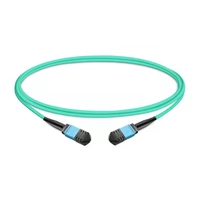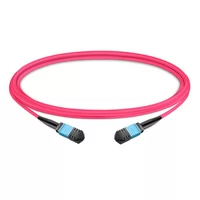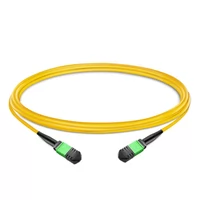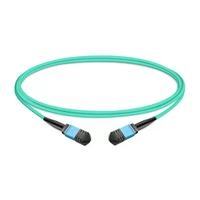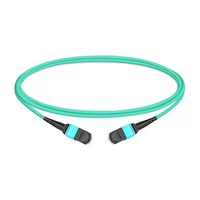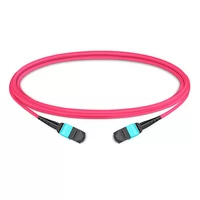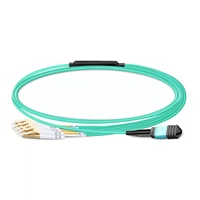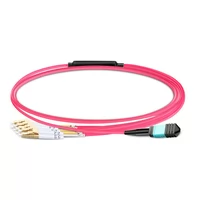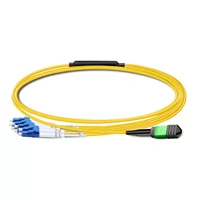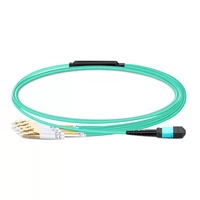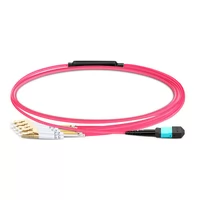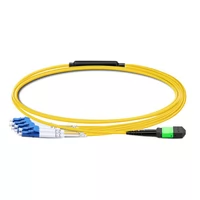

The 400G upgrade which Mark Chen planned failed to achieve his desired level of success because he believed he had completed all aspects of the project. The network architect defined his requirements for the new data hall by using MPO-12 trunk cables because he considered MPO-12 to be the standard cable used by all people. The team discovered that their equipment had a fundamental problem when they received 400G-SR8 transceivers because the SR8 system required 16 fibers to function instead of 12. The organization needed to abandon its deployment plan because the new MPO-12 cables failed to meet its requirements.
Emergency procurement of MPO-24 assemblies became necessary because of a $50,000 mistake, which resulted in a three-week delay for the project. The personnel conducting the work failed to identify the polarity mismatch problem on row 7 because they worked too quickly until random link failures occurred at 3 AM.
The selection of an incorrect MPO fiber count for your system comes with multiple consequences, which include transceiver type restrictions, loss budget impacts, and fiber investment losses. This guide provides you with a decision framework that enables you to achieve correct results on your initial attempt.
The study shows how MPO-8, MPO-12, and MPO-24 differ in their fiber usage and density, and cost. We will match transceivers to their appropriate cable types while we determine the actual total cost of ownership from fiber waste and create a decision matrix that applies to your deployment needs.
Understanding MPO Fiber Count Basics
The fiber counts of MPO connectors were determined based on transceiver lane requirements and the economic factors related to fiber installation.
Parallel optic transceivers transmit and receive data across multiple fiber lanes simultaneously. The 100G SR4 transceiver operates with four 25G lanes, which require eight fibers for their transmission and reception functions. A 400G SR8 transceiver operates with eight 50G lanes, which need 16 fibers to function properly.
The industry standardized around three main MPO configurations:
The Base-8 standard Base-8 MPO-8 system uses 8 fibers to achieve full compatibility with 4-lane parallel optical systems, which include 40G SR4 and 100G SR4. The system uses all its fibers for specific functions because it avoids creating any unnecessary materials.
The Base-12 standard Base-12 MPO-12 system uses 12 fibers, which historically matched 6 duplex pairs used in 10G systems. The system supports breakout scenarios because it can be divided into 2, 3, 4, or 6 equal parts.
The Base-24 standard Base-24 MPO-24 system uses 24 fibers, which run through two rows to achieve maximum density in hyperscale environments that require fewer trunk connections than they need for each cable.
The key insight: your transceiver choice determines your optimal MPO type. Not the other way around.
For a deeper dive into MPO connector mechanics, see our complete MPO connector guide.

MPO-8 (Base-8): The Efficiency Champion
MPO-8 connectors position 8 fibers in a single row—four transmit fibers on one side, four receive fibers on the other. This configuration maps perfectly to modern parallel optics.
Technical Specifications
| Attribute | MPO-8 Specification |
| Fiber count | 8 fibers (single row) |
| Tx/Rx configuration | 4 transmit / 4 receive |
| Duplex channels | 4 (for breakout applications) |
| Connector size | Same as MPO-12 |
| Cable diameter | 3.0mm (standard trunk) |
Best Applications
MPO-8 excels with 8-fiber parallel optics:
- 40G SR4: Native 4×10G lanes, 100% fiber utilization
- 100G SR4: Native 4×25G lanes, 100% fiber utilization
- 100G PSM4: Single-mode parallel, 100% utilization
- 400G DR4: Single-mode 4×100G, 100% utilization
- 400G SR4.2: 2-wavelength BiDi, uses 8 fibers
Advantages
The system uses complete fiber waste. The system processes all fiber lines because 8-fiber transceivers use all fiber lines during their operation. Your cable tray contains no unused capacity because all your equipment operates at full capacity.
The system requires no conversion modules. MPO-8 connects directly to 8-fiber transceivers without Base-12-to-Base-8 conversion cassettes. Each avoided cassette saves approximately 0.35 dB of insertion loss and $75-150 in hardware cost.
The system provides a clear upgrade path. You can upgrade from 40G to 100G to 400G DR4 without touching your fiber plant. The same MPO-8 infrastructure serves all three speeds.
The system uses a basic polarity system. Type B polarity (key-up to key-up) works consistently across MPO-8 deployments. The system needs no complex mapping tables for its operation.
Limitations
Lower ecosystem maturity. While growing rapidly, MPO-8 doesn’t have the same vendor breadth as MPO-12. You might wait an extra week for specific cable lengths.
Density constraints. You need more physical cables for the same fiber count. A 144-fiber backbone requires 18 MPO-8 cables versus 12 MPO-12 cables.
Not suitable for 400G-SR8. MPO-8’s 8-fiber capacity can’t support 400G-SR8’s 16-fiber requirement. You’ll need MPO-16 or MPO-24 for those deployments.
MPO-12 (Base-12): The Universal Standard
MPO-12 remains the most widely deployed configuration, with 12 fibers arranged in a single row. It’s been the data center workhorse for over a decade.
Technical Specifications
| Attribute | MPO-12 Specification |
| Fiber count | 12 fibers (single row) |
| Fiber positions | 1-6 (left), 7-12 (right) |
| Duplex channels | 6 (for 10G/25G breakout) |
| Ecosystem availability | Widest vendor support |
| Conversion options | To MPO-8 via cassette |
Best Applications
MPO-12 works across mixed-speed environments:
- 10G/25G breakout: 6 duplex LC pairs from one MPO-12
- 40G SR4: With conversion cassette (8 fibers used, 4 stranded)
- 100G SR4: With conversion cassette (8 fibers used, 4 stranded)
- Legacy infrastructure: Existing Base-12 deployments
- Structured cabling: Maximum flexibility for unknown future needs
The Fiber Waste Reality
Here’s what competitors won’t tell you: using MPO-12 with 8-fiber transceivers wastes 33% of your fiber investment.
For a 100G SR4 deployment:
- MPO-8 uses: 8 fibers (100% utilization)
- MPO-12 uses: 8 fibers active, 4 fibers stranded (67% utilization)
The total number of fibers that link to multiple connections reaches four. The data center contains 500 links, which require payment for 2000 fibers that transmit no data. The typical OM4 pricing range of 5−8 per meter leads to wasted cable investment costs between 10000 and 16000, while creating ongoing expenses for dark fiber, which remains unused.
The Phoenix data center director, Jennifer Martinez, discovered this information through personal experience. “We specified MPO-12 for our 100G rollout because that’s what we’d always used. The utilization report showed me that 33 percent of our fiber plant remained unused six months after we installed our system. We paid for 12 fibers and used 8. The standard choice resulted in a stranded capacity cost of $40,000 to our organization.
Advantages
Maximum availability. Every vendor stocks MPO-12. Lead times are shortest, and pricing is most competitive due to volume.
Breakout flexibility. Twelve divides evenly into 2, 3, 4, and 6. You can break out MPO-12 to 6× LC duplex, 3× MPO-4, or 2× MPO-6 with standard cassettes.
Legacy compatibility. If your data center has existing Base-12 infrastructure, staying consistent simplifies sparing and maintenance.
Limitations
Conversion overhead. Connecting MPO-12 trunks to 8-fiber transceivers requires conversion cassettes. Each cassette adds insertion loss, cost, and potential failure points.
Fiber waste. The 33% utilization penalty with 8-fiber optics is unavoidable with MPO-12.
Polarity complexity. Mixed Base-12/Base-8 environments require careful polarity tracking to avoid crossed fibers.
MPO-24 (Base-24): The Density King
MPO-24 packs 24 fibers into two rows of 12. It’s the choice when density matters more than anything else.
Technical Specifications
| Attribute | MPO-24 Specification |
| Fiber count | 24 fibers (2 rows × 12) |
| Row configuration | Top row: positions 1-12, Bottom row: 13-24 |
| Density advantage | 50% fewer cables vs MPO-12 |
| Best applications | 400G SR8, 800G SR8, hyperscale |
| Splitting options | 2× MPO-12 or 3× MPO-8 |
Best Applications
MPO-24 dominates specific high-density scenarios:
- 400G SR8: 16 fibers used, 8 spare (or split across multiple links)
- 800G SR8: Native 16-fiber support with headroom
- Hyperscale backbones: Reducing trunk count by 50-67%
- AI clusters: Massive east-west bandwidth requirements
- Cable-constrained pathways: Where conduit fill limits, cable count
Density Impact
For a 576-fiber backbone installation:
| Metric | MPO-8 | MPO-12 | MPO-24 |
| Cable count | 72 | 48 | 24 |
| Panel space (typical) | 12 RU | 8 RU | 4 RU |
| Conduit fill | High | Medium | Low |
MPO-24 reduces your trunk cable count by half versus MPO-12. In a hyperscale facility with thousands of fibers, that translates to significantly less cable tray congestion and easier airflow management.
Advantages
Maximum panel density. MPO-24 achieves the highest fiber count per rack unit. A 1 RU panel can terminate 144 fibers with MPO-24 adapters—impossible with lower fiber counts.
Splitting flexibility. One MPO-24 trunk can split into 2× MPO-12 or 3× MPO-8, supporting mixed environments from a single cable.
Future-ready. 800G SR8 and emerging 1.6T standards align with MPO-24’s capacity. Deploy MPO-24 today, and you’re set for next-generation speeds.
Limitations
Higher per-cable cost. MPO-24 cables cost more than equivalent lengths of MPO-8 or MPO-12—though the per-fiber cost is often lower.
Complex polarity. Managing polarity across two rows of fibers requires careful planning. Method B still applies, but the double-row configuration adds complexity.
Stiffer cables. Twenty-four fiber cables have larger bend radius requirements and are harder to route in tight spaces.
Elite-grade required. For 400G/800G applications, standard MPO-24 connectors don’t provide adequate loss performance. You’ll need MTP Elite or equivalent low-loss grades.
For complete 400G/800G deployment guidance, see our MPO connectors for 400G and 800G networks guide.

Technical Comparison: Side-by-Side Analysis
Master Comparison Table
| Specification | MPO-8 (Base-8) | MPO-12 (Base-12) | MPO-24 (Base-24) |
| Fiber count | 8 | 12 | 24 |
| Physical size | Standard | Standard | Standard |
| Fiber utilization (SR4) | 100% | 67% | 33% (or split) |
| Fiber utilization (SR8) | N/A | N/A | 67% |
| Best for speeds | 40G/100G/400G DR4 | 10G/25G/40G/100G | 400G SR8/800G |
| Ecosystem maturity | Growing | Most mature | Emerging |
| Typical insertion loss | 0.35 dB | 0.35 dB (+0.35dB with conversion) | 0.35 dB |
| Panel density | Moderate | Good | Excellent |
| Cable flexibility | Best | Good | Stiffer |
Application Matrix by Transceiver
| Transceiver | Fiber Requirement | Best MPO Choice | Notes |
| 10G SR | 2 fibers (duplex) | MPO-12 | Via 6× LC breakout |
| 25G SR | 2 fibers (duplex) | MPO-12 | Via 6× LC breakout |
| 40G SR4 | 8 fibers | MPO-8 | 100% utilization |
| 40G SR4 | 8 fibers | MPO-12 | 67% utilization, needs conversion |
| 100G SR4 | 8 fibers | MPO-8 | 100% utilization |
| 100G SR4 | 8 fibers | MPO-12 | 67% utilization, needs conversion |
| 100G SR10 | 20 fibers | MPO-24 | Native support |
| 400G DR4 | 8 fibers | MPO-8 | 100% utilization, single-mode |
| 400G SR8 | 16 fibers | MPO-24 | Native support or split |
| 800G SR8 | 16 fibers | MPO-24 | Future-ready |
Insertion Loss by Path Type
For a typical 100-meter link with two patch panels:
| Path Type | Loss per Connector | Total Loss | Margin |
| MPO-8 end-to-end | 0.35 dB × 4 | 1.40 dB | Excellent |
| MPO-12 with conversion | 0.35 dB × 4 + 0.35 dB × 2 | 2.10 dB | Tight |
| MPO-24 split to MPO-8 | 0.35 dB × 4 + 0.35 dB × 2 | 2.10 dB | Tight |
The 0.70 dB penalty for conversion modules isn’t trivial. In a 400G link with a tight 6.3 dB budget, that conversion loss consumes 11% of your available margin.
TCO Analysis: The Real Cost Difference
Competitors avoid pricing discussions. We’re giving you real numbers to make informed decisions.
Cable Pricing by Type (Generic/OEM)
| Cable Type | 10m Generic | 50m Generic | 100m Generic | OEM Premium |
| MPO-8 OM4 | $45-65 | $180-250 | $350-480 | 8-15× |
| MPO-12 OM4 | $50-75 | $200-280 | $400-550 | 8-15× |
| MPO-24 OM4 | $90-130 | $380-520 | $750-980 | 10-20× |
| MPO-8 OS2 | $80-120 | $350-480 | $680-900 | 6-12× |
Prices representative of North American market, Q2 2025. OEM pricing from the major switch vendor list prices.
Fiber Waste Cost Calculation
Scenario: 200-link 100G SR4 deployment, 50-meter average cable run
MPO-8 approach:
- Cable cost: 200 × 215=215=43,000
- Conversion modules: None
- Total: $43,000
MPO-12 approach:
- Cable cost: 200 × 240=240=48,000
- Conversion modules: 200 × 95=95=19,000
- Fiber waste: 33% of capacity unused
- Total: $67,000 (55% higher)
The MPO-12 “standard” costs 55% more for the same deployed capacity. Over a 5-year lifecycle, that gap widens when you factor in:
- Higher power consumption from conversion modules
- Additional failure points requiring maintenance
- Stranded fiber opportunity cost
When MPO-12 Makes Financial Sense
Despite the waste penalty, MPO-12 can be cost-effective when:
- Existing infrastructure: You’ve already invested in Base-12 panels and cassettes
- Mixed speed requirements: 10G, 25G, and 100G in the same environment
- Short-term deployments: Temporary or lab environments where flexibility matters more than efficiency
- Procurement constraints: MPO-8 lead times are unacceptable for your timeline
How to Choose: Decision Framework
Use this decision tree to select your MPO type:
Start Here: What’s Your Primary Speed?
Primarily 40G/100G SR4 or 400G DR4?
→ Choose MPO-8 for maximum efficiency
Mixed 10G/25G/40G/100G?
→ Choose MPO-12 for flexibility
400G SR8 or 800G?
→ Choose MPO-24 for native support
Scenario-Based Recommendations
New Data Center (Greenfield)
- Standardize on MPO-8 for 40G/100G/400G DR4 deployments
- Deploy MPO-24 for AI clusters and 400G SR8 applications
- Avoid MPO-12 unless you have specific legacy requirements
Legacy Upgrade (Brownfield)
- Assess existing Base-12 infrastructure value
- If staying: Add MPO-12 with conversion for 100G
- If refreshing: Migrate to MPO-8 during upgrade cycle
Hyperscale/AI Cluster
- Backbone: MPO-24 for density
- Leaf-spine: MPO-8 for 400G DR4 efficiency
- Storage fabric: MPO-24 for 400G SR8
Enterprise/Colocation
- MPO-12 remains safe choice for mixed environments
- Specify OM4 minimum (skip OM3)
- Plan for MPO-8 migration at next refresh cycle
Migration Considerations
Moving from Base-12 to Base-8 isn’t an overnight change. Plan for:
Phased migration: Deploy MPO-8 in new zones while maintaining MPO-12 in legacy areas
Cassette bridging: Use MPO-12-to-MPO-8 conversion at patch panels during transition
Documentation: Track which zones use which standard—your future self will thank you
For guidance on MTP vs MPO connector grades, see our MPO vs MTP comparison.
Common Selection Mistakes to Avoid
Mistake 1: Ordering MPO-12 for 400G-SR8
400G-SR8 requires 16 fibers. MPO-12 provides 12. The math doesn’t work.
Consequence: Emergency reorder of MPO-24 or MPO-16 cables, deployment delays, angry executives.
Prevention: Check transceiver fiber requirements before specifying cables. SR8 always needs 16+ fibers.
Mistake 2: Ignoring Polarity Until Installation
Polarity errors are the #1 cause of MPO link failures. Ordering cables without specifying polarity forces installers to guess.
Consequence: Links that won’t come up, 3 AM troubleshooting calls, finger-pointing between contractors.
Prevention: Specify Method B (key-up to key-up) for all parallel optics. Document it. Label everything.
A network engineer in Dallas shared his polarity nightmare: “We assumed all the cables were Method B. One vendor shipped Method A. We spent 12 hours tracing why half the links had 40% packet loss before someone checked the polarity chart. A simple label would have saved us.”
Mistake 3: Mixing APC and UPC Polish Types
APC (angled) and UPC (flat) connectors have different endface geometries. Mating them causes high loss and potential damage.
Consequence: Permanent connector damage, 10+ dB insertion loss, complete link failure.
Prevention: Standardize on one polish type. For 400G/800G, use APC exclusively. Color-code: green for APC, blue for UPC.
Mistake 4: Underestimating Fiber Waste Costs
That “33% waste” statistic seems abstract until you calculate the actual dollars.
Consequence: Budget overruns, stranded capacity, awkward explanations to procurement.
Prevention: Run the TCO calculation before specifying. Include fiber waste in your business case.
Mistake 5: Choosing Based on Cable Cost Alone
MPO-8 cables sometimes cost slightly more per cable than MPO-12. But cable cost is only part of the equation.
Consequence: Higher total project cost due to conversion modules, complexity, and stranded fiber.
Prevention: Calculate TCO including modules, labor, and waste. The “cheaper” cable often costs more.
Frequently Asked Questions
Can I mix MPO-8 and MPO-12 in the same data center?
You require planning when you want to combine MPO-8 with MPO-12 in the same data center. The system requires you to either maintain separate zones or use conversion cassettes at patch panels. You should never attempt to connect MPO-8 and MPO-12 connectors because their design prevents proper alignment which results in endface damage. The standard documentation must show which zones use which standards to prevent any confusion.
Which connector better supports 400G performance: MPO-8 or MPO-12?
The answer depends on which transceiver you use. For 400G-DR4 (single-mode) networks, use MPO-8 with 100% utilization. For 400G-SR8 (multimode) networks, you need MPO-24 or MPO-16—MPO-8 doesn’t have enough fibers, and MPO-12 wastes 33% of capacity.
What percentage of fiber waste results from using MPO-12 with SR4?
MPO-12 used with 8-fiber SR4 transceivers wastes exactly 33% (4 of 12 fibers). The 500-link deployment with 50-meter average runs results in approximately $12,000-16,000 of stranded fiber investment at current OM4 pricing.
Is MPO-24 worth the extra cost?
The extra expense of MPO-24 installation proves its value. The MPO-24 system achieves a 50% reduction in trunk requirements compared to the MPO-12 system which helps to enhance both cable organization and airflow efficiency. The cost per fiber decreases in most instances. The smaller systems experience operational difficulties because their cables become inflexible which decreases their capacity to function effectively.
Which polarity method should I apply
The industry standard for data centers requires transmit and receive fibers to match according to Method B which runs parallel optics from key-up to key-up for 40G 100G 400G and 800G applications.
Is it possible to change MPO-12 into MPO-8
Yes, using conversion cassettes. These modules accept MPO-12 input and provide MPO-8 output. The cassettes introduce a 0.35 dB insertion loss which costs between $75 and $150. Native MPO-8 avoids this overhead entirely.
Conclusion
The MPO-8 versus MPO-12 versus MPO-24 decision isn’t about finding the “best” connector—it’s about matching the right infrastructure to your specific requirements.
Key takeaways:
- MPO-8 delivers 100% fiber utilization for 40G/100G/400G DR4 with the lowest loss path
- MPO-12 provides maximum flexibility but wastes 33% of fiber capacity with 8-fiber transceivers
- MPO-24 achieves highest density for 400G/800G SR8 and hyperscale backbones
For new 40G/100G deployments, MPO-8 is the efficiency winner. For mixed-speed environments with legacy 10G, MPO-12 remains practical despite the waste penalty. For AI clusters and 400G/800G SR8, MPO-24 is the only logical choice.
Your selection checklist:
- Confirm transceiver fiber requirements first
- Calculate TCO including waste and conversion costs
- Specify Method B polarity and document it
- Choose APC polish for 400G/800G applications
- Plan migration path for brownfield scenarios
Need help selecting the right MPO configuration for your deployment? Contact our fiber connectivity experts for personalized guidance on cable specifications, polarity planning, and infrastructure design.
Related Products:
-
 1m (3ft) 12 Fibers Female to Female MPO Trunk Cable Polarity B LSZH OM3 50/125 Multimode Fiber
$20.00
-
1m (3ft) 12 Fibers Female to Female MPO Trunk Cable Polarity B LSZH Multimode OM4 50/125
$21.00
-
1m (3ft) 12 Fibers Female to Female MPO Trunk Cable Polarity B LSZH OS2 9/125 Single Mode
$26.00
-
1m (3ft) 12 Fibers Low Insertion Loss Female to Female MPO Trunk Cable Polarity B LSZH OM3 50/125 Multimode Fiber
$32.00
-
1m (3ft) 12 Fibers Female to Female Elite MTP Trunk Cable Polarity B LSZH OM3 50/125 Multimode Fiber
$35.00
-
1m (3ft) 12 Fibers Female to Female Elite MTP Trunk Cable Polarity B LSZH Multimode OM4 50/125
$36.00
-
1m (3ft) MPO UPC Female to 4 LC UPC Duplex OM3 50/125 Multimode Fiber Breakout Cable, 8 Fibers, Type B, LSZH, Aqua
$20.00
-
1m (3ft) MPO UPC Female to 4 LC UPC Duplex OM4 50/125 Multimode Fiber Breakout Cable, 8 Fibers Type B, LSZH, Aqua/Violet
$23.00
-
1m (3ft) MPO APC Female to 4 LC UPC Duplex OS2 9/125 Single Mode Fiber Breakout Cable, 8 Fibers Type B, LSZH, Yellow
$24.00
-
1m (3ft) MTP Female to 4 LC UPC Duplex OM3 50/125 Multimode Fiber Breakout Cable, 8 Fibers, Type B, Elite, Plenum (OFNP), Aqua
$28.00
-
1m (3ft) MTP Female to 4 LC UPC Duplex OM4 50/125 Multimode Fiber Breakout Cable, 8 Fibers, Type B, Elite, Plenum (OFNP), Aqua/Violet
$30.00
-
1m (3ft) MTP APC Female to 4 LC UPC Duplex OS2 9/125 Single Mode Fiber Breakout Cable, 8 Fibers, Type B, Elite, Plenum (OFNP), Yellow
$32.00