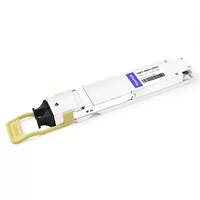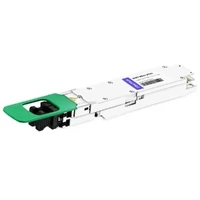

Introduction: Why AI Networks Need a New Optical Form Factor
For more than a decade, the evolution of data center optical interconnects has followed a simple principle: increase bandwidth while keeping the pluggable form factor compatible with existing systems.
This philosophy helped make OSFP (Octal Small Form-factor Pluggable) one of the most important optical module form factors in modern networking. With strong multi-vendor support, a mature supply chain, and adoption across 400G, 800G, and emerging 1.6T Ethernet deployments, OSFP has become a key building block for high-speed data center networks.
However, the rapid growth of AI infrastructure is creating a new challenge. Large-scale GPU clusters require dramatically higher bandwidth density, lower latency, and more efficient thermal management. As switch ASIC capacity moves toward hundreds of terabits per second, traditional air-cooled pluggable optics face increasing limitations in power consumption, cooling, and front-panel density.
This is where XPO (eXtra-dense Pluggable Optics) enters the discussion.
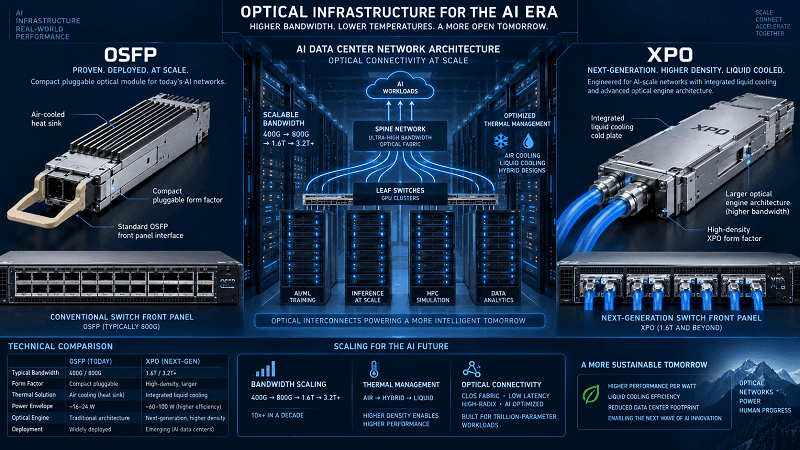
XPO is a new generation of liquid-cooled, high-density pluggable optical module architecture designed for AI data center networks. A 12.8T XPO module integrates high-speed optical engines, advanced power delivery, and liquid cooling technology into a larger pluggable package, targeting bandwidth densities beyond what conventional OSFP-based designs can efficiently support.
This article explains the differences between OSFP vs XPO, how liquid-cooled optical modules solve thermal limitations, and why next-generation AI networks may require new optical architectures.
OSFP’s Success — and the Thermal Challenge of AI Networking
OSFP has played a central role in the transition from 400G to 800G and toward 1.6T optical networking.
The success of OSFP comes from several advantages:
- Standardized pluggable architecture
- Broad ecosystem support
- Field replaceability
- Compatibility with multiple optical technologies
- Deployment flexibility across data center environments
A typical high-density switch platform can support dozens of OSFP ports in a 1U or multi-RU chassis, providing a practical balance between bandwidth, serviceability, and thermal management.
However, AI networking changes the design requirements.
Traditional data center networks were primarily optimized around:
- General cloud workloads
- Enterprise traffic
- Moderate bandwidth growth
AI clusters introduce:
- Thousands of GPUs
- Large-scale distributed training
- Massive east-west traffic
- High-radix switching architectures
- Continuous high utilization
As optical module speeds increase from 800G toward 1.6T and beyond, module power consumption also increases. In air-cooled environments, the challenge is no longer only signal integrity — it becomes a thermal density problem.
The limitation is not the OSFP connector itself, but the combination of:
- Optical engine power
- DSP consumption
- Front-panel airflow constraints
- Rack-level thermal budget
For next-generation AI fabrics, simply increasing the number of OSFP cages may create additional challenges in:
- Cooling infrastructure
- Switch chassis size
- Power delivery
- Data center floor space
Therefore, the industry is exploring new approaches that combine higher bandwidth density with advanced cooling technologies.
What Is XPO? The 12.8T Liquid-Cooled Pluggable Optical Module
XPO stands for eXtra-dense Pluggable Optics.
Unlike traditional OSFP modules that are optimized around air cooling and individual pluggable ports, XPO introduces a larger pluggable optical architecture designed specifically for AI networking environments.
A 12.8T XPO module is designed around:
- 64 electrical channels
- 200G per channel signaling
- 12.8Tbps aggregate bandwidth
- Integrated liquid cooling
- High-density optical engine integration
The XPO architecture was created to support AI networking scenarios including:
- Scale-up networks
- Scale-out Ethernet fabrics
- Scale-across architectures
- Metro-reach connectivity
The XPO MSA positions the technology as an open ecosystem approach rather than a single-vendor proprietary solution.
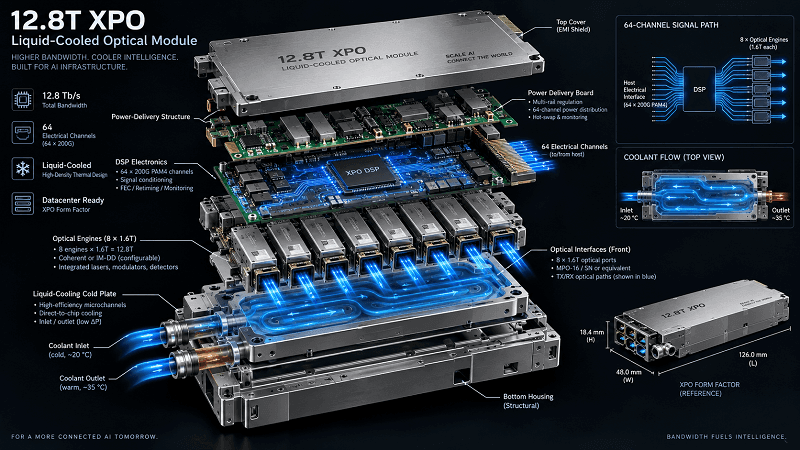
Inside the XPO Module Architecture
The key innovation of XPO is not only higher bandwidth, but the combination of optical density and thermal management.
A typical XPO design includes:
Integrated Liquid Cooling Cold Plate
Instead of relying only on chassis airflow, XPO incorporates a liquid cooling interface.
The integrated cold plate enables significantly higher thermal capacity compared with conventional air-cooled optical modules. Some XPO implementations target cooling capability of approximately hundreds of watts per module.
This allows optical engines, drivers, and high-speed electronics to operate in environments where air cooling becomes insufficient.
Multi-Channel Optical Engine Integration
A conventional 1.6T optical module is typically built around a limited number of high-speed electrical lanes.
XPO increases integration by combining multiple optical channels into a single high-density pluggable package.
A 12.8T XPO module can provide bandwidth equivalent to multiple 1.6T optical modules, reducing the number of individual optical connections required at the switch front panel.
Advanced Power Delivery Architecture
As optical module power increases, traditional motherboard power delivery becomes more challenging.
Future XPO-based systems may adopt higher-voltage rack-level power delivery approaches, reducing conversion losses and improving system-level efficiency.
This design philosophy moves some power management functions away from the host board and closer to the optical module infrastructure.
OSFP vs XPO: Density Comparison for Next-Generation AI Data Center Networks
The biggest difference between OSFP and XPO is not simply bandwidth per optical module. The real difference is how each architecture approaches the challenge of thermal density, front-panel bandwidth, and AI cluster scalability.
Traditional OSFP-based systems scale by increasing the number of pluggable ports. XPO takes a different approach by integrating more optical bandwidth, higher thermal capability, and liquid cooling into a single high-density pluggable module.
According to the XPO MSA specifications announced by Arista and ecosystem partners, a 12.8T XPO module uses 64 electrical lanes and targets significantly higher front-panel bandwidth density compared with traditional 1.6T OSFP solutions. The architecture is designed specifically for AI networking environments where bandwidth and cooling requirements continue to increase.
OSFP vs XPO: Key Technical Comparison
| Feature | 1.6T OSFP Optical Module | 12.8T XPO Optical Module |
| Form factor | OSFP pluggable | XPO high-density pluggable |
| Bandwidth per module | Up to 1.6Tbps | 12.8Tbps |
| Electrical interface | 8 channels | 64 channels |
| Cooling method | Primarily air cooling | Integrated liquid cooling |
| Thermal capability | Tens of watts typical | Hundreds of watts targeted |
| Deployment focus | General high-speed networking | AI-scale networking |
| Density approach | More ports | Higher bandwidth per module |
| Optical support | SR / DR / FR / LR / coherent solutions | Designed to support multiple optical architectures |
Bandwidth Density: Why XPO Changes AI Switch Design
A major challenge in AI networking is that switch bandwidth is growing faster than traditional physical interfaces.
For example:
- Next-generation Ethernet switches may provide hundreds of terabits per second of switching capacity.
- AI training clusters require extremely high bisection bandwidth.
- The number of optical connections can quickly become a limiting factor.
A conventional design using 1.6T OSFP modules requires many optical cages and corresponding cooling capacity.
A 12.8T XPO module provides the equivalent bandwidth capacity of multiple 1.6T optical modules.
The relationship can be simplified as:
1 × 12.8T XPO ≈ 8 × 1.6T OSFP bandwidth capacity
However, this does not mean the two modules have identical physical dimensions or interfaces. XPO achieves higher density through:
- More electrical lanes
- Higher integration
- Liquid cooling
- Optimized power delivery
Front-Panel Density: Moving Beyond the OSFP Limit
One of the most important advantages of XPO is improved front-panel bandwidth density.
Traditional OSFP-based switches are limited by:
- Number of physical cages
- Airflow requirements
- Module power consumption
- PCB routing complexity
XPO addresses these challenges by increasing bandwidth per pluggable position.
A high-density XPO implementation targets:
204.8Tbps bandwidth density per rack unit
which represents approximately a 4× improvement compared with 1.6T OSFP-based solutions according to XPO MSA announcements.
This improvement creates several system-level benefits:
- Fewer optical ports
- Reduced front-panel complexity
- Smaller switch systems
- Lower cable management requirements
- More efficient AI cluster scaling
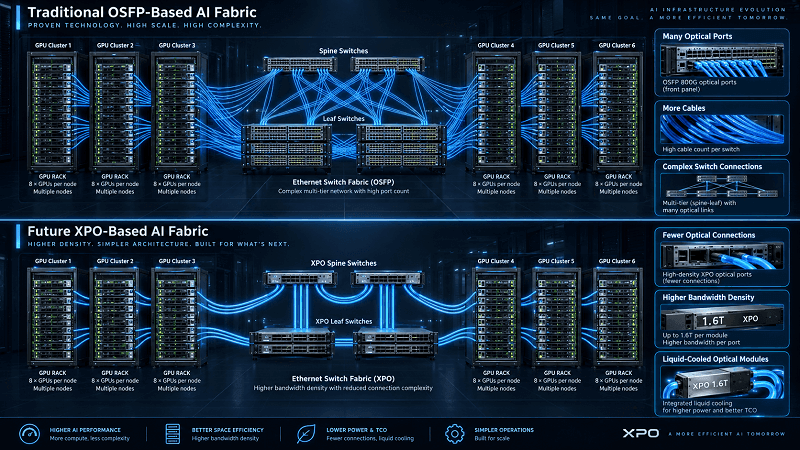
How XPO Improves AI Data Center Architecture
AI clusters are fundamentally different from traditional cloud networks.
A modern AI fabric requires:
- High bandwidth between GPUs
- Low latency communication
- Large-scale east-west traffic
- Predictable performance under continuous load
Optical interconnects become one of the largest contributors to:
- Power consumption
- Rack density
- System complexity
By increasing optical density, XPO can help reduce the number of switching elements required in large AI fabrics.
A simplified example:
Traditional OSFP-Based Architecture
A large AI cluster may require:
- More switch ports
- More optical modules
- More cable connections
- More cooling capacity
XPO-Based Architecture
The same network capacity can potentially be achieved with:
- Higher-density optical modules
- Fewer front-panel connections
- Improved thermal management
- Reduced system footprint
The actual savings depend on:
- Network topology
- Oversubscription ratio
- Switch generation
- Optical reach requirements
Therefore, XPO should be evaluated as a system architecture improvement rather than only a transceiver replacement.
Liquid Cooling: The Key Technology Behind XPO
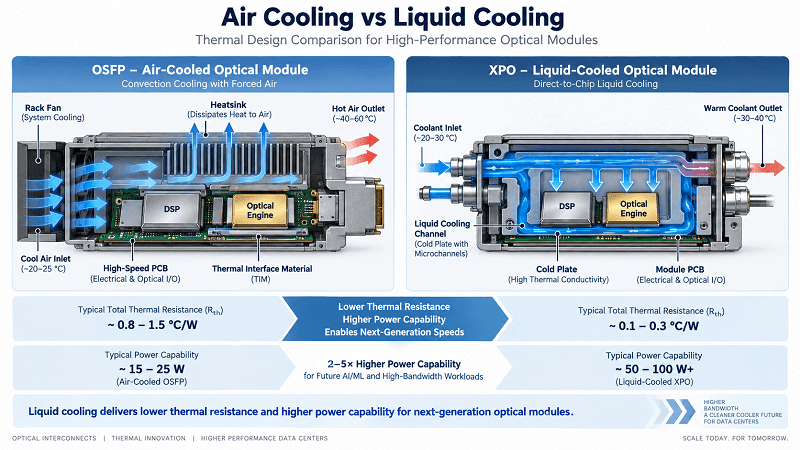
The biggest limitation of future optical modules is not bandwidth — it is heat.
A conventional air-cooled optical module must dissipate heat through:
- Heat sinks
- Fans
- Chassis airflow
As optical engines become more powerful, airflow becomes increasingly inefficient.
XPO introduces an integrated liquid cooling approach using a cold plate.
The cold plate directly removes heat from high-power components, including:
- Optical engines
- Laser drivers
- DSP components
- Retiming electronics
The XPO architecture targets cooling capability in the hundreds-of-watts range per module, with public specifications indicating cold-plate capability around 400W.
This enables future optical modules to move beyond the thermal limits of traditional pluggable optics.
XPO Optical Reach and Technology Flexibility
Another important design goal of XPO is flexibility.
Rather than defining a single optical technology, XPO is designed as a high-density optical platform capable of supporting different transmission technologies.
Potential applications include:
| Reach | Technology Example |
| Short reach | DAC / AEC / copper interconnect |
| Medium reach | VCSEL multimode solutions |
| Data center reach | DR / FR / LR optical modules |
| Metro reach | Coherent solutions |
| Long distance | Coherent ZR technologies |
XPO is designed to support optical standards including:
- SR
- DR
- FR
- LR
- ZR/ZR+
- Coherent-lite solutions
- Copper and RF microwave approaches
This flexibility allows network architects to select the most appropriate interconnect technology based on:
- Distance
- Power efficiency
- Cost
- Latency requirements
OSFP vs XPO: Which One Will Win?
OSFP will continue to play an important role in mainstream networking.
Advantages of OSFP:
- Mature ecosystem
- Broad vendor support
- Existing infrastructure compatibility
- Easier deployment today
However, AI infrastructure is pushing networking toward a new design point.
XPO addresses challenges that become increasingly important in large AI clusters:
- Extreme bandwidth density
- High optical module power
- Thermal limitations
- Rack-level scaling
The future AI data center may not replace OSFP overnight. Instead, the industry is likely to see multiple optical architectures coexist:
- OSFP for conventional 400G/800G/1.6T deployments
- XPO for ultra-high-density AI fabrics
- CPO and optical engine solutions for specific future architectures
Power, Reliability, and Thermal Design of XPO Optical Modules
As AI data centers continue to scale, optical interconnect power consumption has become one of the most important design challenges.
The transition from 400G to 800G and 1.6T optical modules has increased bandwidth dramatically, but it has also increased:
- Optical engine power
- DSP power consumption
- Cooling requirements
- Rack-level energy demand
For traditional air-cooled pluggable optics, thermal management becomes increasingly difficult as module power rises.
XPO addresses this challenge by combining:
- High-density optical integration
- Liquid cooling
- Advanced power delivery
- Pluggable serviceability
The goal is not simply to create a faster optical module, but to build a scalable optical architecture for future AI networking systems. XPO specifications highlight an integrated cold plate design capable of supporting cooling for module power levels around hundreds of watts, including up to approximately 400W in announced implementations.
Liquid Cooling: Breaking the Optical Module Thermal Barrier
Traditional optical modules rely on airflow through the switch chassis.
The thermal path is:
Optical module → Heat sink → Airflow → Chassis cooling system
This approach works well for conventional networking, but becomes increasingly challenging for AI clusters where:
- More bandwidth is required per switch
- More optical engines operate simultaneously
- Rack power density continues increasing
XPO changes the thermal design by introducing an integrated liquid cooling interface.
The thermal path becomes:
Optical engine → Cold plate → Liquid cooling loop → Facility cooling system
This provides several advantages:
Higher Thermal Capacity
Liquid cooling transfers heat more efficiently than air cooling, enabling higher-power optical architectures.
Improved Port Density
Higher module power no longer requires excessive airflow space around each optical port.
More Flexible System Design
Switch manufacturers can design higher-density systems without being limited by traditional front-panel thermal constraints.
Power Delivery: Moving Toward AI-Optimized Infrastructure
As optical bandwidth increases, power delivery becomes another important consideration.
Traditional optical systems typically rely on:
- Motherboard power distribution
- On-board voltage regulation
- Local DC conversion
Future AI networking architectures may adopt alternative power delivery approaches, including higher-voltage rack-level power distribution.
Potential benefits include:
- Lower power conversion losses
- Reduced PCB complexity
- Improved system efficiency
- More scalable power delivery for high-density optics
The exact implementation depends on switch architecture and system design, but the trend is clear:
AI networking requires optical modules and power systems to evolve together.
Reliability Improvements Through Thermal Management
Temperature is one of the major factors affecting electronic component reliability.
Higher operating temperatures can increase:
- Component aging
- Optical degradation
- Electrical stress
- Failure probability
By reducing thermal stress through liquid cooling, XPO-based systems may improve long-term reliability.
Potential reliability benefits include:
- Lower operating temperatures
- Reduced thermal cycling
- Fewer high-power components exposed to extreme conditions
- More stable optical performance
However, actual reliability improvements depend on:
- Module design
- Cooling infrastructure quality
- Manufacturing process
- System operating environment
Therefore, XPO should be viewed as an architecture that enables improved thermal conditions rather than a guaranteed failure-rate reduction.
The XPO MSA Ecosystem: Building an Open Optical Platform
A new optical form factor succeeds only when supported by a broad ecosystem.
The history of optical networking shows that successful technologies require:
- Multiple module suppliers
- Switch vendor adoption
- Standardized specifications
- Manufacturing scalability
The XPO MSA (Multi-Source Agreement) was created to establish an industry-wide ecosystem for high-density liquid-cooled pluggable optics.
The announced XPO ecosystem includes optical module manufacturers and technology partners working on:
- 12.8T liquid-cooled optical modules
- High-speed optical engines
- AI data center interconnect solutions
XPO was introduced as a multi-source approach rather than a single-company proprietary technology.
This ecosystem approach is important because data center operators typically require:
- Supply chain flexibility
- Multiple vendor options
- Long-term product availability
- Competitive pricing
Future Roadmap: From 12.8T Toward Higher Bandwidth
The first generation of XPO focuses on:
- 12.8Tbps module bandwidth
- 64-channel electrical interfaces
- Liquid cooling integration
Future generations may evolve toward:
- Higher lane speeds
- 400G per electrical channel
- 25.6T-class optical modules
- Greater AI fabric density
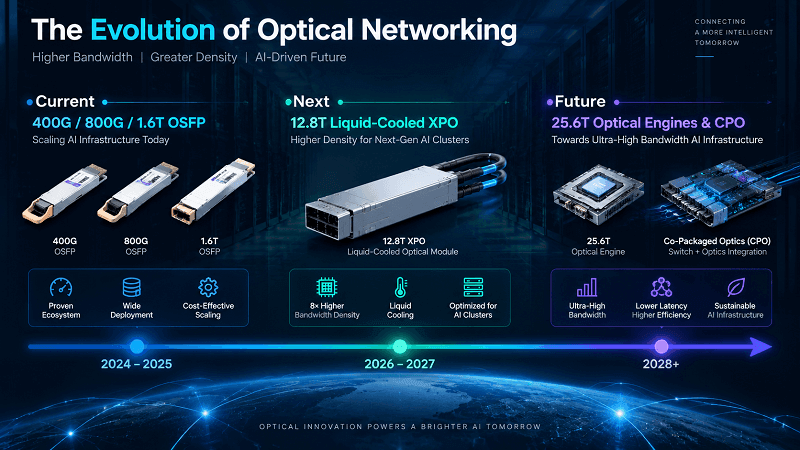
As AI workloads continue expanding, optical networking will likely move through several technology stages:
Current Generation
400G / 800G / 1.6T OSFP
Optimized for:
- Cloud networking
- Enterprise data centers
- Early AI clusters
Next Generation
12.8T XPO
Optimized for:
- Large AI training clusters
- High-density Ethernet fabrics
- Liquid-cooled data centers
Future Generation
Higher-density optical engines and co-packaged architectures
Optimized for:
- Extremely large AI factories
- Exascale computing systems
Five Key Takeaways: OSFP vs XPO
XPO Targets the Next AI Networking Density Level
OSFP remains the dominant pluggable optical form factor today, but XPO introduces a new approach for extreme AI bandwidth requirements.
A 12.8T XPO module provides bandwidth equivalent to multiple 1.6T OSFP modules, significantly increasing optical density.
Liquid Cooling Enables Higher-Power Optical Modules
The main innovation of XPO is not only bandwidth — it is thermal management.
Integrated liquid cooling allows optical modules to operate at power levels beyond traditional air-cooled designs.
XPO Improves AI Data Center Front-Panel Density
By increasing bandwidth per module, XPO reduces the number of optical ports required for large AI networks.
This can simplify:
- Switch design
- Cable management
- Rack deployment
- Cooling infrastructure
XPO Supports Multiple Optical Technologies
XPO is designed as a flexible optical platform supporting different interconnect approaches, including:
- SR
- DR
- FR
- LR
- ZR/ZR+
- Coherent solutions
- Copper and RF microwave technologies
OSFP and XPO Will Likely Coexist
OSFP will continue serving many mainstream networking applications because of its mature ecosystem and widespread deployment.
XPO is positioned for environments where:
- Bandwidth density is the highest priority
- Cooling becomes a limiting factor
- AI workloads require extreme scale
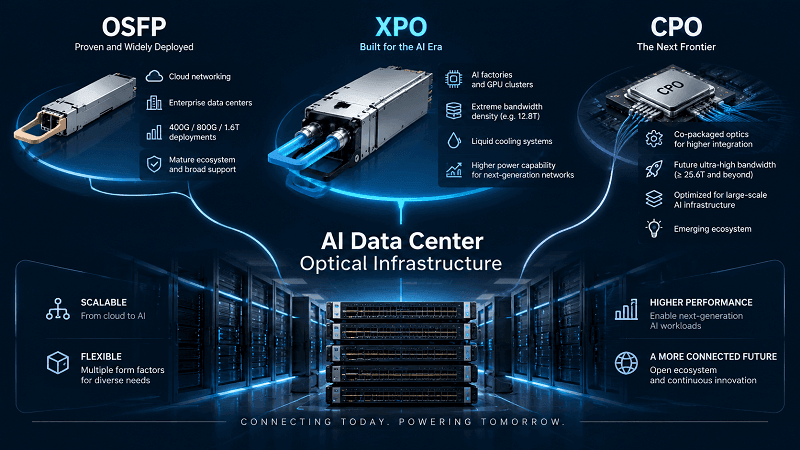
The future data center optical landscape will likely include multiple form factors optimized for different workloads.
Frequently Asked Questions (FAQ)
What is OSFP in optical networking?
OSFP (Octal Small Form-factor Pluggable) is a high-speed optical module form factor widely used for 400G, 800G, and 1.6T Ethernet applications.
It provides a standardized pluggable interface supported by a large optical ecosystem.
What is XPO optical module?
XPO (eXtra-dense Pluggable Optics) is a high-density liquid-cooled optical module architecture designed for AI data center networking.
A 12.8T XPO module uses 64 electrical channels and integrates liquid cooling technology to support higher bandwidth density.
What is the difference between OSFP and XPO?
The main differences are:
| OSFP | XPO | |
| Primary design goal | High-speed general networking | AI-scale optical density |
| Bandwidth | Up to 1.6T class | 12.8T class |
| Cooling | Mainly air cooling | Liquid cooling |
| Density | Traditional pluggable density | Higher bandwidth per module |
| Application | Cloud and enterprise networks | Large AI data centers |
Is XPO replacing OSFP?
Not immediately.
OSFP will continue to be used for many networking applications.
XPO is designed for future AI infrastructure where traditional optical module density and thermal limits become challenging.
Why does AI networking need liquid-cooled optical modules?
AI clusters require enormous bandwidth between GPUs and switches.
As optical module bandwidth increases, power consumption also increases.
Liquid cooling helps remove heat more efficiently, enabling higher-density optical interconnect architectures.
Related Products:
-
 NVIDIA MMA4Z00-NS Compatible 800GBASE 2 x SR4/SR8 OSFP PAM4 850nm 100m DOM Dual MPO-12 MMF Optical Transceiver Module
$550.00
-
NVIDIA MMA4Z00-NS-FLT Compatible 800GBASE 2 x SR4/SR8 OSFP RHS/Flat Top PAM4 850nm 100m DOM Dual MPO-12 MMF Optical Transceiver Module
$600.00
-
NVIDIA MMS4X00-NM Compatible 800GBASE 2 x DR4/DR8 OSFP IHS/Closed Finned Top PAM4 1310nm 500m DOM Dual MTP/MPO-12 SMF Optical Transceiver Module
$600.00
-
NVIDIA MMS4X00-NM-FLT Compatible 800GBASE 2 x DR4/DR8 OSFP Flat Top PAM4 1310nm 500m DOM Dual MTP/MPO-12 SMF Optical Transceiver Module
$650.00
-
NVIDIA MMS4X50-NM Compatible 800G 2x FR4 OSFP IHS/Closed Finned Top PAM4 1310nm 2km DOM Dual Duplex LC SMF InfiniBand NDR Optical Transceiver Module
$1000.00
-
NVIDIA MMA4Z00-NS400 Compatible 400G OSFP SR4 Flat Top PAM4 850nm 30m on OM3/50m on OM4 MTP/MPO-12 Multimode FEC Optical Transceiver Module
$400.00
-
NVIDIA MMS4X00-NS400 Compatible 400G OSFP DR4 Flat Top PAM4 1310nm MTP/MPO-12 500m SMF FEC Optical Transceiver Module
$450.00
-
NVIDIA MMA1Z00-NS400 Compatible 400G QSFP112 VR4 PAM4 850nm 50m MTP/MPO-12 OM4 FEC Optical Transceiver Module
$385.00
-
NVIDIA MMS1X00-NS400 Compatible 400G NDR QSFP112 DR4 PAM4 1310nm 500m MPO-12 with FEC Optical Transceiver Module
$500.00
-
OSFP-400G-DR4-FLT 400G OSFP DR4 Flat Top PAM4 1310nm MTP/MPO-12 500m SMF FEC Optical Transceiver Module
$450.00