


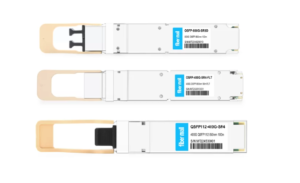
800G SR8 and 400G SR4 Optical Transceiver Modules Compatibility and Interconnection Test Report
Version Change Log Writer V0 Sample Test Cassie Test Purpose Test Objects:800G OSFP SR8/400G OSFP SR4/400G Q112 SR4. By conducting corresponding tests, the test parameters meet the relevant industry standards,

Unveiling Google’s TPU Architecture: OCS Optical Circuit Switching – The Evolution Engine from 4x4x4 Cube to 9216-Chip Ironwood
What makes Google’s TPU clusters stand out in the AI supercomputing race? How has the combination of 3D Torus topology and OCS (Optical Circuit Switching) technology enabled massive scaling while
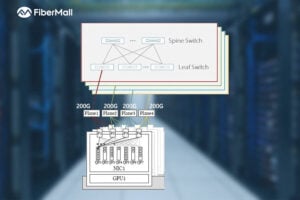
Dual-Plane and Multi-Plane Networking in AI Computing Centers
In the previous article, we discussed the differences between Scale-Out and Scale-Up. Scale-Up refers to vertical scaling by increasing the number of GPU/NPU cards within a single node to enhance individual node
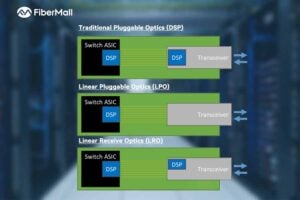
OCP 2025: FiberMall Showcases Advances in 1.6T and Higher DSP, LPO/LRO, and CPO Technologies
The rapid advancement of artificial intelligence (AI) and machine learning is driving an urgent demand for higher bandwidth in data centers. At OCP 2025, FiberMall delivered multiple presentations highlighting its
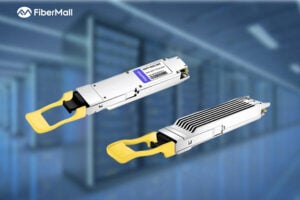
What is a Silicon Photonics Optical Module?
In the rapidly evolving world of data communication and high-performance computing, silicon photonics optical modules are emerging as a groundbreaking technology. Combining the maturity of silicon semiconductor processes with advanced photonics,

Key Design Principles for AI Clusters: Scale, Efficiency, and Flexibility
In the era of trillion-parameter AI models, building high-performance AI clusters has become a core competitive advantage for cloud providers and AI enterprises. This article deeply analyzes the unique network
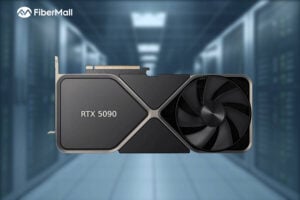
Google TPU vs NVIDIA GPU: The Ultimate Showdown in AI Hardware
In the world of AI acceleration, the battle between Google’s Tensor Processing Unit (TPU) and NVIDIA’s GPU is far more than a spec-sheet war — it’s a philosophical clash between custom-designed ASIC (Application-Specific