

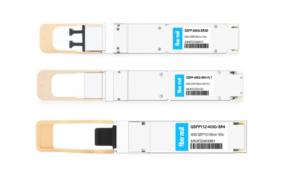
Are There Any 100G Transceivers That Allow the Use of Standard Duplex Multi-Mode Fiber?

Picture of Harry Collins

Harry Collins

Answered on 6:34 am

Yes, there are some 100G transceivers that allow the use of standard duplex multi-mode fiber. For example, the 100G BiDi (Bidirectional) transceivers use a single fiber to transmit and receive data at full-duplex 50Gb/s, and can support distances up to 70m over OM3 or 100m over OM4 fiber. Another example is the 100G SWDM4 (Short Wavelength Division Multiplexing) transceivers, which use four wavelengths to multiplex data over a single fiber, and can support distances up to 70m over OM3 or 100m over OM4 fiber. Both types of transceivers have LC duplex connectors, which are compatible with the standard multi-mode fiber infrastructure.

People Also Ask

What Is USFP? The 400G-per-Lane Optical Module, Explained

USFP (Ultra-Dense Small Form Factor Pluggable) is a next-generation optical transceiver form factor being developed by NVIDIA and Cisco. It is designed to be the first pluggable optics form factor to support 400 Gb/s per electrical lane. Announced at the OCP Global Summit in October 2026, the initial design features

DWDM Mux Demux: Types, Channel Spacing & Selection Guide

A DWDM link may fail to establish even when the transceivers are correctly matched and the fiber is clean. One possible cause lies between them: a passive DWDM mux demux with an incompatible channel plan, excessive insertion loss, or an incorrectly paired single-fiber configuration. Channel count is often the first

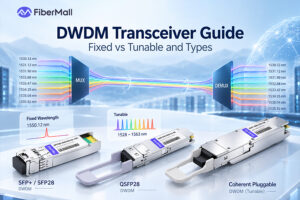
DWDM Transceiver Guide: Fixed vs Tunable and Types

Some DWDM link failures begin before anyone touches a fiber. Consider a hypothetical case: a regional operator adds a 10G wavelength to an active 40-channel C-band MUX. The optics support the right data rate, and their specified reach appears sufficient for the span. Yet the circuit stays down. The transceiver

How RoCE Switches Build an End-to-End Lossless Network for RDMA

As AI clusters expand from hundreds to thousands of GPUs, network performance has become a critical factor in distributed training efficiency. High-speed Ethernet networks must deliver more than raw bandwidth. They also need predictable latency, effective congestion control, and reliable transport for RDMA traffic. Remote Direct Memory Access (RDMA) enables

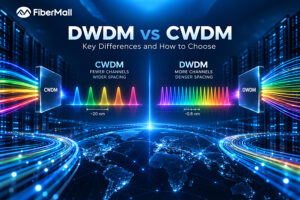
DWDM vs CWDM: Key Differences and How to Choose

One of the fundamental differences between DWDM and CWDM is how far apart their optical wavelengths are spaced. CWDM uses a channel spacing of 20 nanometers. DWDM packs channels much more closely, commonly using 100 GHz or 50 GHz spacing—approximately 0.8 nm or 0.4 nm near 1550 nm. This difference

DWDM Complete Guide: Dense Wavelength Division Multiplexing

A metro fiber route between two data centers can reach its capacity limit faster than expected. When it does, the immediate response may be to deploy additional fiber. However, installing new fiber infrastructure can take months or even years and may cost more than the networking equipment at both ends.

Related Articles

800g sr8 and 400g sr4

800G SR8 and 400G SR4 Optical Transceiver Modules Compatibility and Interconnection Test Report

Version Change Log Writer V0 Sample Test Cassie Test Purpose Test Objects:800G OSFP SR8/400G OSFP SR4/400G Q112 SR4. By conducting corresponding tests, the test parameters meet the relevant industry standards, and the test modules can be normally used for Nvidia (Mellanox) MQM9790 switch, Nvidia (Mellanox) ConnectX-7 network card and Nvidia (Mellanox) BlueField-3, laying a foundation for

Read More »
usfp

What Is USFP? The 400G-per-Lane Optical Module, Explained

USFP (Ultra-Dense Small Form Factor Pluggable) is a next-generation optical transceiver form factor being developed by NVIDIA and Cisco. It is designed to be the first pluggable optics form factor to support 400 Gb/s per electrical lane. Announced at the OCP Global Summit in October 2026, the initial design features

Read More »
DWDM mux demux

DWDM Mux Demux: Types, Channel Spacing & Selection Guide

A DWDM link may fail to establish even when the transceivers are correctly matched and the fiber is clean. One possible cause lies between them: a passive DWDM mux demux with an incompatible channel plan, excessive insertion loss, or an incorrectly paired single-fiber configuration. Channel count is often the first
Read More »
dwdm

DWDM Transceiver Guide: Fixed vs Tunable and Types

Some DWDM link failures begin before anyone touches a fiber. Consider a hypothetical case: a regional operator adds a 10G wavelength to an active 40-channel C-band MUX. The optics support the right data rate, and their specified reach appears sufficient for the span. Yet the circuit stays down. The transceiver

Read More »
RoCE

How RoCE Switches Build an End-to-End Lossless Network for RDMA

As AI clusters expand from hundreds to thousands of GPUs, network performance has become a critical factor in distributed training efficiency. High-speed Ethernet networks must deliver more than raw bandwidth. They also need predictable latency, effective congestion control, and reliable transport for RDMA traffic. Remote Direct Memory Access (RDMA) enables
Read More »
DWDM vs CWDM

DWDM vs CWDM: Key Differences and How to Choose

One of the fundamental differences between DWDM and CWDM is how far apart their optical wavelengths are spaced. CWDM uses a channel spacing of 20 nanometers. DWDM packs channels much more closely, commonly using 100 GHz or 50 GHz spacing—approximately 0.8 nm or 0.4 nm near 1550 nm. This difference
Read More »
dwdm

DWDM Complete Guide: Dense Wavelength Division Multiplexing

A metro fiber route between two data centers can reach its capacity limit faster than expected. When it does, the immediate response may be to deploy additional fiber. However, installing new fiber infrastructure can take months or even years and may cost more than the networking equipment at both ends.

Read More »
Scroll to Top