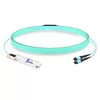
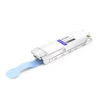
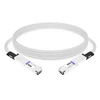
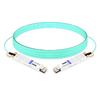
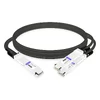
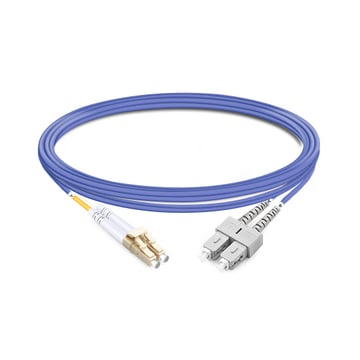
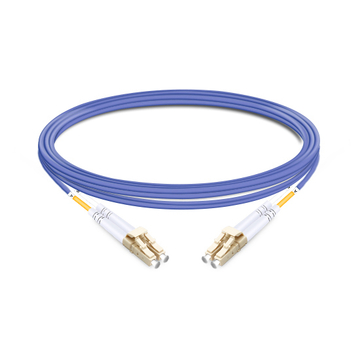
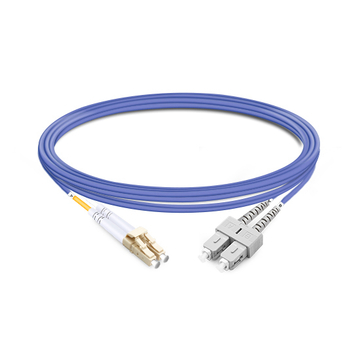
OM4 Multimode Fiber Patch Cords
OM4 multimode fiber patch cords are engineered for high-speed networks, supporting 40G/100G transmission and extended-reach 10G applications. Featuring low insertion loss and high bandwidth, they are ideal for high-density cabling in data centers, server rooms, and enterprise networks. Their stable, reliable performance supports seamless network upgrades and efficient data transmission.
The Problem With Most OM4 Fiber Cables
A reliable 40G/100G link depends on the quality of its multimode fiber cabling. A cable labeled "OM4" should meet the required laser-optimized bandwidth specifications, but labeling alone cannot verify compliance. If the fiber, connectors, or installation fail to meet the required performance standards, even a link designed for a 150-meter reach may experience transmission errors. FiberMall emphasizes clearly specified fiber performance and quality testing to help customers build reliable high-speed connections.
OM4 is often treated as a commodity, but its performance specifications matter. A compliant OM4 cable uses 50/125 µm laser-optimized multimode fiber (LOMMF) with a minimum effective modal bandwidth (EMB) of 4700 MHz·km at 850 nm. This bandwidth supports high-speed VCSEL-based optical transmission and enables applications such as 40GBASE-SR4 and 100GBASE-SR10 to reach up to 150 meters under their respective IEEE specifications.
However, bandwidth alone does not guarantee link performance. Connector insertion loss, fiber attenuation, installation quality, and the optical transceiver's link budget must also be considered. Cables that lack verified optical performance may introduce excessive loss or signal degradation, particularly in longer or higher-speed connections.
Then there is the OM3-versus-OM4-versus-OM5 question. All three use 50/125 µm laser-optimized multimode fiber and support compatible multimode optical transceivers. The primary differences lie in bandwidth, supported transmission distance, and wavelength capabilities.
For standard 10GBASE-SR applications, OM3 supports up to 300 meters, while OM4 supports up to 400 meters under IEEE specifications. Certain extended-reach 10G optical transceivers can support up to 550 meters over OM4, depending on the manufacturer's specifications.
For 40GBASE-SR4, OM3 supports up to 100 meters and OM4 up to 150 meters. For 100GBASE-SR4, the IEEE 802.3bm specification supports up to 70 meters over OM3 and 100 meters over OM4, while 100GBASE-SR10 supports up to 100 meters over OM3 and 150 meters over OM4.
OM5 provides additional wavelength capabilities for short-wavelength division multiplexing (SWDM), but generally offers no reach advantage over OM4 for conventional 850 nm parallel-optics applications.
For many data center deployments, OM4 offers an excellent balance of bandwidth, transmission distance, and cost. Understanding these differences helps customers avoid paying for unnecessary OM5 capabilities or selecting OM3 for links that require greater reach.
OM4 Fiber Cable Specifications
OM4 is a laser-optimized 50/125 µm multimode fiber designed for high-speed optical transmission. It is commonly supplied with an aqua jacket, while Erika violet is also used to distinguish OM4 from OM3. OM4 is optimized for 850 nm VCSEL-based transceivers and supports short-reach parallel-optics applications as well as extended 10G connections.
The key technical specifications of OM4 multimode fiber patch cords include:
· Core/Cladding Diameter: 50/125 µm, providing compatibility with standard 50 µm multimode optical systems.
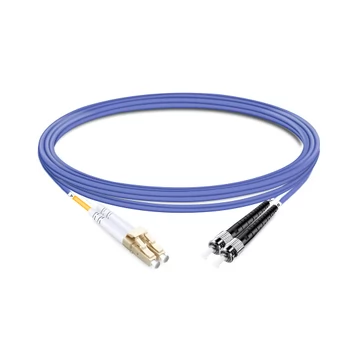
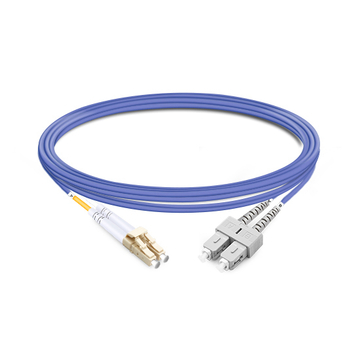
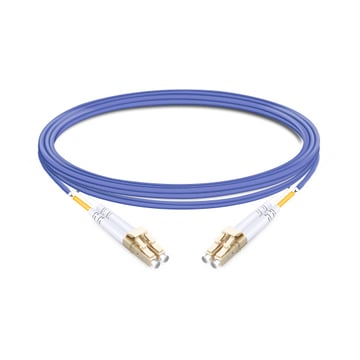
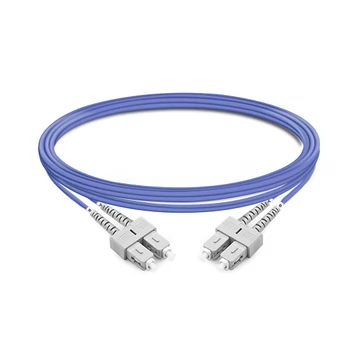
· Jacket Color: Aqua or Erika violet. Both colors are used for OM4 identification, depending on the manufacturer's labeling convention and applicable cabling standards.
· Effective Modal Bandwidth at 850 nm: ≥ 4700 MHz·km, supporting high-speed laser-optimized transmission.
· Fiber Attenuation at 850 nm: ≤ 3.0 dB/km under commonly referenced OM4 cabling specifications.
· Fiber Attenuation at 1300 nm: ≤ 1.5 dB/km.
· Typical Light Source: 850 nm VCSEL (Vertical-Cavity Surface-Emitting Laser).
· Connector Insertion Loss: Typically ≤ 0.3 dB per mated connector pair for standard low-loss assemblies, subject to the connector grade and test conditions.
· Connector Return Loss: Typically ≥ 30 dB for multimode PC/UPC connector assemblies, depending on connector construction and test conditions.
· Bend Radius: Bend-insensitive OM4 fiber may support bend radii as small as 7.5 mm under specified macrobending test conditions. The minimum installation bend radius of the complete patch cord depends on its cable construction and manufacturer specifications.
· Applicable Standards: IEC 60793-2-10 (OM4 fiber category), ANSI/TIA-492AAAD, ISO/IEC 11801, and relevant IEEE 802.3 Ethernet application standards.
Supported Reach
OM4 supports different transmission distances depending on the Ethernet standard, optical transceiver, and overall channel performance.
· 1 Gbps (1000BASE-SX): Supports at least 550 meters over compatible multimode fiber systems. Longer distances may be supported depending on transceiver specifications and the available link budget.
· 10 Gbps (10GBASE-SR): Supports up to 400 meters under IEEE specifications. Some extended-reach 10G transceivers support up to 550 meters over OM4.
· 25 Gbps (25GBASE-SR): Supports up to 100 meters over OM4.
· 40 Gbps (40GBASE-SR4): Supports up to 150 meters over OM4 using parallel optical transmission.
· 100 Gbps (100GBASE-SR4): Supports up to 100 meters over OM4 under IEEE 802.3bm. Supported reach should be verified against the specific transceiver standard and implementation.
· 100 Gbps (100GBASE-SR10): Supports up to 150 meters over OM4 using ten transmit and ten receive optical lanes.
These distances apply to complete optical channels, not individual patch cords alone. Actual supported reach depends on the transceiver specifications, total channel insertion loss, connector quality, fiber characteristics, and installation conditions.
For connections beyond the supported multimode distances, OS2 single-mode fiber is generally the preferred solution for 10G and higher-speed transmission over kilometer-scale links. For shorter 10G connections of 300 meters or less, OM3 multimode fiber can be a cost-effective alternative.
Connector and Jacket Options
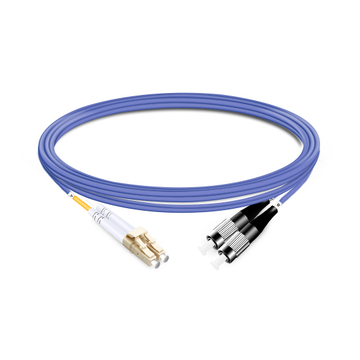
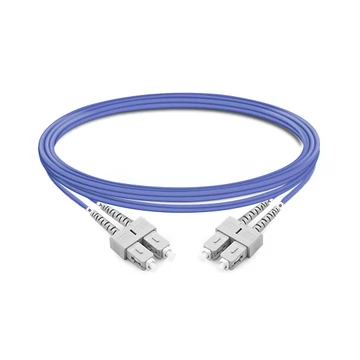
FiberMall offers OM4 duplex fiber patch cords in a variety of connector combinations commonly used in data centers, server rooms, and enterprise networks. Different cable jacket options are available to meet installation and environmental requirements.
· Connectors: LC-LC, LC-SC, LC-ST, LC-FC, SC-SC, and SC-ST configurations are available for different equipment interfaces. Precision zirconia ceramic ferrules help provide consistent alignment, low insertion loss, and reliable optical connections.
· PVC (OFNR): Riser-rated PVC cable is suitable for indoor vertical pathways and other locations where OFNR-rated cabling is permitted by applicable building and fire codes.
· LSZH: Low-smoke zero-halogen jackets reduce smoke emission and halogen-containing gas release during combustion. They are suitable for installations where these properties are required or preferred, subject to local fire-safety regulations.
· OFNP: Plenum-rated cable is designed for use in environmental air-handling spaces where plenum-rated cabling is required by applicable codes.
Selecting the appropriate connector combination and jacket material helps ensure equipment compatibility, installation flexibility, and compliance with relevant building requirements.
Aqua or Erika Violet? How to Identify OM4
OM4 was originally introduced with the same aqua jacket color commonly used for OM3 fiber, making the two fiber grades difficult to distinguish by appearance alone.
Erika violet was subsequently introduced as an alternative identification color for OM4, helping differentiate it from OM3 in high-density cabling environments. However, aqua remains widely used for OM4 patch cords, and jacket color alone should not be considered proof of fiber grade.
FiberMall offers OM4 patch cords in aqua and Erika violet options. Customers should verify the OM4 designation through the cable jacket markings, product specifications, and relevant test documentation.
The most important identification characteristic is compliance with OM4 optical performance requirements, particularly the minimum 4700 MHz·km effective modal bandwidth at 850 nm.
Why the Ferrule Matters
Connector ferrule quality directly affects insertion loss, alignment stability, and long-term connection reliability.
Low-quality ferrules or poorly assembled connectors may introduce excessive insertion loss, inconsistent optical alignment, or performance degradation after repeated mating and unmating.
FiberMall OM4 patch cords use precision zirconia ceramic ferrules designed to maintain accurate fiber alignment and consistent optical performance. Proper connector polishing and assembly help minimize insertion loss and maintain reliable connections during normal operation.
For standard multimode PC/UPC connectors, return loss values of 30 dB or better are commonly specified, while insertion-loss performance depends on connector quality and manufacturing tolerances.
Connector durability and insertion-loss repeatability should be verified according to the applicable product specifications and test conditions. Where required, qualified assemblies can be evaluated through repeated mating-cycle testing to assess long-term performance.
By using quality ferrules and controlled assembly processes, FiberMall OM4 patch cords are designed to provide reliable connectivity in frequently maintained data center and enterprise environments.
OM4 vs OM3 vs OM5: When OM4 Is the Right Choice
The most useful thing a fiber supplier can do is help customers select the appropriate fiber grade for their network requirements, even when OM4 is not the most economical choice.
OM2, OM3, OM4, and OM5 are multimode fiber categories with different bandwidth characteristics and application capabilities. Understanding their differences helps optimize network performance and cabling costs.
OM2 Multimode Fiber
OM2 uses a 50/125 µm core/cladding structure with a minimum overfilled launch bandwidth of 500 MHz·km at 850 nm. It is typically identified by an orange jacket and is primarily used in legacy enterprise networks and Gigabit Ethernet installations.
For 10GBASE-SR applications, OM2 generally supports only short distances of approximately 82 meters. It is not the preferred option for modern 40G/100G parallel-optics deployments.
OM3 Multimode Fiber
OM3 uses a 50/125 µm laser-optimized fiber with a minimum effective modal bandwidth of 2000 MHz·km at 850 nm. It is typically identified by an aqua jacket.
OM3 supports 10GBASE-SR up to 300 meters, 40GBASE-SR4 up to 100 meters, and 100GBASE-SR4 up to 70 meters under IEEE 802.3bm.
It is a cost-effective option for short-distance 10G links and 40G/100G connections that remain within the supported channel limits.
OM4 Multimode Fiber
OM4 provides a minimum effective modal bandwidth of 4700 MHz·km at 850 nm, offering higher bandwidth and longer supported transmission distances than OM3.
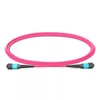
It is commonly supplied with aqua or Erika violet jackets.
OM4 supports standard 10GBASE-SR applications up to 400 meters, with certain extended-reach 10G transceivers supporting up to 550 meters. It also supports 40GBASE-SR4 and 100GBASE-SR10 up to 150 meters, and IEEE 802.3bm 100GBASE-SR4 up to 100 meters.
OM4 is particularly suitable for data center networks requiring higher bandwidth, reliable short-reach optical connectivity, and additional transmission-distance headroom.
OM5 Multimode Fiber
OM5 is a wideband multimode fiber (WBMMF) designed to support transmission across a wider wavelength range.
It provides a minimum effective modal bandwidth of 4700 MHz·km at 850 nm and 2470 MHz·km at 953 nm, enabling additional wavelength-multiplexing capabilities.
OM5 is typically identified by a lime-green jacket and is particularly useful for short-wavelength division multiplexing (SWDM) applications.
For conventional 850 nm parallel-optics Ethernet applications, OM5 generally offers the same standardized reach as OM4. Its main advantage is support for additional wavelength-based transmission technologies rather than longer reach for every optical interface.
Which Fiber Grade Should You Choose?
Choose OM4 when your network requires 40GBASE-SR4, 100GBASE-SR4, or 100GBASE-SR10 connections that benefit from OM4's higher bandwidth and supported transmission distances. OM4 is also suitable for 10G links beyond the standard 300-meter OM3 limit.
For many modern data center networks, OM4 provides an excellent balance of transmission performance, scalability, and overall cabling cost.
Choose OM3 when your 10G connections are 300 meters or shorter, or when your 40G/100G applications operate within the supported OM3 channel limits. OM3 can provide comparable application performance at a lower initial cabling cost when additional OM4 reach is unnecessary.
Choose OM5 when your network is designed for short-wavelength division multiplexing across the 850–953 nm wavelength range or requires specific wideband multimode applications.
For conventional 850 nm parallel optics, OM5 does not generally provide a transmission-distance advantage over OM4 and may add unnecessary cost.
Applications: Where OM4 Fiber Cables Are Used
OM4 fiber patch cords are widely used in modern high-speed networks where bandwidth, connection density, and reliable transmission are essential.
· 40G and 100G Parallel Optics: OM4 supports high-speed applications such as 40GBASE-SR4, 100GBASE-SR4, and 100GBASE-SR10. Depending on the interface, these applications use MPO/MTP-based parallel fiber cabling with supported reaches of up to 100 or 150 meters over OM4. Duplex OM4 patch cords can also be used with appropriate breakout or structured cabling configurations.
· Extended 10G Links: OM4 supports standard 10GBASE-SR transmission up to 400 meters, making it suitable for links beyond OM3's 300-meter limit. Certain extended-reach optical modules may support distances up to 550 meters, subject to equipment specifications.
· Data Center Server-to-Switch Links: OM4 duplex patch cords connect servers, top-of-rack switches, aggregation switches, and patch panels using compatible 10GBASE-SR and 25GBASE-SR optical transceivers.
· Enterprise Backbone Risers: OM4 supports high-bandwidth connections between network distribution areas, equipment rooms, and building floors. Appropriate LSZH, OFNR, or OFNP jacket options can be selected according to installation requirements and applicable safety codes.
· Storage Area Networks (SAN): OM4 supports Fibre Channel optical connectivity, including 16G and 32G Fibre Channel applications, within the supported transmission distances of the selected transceivers and cabling channels.
Across these applications, the primary advantage of OM4 is its combination of high modal bandwidth, reliable multimode transmission, and compatibility with widely deployed short-reach optical systems.
FiberMall provides OM4 fiber patch cords alongside compatible MPO/MTP cabling solutions and 40G/100G optical transceivers, helping customers build integrated high-speed network connections.
OM4 Fiber Cable FAQ
What is OM4 multimode fiber?
OM4 is a laser-optimized 50/125 µm multimode fiber with a minimum effective modal bandwidth of 4700 MHz·km at 850 nm. It is designed for high-speed VCSEL-based optical transmission and is widely used in 10G, 25G, 40G, and 100G short-reach network applications.
How far can OM4 fiber run at 10G, 40G, and 100G?
OM4 supports standard 10GBASE-SR up to 400 meters, with some extended-reach 10G transceivers supporting up to 550 meters. It supports 40GBASE-SR4 and 100GBASE-SR10 up to 150 meters, while IEEE 802.3bm 100GBASE-SR4 supports up to 100 meters. Actual reach depends on the optical interface, transceiver specifications, and overall channel loss.
What is the difference between OM3 and OM4 fiber?
Both use 50/125 µm laser-optimized multimode fiber, but OM4 offers higher effective modal bandwidth at 850 nm: 4700 MHz·km compared with 2000 MHz·km for OM3.
This enables longer standardized transmission distances, including 400 meters versus 300 meters for 10GBASE-SR and 150 meters versus 100 meters for 40GBASE-SR4.
What is OM5, and how does it compare to OM4?
OM5 is a wideband multimode fiber designed to support transmission across the 850–953 nm wavelength range.
Both OM4 and OM5 provide a minimum effective modal bandwidth of 4700 MHz·km at 850 nm, but OM5 also specifies bandwidth performance at longer short wavelengths.
OM5 is particularly useful for SWDM applications, while standard 850 nm parallel-optics systems generally achieve the same transmission reach over OM4 and OM5.
What color is OM4 fiber cable?
OM4 fiber cable is commonly available in aqua or Erika violet. Aqua is also used for OM3, while Erika violet helps distinguish OM4 in high-density installations.
Color conventions may vary, so the most reliable way to identify OM4 is to check the cable's printed fiber grade, technical specifications, and compliance documentation.
Is OM4 backward compatible with OM3?
Yes. OM4 is generally backward-compatible with OM3 and OM2 50/125 µm multimode cabling systems when used with compatible optical interfaces.
OM4 patch cords can be connected to existing OM3 infrastructure, but the supported channel distance and performance must be evaluated based on the complete optical path, including the lowest-bandwidth fiber segment and total connection loss.
Will OM4 work with my existing hardware?
Yes, provided your equipment uses compatible multimode optical transceivers and matching fiber connectors.
OM4 works with common 850 nm VCSEL-based interfaces, including 10GBASE-SR SFP+, 25GBASE-SR SFP28, 40GBASE-SR4 QSFP+, and compatible 100G multimode QSFP transceivers.
For parallel-optics connections, such as 40GBASE-SR4 and 100GBASE-SR4, the appropriate MPO/MTP fiber configuration is required. Standard duplex LC patch cords cannot directly replace parallel-fiber assemblies without a suitable breakout or structured cabling arrangement.