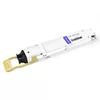
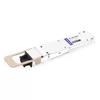
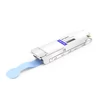
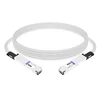
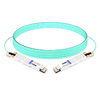
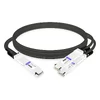
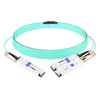
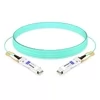
800G DAC: A Complete Guide to Direct Attach Copper for High-Speed Data Centers
An 800G optical transceiver module can consume 15 watts or more under full load. A passive 800G DAC cable consumes well below 1 watt per end, while active copper variants still draw far less power than optical solutions. In a fully populated 1U switch with 36 OSFP ports, that power gap can become the difference between staying within a standard rack power budget and requiring an expensive electrical upgrade. Network architects deploying 800G infrastructure face a critical decision at every port: run copper where possible, or pay the optical premium where distance demands it.
You already know that 800G Ethernet is entering modern data centers. What you need is a practical framework for deciding where direct attach copper makes sense, where it falls short, and how to deploy it without compromising signal integrity. This guide covers 800G DAC technology from the physical layer to the rack level.
What is an 800G DAC?
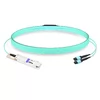
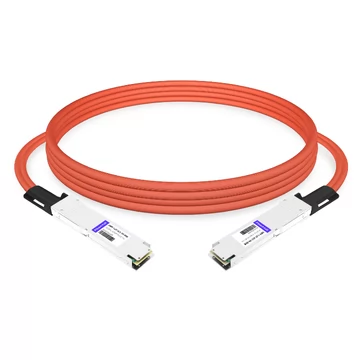
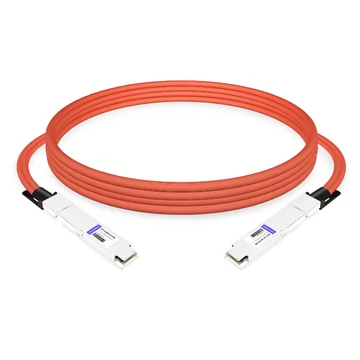
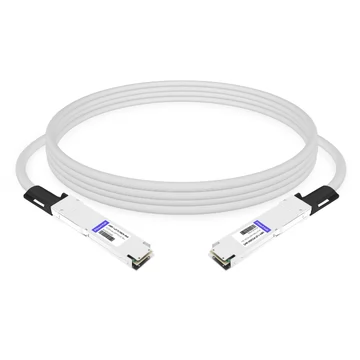
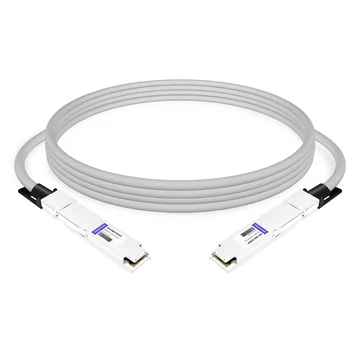
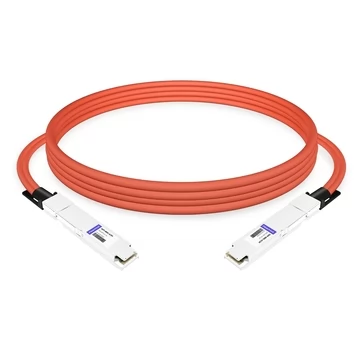
An 800G direct attach copper (DAC) cable is a fixed-length, point-to-point interconnect that uses twinax copper wiring to deliver 800G aggregate Ethernet connectivity between two network ports without optical conversion. Unlike active optical cables (AOC) or pluggable transceivers with fiber, 800G DAC carries high-speed PAM4 electrical signals directly over copper conductors. This eliminates the optical components — lasers, photodetectors, optical engines, and associated DSP functions — that drive cost and power in optical solutions.
800G DAC cables use OSFP or QSFP-DD800 connectors at each end. The cable assembly includes the connector housing, the copper twinax cable, and, in active variants, integrated signal-conditioning electronics. Because the cable and connectors ship as a single assembly, there is no separate optical transceiver to insert. You plug the cable directly into the port cage, and the link comes up when the host platform, port mode, firmware, and cable EEPROM are compatible.
Passive 800G DAC, Active DAC (ACC), and Active Electrical Cable (AEC)
Not all 800G DAC cables are built the same. The market offers three distinct copper categories, and choosing the wrong one for your reach requirement is a common source of link failures.
The passive 800G DAC contains no active signal-conditioning electronics. It relies entirely on the quality of the copper conductors, connector design, cable gauge, and the signal margin of the host channel. Passive 800G DAC is the lowest-cost option and consumes the least power — typically close to zero or well below 0.5W per end for the cable assembly itself. The tradeoff is reach. At 800G speeds using 112G-class PAM4 signaling, passive copper is commonly used for very short links, typically around 0.5 to 1.5 meters. Some vendor-qualified assemblies may support 2 meters or longer, but this depends on cable gauge, host channel margin, and platform validation.
Active DAC, often called ACC or active copper cable, adds signal-conditioning integrated circuits inside the connector housing. These chips typically use analog equalization, linear amplification, or redriver-based compensation to improve the electrical signal and offset channel loss over longer copper runs. ACC cables extend reach to approximately 3 to 5 meters, depending on cable gauge, channel quality, switch ASIC capability, and vendor qualification. Power consumption increases modestly, commonly to around 1–2W per end, which is still far below most 800G optical solutions.
Active Electrical Cable (AEC) represents the next step in copper interconnect technology. AEC usually uses retimer or CDR-based signal regeneration to recover and retransmit the high-speed electrical signal. This gives AEC better signal recovery than passive DAC or simple redriver-based active copper, but it also increases power consumption and adds more latency than passive copper. Some vendor-specific AEC implementations can support around 5 meters or longer at 800G. However, the distinction between ACC and AEC is not always clearly defined by vendors, so procurement teams should verify the actual architecture, reach, power, latency, and platform compatibility rather than relying on marketing labels alone.
How 800G DAC Works: Signal Integrity Basics
Understanding why 800G DAC reach is so limited requires a look at the physical layer. 800G Ethernet over copper uses multiple high-speed PAM4 electrical lanes. Each lane operates at 100G-class or 112G-class signaling rates, depending on the implementation and electrical interface. PAM4 uses four voltage levels to encode two bits per symbol, allowing higher data throughput than NRZ signaling but with a much smaller noise margin. The signal transitions happen fast — very fast — and the copper channel must preserve enough signal integrity for the receiver to distinguish between the four amplitude levels.
Insertion loss, crosstalk, and reflections are the three enemies of 800G copper. Insertion loss increases with cable length and frequency. At 112G-class signaling, even premium twinax copper introduces significant attenuation over a few meters. Crosstalk occurs when energy from one pair of conductors leaks into adjacent pairs. In a dense cable bundle with multiple high-speed lanes operating in parallel, crosstalk management is a major design challenge. Reflections happen at impedance discontinuities, such as connector transitions, PCB trace changes, or bends that distort the cable geometry.
800G DAC Form Factors and Standards
The form factor of an 800G DAC cable determines which hardware it will plug into. Unlike lower speeds, where SFP and QSFP dominated with less confusion, 800G introduces multiple high-density form factors that are not mechanically interchangeable.
OSFP 800G DAC
The Octal Small Form-factor Pluggable (OSFP) is an 800G form factor developed by the OSFP MSA. It is larger than the legacy QSFP family, measuring approximately 22.5mm wide by 10.5mm tall. The extra size accommodates higher-power optics, improved thermal design, and mechanical options such as integrated heatsinks or riding-heatsink-compatible top surfaces. For DAC applications, the OSFP form factor is mechanically robust and provides a stable connector interface for high-speed electrical signaling.
OSFP 800G DAC cables are one of the most common choices for 800G deployments, especially in AI, HPC, and high-density data center fabrics. Major switch platforms from vendors including Cisco, Arista, NVIDIA, and others have adopted OSFP on many 800G product lines. The OSFP MSA defines the module and cable assembly requirements, helping improve interoperability between compliant products.
One important consideration: OSFP is not backward compatible with QSFP form factors. An OSFP port cannot directly accept a QSFP28, QSFP56, or QSFP-DD module. Some switch vendors offer adapter solutions for specific use cases, but native mechanical compatibility does not exist. This matters when you are planning hardware upgrades from 400G to 800G. Even within OSFP, you should check whether the host requires flat-top, finned-top, or riding-heatsink-compatible cable ends.
QSFP-DD800 DAC
QSFP-DD800 is the 800G evolution of the QSFP-DD form factor. It maintains the same QSFP-DD mechanical family and uses an eight-lane electrical interface to support 800G operation. The key advantage of QSFP-DD800 is its continuity with the QSFP ecosystem. In many platforms, QSFP-DD800 cages are mechanically backward-compatible with QSFP-DD, QSFP28, and QSFP56 modules. This can simplify upgrade paths in brownfield deployments.
QSFP-DD800 DAC cables are available but currently represent a smaller share of some 800G deployments compared with OSFP, especially in AI cluster environments where OSFP has strong adoption. The form factor is favored by platforms that prioritize backward compatibility with existing QSFP infrastructure. For data centers with substantial existing QSFP28, QSFP56, or QSFP-DD investments, QSFP-DD800 can be the more practical choice. However, actual operation depends on the switch ASIC, firmware, port speed configuration, FEC mode, and vendor support matrix.
MSA Standards and Interoperability
Both OSFP and QSFP-DD800 are governed by Multi-Source Agreement (MSA) standards. The OSFP MSA publishes specifications for mechanical dimensions, electrical interfaces, thermal requirements, and management. The QSFP-DD MSA does the same for the QSFP-DD family. IEEE Ethernet standards define the relevant Ethernet PHY behavior, while the MSAs define the pluggable form factor, mechanical design, electrical connector interface, thermal envelope, and management interface.
When sourcing 800G DAC cables, verify that the vendor claims compliance with the relevant MSA. MSA-compliant cables are designed for interoperability across compliant host platforms.
That said, MSA compliance is not a guarantee of universal plug-and-play compatibility. Some switch vendors implement firmware-level checks that validate cable vendor information, EEPROM coding, or qualified part numbers. Using a third-party 800G DAC cable on a switch with strict vendor validation may trigger warnings or functional limitations. Always test cables on your target hardware before committing to large-volume procurement.
Breakout Configurations: 800G to 2×400G and 8×100G
One of the most useful features of 800G ports is their ability to break out into lower-speed links. An 800G DAC breakout cable splits a single 800G port into multiple 400G, 200G, or 100G connections. This is valuable during migration phases when not all downstream equipment supports native 800G speeds.
Common breakout configurations include:
800G to 2×400G: One OSFP or QSFP-DD800 end connects to two 400G ends, such as QSFP112, OSFP, or QSFP-DD, depending on the platform and cable design.
800G to 4×200G: One 800G end breaks out to four 200G ends, such as QSFP56, QSFP112, or DSFP, depending on switch support.
800G to 8×100G: One 800G end breaks out to eight 100G ends, such as QSFP28, SFP112, or DSFP, depending on the breakout mode and cable assembly.
Breakout DAC cables add flexibility to 800G switch deployments. Instead of leaving ports idle while waiting for 800G-capable endpoints, you can populate the switch immediately and upgrade endpoints as needed. Breakout cables do introduce additional signal complexity, so verify that your switch ASIC, firmware, port configuration, FEC mode, and qualified cable list support the specific breakout mode you plan to use.
800G DAC Cable Length and Reach Limitations
Reach is the single most important specification for an 800G DAC. Choose a cable that is too long for its technology, and you may see bit errors, link flaps, or complete failure to establish connectivity. Choose a cable that is far shorter than necessary, and you may be paying an active-cable premium for no benefit.
Passive 800G DAC: Typical 0.5 to 1.5 Meters
The passive 800G DAC is suitable for very short interconnects. The practical range is typically 0.5 to 1.5 meters, depending on cable gauge, host channel quality, and platform validation. Some vendors rate passive 800G DAC assemblies up to 2 meters or longer, but real-world deployments should include margin for cable bends, connector wear, airflow temperature, and switch port signal budget.
Cable gauge matters. Thinner wire, meaning a higher AWG number, is more flexible and easier to manage in dense racks, but it introduces more loss. Thicker wire, meaning a lower AWG number, improves signal integrity at the cost of stiffness and bulk. Most 800G passive DACs use twinax conductors in the 26 to 30 AWG range. For sub-meter runs, 30 AWG is usually sufficient and simplifies cable management. For runs approaching 1.5 meters or more, 26 or 28 AWG provides a better signal margin.
Active 800G DAC (ACC): Up to 3 to 5 Meters
When your link exceeds the passive reach limit, active DAC is the next step. ACC cables use redriver, equalization, or linear amplification circuitry inside the connector housing to compensate for channel loss. Typical reach is around 3 to 5 meters, though this varies by vendor, cable construction, host platform, and qualification status.
The power increase from passive to active DAC is modest — often around 0.5W to 1.5W additional per end, depending on the cable design. Compared with an AOC or optical transceiver pair, an active DAC still offers substantial power savings. For intra-rack or adjacent-rack connections where fiber would be unnecessary, active DAC hits a useful sweet spot.
Signal Integrity Challenges at 112G per Channel
At 112G-class PAM4 signaling, every millimeter of copper and every connector transition matters. The Nyquist frequency of a 112Gb/s PAM4 signal is approximately 28 GHz. At those frequencies, the PCB traces inside your switch, the connector pins, and the cable itself all behave as transmission lines with non-ideal characteristics.
What this means in practice: even a well-designed 800G DAC link has limited margin. Temperature changes affect copper resistivity and dielectric properties. Cable bends that exceed the minimum bend radius alter impedance and increase reflections. Connector insertion cycles wear the contact surfaces and can increase resistance. Over time, a link that passed validation on day one may degrade enough to show errors under stress.
For this reason, mission-critical 800G deployments should include link-level error monitoring. IEEE Ethernet standards define the physical layer behavior, but the actual health of a DAC link is best monitored through switch telemetry such as FEC corrected/uncorrected error counters, symbol error rates, link flap logs, and eye diagram metrics where available.
800G DAC vs AOC: When to Choose Copper
The decision between 800G DAC and active optical cable (AOC) is not a matter of brand preference. It is a function of reach, power budget, cost, cable routing, and latency requirements. Understanding the trade-offs lets you standardize on copper where it fits and reserve optics for the connections that truly need them.
Cost Comparison at Rack Scale
At the single-cable level, the cost difference between 800G DAC and AOC is significant. A passive 800G DAC cable may cost one-third to one-half the price of an equivalent AOC. Active DAC sits in between, but still well below optical pricing in many short-reach applications. When you multiply that difference across a rack with 32, 36, or 64 high-speed ports, the savings become substantial.
However, cost is not just the cable itself. Optical solutions require optical engines and more complex electronics at each end, whether implemented as pluggable optical modules or integrated AOC ends. DAC cables are self-contained copper assemblies. For short-reach deployments, the total hardware cost of DAC is often 50 to 70 percent lower than an AOC-based alternative, depending on vendor, length, and volume.
Power Consumption: DAC vs AOC vs Optical Modules
Power is where the 800G DAC delivers its most compelling advantage. A passive DAC draws well below 0.5W per end. An active DAC may draw around 1–2W per end. An AOC or optical module can draw several watts per end, commonly in the 8–15W range depending on reach, optical architecture, DSP design, and host thermal conditions. That power difference has real consequences at rack scale.
Consider a 1U switch with 36 OSFP ports, fully populated with 800G links. Using passive DACs, the cable power contribution may be only a few tens of watts in total. Using AOCs, the same configuration could draw several hundred watts just for the interconnects. In a data center where rack power is capped at 10 to 15kW, that difference can determine whether you can fully populate the switch or leave ports dark.
Cooling load follows power consumption. The heat generated by AOCs or optical modules must be removed by the data center cooling system. Over thousands of ports, the operational expenditure difference between copper and optics compounds significantly.
Latency Differences
Latency-sensitive applications — particularly AI training workloads, HPC clusters, and high-frequency trading infrastructure — benefit from the minimal latency of copper. Passive DAC cables introduce negligible additional latency because there is no optical-electrical conversion or retiming inside the cable. ACC cables add only limited signal-conditioning latency. AEC cables add more latency than passive DAC or ACC because retimers recover and retransmit the signal.
AOC cables perform electrical-to-optical conversion at the transmit end and optical-to-electrical conversion at the receive end, which adds more latency than passive copper. The absolute difference is usually small, often in the nanosecond range, but it can still matter at scale in tightly coupled compute fabrics.
Deployment Scenarios: When DAC Wins, When AOC Wins
Choose 800G DAC when:
The link span is within copper reach limits.
You are optimizing for the lowest power and lowest latency.
Cost per link is a primary concern.
The connection is between fixed positions in the same rack or adjacent racks.
Cable bulk and bend radius can be managed within the rack layout.
Choose 800G AOC when:
The link span exceeds practical copper reach.
You need a lighter and more flexible cable for longer routing paths.
The path includes cable trays or conduits where copper bulk is problematic.
You are connecting across racks, rows, rooms, or data hall zones.
You need longer reach without using separate pluggable optical modules and patch cords.
Want to see how 800G DAC fits your specific deployment? Our engineering team can review your rack layouts and recommend the right cable types for each link. Contact our optical networking experts for a free cabling assessment.
800G DAC Compatibility and Vendor Ecosystem
Not every 800G DAC cable works in every port. Understanding the vendor ecosystem helps you avoid compatibility surprises that delay deployment.
Switch Vendor Support
Major switch vendors have taken different approaches to 800G form factors:
Cisco: 800G-capable platforms in the Nexus and related data center switching families may support OSFP, QSFP-DD800, or both, depending on the exact switch and line card. Check the data sheet and qualified optics/cable list for your specific SKU.
Arista: Many high-density 800G platforms use OSFP, especially in AI and leaf-spine environments, while other form factors may appear on specific models. Always verify the exact platform.
NVIDIA: Spectrum-4 and Spectrum-X Ethernet switches are strongly aligned with OSFP for 800G deployments, especially in AI cluster fabrics.
Juniper: PTX and QFX platforms with 800G capabilities may support different form factors depending on the model and line card.
Dell and HPE: Enterprise and data center switch lines are adding 800G options, generally following the form factor choices of the underlying ASIC platform and target deployment.
The key rule is simple: do not choose an 800G DAC by speed alone. Confirm the exact switch SKU, port form factor, supported breakout modes, firmware version, and qualified cable matrix.
NIC and DPU Compatibility
Network interface cards and data processing units must match the DAC cable form factor. A server with a QSFP-DD800 NIC cannot directly accept an OSFP DAC cable without an adapter, and an OSFP NIC cannot directly accept a QSFP-DD800 cable. Adapters may exist for specific use cases, but they add cost, insertion loss, mechanical complexity, and another point of compatibility risk.
SmartNICs and DPUs from vendors such as NVIDIA, AMD, Intel, Marvell, and others are increasingly available with high-speed interfaces, including 400G and 800G options. When designing a server-to-switch fabric, verify the NIC or DPU form factor, supported speeds, FEC requirements, and vendor-qualified cable list before finalizing DAC procurement.
MSA Compliance vs Proprietary Solutions
Most third-party 800G DAC cables are designed to be MSA-compliant and work across multiple switch platforms. However, some switch vendors implement cable validation that checks vendor EEPROM data, part numbers, firmware coding, or cable attributes. If the switch firmware expects specific coding and your cable reports a different vendor ID or unsupported part type, the link may not come up, may trigger warnings, or may operate in a degraded mode.
FiberMall designs 800G DAC cables to comply with OSFP and QSFP-DD MSA requirements, supporting compatibility with mainstream networking equipment. For environments with strict vendor validation, compatibility testing on target hardware is always recommended before volume deployment.
Frequently Asked Questions
What is 800G DAC?
800G DAC, or Direct Attach Copper, is a high-speed copper cable assembly that connects 800G network ports without optical conversion. It uses twinax copper wiring with OSFP or QSFP-DD800 connectors to deliver 800G aggregate Ethernet connectivity over short distances.
What is the maximum length of an 800G DAC?
A passive 800G DAC is commonly used for 0.5 to 1.5 meters, with some vendor-qualified options available at 2 meters or longer. Active DAC or ACC typically extends reach to around 3 to 5 meters. AEC may support similar or longer distances depending on its retimer architecture and vendor qualification. Beyond practical copper reach, AOC or optical transceivers are usually required.
Is the 800G DAC passive or active?
Both options exist. A passive 800G DAC has no active signal-conditioning electronics and works best for very short links. Active 800G DAC, or ACC, includes redriver or equalization circuitry to extend reach. AEC uses more advanced retimer or CDR-based signal regeneration and can provide better signal recovery at the cost of higher power and latency.
What is the difference between 800G DAC and AOC?
800G DAC uses copper conductors to transmit electrical signals directly between ports. 800G AOC uses optical fiber with integrated electrical-to-optical and optical-to-electrical conversion at each end. DAC is lower cost, lower power, and lower latency, but limited to short reach. AOC supports longer distances — often up to 100 meters depending on the specification — at the cost of higher power and price.
Can I use 800G DAC for AI GPU clusters?
Yes, for intra-rack and adjacent-rack links within copper reach limits. AI clusters with tightly packed GPU nodes often use DAC for short fabric links because it reduces power, cost, and latency. Longer connections between racks, pods, or storage networks typically use AOC or optical transceivers.