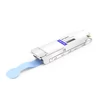
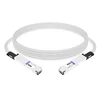
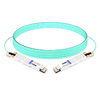
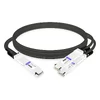
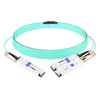
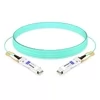
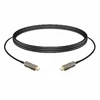
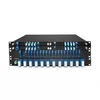
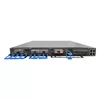
Every AI infrastructure team sourcing NVIDIA Spectrum switches runs into the same bottleneck: the switch arrives from one supplier, but the OSFP transceivers are backordered somewhere else, the DAC cables are on a different lead time entirely, and your GPU cluster sits idle while you chase multiple vendors for status updates.
There’s a simpler way to build your Ethernet fabric.
Ethernet or InfiniBand? Why This Decision Shapes Your Entire AI Infrastructure
NVIDIA offers leading networking platforms for both Ethernet and InfiniBand. The right choice for your deployment depends on workload characteristics, scale, latency requirements, and ecosystem.
Spectrum Ethernet (This Page)
Primary Use: AI inference, cloud-native applications, multi-tenant environments, general-purpose HPC, and increasingly large-scale AI training.
Protocol: Standards-based Ethernet/IP with broad ecosystem compatibility, including RoCE for high-performance RDMA networking.
Latency: Spectrum switches provide low-latency cut-through forwarding designed for high-performance data center and AI fabrics.
Ecosystem: Broad compatibility with Ethernet NICs, servers, operating systems, storage platforms, and cloud infrastructure.
Maximum Throughput: Spectrum-4 SN5600 provides up to 51.2 Tb/s of aggregate front-panel bandwidth with 64 × 800GbE ports.
Best For: Mixed-workload AI clouds, enterprise data centers, Ethernet-based AI fabrics, inference at scale, and environments requiring broad interoperability.
FiberMall Supplies: Switches, transceivers, DACs, ACCs, AOCs, and fiber cabling.
Quantum InfiniBand
Primary Use: Large-scale AI training, tightly coupled HPC, GPU-to-GPU communication, and latency-sensitive distributed computing.
Protocol: InfiniBand with native RDMA capabilities and NVIDIA in-network computing technologies such as SHARP.
Latency: InfiniBand is optimized for extremely low-latency communication and highly synchronized HPC and AI workloads.
Ecosystem: A specialized HPC and AI ecosystem commonly built around NVIDIA ConnectX HCAs and software technologies such as RDMA, MPI, UCX, NCCL, and SHARP.
Maximum Throughput: Quantum-2 QM9700 provides 51.2 Tb/s of aggregate bandwidth with NDR 400G connectivity.
Best For: Large-scale training clusters, GPU-dense HPC environments, tightly coupled workloads, and deployments that benefit from SHARP in-network computing.
FiberMall Supplies: Yes — see our InfiniBand switch solutions for compatible switches, transceivers, and cabling.
The key difference is not simply that one fabric is “fast” and the other is “faster.” Ethernet provides a broader and more familiar networking ecosystem, while InfiniBand is purpose-built for extremely communication-intensive HPC and AI environments.
NVIDIA Spectrum Switch Selector: Match the Model to Your Throughput Requirements
NVIDIA’s Spectrum switch portfolio spans multiple generations, ranging from enterprise access switching to high-density 800GbE AI fabrics. NVIDIA has also introduced the newer Spectrum-6 SN6000 family for next-generation AI factories; the selector below focuses on the Spectrum-4 and earlier generations covered on this page.
Speed Tier Comparison
Spectrum-4 (SN5000) is based on the Spectrum-4 ASIC and supports port speeds up to 800GbE. The SN5600 provides 51.2 Tb/s of aggregate front-panel bandwidth through 64 OSFP cages, while the SN5400 provides 25.6 Tb/s through 64 QSFP-DD cages. These systems are designed for AI back-end fabrics, Spectrum-X deployments, high-density leaf-spine architectures, and hyperscale networks.
Spectrum-3 (SN4000) is based on the Spectrum-3 ASIC and supports speeds up to 400GbE. Representative configurations include the SN4700 with 32 QSFP-DD ports, the SN4600 with 64 QSFP56 ports, and the SN4600C with 64 QSFP28 ports. These platforms are suited to enterprise AI clusters, cloud leaf-spine networks, virtualization, and storage environments. Some specific Spectrum-3 SKUs, including certain SN4600 200GbE configurations, have reached end of life, so availability should be confirmed by exact part number.
Spectrum-2 (SN3000) supports port speeds up to 200GbE. Representative configurations include 32-port QSFP56 systems and mixed SFP28/QSFP28 platforms. Many SN3700 SKUs have now reached end of life, while selected SN3000 platforms such as SN3420 remain available. These switches continue to be useful in existing mid-scale data centers, storage fabrics, and legacy ML infrastructure.
Spectrum (SN2000) supports speeds up to 100GbE and includes configurations such as 32-port QSFP28 platforms as well as access-oriented systems with 1GbE RJ45 interfaces and 100GbE uplinks. Typical deployments include enterprise leaf-spine networks, management networks, branch environments, and cost-sensitive infrastructure.
This generational comparison is intended as a deployment guide rather than a statement that every legacy SKU remains available for new orders. Always confirm the exact NVIDIA part number and lifecycle status before purchasing.
Spectrum-X: When AI Workloads Demand More Than Standard Ethernet
NVIDIA Spectrum-X is an Ethernet networking platform optimized specifically for AI workloads. Spectrum-X combines NVIDIA Spectrum switches with NVIDIA SuperNIC technology, LinkX interconnects, adaptive routing, congestion-control mechanisms, advanced telemetry, and optimized RoCE networking.
Spectrum-4-based deployments commonly use SN5000 switches with BlueField-3 or related NVIDIA SuperNIC technologies, while newer Spectrum-X generations extend the architecture to Spectrum-6. NVIDIA positions Spectrum-X as providing higher effective bandwidth, better performance isolation, and more predictable AI workload performance than conventional Ethernet designs.
For GPU clusters with intensive east-west traffic, including all-reduce and other collective communications, these capabilities can significantly reduce network congestion and improve application-level performance. NVIDIA currently states that Spectrum-X can improve AI performance by up to 1.6× compared with traditional Ethernet in targeted AI environments.
Available NVIDIA Spectrum Ethernet Switch Models
Spectrum-4 Series — 800GbE & 400GbE for AI Fabrics
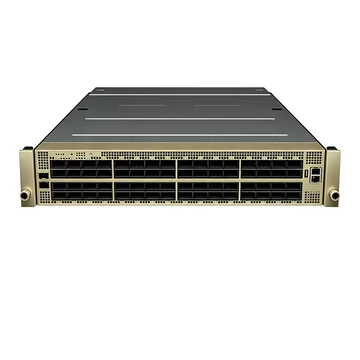
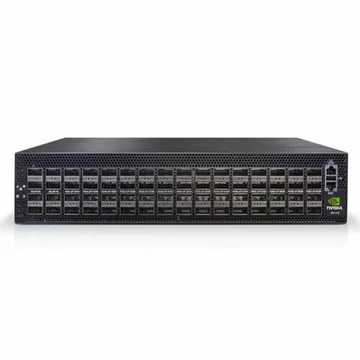
SN5600 — 64-Port 800GbE OSFP, 51.2 Tb/s
· 64 × OSFP cages supporting speeds up to 800GbE, plus 1 × SFP28 bonus front-panel port supporting 1/10/25GbE
· Fully shared 128MB on-chip packet buffer
· Hardware support for advanced security and tunneling features, including MACsec/VXLANsec capabilities
· Adaptive routing, advanced telemetry, and congestion-management capabilities suitable for Spectrum-X deployments
· NVIDIA Cumulus Linux support, with ONIE-based deployment options for supported network operating systems
· Airflow options depend on the exact SKU and hardware configuration
· Designed for: AI back-end fabrics, hyperscale spine networks, and high-density GPU clusters
The SN5600 is based on Spectrum-4 and provides 64 native 800GbE OSFP interfaces. Each 800GbE port can also support lower-speed configurations and breakout modes when used with supported adapters or breakout cables. NVIDIA’s current hardware documentation specifies a fully shared 128MB packet buffer, not 160MB.
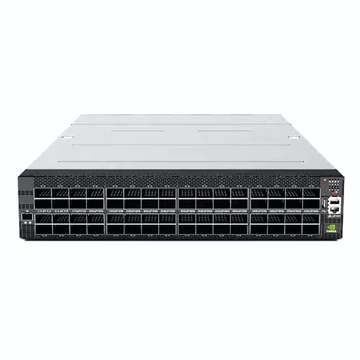
SN5400 — 64-Port 400GbE QSFP-DD, 25.6 Tb/s
· 64 × QSFP-DD 400GbE cages plus 2 × SFP28 bonus front-panel ports supporting up to 25GbE
· Fully shared 128MB on-chip packet buffer
· RoCE support with congestion-management technologies such as ECN and PFC
· Advanced telemetry capabilities for monitoring congestion, microbursts, and network behavior
· NVIDIA Cumulus Linux support and ONIE-based software deployment options
· Airflow options depend on the exact SKU and configuration
· Designed for: AI/cloud leaf-spine networks, enterprise 400G fabrics, and Spectrum-X deployments requiring high-density 400GbE connectivity
The two SFP28 interfaces on the SN5400 are front-panel data/bonus ports. Out-of-band management is provided separately through the dedicated RJ45 management interface.
Spectrum-3 Series — 400GbE & 200GbE for Enterprise and Cloud
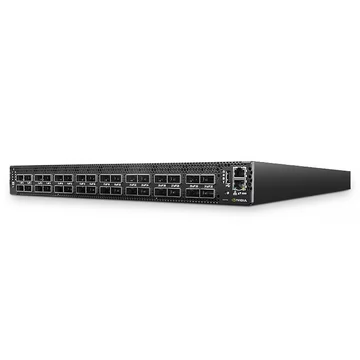
MSN4700-WS2FC — 32-Port 400GbE QSFP-DD, 12.8 Tb/s Front-Panel Bandwidth
· 32 × QSFP-DD ports in a 1U form factor
· Intel x86 quad-core CPU and 16GB system memory
· Shared packet buffering with low-latency cut-through switching
· VXLAN routing, MLAG, ECMP, and other data center networking capabilities
· NVIDIA Cumulus Linux
· P2C airflow for the referenced MSN4700-WS2FC configuration
· Designed for: High-density enterprise leaf/spine networks, cloud virtualization, storage fabrics, and 400GbE data center deployments
The SN4700 supports native 400GbE interfaces and can also be configured for lower-speed breakout connectivity. The MSN4700-WS2FC remains listed by NVIDIA as a mass-production SKU at the time of this revision.
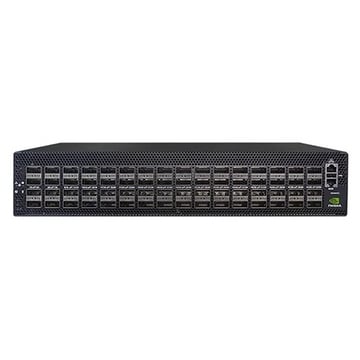
MSN4600-VS2FC — 64-Port 200GbE QSFP56, 12.8 Tb/s Front-Panel Bandwidth
· 64 × QSFP56 ports in a 2U form factor
· Shared packet buffering
· VXLAN, RoCE, and data center networking capabilities suitable for AI/ML and cloud workloads
· Available historically with NVIDIA Cumulus Linux and other supported software options
· Designed for: Cloud data centers, mid-scale AI/ML deployments, and multi-tenant environments
Lifecycle Note: MSN4600-VS2FC has reached NVIDIA end-of-life status and is no longer a current mass-production ordering SKU. It may still be relevant for installed-base expansion, remaining inventory, or professionally refurbished deployments.
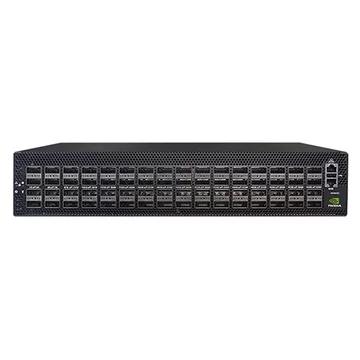
MSN4600-CS2FC — 64-Port 100GbE QSFP28, 6.4 Tb/s Front-Panel Bandwidth
· 64 × QSFP28 ports in a 2U form factor
· Optimized for high-density 100GbE connectivity, storage environments, and east-west traffic
· RoCE v2 support with ECN and PFC capabilities
· Shared packet buffering
· NVIDIA Cumulus Linux
· Designed for: Storage networks, enterprise data centers, and cost-sensitive high-density 100G deployments
Unlike the 200GbE SN4600 configuration, the SN4600C uses 64 × 100GbE interfaces, providing 6.4 Tb/s of aggregate front-panel bandwidth.
Spectrum-2 Series — 200GbE & 100GbE for Mid-Scale
MSN3700-VS2RC — 32-Port 200GbE QSFP56, 6.4 Tb/s
· 32 × QSFP56 ports in a 1U form factor
· NVIDIA Cumulus Linux on the referenced SKU
· C2P airflow with redundant power supplies
· Designed for: Existing mid-scale AI/ML networks, cloud leaf-spine environments, and 200GbE infrastructure
Lifecycle Note: The MSN3700-VS2RC and related SN3700 200GbE SKUs have reached end-of-life status. They remain relevant primarily for existing deployments, secondary-market requirements, and compatible replacement projects.
MSN3700-CS2RC — 32-Port 100GbE QSFP28, 3.2 Tb/s
· 32 × QSFP28 ports in a 1U form factor
· Available historically with NVIDIA Cumulus Linux and NVIDIA Onyx, depending on SKU
· Designed for: Existing enterprise leaf networks, storage environments, and cost-effective 100G fabrics
Lifecycle Note: MSN3700-CS2RC has also reached NVIDIA end-of-life status. Availability should therefore be confirmed before specifying it for a new deployment.
Spectrum Series — 1GbE to 100GbE for Enterprise Access
MSN2700-CS2RC — 32-Port 100GbE QSFP28
· 32 × QSFP28 ports in a 1U form factor
· Supports Ethernet leaf/spine and virtualization environments
· Available with software options appropriate to the specific hardware SKU and deployment generation
· Designed for: Enterprise spine/leaf networks, virtualization clusters, laboratories, and existing 100GbE infrastructure
Because SN2700 is an older-generation Spectrum platform, exact SKU availability and lifecycle status should be verified before placing a new order.
SN2201 — 48-Port 1GbE RJ45 + 4 × 100GbE QSFP28 Uplinks
· 48 × 1GbE RJ45 access ports
· 4 × QSFP28 100GbE uplink ports
· Each QSFP28 uplink can support supported breakout configurations, including 4 × 10/25GbE SFP28 or 2 × 50GbE connectivity
· 1U rack-mountable design
· NVIDIA Cumulus Linux support
· Designed for: Enterprise access layers, branch environments, out-of-band/management networks, and infrastructure requiring large numbers of 1GbE copper connections with high-speed uplinks
The SN2201 does not use dedicated SFP28 uplink cages. Its high-speed interfaces are QSFP28 ports that can be broken out to SFP28 connections where required.
The Compatible Optics Advantage: Reduce Multi-Vendor Compatibility Risk
One challenge with building a complete NVIDIA Ethernet fabric is that switches, optical transceivers, copper cables, active cables, and fiber assemblies are often sourced from different vendors.
FiberMall’s approach is to supply and validate these components as a complete connectivity solution, reducing the time customers spend coordinating multiple suppliers and troubleshooting interoperability problems.
Cost Comparison: All-OEM vs. FiberMall-Optimized
Consider an illustrative 32-GPU AI cluster using one SN5600 800GbE switch and 32 switch-to-host links.
The original cost comparison mixed optical transceivers and DAC/ACC cables into the same deployment total. Because an optical link and a DAC/ACC link are normally alternative physical connectivity methods, they should be calculated separately.
Option 1: Optical Connectivity
For an optical design using 32 links, 64 optical transceivers are required when both ends of each link use pluggable optics.
Using the original illustrative pricing assumptions, an SN5600 switch is estimated at approximately $70,000 for an OEM-oriented procurement scenario, compared with approximately $52,000 in the FiberMall-optimized example.
Sixty-four 800G OSFP transceivers at approximately $1,000 each would total around $64,000 in the OEM-oriented example. At approximately $350 each, the FiberMall-compatible optics would total around $22,400.
The resulting illustrative optical solution cost is therefore approximately $134,000 for the OEM-oriented switch-and-optics configuration versus approximately $74,400 for the FiberMall-optimized configuration, excluding fiber patch cables and any other infrastructure components.
That represents an illustrative saving of approximately 44% based on the example pricing.
Option 2: DAC/ACC Connectivity
If the same 32 short-reach links use DAC or ACC cables instead of optical modules, the transceivers are not added separately.
Using the original assumptions, 32 cables at approximately $300 each would total about $9,600 in the OEM-oriented example. At approximately $150 each, the FiberMall example would total about $4,800.
Combined with the illustrative switch pricing, the estimated DAC/ACC deployment would therefore be approximately $79,600 for the OEM-oriented configuration versus approximately $56,800 for the FiberMall-optimized configuration.
The exact savings depend on switch SKU, cable type, reach, transceiver specification, order volume, and current market pricing. These figures should therefore be treated as an illustrative comparison rather than fixed NVIDIA list pricing.
How FiberMall Validates Compatible Optics
Every compatible transceiver and cable supplied for a validated deployment goes through a defined quality-control process:
· 100% end-of-line testing — individual units are tested rather than relying solely on statistical sampling.
· Platform-specific qualification — compatible products can be validated against the specific switch models for which they are supplied and tested at their rated operating speeds.
· MSA-compliant design — mechanical, electrical, and management interfaces are designed according to the applicable form-factor specifications, while platform-specific coding and interoperability are validated separately.
· Bit-error-rate validation — BER performance is tested under the conditions applicable to the specific product specification and rated temperature range.
· Optical performance characterization — parameters such as transmit power, receive sensitivity, insertion loss, and return loss are verified where applicable according to the relevant product, IEEE, and MSA requirements.
MSA compliance alone does not guarantee interoperability with every switch, firmware release, and network operating system. That is why platform-specific validation is an important part of delivering compatible optics for NVIDIA, Cisco, Arista, Juniper, and other network platforms.
The result is a connectivity solution designed to provide reliable link establishment and stable signal integrity throughout the intended operating conditions of the deployment.
Complete Your NVIDIA Ethernet Solution
A switch requires the correct combination of transceivers, cables, adapters, and fiber infrastructure to build a complete network. FiberMall supplies the complete connectivity ecosystem.
Optical Transceivers by Speed
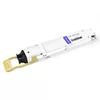
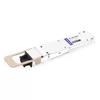
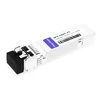
· 800G OSFP — options such as SR8, DR8, and FR8 for compatible SN5600 and other 800GbE deployments
· 400G QSFP-DD — options such as SR8, DR4, FR4, and LR4 for SN5400, SN4700, and other compatible 400GbE platforms
· 200G QSFP56 — SR4, FR4, LR4, and other supported 200G optical options for compatible Spectrum-2 and Spectrum-3 deployments
· 100G QSFP28 — SR4, LR4, CWDM4, ER4, and related variants for SN4600C, SN3700C, SN2700, SN2201 uplinks, and other compatible 100GbE interfaces
· 25G SFP28 / 10G SFP+ — suitable for compatible native SFP28/SFP+ ports and for supported breakout connections from higher-speed QSFP interfaces. On the SN2201, 25G/10G SFP28 connectivity is provided through breakout from its QSFP28 uplink ports rather than through native SFP28 uplink cages.
DAC & AOC Cables
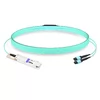
· OSFP DAC/ACC — direct-attach copper and active copper options for supported high-speed OSFP links, particularly short-reach connections inside or between adjacent racks
· QSFP-DD DAC/ACC — short-reach copper connectivity for supported 400G switch-to-server and switch-to-switch connections
· QSFP56 DAC/AOC — copper and active optical cable options for compatible 200G deployments
· QSFP28 DAC/AOC — short- and medium-reach connectivity for 100G enterprise and data center fabrics
· Breakout cables — supported configurations can include QSFP-DD to 2 × QSFP56, QSFP28 to 4 × SFP28, OSFP to 2 × 400G or 4 × 200G, as well as other switch-specific breakout arrangements
The exact breakout configuration depends on the switch platform, port mode, lane rate, firmware, and cable type. For example, NVIDIA documents the SN5600 as supporting 800GbE ports broken out to 2 × 400GbE or 4 × 200GbE, with additional lower-speed configurations subject to port mapping rules.
Fiber Optic Patch Cables
· MPO/MTP and LC duplex fiber patch cables for compatible OSFP, QSFP-DD, QSFP56, and QSFP28 optical modules
· Single-mode OS2 and multimode OM3/OM4/OM5 fiber options
· Custom lengths available according to deployment requirements
The connector and fiber type must always be matched to the optical transceiver specification. An OSFP or QSFP-DD form factor does not by itself determine whether the optical interface requires MPO/MTP or LC connectivity.
NVIDIA Ethernet Switch Buying FAQ
What’s the difference between NVIDIA Spectrum (Ethernet) and Quantum (InfiniBand) switches? Which should I choose?
Spectrum switches use standards-based Ethernet and IP networking and support familiar Layer 2/Layer 3 architectures, RoCE, routing, virtualization, and cloud networking. They are designed for broad interoperability with Ethernet infrastructure and support NVIDIA networking software as well as selected open NOS options depending on the platform and SKU.
Quantum switches use InfiniBand, a specialized high-performance fabric designed for RDMA-intensive AI and HPC communication. Quantum also supports NVIDIA technologies such as SHARP in-network computing and is commonly deployed with NVIDIA ConnectX HCAs in tightly coupled compute clusters.
Choose Spectrum if you need broad Ethernet ecosystem compatibility, cloud-native architectures, storage integration, mixed workloads, or an Ethernet-based AI fabric.
Choose Quantum if you are building a tightly coupled large-scale training or HPC environment where highly predictable low latency, RDMA performance, and InfiniBand-specific in-network acceleration are primary requirements.
FiberMall supplies connectivity solutions for both architectures and can help determine which fabric best matches your GPU topology and workload.
Do NVIDIA Spectrum switches come with an operating system pre-installed?
It depends on the exact switch SKU.
Many NVIDIA Spectrum systems are available with NVIDIA Cumulus Linux, while other configurations may use ONIE for NOS installation. NVIDIA also supports Pure SONiC on selected current platforms. Older Spectrum generations may additionally be encountered with NVIDIA Onyx.
Cumulus Linux is a Linux-based network operating system providing Layer 2 and Layer 3 switching, routing, automation, telemetry, and standard Linux management tools.
ONIE, or Open Network Install Environment, is not itself a network operating system. It is an installation environment that enables a supported NOS to be installed on compatible open-networking hardware.
Because operating-system support differs by hardware generation and SKU, the software option should be confirmed before ordering.
Can I use FiberMall transceivers and cables with NVIDIA Spectrum switches without voiding the warranty?
Compatible third-party transceivers and cables can be used with Spectrum switches when the module, electrical interface, optical specification, firmware behavior, and platform configuration are compatible.
However, it is not accurate to make a blanket statement that the use of any third-party MSA-compliant transceiver can never affect NVIDIA warranty or support coverage. Hardware warranty and technical-support obligations remain subject to NVIDIA’s applicable terms, the specific failure condition, and the product configuration.
FiberMall transceivers are designed according to applicable MSA specifications and are validated for compatibility with the specific switch platforms for which they are supplied. FiberMall also provides its own warranty for the compatible transceivers and cables.
This combination of MSA-based design and platform-specific validation is more meaningful than relying on MSA compliance alone.
What is Spectrum-X and do I need it for my AI cluster?
Spectrum-X is NVIDIA’s Ethernet networking platform optimized specifically for AI workloads. It integrates Spectrum Ethernet switches, NVIDIA SuperNIC technologies, LinkX connectivity, advanced telemetry, adaptive routing, and congestion-control mechanisms to improve the performance and predictability of Ethernet-based GPU fabrics.
Spectrum-4-based Spectrum-X deployments commonly use SN5000 switches with BlueField-3-class SuperNIC endpoints, while NVIDIA’s newer Spectrum-X architecture also includes Spectrum-6 systems.
For AI clusters with heavy east-west traffic, including all-reduce, all-to-all, and NCCL collective operations, Spectrum-X can provide significant performance advantages by improving traffic distribution and reducing congestion. NVIDIA currently states that Spectrum-X can improve AI application performance by up to 1.6× compared with traditional Ethernet in targeted workloads.
For general-purpose enterprise networking, conventional cloud workloads, or smaller environments that do not generate intensive synchronized GPU traffic, a standard Spectrum Ethernet deployment may be sufficient.
The decision should therefore be based on GPU count, oversubscription ratio, topology, workload communication pattern, target utilization, and expected cluster growth.
What are typical lead times for NVIDIA Spectrum switches?
Lead times vary substantially by exact model, SKU, lifecycle status, software configuration, regional allocation, and available inventory.
This is particularly important in 2026 because the Spectrum portfolio now includes current-generation platforms as well as several older models that have entered end-of-life status. For example, NVIDIA currently lists the referenced AC SN5600 SKU as EOL, while other Spectrum-4 configurations such as SN5600D and SN5610 have different lifecycle states. Several SN3700 and SN4600 200GbE SKUs are also listed as EOL.
For this reason, fixed statements such as “8–12 weeks for SN5600” or “2–4 weeks for SN3700” can quickly become inaccurate.
FiberMall provides a confirmed ETA based on the exact requested SKU and current inventory or supply-channel availability and can provide alternative models where appropriate.
Can I purchase refurbished NVIDIA Mellanox switches from FiberMall?
Yes. FiberMall offers both new and professionally refurbished NVIDIA Spectrum switches, depending on model availability.
Refurbished units undergo procedures such as factory reset, firmware validation, configuration removal, and port-level diagnostic testing before shipment.
Refurbished switches can provide substantial cost savings for laboratories, test environments, installed-base expansion, replacement projects, and budget-sensitive deployments, particularly where a required legacy model has already reached end-of-life status.
The actual price difference depends on model, age, condition, configuration, warranty coverage, and current supply. Specify whether you are interested in new or refurbished equipment when requesting a quotation, and FiberMall can provide available options for comparison.
Are Spectrum-4 switches backward compatible with my existing 100G and 200G infrastructure?
Yes, Spectrum-4 switches support multiple lower-speed operating modes and breakout configurations, subject to the specific switch, port, cable, transceiver, and port-mapping rules.
For example, an SN5600 800GbE OSFP port can support breakout configurations including 2 × 400GbE or 4 × 200GbE. NVIDIA also documents additional lower-speed configurations using supported breakout cables and adapters.
The SN5400’s QSFP-DD ports support lower data rates and can be used with supported QSFP56/QSFP28-class connectivity and breakout configurations where the hardware, optics, and software configuration are compatible.
This flexibility allows organizations to deploy a Spectrum-4 fabric while continuing to connect existing 100G and 200G infrastructure, then migrate endpoints to higher speeds as the cluster expands.