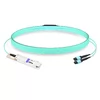
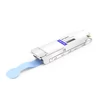
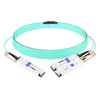
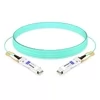
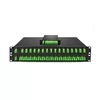
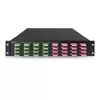
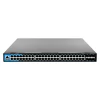
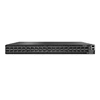
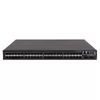
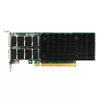
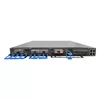
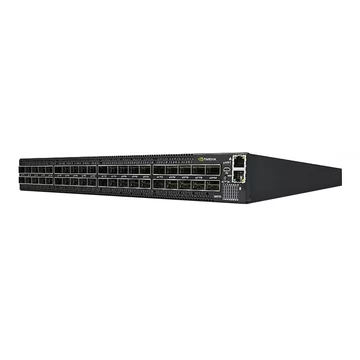
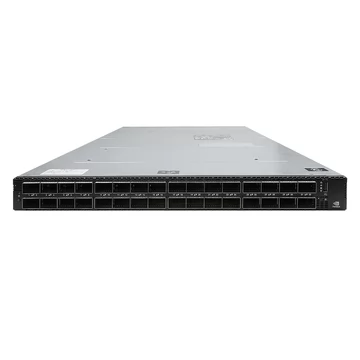
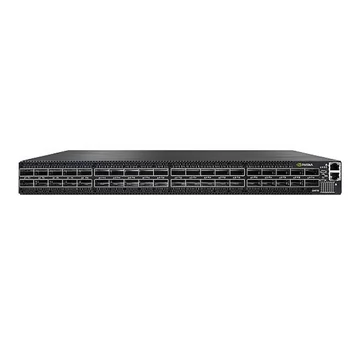
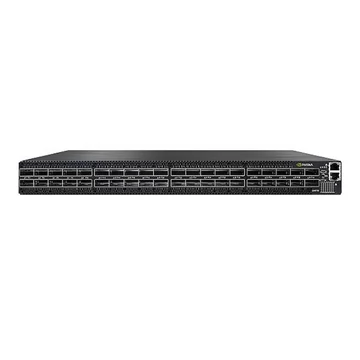
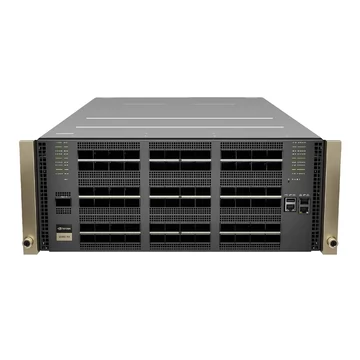
NVIDIA InfiniBand switches span multiple generations of high-performance networking, from EDR and HDR to NDR 400Gb/s and XDR 800Gb/s. Designed for ultra-high throughput and ultra-low latency, NVIDIA Quantum platforms accelerate AI and high-performance computing workloads through technologies such as RDMA, adaptive routing, and SHARP in-network computing. The accompanying NVIDIA LinkX portfolio of cables and transceivers—including DACs, active copper cables, AOCs for supported applications, optical transceivers, and multimode and single-mode fiber solutions—provides reliable, power-efficient interconnects between switches, network adapters, and GPU systems.
Why Your InfiniBand Infrastructure Decision Matters More Than the Switch Itself
A $25,000 InfiniBand switch doesn't operate in isolation. Each active link requires a compatible interconnect solution, such as a DAC, AOC, or a pair of optical transceivers with fiber cabling. The fabric also requires a subnet manager, either integrated into a managed switch or deployed externally. Every one of these components represents a purchasing decision—and a potential compatibility risk.
When you buy the switch from one vendor and optics from another, three things can happen:
1. Costs escalate. OEM-branded transceivers and cables can cost significantly more than validated compatible alternatives designed to meet the required link specifications.
2. Compatibility becomes your problem. If a transceiver or cable doesn't establish a link correctly, you may find yourself troubleshooting components from multiple vendors—none of whom may have tested your specific hardware combination.
3. Deployment timelines slip. Waiting on shipments from three or four suppliers means the last component to arrive determines when your cluster can go live.
FiberMall addresses all three challenges. We stock switches, supply compatible optics and cables, and validate supported combinations before shipment.
NVIDIA InfiniBand Switch Selector: Find the Right Model for Your Deployment
Not sure which switch fits your cluster? Start with the speed supported by your GPU servers' network adapters and fabric architecture, then choose between managed and unmanaged platforms based on the scale and management requirements of your deployment.
Speed Tier Comparison
Quantum-X800 — Q3400-RA
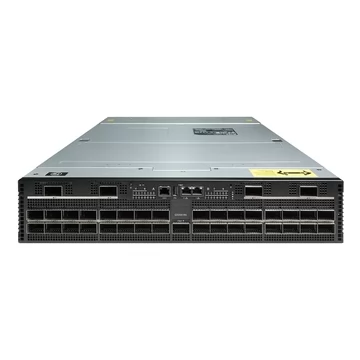
The Quantum-X800 Q3400-RA operates at XDR 800Gb/s per logical port. It provides 144 XDR 800Gb/s ports across 72 physical twin-port OSFP cages, with an aggregate bidirectional throughput of 115.2 Tb/s. It is designed for next-generation, extreme-scale AI and HPC fabrics, including NVIDIA DGX B300 and other validated Quantum-X800 architectures.
Quantum-2 — QM9700 / QM9790
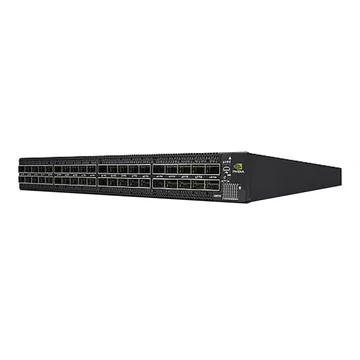
Quantum-2 switches operate at NDR 400Gb/s. The QM9700 and QM9790 provide 64 logical NDR 400Gb/s ports through 32 physical twin-port OSFP cages, with 51.2 Tb/s of aggregate bidirectional throughput. They are widely deployed with H100, H200, ConnectX-7, and other NDR-based AI and HPC systems.
Quantum HDR — MQM8700 / MQM8790
The Quantum HDR generation supports HDR 200Gb/s connectivity. These switches provide 40 QSFP56 ports and up to 16 Tb/s of aggregate bidirectional throughput. They are suitable for small-to-medium AI clusters, enterprise HPC environments, and established ConnectX-6-based infrastructures.
Switch-IB 2 — MSB7800 / MSB7890
Switch-IB 2 supports EDR 100Gb/s InfiniBand. These systems provide 36 QSFP28 ports and approximately 7.2 Tb/s of aggregate bidirectional throughput. They remain useful for legacy HPC environments and cost-sensitive deployments that continue to operate EDR infrastructure.
Managed vs. Unmanaged: Which Do You Need?
Managed switches such as the QM9700 and MQM8700 include an onboard management processor and integrated subnet management capabilities. The QM9700's embedded subnet manager can support fabrics of up to approximately 2,048 nodes, depending on software and system configuration. Management functions include CLI, WebUI, SNMP, and other supported management interfaces.
Managed switches are best suited to standalone clusters, smaller fabrics, and environments where administrators want simplified deployment without relying on a separate server for the subnet manager.
Unmanaged switches such as the QM9790 and MQM8790 do not provide the same onboard management environment and therefore require an external subnet manager, such as NVIDIA UFM or OpenSM. They are commonly used in larger fabrics where centralized management is already deployed.
Managed switches generally cost more because of their integrated management capabilities, while unmanaged switches can be more cost-effective in large, standardized environments with existing external fabric management infrastructure.
Airflow Direction: Get This Right
Airflow mismatch is a common deployment problem that can cause inefficient cooling, elevated component temperatures, and long-term reliability issues. The airflow suffix in the NVIDIA legacy ordering part number identifies the direction of airflow.
NS2F / HS2F — P2C, or Power-to-Connector airflow: Cold air enters through the power supply side and exhausts through the connector or port side. This configuration is appropriate when the cold aisle faces the power supply side of the switch.
NS2R / HS2R — C2P, or Connector-to-Power airflow: Cold air enters through the connector or port side and exhausts through the power supply side. This configuration is appropriate when the cold aisle faces the port side.
Always match the airflow direction to the hot-aisle/cold-aisle design of your data center.
Available NVIDIA InfiniBand Switch Models
Quantum-X800 Series — XDR 800Gb/s
Q3400-RA — 144-Port XDR 800G Managed Switch
· 144 logical XDR 800Gb/s ports across 72 physical twin-port OSFP cages
· 115.2 Tb/s aggregate bidirectional throughput
· NVIDIA Quantum-3 switch architecture
· SHARP v4 hardware-accelerated in-network computing
· Self-healing fabric capabilities designed for rapid recovery from link failures
· Adaptive routing and telemetry-based congestion control
· Designed for next-generation, large-scale AI factories and HPC clusters
Quantum-2 Series — NDR 400Gb/s
QM9700 — 64-Port NDR 400G Managed Switch
Legacy OPN examples: MQM9700-NS2F / MQM9700-NS2R
· 64 logical NDR 400Gb/s ports across 32 twin-port OSFP cages
· 51.2 Tb/s aggregate bidirectional throughput
· Onboard subnet manager for simplified standalone fabric deployment
· SHARP v3 hardware-accelerated in-network computing
· Supports NDR and selected backward-compatible InfiniBand connectivity modes through validated cable configurations
· Can support up to 128 NDR200 200Gb/s connections in supported split configurations
· MLNX-OS management environment with CLI, WebUI, SNMP, and other supported management interfaces
· P2C and C2P airflow variants available
QM9790 — 64-Port NDR 400G Unmanaged Switch
Legacy OPN examples: MQM9790-NS2F / MQM9790-NS2R
· Same Quantum-2 switching architecture and 51.2 Tb/s aggregate bidirectional throughput as the QM9700
· 64 logical NDR 400Gb/s ports across 32 twin-port OSFP cages
· Requires an external subnet manager and fabric management environment
· Suitable for NVIDIA UFM- or OpenSM-managed fabrics
· Cost-effective for large-scale standardized deployments
· SHARP v3 in-network computing support
· P2C and C2P airflow variants available
Quantum HDR Series — 200Gb/s
MQM8700-HS2F / MQM8700-HS2R — 40-Port HDR 200G Managed Switch
· 40 QSFP56 ports
· 16 Tb/s aggregate bidirectional throughput
· Sub-130ns-class switch latency under supported conditions
· Onboard subnet manager with MLNX-OS management
· Supports up to 80 HDR100 100Gb/s connections through supported port-split configurations
· P2C and C2P airflow variants available
MQM8790-HS2F / MQM8790-HS2R — 40-Port HDR 200G Unmanaged Switch
· Uses the same NVIDIA Quantum HDR switching architecture
· Externally managed through an external subnet manager
· Cost-effective option for centrally managed HDR fabrics
· Hot-swappable redundant power supplies and fan modules
· P2C and C2P airflow variants available
The Compatible Optics Advantage: Why Pay Double for the Same Performance?
Cost Comparison: All-OEM vs. FiberMall-Optimized
Consider a representative NDR deployment using one QM9700 switch and 16 optical 400Gb/s server links.
Because the QM9700 uses twin-port OSFP cages on the switch side while ConnectX adapters use single-port OSFP or QSFP112 interfaces, the optical BOM should be calculated according to the actual link architecture rather than assuming that every physical transceiver is the same.
For 16 optical NDR links, a typical architecture may require eight switch-side twin-port 2×400G OSFP transceivers, 16 host-side single-port 400G transceivers, and the appropriate fiber cabling.
Using the original illustrative pricing assumptions, an NVIDIA-branded QM9700-class switch is estimated at approximately $35,000, compared with approximately $25,000 for a competitively priced FiberMall-supplied configuration.
For the optical interconnect portion of the example, the estimated OEM-branded optics budget is approximately $32,000, while the equivalent FiberMall-compatible optical solution is estimated at approximately $11,200.
This produces an illustrative total of approximately $67,000 for the OEM-based configuration versus approximately $36,200 for the FiberMall-optimized configuration, representing savings of approximately 46%.
Actual BOM requirements and pricing depend on link distance, endpoint form factor, cable topology, transceiver type, quantity, and current market availability. Fiber cabling and other infrastructure costs should also be included when calculating a final deployment budget.
Why FiberMall Optics Perform Reliably in NVIDIA Environments
Every compatible transceiver and cable we manufacture goes through a rigorous validation process:
· 100% end-of-line testing on production units rather than relying solely on sample-based inspection
· Platform-specific pre-qualification against supported NVIDIA switch and adapter configurations
· MSA-compliant designs combined with platform-specific interoperability testing
· Bit-error-rate testing at the rated link speed
· Optical and electrical performance verification under specified operating conditions
· Commercial and industrial temperature options, typically 0°C to 70°C and -40°C to 85°C depending on the specific product
The result is a range of compatible interconnect products designed and validated to establish reliable links and meet the required signal-integrity and performance specifications in supported NVIDIA configurations.
Complete Your InfiniBand Solution
Every switch requires a complete interconnect ecosystem to operate. FiberMall supplies switches, transceivers, cables, fiber assemblies, and compatible network adapters for supported InfiniBand deployments.
Optical Transceivers
· 1.6T Twin-Port OSFP (2×800G XDR) — For Quantum-X800 switch-side connectivity, including supported multimode and single-mode optical options. Q3400 systems use twin-port OSFP interfaces that provide two 800Gb/s XDR ports from each physical cage.
· 800G Single-Port OSFP — For compatible XDR network adapters and endpoints requiring a single 800Gb/s interface.
· 800G Twin-Port OSFP (2×400G NDR) — For Quantum-2 switch-side connectivity. Each switch-side twin-port OSFP contains two independent 400Gb/s optical engines.
· 400G Single-Port OSFP / QSFP112 — For compatible ConnectX-7 adapters and other supported NDR endpoints. Single-port 400G OSFP devices are intended for network adapters and must not be inserted into Quantum-2 twin-port OSFP switch cages.
· 200G QSFP56 — For Quantum HDR switches and ConnectX-6-based HDR deployments, with supported SR4, FR4, and other application-specific optical variants.
· 100G QSFP28 — For Switch-IB 2 EDR switches and compatible EDR network adapters.
DAC & AOC Cables
· XDR Twin-Port OSFP DAC/LACC and optical cable solutions — For short-reach and supported breakout connectivity in Quantum-X800 environments.
· NDR Twin-Port OSFP DAC/ACC — Direct-attach and active copper solutions for short-distance NDR links between Quantum-2 switches and compatible 400G endpoints.
· Optical NDR links — Longer native NDR connections are commonly implemented using compatible twin-port switch-side transceivers, single-port endpoint transceivers, and detachable fiber cabling.
· Backward-compatible AOC solutions — Specific NVIDIA-supported AOC architectures can downshift Quantum-2 interfaces for connectivity to HDR 200Gb/s systems.
· QSFP56 DAC/AOC — For HDR 200Gb/s deployments.
· Breakout and compatibility cables — Validated twin-port OSFP-to-QSFP56 and related assemblies can support selected NDR-to-HDR, HDR100, or EDR compatibility scenarios. The exact supported data rate depends on the cable design, lane rate, modulation format, switch firmware, and endpoint.
Not every physical OSFP-to-QSFP cable supports every InfiniBand generation. In particular, NDR uses 100G PAM4 per lane, HDR uses 50G PAM4 per lane, and EDR uses 25G NRZ per lane. Backward compatibility therefore requires the correct NVIDIA-qualified or platform-validated cable architecture rather than a simple passive pin breakout.
Network Adapters
· ConnectX-8 XDR 800G — For current Quantum-X800 XDR deployments and supported next-generation AI/HPC architectures
· ConnectX-7 NDR 400G — Available with supported single- and dual-port configurations depending on adapter model and form factor
· ConnectX-6 HDR 200G — Available in supported single- and dual-port QSFP56 configurations for HDR environments
NVIDIA InfiniBand Switch Buying FAQ
What's the difference between managed (QM9700) and unmanaged (QM9790) InfiniBand switches?
Both are based on NVIDIA Quantum-2 technology and provide 64 NDR 400Gb/s ports through 32 twin-port OSFP cages, delivering 51.2 Tb/s of aggregate bidirectional throughput.
The QM9700 includes an onboard management processor and MLNX-OS environment with integrated subnet management capabilities, CLI, WebUI, SNMP, and other supported management functions. Its embedded subnet manager can support fabrics of up to approximately 2,048 nodes, depending on system and software configuration.
The QM9790 is an unmanaged switch and relies on an external subnet manager running elsewhere in the fabric, typically through NVIDIA UFM or OpenSM.
Choose the QM9700 for standalone clusters or smaller deployments where integrated management simplifies deployment. Choose the QM9790 for larger, centrally managed fabrics where an external subnet manager and UFM infrastructure are already available.
How do I determine the correct airflow direction for my rack?
Check which side of the switch faces the cold aisle.
If the cold aisle is at the front or connector side, select C2P airflow, corresponding to NS2R or HS2R variants in the relevant legacy ordering numbers. Cold air enters through the connector side and exits through the power supply side.
If the cold aisle is at the power supply side, select P2C airflow, corresponding to NS2F or HS2F variants. Cold air enters through the power supply side and exits through the connector side.
Data center layouts vary, so always verify the airflow arrangement of the specific rack and facility rather than assuming one airflow direction is universal. Incorrect airflow can cause the switch to ingest hot exhaust air, increasing operating temperatures and potentially reducing long-term reliability.
Can I use FiberMall optics and cables with NVIDIA InfiniBand switches?
Yes, provided that the exact transceiver or cable configuration has been validated for the target switch, adapter, speed, and link architecture.
FiberMall tests compatible transceivers and cables against supported NVIDIA platforms and verifies key parameters such as link establishment, optical performance, signal integrity, and bit-error rate.
MSA compliance by itself does not guarantee complete InfiniBand interoperability. NVIDIA platforms use different form factors, electrical lane rates, modulation schemes, firmware requirements, and link configurations across EDR, HDR, NDR, and XDR generations. For this reason, platform-specific validation is an important part of selecting a compatible third-party optical or cable solution.
What is the typical lead time for InfiniBand switches in 2026?
Lead times vary significantly by switch model, configuration, NVIDIA allocation, region, and order quantity.
Mature NDR and HDR products may have different availability from newer XDR Quantum-X800 systems, and availability can change quickly. Rather than relying on a fixed industry-wide lead-time estimate, customers should confirm the current ETA for the exact model and configuration at the time of quotation.
FiberMall provides a confirmed estimated delivery schedule with each quotation and updates customers if supply conditions change.
Do I need NVIDIA UFM (Unified Fabric Manager) for my deployment?
UFM is strongly recommended for multi-switch and large-scale InfiniBand fabrics. It provides centralized fabric discovery, monitoring, telemetry, congestion analysis, topology visibility, automation, and security-related management capabilities.
For unmanaged switches such as the QM9790 and MQM8790, an external subnet manager is required. NVIDIA UFM can provide this function, while OpenSM can also be used in appropriate environments.
For managed switches such as the QM9700 and MQM8700, the onboard subnet manager can be sufficient for a single-switch or relatively small fabric. However, UFM adds centralized monitoring, management, analytics, and automation capabilities that become increasingly valuable as the fabric grows.
How does InfiniBand compare to Ethernet for AI clusters in 2026?
InfiniBand remains one of the leading networking technologies for large-scale GPU-to-GPU communication and distributed AI training. NVIDIA Quantum platforms combine very low switch latency, RDMA, adaptive routing, congestion control, and SHARP in-network computing, which can offload selected collective communication operations directly into the network fabric.
Ethernet has also advanced significantly. The Ultra Ethernet Consortium released its 1.0 specification in June 2025 and continued updating the specification through 2026. Ultra Ethernet is designed to improve transport efficiency, congestion management, scalability, and reliability for AI and HPC workloads.
NVIDIA's Spectrum-X Ethernet platform is another high-performance alternative, particularly for organizations that prefer Ethernet-based infrastructure or operate mixed AI, cloud, storage, and general-purpose workloads.
For large-scale AI training where collective communication efficiency, predictable latency, and tightly integrated GPU networking are priorities, InfiniBand remains widely deployed. For mixed workloads and Ethernet-centric data centers, modern high-performance Ethernet solutions are increasingly viable.
The right choice depends on workload characteristics, existing infrastructure, cluster scale, network-management requirements, and total cost of ownership.
Are NDR switches backward compatible with HDR and EDR equipment?
Yes, but backward compatibility depends on the exact cable, adapter, link mode, and firmware combination.
NVIDIA Quantum-2 NDR switches support several InfiniBand speed modes, including:
· NDR — 400Gb/s using four lanes of 100G PAM4
· NDR200 — 200Gb/s using two lanes of 100G PAM4
· HDR — 200Gb/s using four lanes of 50G PAM4
· HDR100 — 100Gb/s using two lanes of 50G PAM4
· EDR — 100Gb/s using four lanes of 25G NRZ
Because these generations use different lane rates and, in the case of EDR, a different modulation format, backward compatibility is not achieved simply by connecting any generic OSFP-to-QSFP cable.
For example, a Quantum-2 switch can connect to compatible ConnectX-6 HDR adapters using specific NVIDIA-qualified or platform-validated OSFP-to-QSFP56 HDR cable assemblies. Other validated cable configurations can support HDR100 and EDR endpoints.
This allows organizations to deploy NDR switching infrastructure while continuing to use selected existing HDR or EDR equipment during a phased migration. Always verify the specific switch, HCA, cable, firmware, and target link speed before deployment.