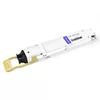
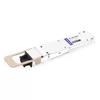
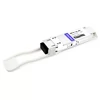
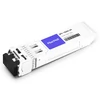
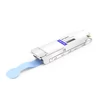
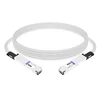
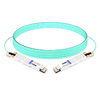
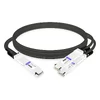
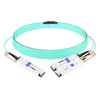
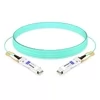
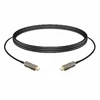
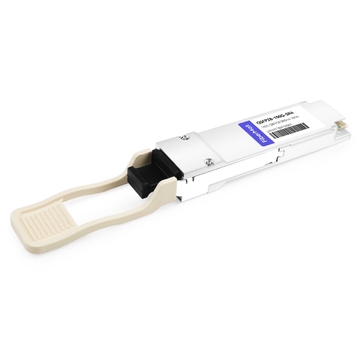
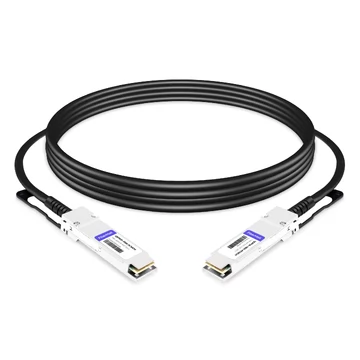
100G QSFP28 InfiniBand EDR Compatible Optical Cable: A Comprehensive Guide
The development of data-driven technologies together with high-performance computing has created an urgent need for networking solutions that provide faster and better performance. The 100G QSFP28 InfiniBand EDR compatible optical cable stands out among modern solutions because it delivers both high-speed data transmission and dependable network connection abilities.
Introduction to 100G QSFP28 InfiniBand EDR
Understanding the Importance of InfiniBand EDR in HPC
In a high-assets-HPC environment, when high-speed networks or ultra-low latency were a requirement, InfiniBand EDR (Enhanced Data Rate) would be an asset. In the case of reaching up to 100Gbps data rates, InfiniBand EDR exceeds a situational number of memory architectures. These include building blocks for addressing problems at scale, such as large-scale compute clusters, data analysis workloads, and AI training models.
Thus, during most discussions on market analysis, it remains undisputed that over 60% of the best-performing systems advantageous to InfiniBand could be traced with this new network technology. An EDR network with newer creative premises-guaranteed results of high-performance computing with controlled latency when differentiating itself from the capacity to provide increased mediation among nodes and swift executions upon high computational tasks under severe conditions.
Main Concepts of 100G QSFP28
100G QSFP28 technology is known for getting placed very high when it came to high-speed data transmissions. It was mandatory to evolve a transmission solution capable enough to cater to the rising needs set by our ultra-modern networking and data center environments. The QSFP28 was an abbreviation of 100Gb/s support by the use of four self-governing 25Gbps lanes. With a particular focus on this form factor, a modular transceiver, the 100G Ethernet has to meet high bandwidth, high power, and scalability requirements.
With extensive scaling being one core attribute of 100G QSFP28 technology, the suffering need for so rapidly and so remarkably efficient data transfer finds its justification in cloud computing, artificial intelligence, and big data analytics. Technologies in terms of jurisdiction now allow QSFP28-systems to operate under up to 3.5 watts power consumption, and remain some pretty huge cuts to the operating costs.
Significance in Modern Data Centers
Quality, implying the greater need for bandwidth, reduces latency and energy conservation as the major focus between technology and minority data centers. In terms of the current data slur and a significant increase in data-the-cloud, AI, machine learning, and IoT, data centers are forced to venture on solutions that are scalable and strong enough to handle extremely massive incoming traffic amounts.
A total of 20 zettabytes of IP traffic in global data centers will be in the year 2025, according to the 2023 report, with a C. A. G. of 25.4%. Quite different from development, the QSFP28 modules instead are used to provide 100Gbps connections in hyperscalar and enterprise data centers worldwide. Most notably, since the design is so compact, QSFP28 transceivers allowed for high port densities, thus saving a lot of space in data centers.
Technical Deep Dive into 100G QSFP28 InfiniBand EDR
Overview of 100G QSFP28 Specifications
100G QSFP-28 modules are designed to provide higher-speed and high-density network solutions, making them an important component of myriad data centers and enterprise networks. Generation of 100G using 4x25G electrical lanes requires the use of advanced modulation methods such as PAM4 and NRZ for proper operations. Dimensions of this module in the QSFP-28 form factor are very compact; that is, approximately 18.35mm X 71mm X 8.5mm thus making either operation very effective and highly scalable within a confined space.
Key features include them being IEEE standard compliant for standards such as 802.3bm related to 100G Ethernet, and they can support different protocols such as Infiniband and OTN, i.e., Optical Transport Network. Furthermore, the transmission distances supported by them range from 70 meters on OM3 on a multimode fiber to 10 kilometers or more to another city on single-mode fiber together with DFB or EML laser.
Protocols and Connector Types Demystified
The 100G QSFP-28 optical transceiver is able to support various types of protocols and connectors, and it is designed to function in multiple high-speed networking applications. The main protocols include 100GBASE-SR4, 100GBASE-LR4, and 100GBASE-ER4, all created according to different transmission distances. For instance, 100GBASE-SR4 is meant to cover very short distances over multimode fiber, formerly limited to 100 meters over OM 4 fiber.
At the connector types end, MPO/MTP connectors and duplex LC connectors are the most predominant types used for QSFP28 modules, each having its own distinctive advantages. MPO/MTP connectors mostly come handy for parallel optics and multidata links, while LC connectors are mostly employed for serial connection links to a further distance or possibly single mode fiber.
Comparison: EDR vs. Other Standards
Comparing EDR to FDR and HDR Standards
Some distinguish between EDR, FDR (Fourteen Data Rate), and HDR (High Data Rate) by examining, for example, capacity, CPU operation, and rate of data. While FDR clocked a 56Gbps operation, that was a big hit back then; however, FDR is not quite as effective when critically compared to EDR, while HDR can run at both 100 and 200Gbps. For high throughput capacities, signal integrity remains a major advantage concerning EDR for fast and large systems. `HDR, on the other hand, extends support towards EDK even and goes up to 200Gbps (2 times the throughput) to facilitate rapid growth for the next-generation data centers.
Why EDR Beats Ethernet Competitors
One of the very few differences one can see between the Enhanced Data Rate (EDR) InfiniBand options and the Ethernet alternatives is that of performance, scalability, and where each technology suits the best. Intended for a lump-sum data-throughput of 100 Gbps; EDR carries quite-tiny levels of end-to-end latency, usually at about 600 ns; thus, it is an ideal match for high-performance computing (HPC), artificial intelligence workloads, and tasks heavily dependent on high latency in their varied operations.
In contrast, the growing homogenization of Ethernet with standard networking surroundings and large-scale cloud infrastructures solidifies 100GbE and the forthcoming 400GbE options rather seriously; connecting the protocol with substantially reduced microseconds of latency against (further) performance enhancement and the inherent pluses of multi-vendor mix. In addition to that, it also proves a bargain compared to the one established by EDR for those original use cases in which just that little increased latency above ultra-low latency is considered bearable.
Implementation Insights for 100G QSFP28 InfiniBand EDR
Selection Criteria for Cables and Transceivers
Types of Cables
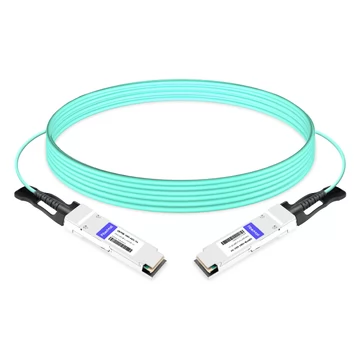
The Direct-Attach Copper (DAC) cables make it inexpensive to join data center resources. In addition to this, they are low in terms of latency and power when compared to other types. Active Optical Cables (AOCs) themselves stand out, as they are very versatile between short and middle distances of up to 100 m and can be a smarter choice for mid-distance links, giving them comparatively longer reach.
Optical Transceivers
In a software-defined software deployment, QSFP28 optical transceivers are probably 'Short Range' and 'Long Range.' One option could be the SR4 over multimode fiber QSFP28 transceivers within 100 meters when equipped to overcome intra-rack or rack-to-rack distances. The second option is the LR4 QSFP28 transceivers working over single mode fiber up to a distance of 10 km.
Compatibility and Interworking
The choice of cables and transceivers that are fully compatible with 100G InfiniBand EDR hardware is of paramount importance. Vendor certifications and interoperability are the key factors for ensuring hardware compatibility for optimal network performance.
Understanding Cable Types: AOC vs. DAC
Active Optical Cables (AOCs):
This cable shows its birth when it comes to longer distance transmission. It offers a high-speed connection over lengths as great as 100 meters or even more. Converting the electric signal to optical, it aids in the elimination of signal losses and in interference. Thus, in large installations with racks to handle, which will form huge length of extensions, AOC is indeed a good answer. AOC's guideline is for low-weight, flexibility, and thus, for easy cable management.
Direct Attach Copper Cable (DAC):
QEICs perform well in close contacts, for situations where the distance is between 3 and 5 meters. With twin axial cables, these cabling solutions prove to be very cost-effective in cases of a densely blocked environment with racks closely placed. With this particular feature, DACs come clear at the lower end of power utilization range in comparison to AOCs, which make them really advantageous in short-range interconnecting in hyperscale and enterprise-grade data centers.
Conclusion: The Future of 100G QSFP28 InfiniBand EDR
Summarizing the Value Proposition of 100G QSFP28 InfiniBand EDR
A 100G QSFP28 Quad Small Form-factor Pluggable Business Entity (EDR) is considered as a higher-speed, super-yank data fuel solution for data center and high-performance computing (HPC) environments. As the mirror rate stands at 100 Gbps per port, 100G QSFP28 should or could surpass every other performance-$everything a data center administrator can dream of in terms of configuration quality for third- or sub-milliseconds and incredulous volumes of processing.
When comparing with FDR and HDR as well as Ethernet, which can be seen on the same level in SES building, EDR poses immense advantage with speed. Asynchronicity in the communication complexities within distributed systems asks for precision regarding synchronization on components like QSFP28 transceivers along with essential cables such as DACs and AOCs, which ensure low-priced and stable functional excellence.
What Are the Emerging Trends Associated with InfiniBand Technology?
The latest InfiniBand technology is still at a development, as the population of a high-data-rate-per-port 1 TB connected; great capabilities include developing high latency level at valiant denominator. One of the flyovers in the currently progressing phase is bringing the second NDR (400 Gb/s) generation of InfiniBand to a larger area out of bandwidth constraints, or basic advancements in HDR (200 Gb/s) and attheming along. In short, the trend is driven by extensive incorporation of InfiniBand with advanced network automation and orchestration tools, enabling management of more complex HPCs centralized in nature while also offering an additional layer of energy savings for smart gateways in implementation.
Frequently Asked Questions (FAQs)
What constitutes a 100g, qsfp28 to qsfp28 active optical cable?
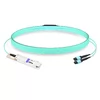
A 100g qsfp28 to qsfp28 active optical cable (AOC) is an optical interconnect that links two QSFP28 ports over multi-mode fiber (MMF) using integrated transceiver modules and lasers, often compliant with QSFP28 MSA and IEEE 802.3bm. This is the cable that delivers 100G InfiniBand EDR performance stores for the add, and cannot reach up to 100 meters (850nm 100m MMF) even with latency and power lower than those of DACs in many data center and HPC deployments.
Is the QSFP28 Infiniband EDR active c non-compliant with NVIDIA and Mellanox compatible?
Definitely the active All ZR4 Optics QSFP28 Infiniband EDR OEM branded 100g cables work fine with NVIDIA ConnectX-5 HCAs and switches. Watch out for the phrase "compatible with NVIDIA" or specific part number compatibility information like MMA1B00-E100compatible 100G or MFA1A00-E001 compatible.
What are the differences between the EDR transceivers and QSFP28 active optical cables?
Since an EDR transceiver is a pluggable optical module that converts electronics to optics and vice versa, an active optical 100Gbps DAC is compatible with Mellanox LinkX (SDR / QDR / FDR / FDR10 / EDR) and directly connects two EDR ports on one or two ends. AOC provides the only QSFP28 to QSFP28 solution for 100G InfiniBand EDR links, with fiber speed offering flexibility, better reach, longer cable length, and better electromagnetic interference protection ability.
How can I confirm compatibility between a 100g QSFP28 Infiniband EDR AOC and my switch or HCA?
To assure compatibility, check to see that the cable or transceiver modules list supported devices (e.g., "compatible 100G QSFP28 InfiniBand EDR," "ConnectX-5 HCA," specific switch models). Look for QSFP28 MSA compliance and IEEE 802.3bm conformance where applicable. Check vendor interoperability notes and the related co-competency notes for switch/HCA from Mellanox LinkX (MMA1B00-E100, MFA1A00-E001) online in intercompatibility matrices for multivendor and OEM-certified options.