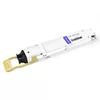
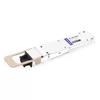
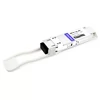
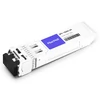
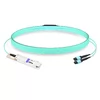
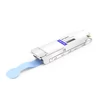
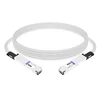
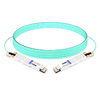
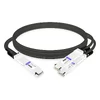
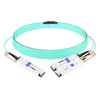
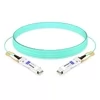
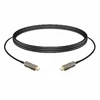
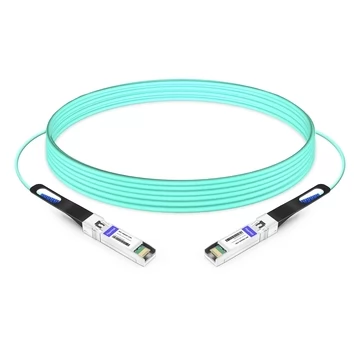
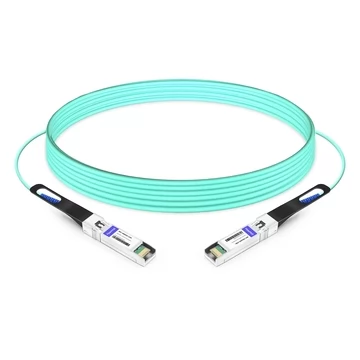
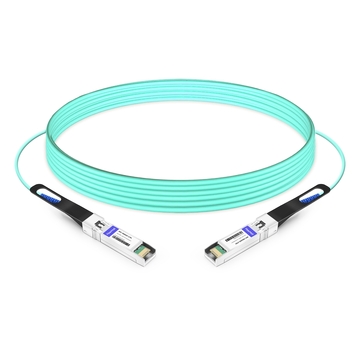
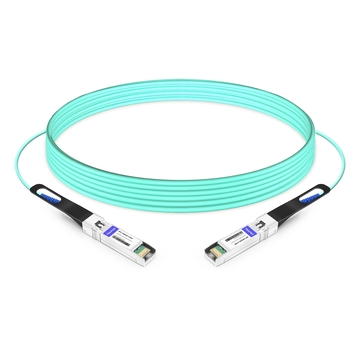
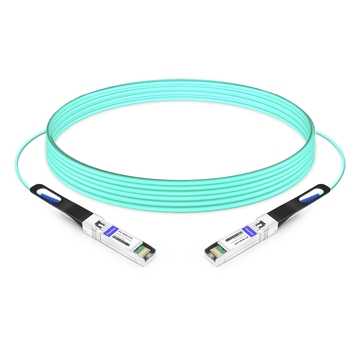
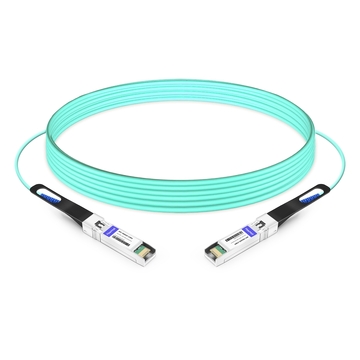
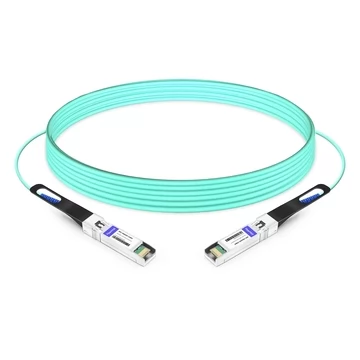
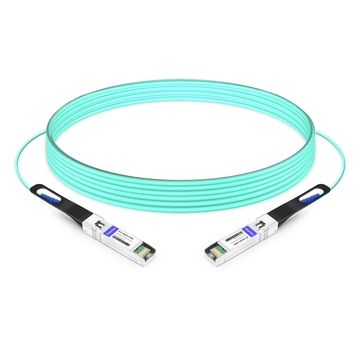
Standard 10G SFP+ AOCs are not designed for continuous operation inside an immersion cooling tank. Coolant ingress, material swelling, chemical extraction, and changes in optical coupling can damage an unqualified cable assembly and disrupt high-density compute nodes.
FiberMall 10G SFP+ immersion cooling AOCs use sealed module construction, fluid-compatible materials, and fluid-specific qualification procedures. They can also be coded and pre-verified on selected Cisco, Arista, Juniper, NVIDIA Networking, and other switch platforms, helping immersion-cooled deployments maintain stable 10GbE connectivity.
Why Standard 10G SFP+ AOCs Fail in Immersion Cooling
Immersion cooling places servers, switches, and selected interconnects in a dielectric liquid that captures and transfers heat more efficiently than conventional air-cooling systems. Depending on the facility design, immersion cooling can reduce cooling overhead, improve energy efficiency, and support substantially higher rack power densities.
However, standard active optical cables are normally engineered for dry, air-cooled data center environments. When an unqualified AOC is continuously submerged, three major failure mechanisms may develop.
1. Coolant Ingress into the Optical Engine
Standard module seals, adhesives, and mechanical interfaces may not be designed for continuous contact with dielectric fluids.
Over time, an incompatible coolant may penetrate the transceiver housing or migrate through gaps in the module assembly. It may contaminate optical surfaces, affect optical adhesives, alter optical coupling, or damage internal electronic components.
The result may be reduced optical margin, increased bit-error rates, intermittent link flaps, or complete link failure.
2. Cable-Jacket Degradation
Some conventional PVC and other polymer cable jackets may be incompatible with hydrocarbon-based, mineral-oil-based, ester-based, silicone-based, or fluorinated coolants.
Depending on the exact jacket formulation and coolant chemistry, prolonged exposure may cause the jacket to soften, swell, shrink, harden, become brittle, or release additives into the cooling fluid. This can reduce cable reliability, expose internal fibers, and introduce contaminants into the immersion system.
Material compatibility must therefore be evaluated using the exact coolant, cable material, operating temperature, and required exposure duration. Compatibility with one dielectric fluid does not automatically guarantee compatibility with another.
3. Thermal-Cycling and Mechanical Stress
Immersion-cooled equipment experiences different temperature gradients, fluid-flow forces, and thermal-cycling conditions from equipment installed in air-cooled racks.
The module housing, sealants, PCB, optical components, cable jacket, and strain-relief materials may expand and contract at different rates. Repeated thermal cycling can stress seals, optical alignments, cable-entry points, and connector interfaces.
The result may be intermittent links, rising bit-error rates, unexpected cable failures, and costly tank maintenance.
An immersion-rated AOC is therefore not simply a standard AOC with a different marketing label. It requires a different material set, mechanical design, sealing approach, and qualification process.
The FiberMall Solution: 10G SFP+ Immersion Cooling AOC
FiberMall 10G SFP+ immersion cooling AOCs are designed for direct contact with qualified single-phase or two-phase dielectric fluids.
Each cable uses sealed SFP+ module construction, fluid-compatible cable materials, reinforced cable-entry points, and optical and electrical components selected for the intended immersion environment. Fluid compatibility and immersion testing are performed according to the exact coolant and project requirements.
Key Benefits
• Coolant-qualified construction — Available for selected fluorinated fluids, PAO-based coolants, silicone oils, synthetic esters, mineral oils, and other dielectric fluids. Compatibility must be confirmed using the exact coolant brand, product grade, operating temperature, and exposure duration.
• Switch-verified interoperability — Cables can be coded and tested on selected Arista, Cisco, H3C, Juniper, NVIDIA Networking, HPE, Ruijie, Huawei, and Dell platforms. Testing is based on the exact switch model, port type, firmware version, and coding profile.
• Factory-direct flexibility — Standard lengths include 1 m, 3 m, 5 m, and 10 m, with custom lengths available up to 100 m.
• Code-on-demand EEPROM — Platform-specific and dual-vendor EEPROM coding options are available for mixed-vendor network environments.
• Transparent B2B pricing — Factory-direct quotations, project-specific configurations, and flexible lead times are available for OEM, ODM, and data center deployments.
Specifications That Matter for Immersion-Cooled 10G Networks
Form Factor and Performance
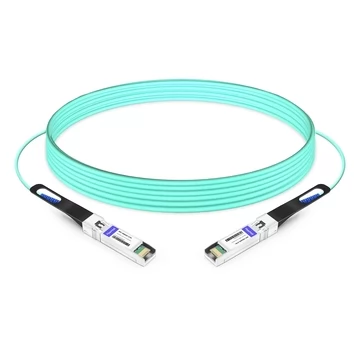
The FiberMall 10G SFP+ immersion cooling AOC uses an SFP+ connector at each end and integrates the optical transmitters, receivers, and multimode fiber into one factory-terminated cable assembly.
The nominal Ethernet line rate is 10.3125 Gb/s per direction for 10 Gigabit Ethernet applications.
The primary supported application is 10GbE. Support for 8G or 10G Fibre Channel is available only on separately designed and qualified part numbers. Fibre Channel operation should not be assumed solely because the cable uses an SFP+ form factor, since different Fibre Channel generations use different line rates, coding requirements, and host-interface behavior. For example, 8G Fibre Channel operates at an 8.5 GBd line rate.
The optical engine typically uses an 850 nm VCSEL transmitter and a PIN photodiode receiver with a transimpedance amplifier.
The internal transmission medium is multimode optical fiber. The exact fiber grade and cable construction depend on the selected product configuration.
Available cable lengths range from 1 meter to 100 meters. Actual maximum reach depends on the cable design, host platform, coolant environment, operating temperature, and required system margin.
Typical power consumption for selected configurations is less than 0.35 watts per cable end. The applicable typical and maximum power values should be confirmed in the specific product datasheet.
The standard operating module case-temperature range is 0°C to 70°C. Extended-temperature or industrial-temperature configurations may be available, subject to separate product qualification.
Coolant and Environmental Compatibility
FiberMall 10G SFP+ immersion cooling AOCs can be configured for selected single-phase and two-phase dielectric cooling systems.
Single-phase and two-phase immersion fluids have different chemical, thermal, pressure, and material-compatibility characteristics. A cable qualified for one single-phase hydrocarbon coolant should not automatically be considered suitable for a two-phase fluorinated fluid.
The cable assembly uses fluid-resistant housing, cable-jacket, sealing, and strain-relief materials selected for the target coolant. The optical fiber also provides electrical isolation and immunity to electromagnetic interference along the transmission path.
Depending on the project requirements, qualification may include:
• Visual and dimensional inspection before and after immersion
• Mass, volume, hardness, or tensile-property measurements
• Powered and unpowered fluid-exposure testing
• Thermal-aging and thermal-cycling testing
• Leak-resistance or sealing verification
• Optical power and bit-error-rate measurements
• Cable-jacket swelling, hardening, cracking, and extraction analysis
• Post-immersion switch interoperability testing
The exact test fluid, exposure temperature, test duration, sample quantity, and acceptance criteria should be defined before production.
Standards and Compliance
Applicable SFP+ interface, mechanical, power, management, and diagnostic references may include SFF-8418, SFF-8419, SFF-8432, and SFF-8472, as applicable.
SFF-8431 may appear in older product documentation, but its interface functions have been replaced or divided among newer SFF specifications. SFF-8432 defines the mechanical requirements for the SFP+ module and cage, while SFF-8472 covers the management and digital diagnostic interface.
The Ethernet implementation is based on the 10GbE architecture defined by IEEE 802.3ae, including the 10GBASE-SR optical reference where applicable.
Regulatory compliance may include CE, FCC, and RoHS, subject to the applicable product declarations and test reports.
The product is manufactured under an ISO 9001-certified quality management system. ISO 9001 describes the manufacturer’s quality-management system and should not be presented as an individual product certification.
10G SFP+ Immersion AOC vs. Extender vs. DAC: Which Do You Need?
The correct 10G immersion interconnect depends on transmission distance, cable-routing space, serviceability, power consumption, host-port location, and whether the active optical components will remain inside or outside the coolant.
Immersion Cooling AOC
A 10G SFP+ immersion cooling AOC can support cable lengths from approximately 1 meter to 100 meters, depending on the selected configuration.
The SFP+ cable ends and optical cable can be fully submerged when the complete assembly has been qualified for the exact coolant and operating conditions.
An AOC is lightweight, flexible, electrically isolated, and immune to electromagnetic interference along the optical transmission path. It is suitable for intra-tank connections, connections between submerged systems, and longer links between immersion-cooled equipment and nearby network infrastructure.
Power consumption is low but not zero because each cable end contains an active optical transmitter and receiver.
Immersion Cooling Extender
An immersion extender moves the standard optical transceiver or another active component away from the submerged switch or server port.
The wet-side connector and extension cable may be submerged, while the conventional optical module remains above the coolant surface or inside a dry-side enclosure.
Typical extension lengths may range from approximately 1 meter to 3 meters, although the actual supported length depends on the extender design and host electrical interface.
An extender is suitable for installations that need to keep standard optical modules dry, move serviceable components to the tank surface, or reuse existing transceivers.
Its total power consumption depends on the extender design and the optical module installed on the dry side.
Immersion Cooling DAC
An immersion-rated DAC is normally used for short links ranging from approximately 1 meter to 7 meters.
The cable and both connector ends may be fully submerged only when the entire assembly has been qualified for the selected coolant.
A passive DAC contains no active electronics in the cable assembly and therefore consumes less cable-level power than an AOC. However, it is heavier, thicker, and less flexible than optical fiber, particularly at longer lengths.
Copper DACs are also more susceptible to electromagnetic interference than optical cables, although properly shielded assemblies normally provide good noise resistance.
An immersion DAC is best suited to very short, cost-sensitive connections where cable weight, bend radius, insertion loss, and routing space are acceptable.
When to Choose the 10G SFP+ Immersion Cooling AOC
Choose a 10G SFP+ immersion cooling AOC when:
• You require a flexible transmission distance beyond the practical reach of most passive DACs.
• You want a single factory-terminated cable assembly without separate optical transceivers and fiber patch cords.
• Your switches, servers, or network adapters are installed inside or immediately adjacent to the immersion tank.
• You need a lightweight cable with a smaller diameter and tighter routing capability than a long copper DAC.
• You require electrical isolation and immunity to electromagnetic interference along the data path.
• You want a replaceable pluggable cable assembly. Installation or replacement must still follow the immersion-system manufacturer’s electrical-isolation, coolant-handling, and maintenance procedures.
An SFP+ product may be electrically hot-pluggable in a conventional dry environment, but this does not automatically mean that it can be safely inserted or removed from energized equipment while submerged. Do not service live submerged connections unless the tank, host equipment, cable assembly, and operating procedure have all been specifically approved for that practice.
Switch and Platform Compatibility
FiberMall 10G SFP+ immersion cooling AOCs can be coded and tested for interoperability with selected network switches, servers, and adapters.
Potentially supported platforms include:
• Arista — Selected switches, including applicable 7000-series platforms with SFP+ or dual-rate SFP+/SFP28 ports
• Cisco — Selected Nexus 9000, Catalyst, UCS, and other platforms equipped with compatible 10G SFP+ ports
• Juniper — Selected QFX, EX, and MX platforms with compatible SFP+ interfaces
• NVIDIA Networking — Selected Spectrum and SN-series switches that support 10G operation on the relevant ports
• H3C, HPE, Ruijie, Huawei, and Dell — Selected switches and adapters with compatible SFP+ host interfaces
Compatibility must be confirmed using the exact:
• Switch, server, NIC, or line-card model
• Port type and supported data rate
• Network operating-system or firmware version
• EEPROM coding profile
• Third-party transceiver policy
• FEC or port-mode configuration, where applicable
• Required protocol
• Cable length and operating environment
Before shipment, each cable can be tested for EEPROM recognition, link establishment, and bidirectional traffic transmission on the specified target platform.
When dedicated test equipment is required, bit-error-rate testing can also be performed using a defined pattern, data rate, test duration, and acceptance threshold.
FAQ
What Is a 10G SFP+ Immersion Cooling AOC?
A 10G SFP+ immersion cooling AOC is an active optical cable with sealed SFP+ modules designed for operation while submerged in a qualified dielectric cooling fluid.
It combines the optical transmitters, receivers, and multimode fiber into one factory-terminated assembly for 10GbE links inside or near immersion-cooled data centers.
Unlike a standard AOC intended for air-cooled equipment, an immersion-rated cable uses housing, sealing, jacket, strain-relief, adhesive, and optical materials selected and tested for the target dielectric fluid.
Can I Use a Standard 10G SFP+ AOC in an Immersion Cooling Tank?
A standard AOC should not be submerged unless its manufacturer has specifically qualified the complete cable assembly for the exact coolant and operating environment.
Standard AOCs may contain seals, adhesives, cable jackets, labels, plastics, and optical components intended only for dry data center conditions. Prolonged coolant exposure may cause swelling, extraction, embrittlement, fluid ingress, optical contamination, or reduced link margin.
A standard cable may initially establish a link and still develop intermittent errors or premature failure after extended fluid exposure.
Which Dielectric Fluids Are Compatible?
FiberMall 10G SFP+ immersion cooling AOCs can be configured for selected fluorinated fluids, PAO-based coolants, silicone oils, synthetic esters, mineral oils, and other dielectric cooling fluids.
Compatibility must be confirmed using the exact:
• Coolant manufacturer
• Product name and grade
• Chemical formulation
• Single-phase or two-phase cooling architecture
• Normal and maximum fluid temperature
• Operating pressure, where applicable
• Required exposure duration
• Cable material and module construction
Compatibility with legacy 3M Novec or Fluorinert installations can be evaluated on request using the exact fluid grade and deployment conditions.
A general statement such as “compatible with mineral oil” or “compatible with fluorinated fluid” is not sufficient because different products within the same fluid category may interact differently with seals, jackets, adhesives, plastics, and optical materials.
How Far Can a 10G SFP+ Immersion Cooling AOC Reach?
Standard stock lengths include 1 m, 3 m, 5 m, and 10 m. Custom lengths up to 100 m are available for larger tanks, multi-rack systems, and row-level configurations.
Actual maximum supported reach depends on:
• Cable construction
• Internal multimode fiber
• Host transmitter and receiver performance
• Cable operating temperature
• Coolant environment
• Optical link margin
• Required bit-error-rate performance
• Target switch or adapter platform
The required cable length should be included when requesting compatibility and qualification testing.
Are These AOCs Compatible with Cisco, Arista, Juniper, and NVIDIA Networking Switches?
FiberMall can provide EEPROM coding and interoperability testing for selected Cisco, Arista, Juniper, NVIDIA Networking, H3C, HPE, Ruijie, Huawei, and Dell platforms.
However, compatibility cannot be guaranteed for an entire switch family based only on the vendor or series name.
The exact switch model, line card, port type, firmware version, port-speed setting, third-party transceiver policy, and required cable length must be confirmed before ordering.
Test reports for EEPROM recognition, link establishment, traffic transmission, and bit-error-rate performance may be provided according to the agreed project requirements.
Should I Choose an Immersion AOC, Extender, or DAC?
Choose an immersion cooling AOC when you need flexible reach from approximately 1 meter to 100 meters, lightweight cabling, electrical isolation, and EMI immunity inside or near the tank.
Choose an immersion extender when you want to keep conventional optical transceivers above the coolant surface or move serviceable components to a dry-side location.
Choose a sealed immersion DAC for short, cost-sensitive links, generally below 7 meters, when copper-cable weight, bend radius, insertion loss, and routing space are acceptable.
A passive DAC normally has the lowest cable-level power consumption because it contains no active optical electronics. An AOC offers lower weight and longer practical reach, while an extender provides flexibility in locating the active optical module.
Is a 10G SFP+ Immersion Cooling AOC Backward Compatible with 1G SFP?
A standard 10G SFP+ AOC should not be assumed to support 1GbE.
A switch port that accepts both 1G SFP and 10G SFP+ modules does not necessarily make a fixed 10G AOC capable of operating at 1 Gb/s. Most 10G AOCs are designed for a 10.3125 Gb/s host interface and may not support the electrical signaling, clocking, rate selection, or EEPROM configuration required for 1G operation.
Dual-rate 1G/10G operation is possible only when:
• The AOC is explicitly designed and specified for both rates
• Both cable ends support the required rate
• The host ports support the same dual-rate operation
• The firmware accepts the cable coding
• The ports can be manually configured or automatically negotiate the required rate
The exact host model and required data rate should be verified before deployment.
What Lengths and Custom Options Are Available?
Standard stock lengths include:
• 1 meter
• 3 meters
• 5 meters
• 10 meters
Custom lengths up to 100 meters are available, subject to optical and environmental qualification.