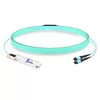
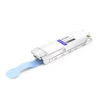
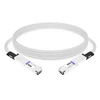
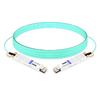
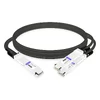
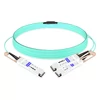
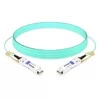
A 40G QSFP+ to 4×10G SFP+ breakout active optical cable splits one 40GbE port into four independent 10GbE links. This improves port utilization and simplifies connections between 40G leaf, top-of-rack, or aggregation switches and 10G servers, storage systems, and access switches.
Compared with separate optical transceivers and patch cords, an integrated breakout AOC provides lighter cabling, longer reach than passive copper, and immunity to electromagnetic interference along the optical transmission path. Each cable undergoes compatibility and signal-integrity testing, while custom lengths and platform-specific coding options are available upon request.
The Real Cost of 40G-to-10G Breakout
When a 40G aggregation or leaf switch must connect to four 10G servers, storage systems, or access switches, OEM-branded breakout AOCs may appear to be the safest option. However, network teams frequently encounter three challenges:
1. OEM pricing pressure — Vendor-branded QSFP+ to 4×SFP+ breakout AOCs can cost significantly more than compatible third-party assemblies, especially at lengths of 7 m, 10 m, or longer.
2. Compatibility uncertainty — A generic cable may fail vendor validation or EEPROM checks on platforms with strict compatibility controls, turning a routine installation into a failed-link troubleshooting session.
3. Unclear media selection — Many product pages provide specifications without explaining whether a passive DAC, active copper cable, AOC, or separate transceiver solution is appropriate for the required distance, power budget, airflow, and electromagnetic environment.
A 40G-to-10G Breakout AOC Built for Production Networks
FiberMall’s QSFP+ to 4×SFP+ breakout AOC is designed for reliable, high-density 40G-to-10G fan-out over integrated multimode optical fiber.
The assembly uses one QSFP+ active optical end and four SFP+ active optical ends. It divides a single 40GbE interface into four independent 10GbE links without requiring separate optical transceivers, an MPO breakout harness, or multiple fiber patch cords.
The target QSFP+ port must support 40G-to-4×10G breakout operation. Each 10G branch can then connect to a compatible 10GbE SFP+ port on a server, switch, storage device, or network appliance.
Key Benefits
Platform-specific compatibility options — Vendor-coded versions are available for Cisco, Arista, Juniper, Dell, NVIDIA/Mellanox, HPE, H3C, Extreme, Fortinet, and many other platforms. Compatibility should always be confirmed against the exact device model, port type, and software version.
Longer reach than passive copper — Available lengths typically range from 1 m to 100 m, depending on the specific cable design and platform qualification. This is well beyond the normal reach of passive breakout DACs.
Lighter and cleaner cable routing — Integrated optical fiber is thinner and lighter than twinax copper, helping improve airflow and cable management in dense racks.
EMI immunity along the optical path — Optical transmission is not affected by electromagnetic interference from nearby power cables, radio-frequency equipment, or other electrically noisy infrastructure.
Digital diagnostic support — Temperature, voltage, and optical diagnostic information may be available through the host platform, depending on the cable design and the switch or server implementation.
Factory-direct pricing — Competitive pricing is available for samples, volume procurement, and OEM or ODM programs without traditional distributor markups.
Technical Specifications
The cable uses a QSFP+ connector on the 40G side and four SFP+ connectors on the 10G side. It is an integrated active optical cable intended for 40GbE-to-4×10GbE breakout applications.
The QSFP+ side carries four electrical lanes operating at 10.3125 Gb/s per lane. This provides a raw aggregate line rate of 41.25 Gb/s and supports an Ethernet data rate of 40 Gb/s. Each SFP+ branch carries one 10.3125 Gb/s lane for a 10GbE connection.
The optical system normally uses an 850 nm VCSEL-based architecture with integrated multimode optical fiber. Because an AOC is a permanently terminated cable assembly, users do not connect separate OM3 or OM4 patch cords between its ends.
Available cable lengths generally range from 1 m to 100 m. The maximum qualified length depends on the cable design, host platform, coding requirements, and product configuration.
Power consumption is product- and length-dependent. Most breakout AOCs operate within a low-single-digit-watt power range for the complete assembly, but the exact maximum and typical values should be confirmed in the product-specific datasheet.
The cable operates from the 3.3 V power supplied by the host ports. It is designed for 40GbE operation on the QSFP+ side and 10GbE operation on each SFP+ branch.
The QSFP+ host interface follows the relevant QSFP+ MSA requirements, including specifications such as SFF-8436 or SFF-8636 where applicable. The SFP+ ends follow relevant SFP+ MSA specifications, including SFF-8431, SFF-8432, and SFF-8472 where implemented.
Management communication is provided through the standard two-wire serial interface. Digital diagnostics may include temperature, supply voltage, bias current, and optical power information, but the values exposed to the user depend on both the AOC design and the host operating system.
Standard commercial-temperature versions typically operate from 0°C to +70°C. Industrial-temperature versions may be available for selected configurations.
Cable-jacket options may include OFNP, LSZH, or PVC, depending on the required length, deployment environment, and order quantity.
The complete assembly is hot-pluggable, allowing installation or replacement without shutting down compatible host equipment.
Built-In Reliability Features
Platform-specific EEPROM coding helps the cable meet the validation requirements of supported switches, servers, and network adapters.
Integrated optoelectronic conversion and optimized electrical interfaces help maintain signal integrity across the rated cable length.
Secure connector latches help maintain stable seating during normal operation, installation, and maintenance.
Fiber routing optimized for dense racks helps reduce the risk of excessive bending while supporting organized cable bundles.
RoHS- and REACH-compliant material options are available for applicable products, together with Class 1 laser-safety compliance.
Compatibility testing should still be performed against the exact switch model, firmware version, port configuration, and remote-end device before large-scale deployment.
Switch Compatibility Matrix
Buyers frequently search for cables by OEM platform or vendor part-number family. Because exact OEM product numbers, firmware restrictions, and supported cable lengths may change, compatibility should be confirmed by device model rather than by vendor name alone.
Cisco
FiberMall offers Cisco-coded QSFP+ to 4×SFP+ breakout AOCs for supported Nexus, Catalyst, and other Cisco switching platforms. The target QSFP+ port must support 4×10G breakout mode, and third-party transceiver support may depend on the switch family and software configuration.
The FiberMall naming format is generally:
QSFP-4xSFP-AOC-xM-CS
The “xM” designation represents the cable length.
Arista
Arista-coded versions are available for compatible Arista switches. Support depends on the exact switch model, EOS version, port type, and whether the selected port can operate as four independent 10GbE lanes.
The FiberMall naming format is generally:
QSFP-4xSFP-AOC-xM-AR
Because Arista OEM naming varies by product generation, the exact platform should be provided before ordering.
NVIDIA/Mellanox
NVIDIA/Mellanox-coded versions are available for selected Ethernet and InfiniBand platforms that support 40G-to-4×10G Ethernet breakout operation.
The FiberMall naming format is generally:
QSFP-4xSFP-AOC-xM-ML
Not every QSFP+ port on an NVIDIA or Mellanox device supports Ethernet breakout, and not every InfiniBand port can be used for four independent 10GbE links. The device model, protocol mode, firmware version, and port configuration must therefore be checked in advance.
Dell
Dell-coded options are available for supported PowerSwitch, Networking, and legacy Dell switching platforms.
The FiberMall naming format is generally:
QSFP-4xSFP-AOC-xM-DL
Compatibility depends on the switch model, operating system, breakout capability, and third-party cable policy.
Juniper
Juniper-coded versions are available for compatible QFX, EX, and other supported switching platforms.
The FiberMall naming format is generally:
QSFP-4xSFP-AOC-xM-JN
The selected QSFP+ port must support 4×10G breakout, and the required configuration can vary among Junos OS releases and switch families.
HPE
HPE-coded options are available for selected HPE and Aruba switching platforms.
The FiberMall naming format is generally:
QSFP-4xSFP-AOC-xM-HP
The exact switch model and operating system should be provided so that the appropriate coding and breakout configuration can be confirmed.
H3C, Extreme, Fortinet, and F5
Custom-coded versions are available for selected H3C, Extreme Networks, Fortinet, and F5 platforms.
These manufacturers use different validation methods across product families, so each requirement should be checked against the exact device model, port type, firmware version, and required cable length.
Breakout AOC vs DAC: Which Cable Do You Need?
Not every 40G-to-10G connection requires optical fiber. Choosing the wrong cable medium can create unnecessary cost, reach limitations, airflow problems, or compatibility issues.
Passive Breakout DAC
A passive QSFP+ to 4×SFP+ breakout DAC uses copper twinax cable without active signal-conditioning electronics.
Typical lengths range from approximately 0.5 m to 5 m, although some qualified products may reach around 7 m depending on cable gauge and host platform.
Passive DACs generally have the lowest cost, lowest power consumption, and lowest latency. They are best suited to same-rack or short adjacent-rack switch-to-server connections.
Their main disadvantages are greater cable weight, a larger bend radius, and more difficult routing at longer lengths.
Active Breakout Copper Cable
An active breakout copper cable includes electronic signal-conditioning components that allow it to operate over longer distances than a passive DAC.
Typical supported lengths may extend to approximately 7–15 m, depending on the cable design, data rate, and host platform.
This option is suitable when a copper connection is preferred but passive signal integrity is insufficient. It normally consumes more power than a passive DAC and remains heavier than an optical AOC.
Breakout AOC
A QSFP+ to 4×SFP+ breakout AOC uses integrated optical transmitters, receivers, and multimode fiber.
Available lengths commonly range from 1 m to 100 m. It provides lightweight routing, a smaller cable diameter, strong EMI immunity along the optical path, and easier installation across racks or rows.
Power consumption is generally higher than that of a passive DAC but remains modest compared with using multiple separate optical transceivers.
A breakout AOC is often the best choice for longer rack-to-rack connections, dense cabling environments, airflow-sensitive systems, and locations with significant electromagnetic noise.
QSFP+ SR4 Transceiver with an MPO-to-LC Harness
A structured optical-cabling solution uses a separate 40GBASE-SR4 QSFP+ transceiver, an MPO-to-4×LC breakout harness or structured cabling system, and four compatible 10GBASE-SR SFP+ transceivers at the remote end.
A standard 40GBASE-SR4 link typically supports up to 100 m over OM3 multimode fiber or up to 150 m over OM4 multimode fiber, subject to the total channel-loss budget and connector count.
This architecture is suitable when detachable optics, patch panels, permanent structured cabling, or field-replaceable components are required.
For distances beyond the normal SR4 limits, extended-reach multimode or parallel single-mode optical solutions should be considered rather than assuming that a standard SR4 link will support any distance greater than 100 m.
Rule of Thumb
When the 40G QSFP+ port and the four 10G SFP+ devices are located in the same rack or in adjacent racks within approximately 5 m, a passive breakout DAC is normally the simplest and lowest-cost choice.
When a longer distance, lighter cable, improved airflow, or EMI immunity is required, a breakout AOC is usually more appropriate.
When the deployment requires patch panels, structured cabling, or individually replaceable transceivers, use a QSFP+ SR4 transceiver, an MPO-to-LC breakout system, and four 10GBASE-SR SFP+ modules.
For distances beyond the rated reach of standard multimode optics, use an appropriate extended-reach or single-mode optical solution.
Where This Cable Delivers Value
Top-of-Rack and Leaf Fan-Out
Connect one 40G QSFP+ port on a leaf or top-of-rack switch to four 10G servers, storage systems, network appliances, or access switches.
Compared with a solution using one separate QSFP+ transceiver, four SFP+ transceivers, and the associated fiber patching components, the integrated breakout AOC provides a simpler and lighter connection that can improve airflow in dense racks.
40G-to-10G Migration
Upgrade leaf, top-of-rack, or aggregation switches to 40G while keeping existing 10G servers, storage systems, and access switches in service.
Breakout AOCs provide a staged migration path, allowing organizations to introduce higher-density 40G switching without immediately replacing every downstream 10G device.
High-Performance Computing
Route lightweight optical breakout cables around GPU servers, compute nodes, and storage arrays where bulky copper cabling could restrict airflow or complicate cable management.
The low cable weight and longer reach are especially useful when several compute or storage systems must connect to a high-density leaf switch.
Enterprise Storage and Converged Fabrics
Connect a 40GbE storage platform or Ethernet switching system to multiple 10GbE NICs, converged network adapters, or server interfaces.
Optical cabling helps preserve signal integrity over longer distances and is useful in installations containing significant power or radio-frequency equipment.
The connected devices must use compatible Ethernet interfaces. A 40GbE breakout AOC should not be treated as a direct replacement for Fibre Channel cabling unless the equipment and cable are specifically designed and qualified for that protocol.
Telecom Edge and RF-Dense Sites
Use lightweight optical fan-out cables for edge routers, aggregation switches, and network appliances installed near RF transmitters, power-distribution equipment, or other sources of electromagnetic noise.
The optical transmission path provides greater immunity to electromagnetic interference than copper-based interconnects.
How to Configure QSFP+ Breakout Mode
Many switches can detect a breakout AOC after it is inserted, but the target port may still need to be configured for 4×10G breakout mode before the four SFP+ links become available.
The general procedure is as follows:
Verify port support — Confirm that the switch model, target port, line card, and software version support 40G-to-4×10G breakout operation. Some QSFP+ ports are fixed at 40G and cannot be divided into four 10G interfaces.
Confirm both-end compatibility — Verify that the QSFP+ end is coded for the switch and that each SFP+ branch is compatible with the connected server, switch, storage system, or network appliance.
Insert the cable — Seat the QSFP+ connector fully in the 40G port and connect the four SFP+ ends to the required 10G devices. Observe the branch labels so that each logical lane can be identified correctly.
Enable breakout mode — Configure the target QSFP+ port for four independent 10GbE interfaces. The command syntax varies by vendor and operating system.
Check interface numbering — After breakout is enabled, the original 40G interface is normally replaced by four logical 10G interfaces. For example, an interface such as Ethernet1/1 may become Ethernet1/1/1 through Ethernet1/1/4, although naming conventions vary by platform.
Set the port speed — Configure each branch for 10GbE where manual speed configuration is required. Standard 10GBASE-SR-class links normally do not require FEC, but any vendor-specific settings should follow the platform documentation.
Verify link status — Confirm that all four interfaces report an operational state such as “up/up.” Review error counters, signal alarms, and available digital diagnostic information.
Test traffic on every branch — Verify traffic transmission independently across all four 10G links rather than assuming that one active lane confirms the operation of the entire cable.
Frequently Asked Questions
What is a QSFP+ to 4×SFP+ breakout AOC cable?
A QSFP+ to 4×SFP+ breakout AOC is an integrated active optical cable that divides one 40GbE QSFP+ port into four independent 10GbE SFP+ links.
It contains built-in optoelectronic components and integrated multimode optical fiber, eliminating the need for separate transceivers and fiber patch cords.
What is the maximum reach of a 40G QSFP+ to 4×10G SFP+ breakout AOC?
Typical product lengths range from 1 m to 100 m. The exact maximum length depends on the AOC design, product qualification, platform compatibility, and manufacturer specifications.
Because the fiber is integrated into the cable, the user does not extend an AOC by adding external fiber patch cords.
For structured multimode cabling, a separate 40GBASE-SR4 QSFP+ transceiver can typically support up to 100 m over OM3 or 150 m over OM4 when used with an MPO-to-4×LC breakout system and four compatible 10GBASE-SR transceivers.
Longer distances require an appropriate extended-reach multimode or single-mode optical solution.
Will this cable work with Cisco, Arista, Juniper, Dell, or NVIDIA/Mellanox switches?
It can work with supported platforms when ordered with the correct coding and used in a port that supports 40G-to-4×10G breakout operation.
Compatibility cannot be determined by the manufacturer name alone. The exact switch model, port type, firmware or operating-system version, breakout capability, and remote-end devices must be checked before ordering.
Does the QSFP+ port need to support breakout mode?
Yes. The four 10G links will only appear if the QSFP+ port supports 40G-to-4×10G breakout operation.
On many platforms, breakout mode must be enabled manually. Some ports may be fixed at 40G, reserved for stacking, restricted by line-card architecture, or unable to support four independent 10G lanes.
What is the difference between a breakout AOC and a breakout DAC?
A breakout AOC uses integrated optical components and fiber. It provides longer reach, lower cable weight, easier routing, and EMI immunity along the optical path.
A breakout DAC uses copper twinax cable. A passive DAC offers lower cost, lower power consumption, and slightly lower latency but is normally limited to short distances and is heavier to route.
An active copper cable can extend the reach beyond that of passive DAC but still remains heavier than an AOC and consumes additional power.
Does using a compatible AOC void my switch warranty?
FiberMall AOCs are third-party compatible products and are not OEM-branded or OEM-endorsed unless explicitly stated.
Warranty and technical-support policies vary among equipment manufacturers, regions, and service contracts. Using a third-party cable does not automatically determine the status of every equipment warranty, but an OEM may limit support for problems it attributes to an unsupported component.
Customers should review the applicable OEM support policy and confirm the platform requirements before deployment. FiberMall products are covered by FiberMall’s own applicable product warranty and replacement terms.
Does the cable use OM3 or OM4 fiber?
The breakout AOC contains integrated multimode optical fiber and normally uses an 850 nm optical architecture.
Unlike a detachable transceiver solution, an AOC does not require the customer to select and install a separate OM3 or OM4 patch cord between its ends. The internal fiber construction and qualified cable length are determined by the AOC manufacturer.
Because the connectors are permanently attached, there are no intermediate LC or MPO optical interfaces within the cable assembly that require routine cleaning.
Can I order custom lengths, jacket types, or EEPROM coding?
Yes. FiberMall supports selected custom lengths, jacket materials, and platform-specific EEPROM coding for OEM, ODM, and volume deployments.
Common jacket options may include OFNP, LSZH, and PVC. Availability depends on the required cable length, quantity, product design, certification requirements, and target platform.
The exact switch and remote-end device models should be provided when requesting custom coding.
What warranty does FiberMall offer on breakout AOCs?
FiberMall breakout AOCs are covered by the applicable standard product warranty and DOA replacement policy in effect at the time of purchase.
Extended warranty or support terms may be available for qualified volume and strategic customers. Customers should contact FiberMall for the current warranty period, coverage conditions, return process, and any project-specific service terms.