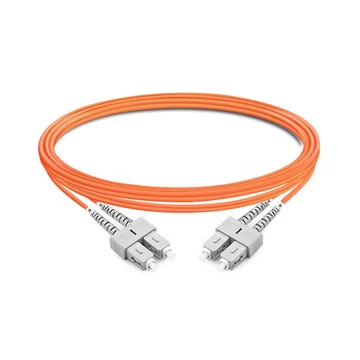
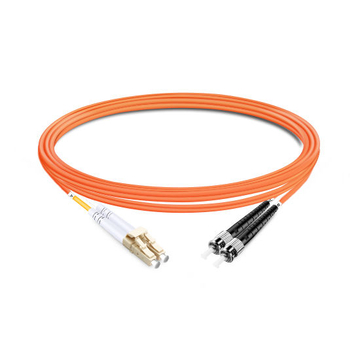
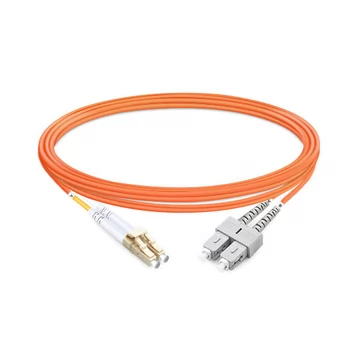
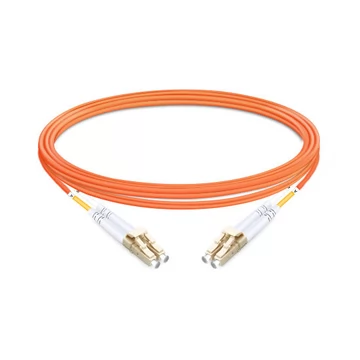
If your network still runs on 62.5/125µm multimode fiber, you already know the problem: most suppliers have moved on to OM3 and OM4, leaving you to hunt for cable that matches the plant you actually have. Ordering the wrong fiber—such as a 50/125µm core for a 62.5/125µm backbone—creates insertion loss that takes links down rather than extending them.
Your Legacy Plant Needs an Exact Match, Not an Upgrade
62.5/125µm multimode fiber was the workhorse of enterprise LANs, campuses, FDDI and Token Ring backbones, and early data centers. Much of that infrastructure is now 15 to 30 years old, yet it remains in service because replacing it means re-cabling an entire building at a cost that easily dwarfs the price of new patch cords.
The primary challenge is sourcing. ANSI/TIA standards have moved OM1 and OM2 to an annex, and most vendors now steer customers toward OM3 or OM4. However, you cannot patch a 62.5/125µm plant with 50/125µm fiber without causing a serious mismatch at the splice or connector.
Consider a facilities engineer extending a legacy campus backbone. The existing riser is 62.5/125µm OM1 with an orange jacket and SC terminations. If a generic "multimode" patch cord arrives with a 50/125µm core, the link will go marginal the moment it is installed—resulting in high loss, flapping, and a costly truck roll to troubleshoot. The fix is not faster fiber; the fix is fiber that perfectly matches.
OM1 Fiber That Matches What's Already Installed
FiberMall supplies OM1 fiber optic cable built to the exact 62.5/125µm standard, allowing you to repair and extend your existing plant without re-engineering it.
Key Benefits:
· Exact 62.5/125µm geometry: Matches your installed backbone perfectly, eliminating the insertion loss that comes from mixing core sizes.
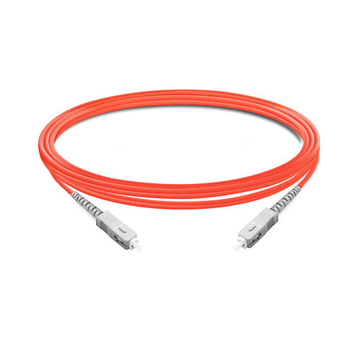
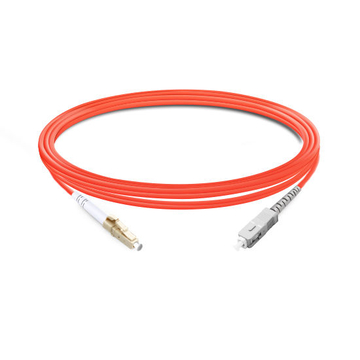
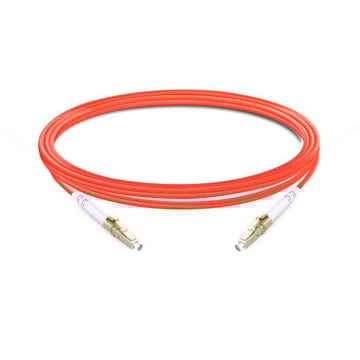
· Custom connectors and lengths: Available with LC, SC, ST, FC, and legacy terminations, cut to the exact meter for your connection points.
· In-stock availability: While OM1 is being phased out industry-wide, FiberMall keeps it stocked so you are not left waiting.
OM1 Fiber Specifications
OM1 is a graded-index multimode fiber featuring a 62.5µm core and 125µm cladding, typically supplied with an orange jacket. It is optimized for LED light sources and complies with IEC 60793-2-10 and TIA-492AAAA standards.
In terms of performance, OM1 delivers a minimum bandwidth of 200 MHz·km at 850 nm and 500 MHz·km at 1300 nm. Its maximum attenuation is ≤ 3.5 dB/km at 850 nm and ≤ 1.5 dB/km at 1300 nm. Regarding supported reach, OM1 can transmit 1 Gbps (1000BASE-SX) up to 275 meters and 10 Gbps (10GBASE-SR) up to 33 meters.
OM1 vs. OM2 vs. OM3: When 62.5/125 Is the Right Choice
The difference between multimode grades fundamentally comes down to core size, bandwidth, and the specific light source each is optimized for.
Both OM1 and OM2 traditionally feature orange jackets and are optimized for LED light sources. However, while OM1 uses a 62.5µm core with a bandwidth of 200 MHz·km at 850 nm, OM2 utilizes a smaller 50µm core and achieves a higher bandwidth of 500 MHz·km at 850 nm. This allows OM2 to extend 1 Gbps reach to 550 meters and 10 Gbps reach to 82 meters, compared to OM1's 275 meters and 33 meters. Neither OM1 nor OM2 supports 40 Gbps or 100 Gbps speeds.
OM3, on the other hand, features an aqua jacket and a 50µm core optimized for VCSEL (Vertical-Cavity Surface-Emitting Laser) light sources. It boasts a significantly higher bandwidth of 2000 MHz·km at 850 nm. This supports 1 Gbps transmission up to 860 meters (and up to 1000 meters with some proprietary extended transceivers) and standard 10 Gbps up to 300 meters, while also fully supporting 40 Gbps and 100 Gbps networks.
Although OM1 is strictly a "legacy" grade, that label is exactly why it still matters. When your existing plant is already 62.5/125µm, matching it with OM1 is the correct engineering decision. Mixing 62.5/125µm and 50/125µm fiber—even in an emergency—is the most common cause of unexplained high loss on legacy links.
Can You Mix 62.5/125 and 50/125 Fiber?
No. The 62.5µm and 50µm cores have different diameters and numerical apertures (0.275 vs. 0.20, respectively). Transmitting light across this junction causes a massive core-size mismatch that produces significant insertion loss—typically enough to push a working link into failure. If you need to extend or repair a 62.5/125µm plant, you must use 62.5/125µm OM1 cable end-to-end.
OM1 Patch Cords and Bulk Cable, Built to Your Plant
FiberMall supplies OM1 in the specific configurations that legacy networks actually require:
Patch Cords
· Connectors: Standard LC, SC, ST, and FC, plus legacy formats like MTRJ, MU, and E2000.
· Configuration: Simplex or duplex.
· Length: Custom cut to the exact meter.
· Jacket: OFNR (riser), OFNP (plenum), or LSZH (Low Smoke Zero Halogen).
Bulk Cable
· Construction: Tight-buffered or loose-tube, depending on the deployment type.
· Fiber count: Standard and custom core counts.
· Application: Ideal for backbone extensions, riser replacements, or campus links.
Frequently Asked Questions
What is OM1 multimode fiber?
OM1 is a legacy multimode fiber featuring a 62.5µm core and 125µm cladding, easily identified by its traditional orange jacket. It is optimized for LED-based, short-reach systems and remains widely installed in older enterprise and campus networks.
Is OM1 fiber obsolete?
For new, high-speed installations, yes—OM3 or OM4 is the recommended minimum. However, for maintaining an existing 62.5/125µm plant, OM1 is absolutely still the correct match, and it is actively manufactured and stocked by suppliers like FiberMall.
Can I mix 62.5/125 and 50/125 fiber?
No. The core-size mismatch causes high insertion loss at the splice or connector. Always use 62.5/125µm OM1 end-to-end on a legacy plant.
How far can OM1 fiber transmit?
OM1 can transmit up to 275 meters at 1 Gbps (1000BASE-SX) and up to 33 meters at 10 Gbps (10GBASE-SR). Beyond those distances, or for higher networking speeds, a laser-optimized fiber grade is required.
What connectors are available for OM1 patch cords?
LC, SC, ST, and FC are the standard options, with MTRJ, MU, and E2000 also available to support legacy network equipment.