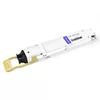
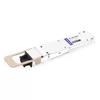
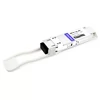
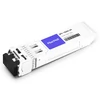
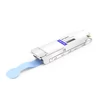
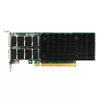
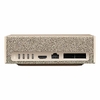
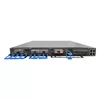
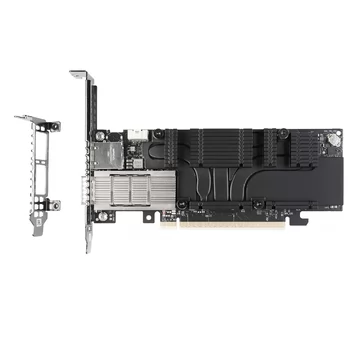
A BlueField-3 SuperNIC is one of the networking engines at the heart of a modern GPU cluster. It turns GPU-to-GPU traffic into a hardware-accelerated 400Gb/s Ethernet or InfiniBand data path and is designed to keep high-value GPU resources from waiting on the network.
But the card itself is only one part of the link. A BlueField-3 B3140H SuperNIC provides a single QSFP112 port, while the optics, DACs, AECs, AOCs, breakout cables, and switches needed to complete the fabric are purchased separately.
For Spectrum-X Ethernet deployments, the SuperNIC is commonly paired with NVIDIA Spectrum Ethernet switches, including Spectrum-4-based systems. In InfiniBand deployments, the same adapter architecture can instead be configured for an NDR InfiniBand fabric.
Buy the NIC, switch, and cabling from different sources without validating the complete link, and your AI fabric quickly becomes an integration project.
A SuperNIC Is Only One Node of the AI Fabric
Most resellers sell the SuperNIC as a bare adapter and leave the rest of the link to you. That is exactly where AI cluster deployments can become complicated, because a 400Gb/s QSFP112 interface is not as media-agnostic as an RJ45 Ethernet port.
At 400G, the adapter, switch port, modulation format, transceiver, fiber type, FEC configuration, breakout mode, firmware, and cable coding all need to work together.
The "SuperNIC vs DPU" confusion. "BlueField-3" is a product family, not a single adapter. BlueField-3 SuperNICs are streamlined for high-performance AI networking, while BlueField-3 DPUs provide a broader infrastructure-offload environment for networking, storage, security, and management workloads.
For GPU-to-GPU east-west traffic, a SuperNIC is typically the more purpose-built choice. If you need a full infrastructure-services platform running on the adapter itself, a BlueField-3 DPU may be more appropriate.
Choosing the wrong device does not necessarily prevent RoCE or RDMA from working, because BlueField-3 DPUs also support high-performance networking. The real difference is whether you need an AI-networking-optimized adapter or a broader infrastructure-offload platform.
The QSFP112 media decision. The B3140H uses a QSFP112 cage designed for 400G-class connectivity. The cage is mechanically backward-compatible with QSFP56 and QSFP28 devices, although actual link operation depends on the configured port speed, modulation format, firmware, and supported cable or transceiver.
QSFP-DD and OSFP modules do not plug directly into a QSFP112 cage. When the switch uses a different form factor — as with Spectrum-4 switches using OSFP ports — the correct cross-form-factor cable, transceiver pair, or breakout assembly must be selected.
The fabric decision. The B3140H can be configured for either 400GbE Ethernet or NDR 400Gb/s InfiniBand. For Ethernet AI fabrics, it can operate as part of a Spectrum-X architecture with NVIDIA Spectrum Ethernet switches. For InfiniBand environments, it can instead connect into an NDR InfiniBand fabric.
The optics and cables you choose therefore depend not only on distance, but also on the fabric architecture, switch form factor, required lane configuration, and whether the link will run at 400G, 2×200G, or 4×100G.
The crypto and form-factor variants. BlueField-3 adapters are available under multiple ordering codes, with differences including form factor, default link type, crypto enablement, and product lifecycle status. Always verify the exact NVIDIA OPN before ordering.
The NVIDIA BlueField-3 SuperNIC B3140H: What You're Buying
For new 400Gb/s BlueField-3 SuperNIC deployments, the B3140H is the key current-production model to focus on.
Networking: The B3140H supports up to 400GbE Ethernet or NDR 400Gb/s InfiniBand. Ethernet is the default link type on the B3140H.
Network port: One QSFP112 port supporting 400G operation, with supported lower-speed and breakout configurations including 2×200G and 4×100G depending on the selected mode, firmware, and media.
Host interface: PCIe Gen5.0 x16.
Processor: 8 Arm Neoverse cores.
Memory and onboard storage: 16GB DDR5 ECC memory, together with onboard eMMC and SSD storage according to the platform configuration.
Crypto: Crypto-enabled and crypto-disabled versions are available depending on the NVIDIA ordering code and regional requirements.
Form factor: HHHL, single-slot.
Software and networking stack: NVIDIA DOCA, RoCEv2, RDMA, GPUDirect RDMA, hardware-accelerated networking, programmable congestion control, and related BlueField networking capabilities.
A legacy FHHL version, the B3140L, was also offered with a similar 400Gb/s networking architecture. However, B3140L is now an end-of-life platform in NVIDIA's current product documentation, so new deployments should generally be designed around the current-production B3140H unless there is a specific requirement to support installed B3140L hardware.
The SuperNIC is built for network-intensive, massively parallel AI workloads — particularly the east-west traffic that moves gradients, model parameters, activations, and inference data between GPU servers.
Unlike a general-purpose infrastructure DPU, the SuperNIC is optimized around high-performance networking. Its role is to help deliver high effective bandwidth, low tail latency, GPUDirect RDMA connectivity, advanced RoCE behavior, adaptive-routing support, hardware packet reordering, and programmable congestion control.
Why this matters for AI. During large-scale training or distributed inference, GPUs can stall whenever communication cannot keep up with computation. The SuperNIC helps keep RDMA flows moving efficiently and responds to congestion before it significantly affects GPU communication.
In a Spectrum-X deployment, the SuperNIC works together with NVIDIA Spectrum Ethernet switches to create an AI-optimized Ethernet fabric designed for predictable performance at scale.
SuperNIC vs DPU: Which BlueField-3 Do You Need?
This is one of the most important BlueField-3 purchasing decisions.
The B3140H SuperNIC is an 8-core, 16GB BlueField-3 adapter designed primarily for high-performance 400G AI networking. It is well suited to GPU clusters where the main requirement is moving traffic between accelerators efficiently over Ethernet or InfiniBand.
The B3240 BlueField-3 DPU is the closer 400G-class DPU alternative. It provides a larger Arm subsystem and is designed for broader infrastructure offload, including networking, security, storage, virtualization, and management workloads in addition to high-speed networking.
The B3220 BlueField-3 DPU provides a similar general-purpose DPU architecture at a lower network-speed tier, typically up to 200Gb/s depending on the exact variant and configuration. It should therefore not be treated as a direct 400G-equivalent replacement for the B3140H.
The B3220SH storage-oriented platform is designed for storage-controller and NVMe-oF use cases where storage infrastructure offload is the primary workload.
The B3210L SuperNIC is a lower-speed SuperNIC option with 8 Arm cores and 16GB of memory, while the B3210E DPU is a separate 16-core, 32GB DPU-class product. These model names should not be used interchangeably.
The practical rule is simple: if the primary workload is GPU-to-GPU communication in an AI compute fabric, choose a SuperNIC. If you need to run networking, storage, security, and other infrastructure services on the adapter, choose a DPU that matches both your compute requirements and your required network speed.
How the SuperNIC Accelerates AI Workloads
The value of the SuperNIC shows up in what your GPUs spend less time waiting for.
GPU-to-GPU east-west traffic. RoCEv2, RDMA, and GPUDirect RDMA provide a high-performance data path between GPU servers. GPUDirect RDMA allows network adapters and GPUs to exchange data with significantly less host-CPU involvement than a conventional networking path, helping reduce latency and CPU overhead.
Accelerating NCCL collective traffic. All-reduce, all-to-all, and other collective communication patterns are fundamental to distributed AI training. The SuperNIC does not replace the NCCL collective algorithms themselves. Instead, it accelerates the RDMA or RoCE transport used to carry NCCL traffic across the network.
By improving effective bandwidth, congestion response, and packet delivery behavior, the networking fabric can reduce communication overhead and tail latency during large collective operations.
Congestion control and packet reordering. AI traffic is highly synchronized and bursty. Large numbers of GPUs may begin transmitting at nearly the same time, creating congestion hot spots.
In a Spectrum-X Ethernet fabric, Spectrum switches can dynamically route traffic across available paths, while the SuperNIC participates in advanced congestion-control mechanisms and handles packet reordering at the endpoint when adaptive routing causes packets from the same flow to arrive out of order.
This combination helps preserve application performance without requiring the application to manage network-level packet reordering itself.
Multi-tenant performance isolation. AI clouds frequently run workloads from multiple customers or internal teams on the same physical infrastructure. Spectrum-X is designed to provide more predictable network behavior and stronger performance isolation so that congestion created by one workload is less likely to degrade another workload.
The common objective is straightforward: keep the network from becoming the bottleneck in an expensive GPU cluster.
Cable the QSFP112 Port: 400G Optics, DACs, AECs and AOCs
This is where complete-link qualification matters.
The BlueField-3 B3140H uses a QSFP112 interface, but the correct media depends on reach, switch form factor, optical architecture, port speed, and breakout requirements.
400G QSFP112 DR4: A common single-mode option for 400G links. DR4 products are available for reaches such as 100 meters or up to 500 meters depending on the exact transceiver specification. DR4 is well suited to server-to-switch links where single-mode fiber is preferred.
400G QSFP112 SR4: A multimode option for short-reach 400G links. NVIDIA's current 100G-PAM4 SR4 portfolio is generally specified for up to 50 meters over the appropriate multimode fiber. If a third-party 100-meter SR4 product is used, its reach and interoperability should be verified against the exact FiberMall SKU rather than assumed from the form factor alone.
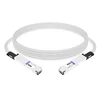
400G QSFP112 passive DAC: Best suited to very short same-rack connections where minimum latency, low power consumption, and low cost are priorities. Practical reach depends on cable construction and gauge, with passive 400G copper normally used over only a few meters.
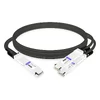
400G QSFP112 AEC or active copper cable: Useful when a passive DAC cannot reliably cover the required distance or insertion-loss budget. Because active copper contains signal-conditioning electronics, supported reach can be longer than passive DAC and should be specified according to the exact cable model.
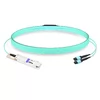
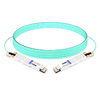
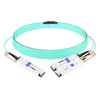
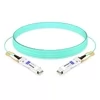
400G QSFP112 AOC: Third-party QSFP112 active optical cable solutions can be used for longer in-rack or multi-rack connections where a pre-terminated optical assembly is preferred. Reach and platform compatibility depend on the exact AOC design and should be validated against both endpoints.
Spectrum-4 to BlueField-3 connectivity: Many Spectrum-4 switches use OSFP interfaces while the BlueField-3 SuperNIC uses QSFP112. In these deployments, use a validated OSFP-to-QSFP112 cable or optical solution rather than attempting to insert an OSFP module directly into the SuperNIC.
Breakout applications: The BlueField-3 port can support lower-speed configurations such as 2×200G or 4×100G when supported by the port mode, switch, firmware, and cable assembly. The correct breakout solution depends on the connector type at both ends. For example, an OSFP-based Spectrum switch may require a different breakout assembly from a third-party QSFP-DD switch.
QSFP56 and QSFP28 devices can physically fit into the QSFP112 cage because of backward mechanical compatibility, but physical fit does not guarantee link operation. Always verify speed, electrical signaling, modulation, firmware support, FEC, and device qualification.
FiberMall can qualify the complete adapter-to-switch link rather than treating the transceiver or cable as an isolated component.
NVIDIA BlueField-3 SuperNIC FAQ
What is the difference between a SuperNIC and a DPU?
A BlueField-3 SuperNIC is optimized primarily for high-performance AI networking. The B3140H uses 8 Arm cores and 16GB of DDR5 memory and supports up to 400Gb/s networking.
A BlueField-3 DPU provides a larger infrastructure-offload environment designed to run networking, storage, security, management, and virtualization services on the adapter itself. Higher-end BlueField-3 DPU models provide more Arm cores and memory than the SuperNIC.
Both product classes can support high-performance RDMA networking. The difference is therefore not that a DPU "cannot do RoCE," but that the SuperNIC is a leaner architecture optimized around AI network acceleration.
Choose the SuperNIC when GPU-to-GPU networking is the primary job. Choose a DPU when broader infrastructure offload is required.
What is the difference between a SuperNIC and a SmartNIC?
"SmartNIC" is a broad industry term for a programmable network adapter capable of offloading networking and, in many cases, security or storage functions.
A SuperNIC is better understood as a network accelerator specifically optimized for high-performance AI fabrics. Its differentiation comes from the combination of very high bandwidth, low tail latency, advanced RDMA and RoCE capabilities, GPUDirect RDMA support, congestion-control features, packet reordering, and tight integration with AI-optimized network architectures such as Spectrum-X.
It is therefore more accurate to describe a SuperNIC as an AI-networking-optimized class of accelerated NIC rather than to claim that conventional SmartNICs are inherently incapable of RDMA or advanced network offload.
What is the difference between the B3140H and B3140L?
Both are 400Gb/s-class BlueField-3 SuperNICs with 8 Arm cores, 16GB of DDR5 memory, a single QSFP112 interface, and onboard eMMC and SSD storage.
The B3140H is an HHHL single-slot adapter and uses Ethernet as its default link type. The B3140L is an FHHL version whose default link type was InfiniBand.
The most important difference for a new purchase today is product lifecycle: B3140H remains the relevant current-production platform, while B3140L has been moved to end-of-life status in NVIDIA's current documentation.
For new designs, B3140H should therefore normally be the starting point unless compatibility with an existing B3140L deployment is required.
Does the BlueField-3 SuperNIC support both Ethernet and InfiniBand?
Yes. The B3140H can be configured for either 400GbE Ethernet or NDR 400Gb/s InfiniBand.
In Ethernet mode, it can run RoCEv2 and participate in a Spectrum-X Ethernet fabric. In InfiniBand mode, it can connect to an NDR InfiniBand fabric.
The adapter should not be described as running Ethernet and InfiniBand simultaneously on the same physical port. Instead, the port is configured for the required link type.
What optics or cables do I need for the QSFP112 port?
For a native 400G QSFP112 connection, use a compatible QSFP112 transceiver, DAC, AEC, or AOC that matches the required reach and the device at the opposite end.
For single-mode fiber, 400G QSFP112 DR4 is a common option, with reach depending on the specific module. For multimode short-reach applications, QSFP112 SR4 can be used within its specified optical budget.
For short copper links, use a passive QSFP112 DAC. If more reach is required than passive copper can provide, use an appropriate AEC or active copper assembly.
If the switch uses OSFP — as many Spectrum-4 systems do — use a validated OSFP-to-QSFP112 connection. If the switch uses QSFP-DD, use a suitable QSFP-DD-to-QSFP112 or breakout solution where supported.
QSFP56 and QSFP28 devices are mechanically compatible with a QSFP112 cage, but successful operation depends on port mode, signaling rate, firmware, FEC, and qualification.
QSFP-DD and OSFP modules do not plug directly into the QSFP112 cage.
FiberMall can code and test the transceiver or cable against the intended adapter and switch combination before shipment.
What is NVIDIA Spectrum-X and why does it matter?
Spectrum-X is NVIDIA's Ethernet networking platform for AI workloads. It combines NVIDIA Spectrum Ethernet switches with NVIDIA accelerated endpoint adapters such as BlueField SuperNICs and other supported NVIDIA NIC architectures.
The platform is designed around the traffic patterns created by distributed AI workloads, including synchronized bursts, large collective operations, high east-west bandwidth, and sensitivity to tail latency.
Spectrum-X uses technologies such as adaptive routing, telemetry-assisted congestion management, endpoint packet reordering, RDMA acceleration, and performance-isolation mechanisms to improve effective network performance under load.
This matters because conventional Ethernet can experience congestion hot spots, out-of-order delivery challenges, and performance variability when thousands of accelerators communicate simultaneously.
Spectrum-X does not change the basic Ethernet standard. Instead, it combines an Ethernet-compatible fabric with coordinated switch and endpoint acceleration designed specifically for AI-scale networking.