AI training clusters and high-performance computing fabrics are pushing network interconnects past 800G. The jump to 1.6T breakout DAC/ACC/AEC cables is no longer a roadmap item—it's the current standard for switch-to-NIC and switch-to-switch connections in next-generation data centers. But not every 1.6T link needs the same cable technology. Choosing the wrong interconnect means wasted power, limited reach, or premature optical upgrades.
The 1.6T Interconnect Challenge
Data center architects face a familiar problem: new 1.6T switches ship with high-density OSFP224 or OSFP-XD ports, but the servers, NICs, and storage endpoints they connect to still run 800G or 400G. Running separate parallel networks is expensive. Replacing every endpoint before it is needed is wasteful.
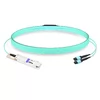
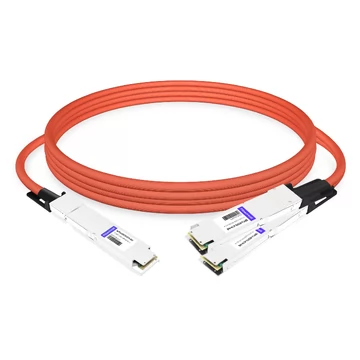
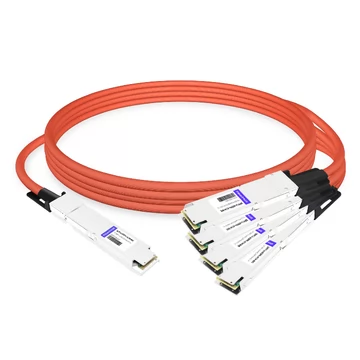
Breakout cables solve this by splitting one high-speed port into multiple lower-speed lanes. A single 1.6T port can fan out to 2×800G, 4×400G, or even 8×200G connections, letting engineers deploy next-generation switches without stranding existing hardware. The challenge is selecting the right cable technology for each link.
At 1.6T data rates, signal integrity becomes the limiting factor. Passive copper faces severe reach limitations. Active copper cables extend reach slightly. Active electrical cables use DSPs to retime and reshape PAM4 signals, enabling rack-to-rack connections without the cost or power of optics. Each option has a specific place in the network hierarchy, and the wrong choice leads to deployment delays, thermal issues, or budget overruns.
1.6T ports support several breakout modes. The right configuration depends on your switch architecture and endpoint density:
• 1.6T OSFP224 to 2×800G OSFP224: Best for spine-to-leaf or spine-to-spine aggregation where 800G endpoints are the next hop. This configuration preserves lane mapping and simplifies cabling in 800G-native fabrics.
• 1.6T OSFP224 to 4×400G OSFP224: The most common fan-out for AI clusters connecting 1.6T switches to 400G GPU NICs and storage controllers. It maximizes port utilization and defers full endpoint upgrades.
• 1.6T OSFP224 to 8×200G OSFP112: Used in high-density GPU farms where 200G NICs remain the endpoint standard. This mode provides the highest fan-out ratio for large training clusters.
All configurations are available in DAC, ACC, and AEC variants depending on reach and power requirements.
DAC vs ACC vs AEC: Which 1.6T Cable Do You Need?
Selecting between 1.6T DAC, ACC, and AEC comes down to distance, power budget, latency tolerance, and cost. At 200G or 224G per lane, passive copper faces severe reach limitations. Here is how the three technologies compare:
• 1.6T DAC (Direct Attach Copper): Utilizing passive copper technology, DACs offer a typical reach of 1 meter or less and consume a minimal ~0.1 W per end. They provide the lowest cost and near-zero latency, making them ideal for same-tray or ultra-short intra-rack connections where the switch and endpoint sit within the same or adjacent trays. However, at 1.6T, cables require a thicker wire gauge and a larger bend radius, making deployment space a critical consideration.
• 1.6T ACC (Active Copper Cable): ACC adds active analog linear equalizers at each end to clean up the received signal without full DSP retiming. This slightly extends the typical reach to 0.5–2 meters, with a moderate power draw of around 2.5 W per end. ACC is well suited to short-reach links, particularly in environments with liquid-cooled switches, where DAC signal integrity is marginal.
• 1.6T AEC (Active Electrical Cable): AEC modules use digital signal processors (DSPs) to retime, reshape, and reclock PAM4 signals. This technology achieves typical reaches of 2–5 meters or more while consuming 20–27 W per end. The result is a thinner, lighter cable capable of rack-to-rack runs, consuming roughly half the power and cost of an optical AOC. For AI training clusters where most links stay inside a row, AEC is becoming the default copper choice.
1.6T Cable Specifications and Performance
FiberMall 1.6T breakout cables are built to meet the demands of 200G/lane and 224G/lane electrical signaling. Key specifications include:
• Data Rate: 1.6 Tbps aggregate (8×200G or 8×224G PAM4)
• Form Factors: OSFP, OSFP-XD, Twin-port OSFP
• Breakout Modes: 1.6T to 2×800G, 4×400G, 8×200G
• Reach Options: 0.5 m to 5 m+ depending on cable type
• Wire Gauge: 27 AWG (DAC) to 30–32 AWG (AEC)
• Management: CMIS 5.2 compliant for cable identification and monitoring
• Standards: IEEE 802.3, OSFP MSA, InfiniBand XDR ready
Every cable undergoes signal integrity testing, insertion loss validation, and compatibility checks before shipment.
Built for AI, HPC, and Hyperscale Networks
1.6T interconnects are not just faster versions of 800G links. They are purpose-built for the traffic patterns of modern AI infrastructure.
AI Training Clusters
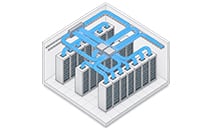
Large language model and generative AI training require thousands of GPUs exchanging gradients with minimal latency. 1.6T AEC breakout cables connect high-radix switches to 400G and 800G GPU NICs while keeping power and cost lower than optical alternatives for in-row links.
High-Performance Computing
HPC fabrics demand predictable latency and high bisection bandwidth. 1.6T copper interconnects deliver consistent electrical performance for short-reach top-of-rack and spine-leaf deployments.
Hyperscale Cloud Infrastructure
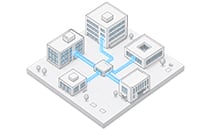
Cloud providers are scaling from 800G to 1.6T spine layers while keeping leaf and server ports at lower speeds. Breakout cables let them upgrade spine capacity without replacing every endpoint, protecting infrastructure investments.
InfiniBand XDR and NVIDIA Compatibility
FiberMall 1.6T breakout cables support InfiniBand XDR signaling. The 800G and 400G endpoint connectors of these breakout cables are designed for seamless compatibility with NVIDIA Quantum-X800 Q3400-RA switches and ConnectX-8 C8180 SuperNICs. This makes them highly suitable for NVIDIA DGX and SuperPOD deployments where validated interconnects are required.
Frequently Asked Questions
What breakout options are available for 1.6T ports?
1.6T OSFP224 and OSFP-XD ports support breakout to 2×800G, 4×400G, and 8×200G. The best choice depends on your switch topology and endpoint speed mix.
What is the difference between 1.6T DAC, ACC, and AEC?
DAC is passive copper for links under 1 meter. ACC adds active analog equalizers for slightly longer reach (0.5–2 m). AEC uses DSP-based retiming for rack-to-rack connections reaching up to 5 meters or more.
Are 1.6T breakout cables compatible with NVIDIA switches?
Yes. The breakout endpoint connectors (e.g., 800G) of FiberMall 1.6T cables are designed for compatibility with NVIDIA Quantum-X800 Q3400-RA switches and ConnectX-8 C8180 SuperNICs, fully supporting InfiniBand XDR signaling.
What is the maximum reach of a 1.6T AEC cable?
Typical 1.6T AEC cables reach 2–5 meters. Some designs can maintain up to 3–5 meter lengths even while utilizing thinner 30–32 AWG cables, thanks to advanced DSP equalization compensating for the higher insertion loss.
How do I migrate from 800G to 1.6T using breakout cables?
Install 1.6T-capable spine or aggregation switches, then use breakout cables to connect existing 800G or 400G leaf switches and NICs. This upgrades core capacity without replacing every endpoint.
What is the difference between OSFP1600 and OSFP-XD?
OSFP1600 uses 8 lanes at 200G each in the same physical size as an 800G OSFP. OSFP-XD uses 16 lanes at 100G each in a larger, extra-dense form factor. While OSFP-XD is not physically backward compatible with standard OSFP ports, using breakout cables allows an OSFP-XD switch port to connect seamlessly to standard OSFP endpoint devices.
What power consumption should I expect from 1.6T cables?
Passive DAC consumes roughly 0.1 W per end. ACC consumes around 2.5 W per end. AEC modules consume 20–27 W per end and require rack-level thermal planning.
Are FiberMall 1.6T cables MSA compliant?
Yes. Our 1.6T breakout cables comply with OSFP MSA, IEEE 802.3, and CMIS 5.2 management standards for broad interoperability.