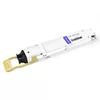
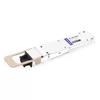
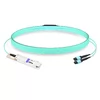
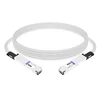
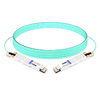
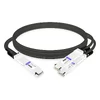
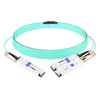
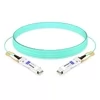
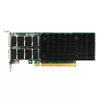
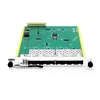
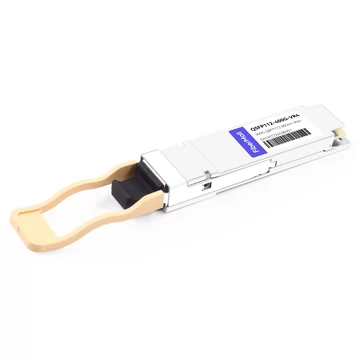
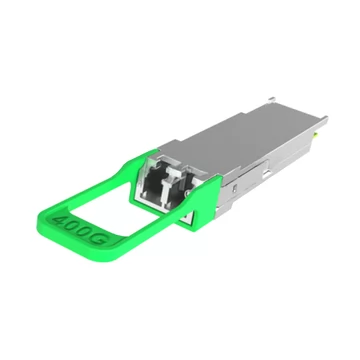
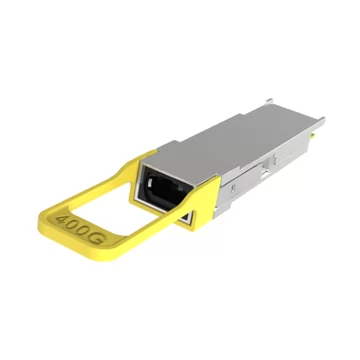
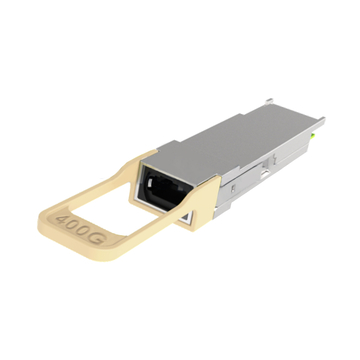
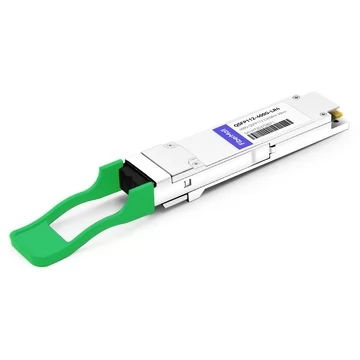
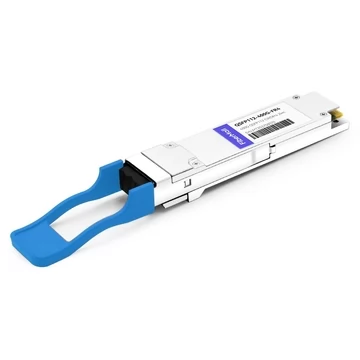
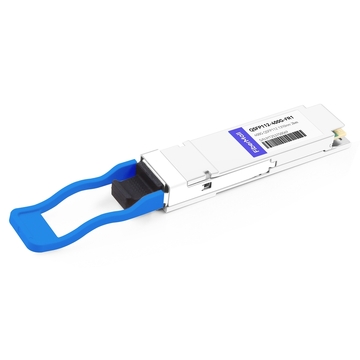
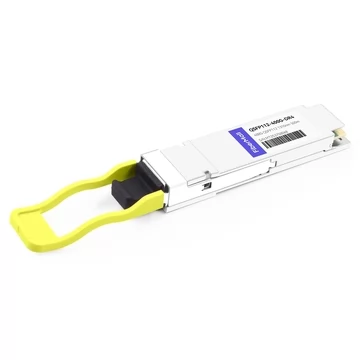
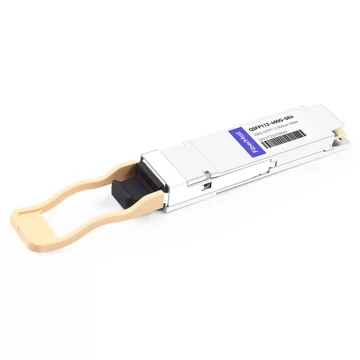
400G QSFP112 Optical Transceiver Module
The 400G QSFP112 optical transceiver module is a cutting-edge product in the field of high-speed data transmission technology, capable of meeting the ever-increasing demands for network capacity and efficiency. Its advanced features, technical specifications, and how it enables seamless connectivity for modern data centers and telecommunications networks are key aspects of this product.
What is 400g QSFP112?
The 400 G QSFP-112 represents a modern type of transceiver used in optical transmission of data at a speed of 400 gigabits per second. The module uses the Quad Small Form-Factor Pluggable design as it contains 112Gbps electrical lanes that accomplish the task quite fast. This type of module is usually found in both data centers and team communications since the need for more bandwidth and lower latency has emerged. Offering compactness, better performance, and low power consumption, the module is perfect for today's high-speed network setup.
Definition and explanation of 400g QSFP112
400G Qsfp112 optical modules are advanced devices. These QSFP113 form factor optical transceivers are equipped with the capability of transmitting at 400Gbps per second. Each QSFP112 transceiver incorporates four 112Gbps electrical lanes, which is quite innovative in terms of both density and performance. Different communication protocols are supported, including Ethernet, infiniBand and optical transport network (OTN) standards as well, making it applicable across the various industries.
How 400g QSFP112 is Transforming Data Center Connectivity
Greater scalability and productivity: The expansion of data center technology relies on the 400G QSFP112 module, which is a key factor. This module supports high-density deployments in hyperscale data centers, helping to increase capacity without excessive space requirements.
High bandwidth and superior performance: The 400G QSFP112 employs PAM4 coding technology, which fully utilizes the capacity of existing fiber optic networks and supports higher data transmission rates. This modulation scheme, combined with other modulation schemes, helps improve packet dispersion characteristics, significantly increases data communication efficiency, and substantially reduces pulse load in cloud computing, artificial intelligence systems, real-time analytics, and other similar applications.
Advanced and Ready for the Future Networks: 400g qsfp112 compliments the next generation of communication platforms, which implies its adaptability to systems. Built for speed and low latency, it enables emerging technologies, for instance, 5G networks and edge computing, confirming the readiness of data centers for any workloads and demands that might arise in the future.
Role of 400g QSFP112 in Modern Data Centers
There should be no doubt regarding the fact that the 400G QSFP112 is an important component of existing data centers because it also meets all the urgent requirements of more bandwidth, less energy usage, and better scalability. The high rate of data transmission enhances the ability to transport the amount of data needed to sustain the growth of many things, such as video content, the use of artificial intelligence in firms, and access to cloud services. Also, it is notable that the QSFP112 module, owing to its accompanying small form factor, achieves space management efficiently in very congested systems and facilitates reaching maximum port density of data centers and lowering the operating cost, mainly due to the developed power consumption rate.
Technical Specifications of 400g QSFP112 Modules
These transceivers, 400g QSFP112, are purpose-built to cater to the current megatrends of supra-speed networks. Main characteristics are as outlined below:
Data Rate: 400 Gbps is a high-speed, high-capacity application and a data center-fitted device that expands the limit.
Form Factor: Designed in a QSFP112 configuration, which has a pioneering compact design with a shrunk form factor after feedback on the existing networks.
Wavelength: Multicarrier channel wavelengths are used in this scenario or variation, which enables any appropriate deployment.
Transmission Distance: Comes in all distances, from the short distances to the long distances, covering any network model.
Power Consumption: Consumes relatively less power, thereby improving the energy utilisation while the performance is kept constant.
Connector Type: Connectors are of the LC or MPO varieties as is appropriate, thus facilitating connectivity to universal systems.
Compliance: Meeting the standards set out by the IEEE, the OIF, and other applicable standards organizations to guarantee cross-vendor system cooperation and reliability.
Detailed Technical Breakdown of the QSFP112 Standard
The 400 G QSFP112 standard can be regarded as an epochal change to the high-speed optical fiber communication technology, aimed at improving the current state of the communication systems. The following are its specifications and features in detail:
Transmission Capacity and Type of Signal: The highest amount of data that can be transferred using qsfp112 module per channel is 112G, using 4-level modulation, meaning that up to 400G in total bandwidth can be achieved when all four lanes are filled. 4-level modulation increases the data transmission per lane by two in comparison to the ordinary NRZ, which is more efficiently used in the spectrum transmission of signals.
Connection and Transmission Protocols: The transceivers support CEI-112G-VSR (Very Short Reach) range electrical interfaces, providing very short reach interconnect capabilities. This is capable on ASIC AND switch devices with low latency.
The Impact of Optical reach: The QSFP112 contacting objectives come in several settings, such as Short reach, Data center Reach, and Long Reach, the final type having two variants. This makes them adaptable in data centers or high-performance computing as well as metro networks.
Energy Use: The improved thermal management and power consumption-oriented design ensures that most QSFP112 transceivers stay within an energy envelope of 4.5W to send Ethem at BYC ST, and 7W maximum, this is conditional on particular arrangements. More energy-saving than the previous generations of modules.
Physical Framework and Appearance: The QSFP112 module, just like other QSFP modules, has a small hot-pluggable form factor, which facilitates mounting and upgrading in the existing infrastructure. This backward compatibility makes integration into old systems easier.
Conformance and Inter-operability: Following generally accepted practices: IEEE 802.3, OIF; The compliance of QSFP112 is ensured, and so is its cross compatibility. TSPSC Special class mobile modules and operators plural nexus and defeat.
Correct and intact or intact signals: The inclusion of correction techniques of multiple short codes is common in the design of the QSFP112 scheme, especially in the unit of the data lines, which enhances the links. Additional factors, such as low insertion losses and the deployment of complex digital signal processing (DSP), enhanced the system performance.
Comparing 400g QSFP112 with Other Optical Transceivers
The 400G QSFP112 incorporates features found in other optical transceiver designs, but leads the pack in bandwidth processing power, low power consumption, and space efficiency. This represents a significant technological improvement over 100G and 200G transceivers, enabling the production of the aforementioned 400G QSFP112 transceiver with four times the throughput while maintaining size and electrical coupling. This provides target user organizations with high-density network equipment that meets their minimum space requirements. Compared to CFPs, these modules offer significantly lower power consumption and excellent thermal performance. Furthermore, the modules' components are manufactured to industry standards, reducing version compatibility issues, while their performance is also outstanding due to the use of digital signal processors and long-distance optical transmission technology.
Side-by-Side Comparison with QSFP-DD, OSFP, and Other 400G Solutions
In analyzing the properties of QSFP112 and the counterparts like QSFP-DD or OSFP and other 400G interconnects, it is worthy to note that several key issues are raised. These essentially relate to the form, power consumption, temperature regulation, and port-count aspects. Just like the QSFP-DD, the QSFP112 takes the smaller size of the QSFP, having a high number of ports and providing an easy task of fitting them in any already existing system. But, QSFP-DD consists of eight lanes of electrical interface, making it possible to achieve higher bandwidth than the QSFP112 with only four lanes, but more power is consumed, and heat is emitted.
Future Trends in High-Speed Optical Networking with 400 G QSFP112
Advancement of Industry Best Practices and Widespread Usage: The expectation is that the adoption of new 400 G QSFP112 modules will benefit from the convergence of IEEE 802.3bs, the convergence of OIF standards, and such other standards through facilitated interoperability. Adoption of these concepts and technologies will be supported by the need for reduced response time, enhanced port densities, and the ever-increasing importance of enhancing environmentally friendly designs.
Network Operational Procedures Infused with Artificial Intelligence and Automation: Advanced AI and automated software will become an urgent need when implementing an optical network with increasing complex architecture due to 400 G QSFP112 utilization. This management system, which involves a predictive CRM application, will enhance, for instance, the management process, avoiding cost, thereby ensuring optical data communication remains optimum.
To the 800G Rate and the Advent of Terabit Transmission: And in the interest of achieving high-speed transmission rates, for instance, 400 G QSFP112 is a major and essential mechanism that will eventually assist further development to 800G networking and beyond. However, study efforts are already trying to come up with solutions aimed at tackling the problems of temperature control, preserving signal quality, and conserving power even at a higher speed of data transmission, thus ushering in a promising bandwidth increase and biological innovations in optical networks management.
Role of 400g QSFP112 in the evolution of optical communications
In the field of optical communications, the quest for greater speeds in data centers and telecommunication networks has ushered in the era of 400G QSFP112 modules. These leverage, respectively, enhance bandwidth density, improve power efficiency, and scaling efficiency, offering significant benefits over traditional network structures. Thanks to enhanced modulation techniques, such as the conventional PAM4 (Pulse Amplitude Modulation), even long lengths can be covered with minimized signal degradation. Lastly, there is the small QSFP112 form factor that allows for compact-whicheven helps in reducing the hardware and possesses the up gradation at network environments cost-effectively.
Frequently Asked Questions (FAQs)
What purpose does the 400G QSFP112 module serve the most?
The module operation at the 400G QSFP112 level has key functional roles in enabling workloads requiring high-throughput services, such as those in large, highly distributed deployments of data centers, such as clouds, for video engagement and artificial intelligence. The scalability and efficacy of the system mean that such an architecture can be implemented in the future.
Does the transceiver 400G QSFP112 work with the two most common types of optical fiber?
The 400G QSFP112 module possesses the ability to operate with both single-mode fibers and multimode fibers, which guarantees flexibility and expansive serviceability in diverse networking contexts.
In what ways does the 400G QSFP112 module aid in an increased power efficiency of data centers?
With the compact structure and engineering power usage of the module, it reduces the electricity use of high-performance data centers, encouraging more energy savings.
Why are wireless innovations, about migration to cloud services, being achieved?
400g QSFP112 supports a very high data rate, which has very low latency, therefore becomes very helpful to the users who are basically on the cloud and needs lot of bandwidth without much delay.