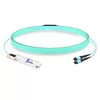
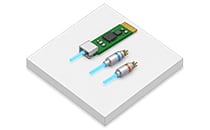
OM2 multimode fiber patch cords feature a 50/125µm core and LC-LC duplex connectors, optimized for 1G networks. Offering low loss and high bandwidth, they are compatible with both LED and VCSEL light sources and are suitable for short-range interconnections in data centers, LANs, and equipment rooms. This ensures connection stability, reliability, and cabling flexibility.
The Problem With Most OM2 Fiber Cables
Most OM2 patch cables are sold as a commodity. You get a SKU, a length, and a price—and little else. The listing rarely tells you the bandwidth rating, the insertion loss, or whether the cable will successfully carry 10G. When a budget patch cord fails a link test or drops packets under load, any initial "savings" disappear into expensive troubleshooting time.
There is also the confusion surrounding upgrades. OM2 is often described as "obsolete," which leaves network teams with two unresolved questions: Is OM2 still safe to buy? And when do I actually need OM3 or OM4? Few suppliers answer either question; they simply list the product and move on.
Here is the reality: OM2 is a 50/125µm multimode fiber rated at 500 MHz·km (OFL). It carries 1 Gbps up to 550 meters—farther than OM1—and remains the correct, economical choice for existing 1G campus backbones, building risers, and legacy equipment rooms. However, it is not the right choice for new 10G-and-beyond builds, and a responsible supplier should tell you that plainly.
What You Get: OM2 Specifications That Matter
Optical Performance
An OM2 fiber cable is defined by its 50/125µm geometry and its 500 MHz·km overfilled-launch (OFL) bandwidth at 850 nm and 1300 nm. That bandwidth rating is what allows 1 Gigabit Ethernet (1000BASE-SX) links to reach 550 meters. For 10 Gigabit Ethernet, OM2 tops out at 82 meters—a hard physical limit that should be published, rather than hidden.
Connectors and Ferrule
Quality OM2 patch cords use precision zirconia ceramic ferrules for low, repeatable loss. LC-LC duplex is the standard configuration, though SC and ST options are readily available on request. Return loss meets or exceeds 30 dB, with a repeatability of less than 0.2 dB over 1,000 mating cycles.
Cable Construction
The standard OM2 jacket is orange, per industry convention. You can choose PVC for general indoor runs, LSZH (low-smoke zero-halogen) where fire safety codes require it, OFNR (riser-rated) for vertical shafts, or OFNP (plenum-rated) for environmental air spaces. Aramid yarn strength members protect the fibers during pulls and bends.
Standards and Compliance
· ISO/IEC 11801 multimode fiber classification
· Tested to TIA/EIA-455-171A procedures
· RoHS compliant
· Operating temperature range of -40°C to +85°C
OM2 vs. OM3 vs. OM4: When OM2 Is Still the Right Choice
The most useful thing a supplier can do is help you pick the correct grade—even when the correct answer is "not OM2." Here is how the three 50µm multimode grades compare:
OM2 features an orange jacket and provides a bandwidth of 500 MHz·km (OFL). It is best suited for legacy 1G campus networks, building risers, and existing plants. It supports 1 GbE distances up to 550 meters and 10 GbE distances up to 82 meters.
OM3 features an aqua jacket and delivers a bandwidth of 2000 MHz·km (EMB). It is designed for new 10G data center installations, supporting 1 GbE up to 550 meters (and often further depending on optics) and standard 10 GbE up to 300 meters.
OM4 also features an aqua jacket but offers a higher bandwidth of 4700 MHz·km (EMB). It is ideal for 40G/100G networks and longer 10G runs, supporting 1 GbE up to 550 meters and standard 10 GbE up to 400 meters.
Choose OM2 when you are maintaining or extending an existing 1G network, matching a legacy 50/125µm plant, or need a cost-effective patch cord for 1000BASE-SX links at 550 meters or less.
Choose OM3 or OM4 when you are planning 10G, 40G, or 100G connectivity. OM3 and OM4 are laser-optimized for VCSEL transmission and carry 10G dramatically farther.
Applications: Where OM2 Fiber Still Excels
OM2 fiber cable remains a workhorse in specific, well-defined roles:
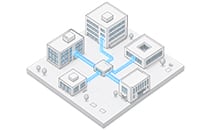
· Legacy campus backbones — Building-to-building 1G links that were built on a 50/125µm plant and do not require 10G speeds yet.
· Building risers and horizontal runs — OFNR, OFNP, and LSZH OM2 patch cords for code-compliant indoor distribution.
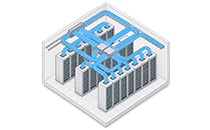
· Equipment-room patching — Short LC-LC runs between switches, patch panels, and optical distribution frames.
· 1G enterprise LAN extensions — Extending existing 50/125µm multimode infrastructure without re-pulling new trunk fiber.
· Matching existing OM2/OM3 plants — OM2 perfectly matches the 50/125µm core size of existing OM2 and OM3 networks, avoiding the insertion loss that occurs if you mistakenly patch a 50µm system with 62.5µm OM1 cables.
For each of these applications, the value is the same: a tested, spec-correct cable at a price that makes keeping the existing plant running an easy decision.
OM2 Fiber Cable FAQ
What is the difference between OM2, OM3, and OM4 fiber?
All three are 50µm core multimode fibers, but they differ in bandwidth and light-source optimization. OM2 offers 500 MHz·km and is traditionally optimized for LED sources. OM3 (2000 MHz·km) and OM4 (4700 MHz·km) are laser-optimized for VCSEL transmission. Higher bandwidth translates to much longer 10G, 40G, and 100G reach.
How far can OM2 fiber run at 1G and 10G?
OM2 carries 1 Gigabit Ethernet up to 550 meters over 1000BASE-SX links. For 10 Gigabit Ethernet, the practical limit drops to 82 meters, which is why new 10G builds require OM3 or OM4.
Is OM2 fiber single-mode or multimode?
OM2 is a multimode fiber with a 50/125µm core-to-cladding diameter. It is identified by an orange jacket and is typically used over shorter distances than single-mode fiber.
What color is OM2 fiber cable?
OM2 cable uses an orange jacket by industry convention. OM3 and OM4 use aqua (or sometimes Erika Violet for OM4), while single-mode OS1/OS2 uses yellow.
Should I upgrade from OM2 to OM3 or OM4?
Upgrade if you are planning 10G, 40G, or 100G connectivity, or if you need 10G links beyond 82 meters. For existing 1G campuses and legacy 50µm plants, OM2 remains a correct, economical choice.
Will OM2 work with my existing hardware?
Yes, if your links use a 50/125µm multimode plant and 1000BASE-SX or 10GBASE-SR optics. Note: OM2 is not backward-compatible with 62.5µm OM1 fiber. Mixing 50µm OM2 patch cords with a 62.5µm OM1 backbone causes severe core-size mismatch and significant insertion loss. Always match your patch cords to your backbone's core size.