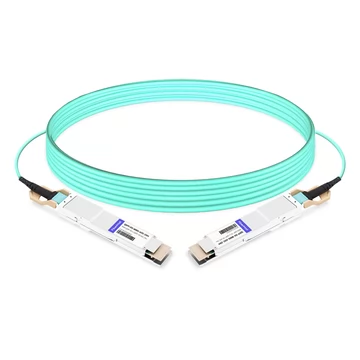
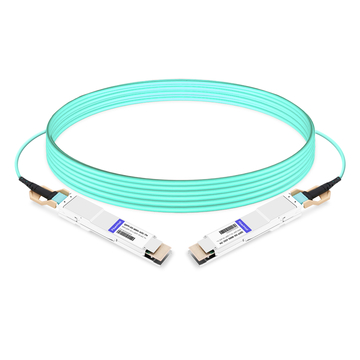
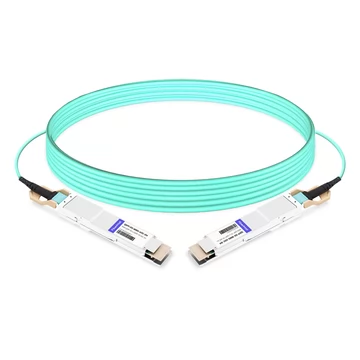
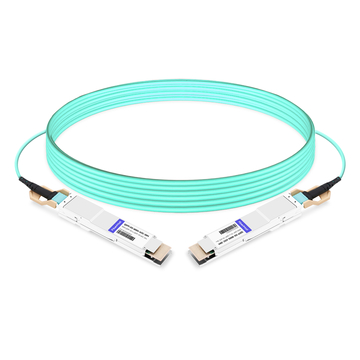
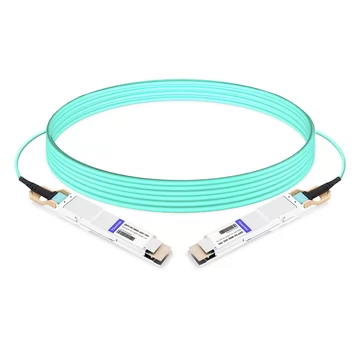
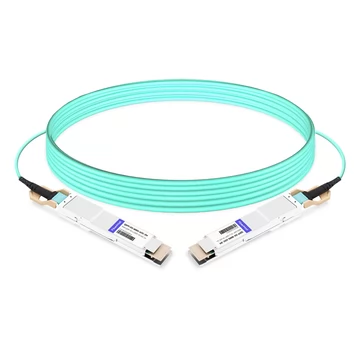
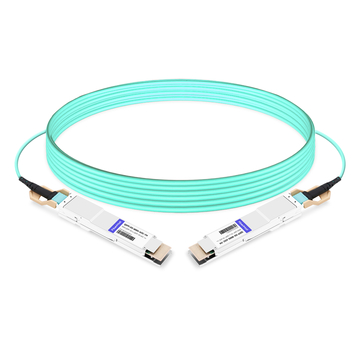
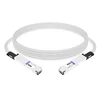
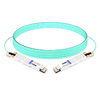
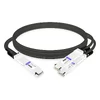
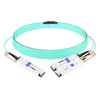
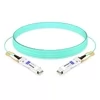
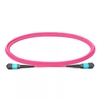
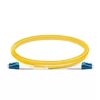
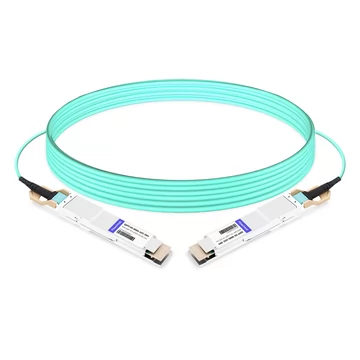
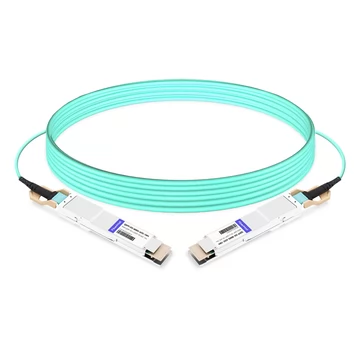
At 800G, the wrong interconnect becomes a bottleneck before the first packet leaves the rack. Passive DAC hits its reach limit at 2–3 meters. Active Electrical Cable (AEC) adds power and weight without solving fiber-management challenges.
The 800G Cabling Decision Nobody Gets Right
800G Ethernet pushes eight lanes of 106.25 Gbps PAM4 signaling through every connector. The signal integrity margin is thin, the power budget is real, and the cable you choose directly affects rack density, cooling, and deployment costs.
Most engineers know the headline tradeoffs: DAC is cheap and short, AOC is longer and lighter, and AEC sits somewhere in between. What is harder to find is an honest guide that tells you exactly where each technology stops being the right answer. Vendors who only sell DAC will recommend DAC up to the absolute limit. Vendors who only sell AOC will recommend AOC for 1-meter links. Neither helps you optimize a cluster with 10,000 cables.
AOC vs. AEC vs. DAC: Choose the Right 800G Interconnect
The following breakdown maps the three main 800G copper and optical cable technologies to real deployment scenarios:
Passive DAC (Direct Attach Copper)
Max Reliable Reach: 0.5–2 m (up to 3 m under ideal conditions)
Media: Twinax copper
Signal Conditioning: None
Power Consumption: < 0.1 W per end
Weight & Flexibility: Heavy and stiff
EMI Immunity: Susceptible to interference
Typical Use Case: In-rack ToR-to-server or switch-to-switch connections
Relative Cost: Lowest
AEC (Active Electrical Cable)
Max Reliable Reach: 3–5 m (up to 7 m tested)
Media: Twinax copper with integrated retimers/DSPs
Signal Conditioning: Active equalization and retiming
Power Consumption: ~4–8 W per end
Weight & Flexibility: Heavy and stiff
EMI Immunity: Susceptible to interference
Typical Use Case: Adjacent racks and longer copper runs
Relative Cost: Approximately 2× the cost of DAC
AOC (Active Optical Cable)
Max Reliable Reach: 7–30 m (using OM3/OM4 multimode fiber)
Media: Multimode fiber (OM3/OM4)
Signal Conditioning: Optical conversion (VCSEL/PIN)
Power Consumption: ~12–15 W total (for both ends)
Weight & Flexibility: Light and flexible
EMI Immunity: Fully immune
Typical Use Case: Rack-to-rack, AI fabric, and spine-leaf architectures
Relative Cost: Higher than copper, but lower than separate transceivers plus structured fiber
Our Recommendation: Use a passive DAC for links under 2 meters. Use AEC for 2–5 meter copper runs where fiber is unnecessary. Use 800G QSFP-DD AOC when you need to reach beyond 5 meters, require immunity to EMI, or need lighter cable bundles and cleaner cable management in dense AI clusters. For distances beyond 30 meters, we recommend 800G optical transceivers with structured fiber.
Why Data Center Engineers Choose FiberMall 800G AOC
Factory-Direct Pricing Without Distributor Markup
FiberMall designs and manufactures 800G QSFP-DD AOC cables in-house. There is no distributor layer, no brand licensing fee, and no OEM tax. Standard lengths are priced transparently: $2,740 for 7 m, $2,790 for 20 m, and $2,805 for 25 m. Volume pricing is available for 10+ units.
Pre-Ship Optical and Electrical Testing
Every 800G AOC undergoes optical power measurement, eye-mask testing, BER verification, and DDM accuracy checks before it leaves our facility. We do not spot-check; we test every unit. That is how we maintain sub-1% annual failure rates in production data centers.
Multi-Vendor CMIS 5.0 Coding
Our cables ship with EEPROM signatures configured for your target switch platform. We code for Arista, Juniper, Cisco, Dell, HPE, and NVIDIA Mellanox. Digital Diagnostic Monitoring (DDM) reports correctly, and CMIS registers match. There are no compatibility surprises after installation.
Light, Flexible, EMI-Immune Fiber
AOC replaces stiff copper bundles with multimode fiber. This reduces weight, improves bend radius, and eliminates electromagnetic interference—a real advantage when you are routing thousands of cables through GPU-dense AI racks.
Certifications That Matter
ISO 9001 quality management
CE (European conformity)
RoHS (hazardous substance restriction)
FCC (electromagnetic compliance)
QSFP-DD MSA Rev 6.3, IEEE 802.3ck, CMIS Rev 5.0
Technical Specifications
Optical
Form Factor: QSFP-DD to QSFP-DD (QSFP-DD800)
Data Rate: 800 Gbps (8 lanes × 106.25 Gbps PAM4, ~850 Gbps aggregate)
Wavelength: 850 nm
Transmitter: VCSEL
Receiver: PIN photodiode
Fiber Type: OM3 / OM4 multimode fiber
Reach: 7 m, 20 m, 25 m standard; custom lengths up to 30 m (OM3) / 50 m (OM4)
Electrical & Management
Electrical Interface: 800GAUI-8
Modulation: PAM4
Power Consumption: ≤ 14 W typical (total, both ends)
Supply Voltage: Single 3.3 V
Management: I²C with DDM/DOM via CMIS 5.0
Hot Pluggable: Yes
Physical & Environmental
Operating Temperature: 0 °C to 70 °C (commercial)
Storage Temperature: -40 °C to 85 °C
Minimum Bend Radius: ~30 mm
Mating Cycles: Minimum of 200 insertions
Compliance
QSFP-DD MSA Rev 6.3
IEEE 802.3ck
CMIS Rev 5.0 / 5.2
RoHS 2.0, REACH
OEM Compatibility Matrix
FiberMall 800G QSFP-DD AOC cables are tested and coded for the following platforms:
Arista: Compatible with 7060X6, 7800R3, and other QSFP-DD800 switches (utilizes A-D800-D800-xxxM compatible signatures).
Juniper: Compatible with QFX and PTX QSFP-DD800 platforms (utilizes QSFP-DD-800G-AOC-xxM compatible signatures).
Cisco: Tested on 800G-capable line cards for Nexus 9000 QSFP-DD800 models.
NVIDIA / Mellanox: Compatible with QM97xx, SN47xx, and ConnectX-7 adapters. (Note: NVIDIA 800G primarily utilizes the OSFP form factor; verify whether your specific port type is QSFP-DD or OSFP).
Dell: Custom coding available for Z9xxx and PowerSwitch QSFP-DD800.
HPE: Custom coding available for Aruba CX 10000 and C-series 800G-ready switches.
Important: QSFP-DD and OSFP are physically different form factors. A QSFP-DD AOC fits only a QSFP-DD800 cage. Many NVIDIA 800G platforms use OSFP ports.
Typical Applications
AI/ML training clusters: GPU-to-switch and leaf-to-spine links in distributed training fabrics.
High-performance computing (HPC): Low-latency, high-bandwidth interconnects.
Hyperscale data centers: Rack-to-rack and adjacent-rack 800GbE connections.
Spine-leaf architectures: 800 Gbps uplinks between leaf and spine switches.
Disaggregated storage: High-throughput links between compute and storage nodes.
Telecom aggregation: 5G core and carrier aggregation uplinks.
Available Lengths and Pricing
Standard Direct-Attach 800G QSFP-DD AOC
7 m (23 ft) — $2,740
20 m (66 ft) — $2,790
25 m (82 ft) — $2,805
Custom Options
Non-standard lengths from 1 m to 30 m (OM3) / 50 m (OM4)
Custom labeling and packaging
OEM / ODM branding
FAQ
What is an 800G QSFP-DD AOC cable?
An 800G QSFP-DD Active Optical Cable is a fixed-length cable with integrated QSFP-DD optical transceivers on both ends. It transmits 800 Gbps over multimode fiber (typically OM3/OM4 at 850 nm) using eight lanes of 106.25 Gbps PAM4 signaling. Because the optics are built into the cable, no separate transceivers or patch cords are needed.
What is the maximum distance of an 800G QSFP-DD AOC?
FiberMall standard SKUs are available in 7 m, 20 m, and 25 m. Custom AOCs can be built up to approximately 30 m on OM3 fiber or 50 m on OM4 fiber, depending on the host system's FEC and signal budget. For longer distances, use 800G pluggable optical transceivers with structured fiber.
What is the difference between 800G AOC and DAC?
DAC (Direct Attach Copper) uses passive twinax copper and is limited to roughly 2–3 meters. AOC uses fiber and embedded optics, offering longer reach, lighter weight, and immunity to electromagnetic interference. AOC consumes more power than DAC but is the right choice for rack-to-rack and EMI-sensitive deployments.
What is the difference between 800G AOC and AEC?
AEC (Active Electrical Cable) uses copper with signal-conditioning retimers or DSPs inside the connector. It extends copper's reach to about 5–7 meters but retains copper's weight and EMI susceptibility. AOC uses optical fiber and can reach 30 meters or more, while being lighter and EMI-immune. AEC is usually cheaper than AOC for mid-length runs.
Are FiberMall 800G AOCs compatible with Arista, Juniper, Cisco, and Mellanox switches?
Yes. We configure EEPROM and CMIS 5.0 signatures for the specific switch or NIC vendor you specify. Supported platforms include Arista, Juniper, Cisco, Dell, HPE, and NVIDIA Mellanox. DDM reports correctly, and the host system recognizes the cable. Just confirm whether your switch uses QSFP-DD or OSFP ports.
Is 800G QSFP-DD compatible with OSFP?
QSFP-DD and OSFP are different physical form factors, so a QSFP-DD AOC cannot plug into an OSFP port. However, both can support 800G speeds and may coexist in the same network. If your platform uses OSFP, we offer 800G OSFP AOCs and optical modules.
Can 800G QSFP-DD AOC support breakout configurations?
Yes. 800G QSFP-DD can be configured as 1×800G, 2×400G, or 8×100G, depending on the host switch and cable design. Contact us with your breakout requirements and switch model so we can confirm the correct SKU and polarity.