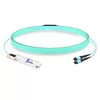
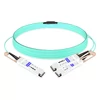
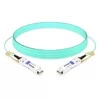
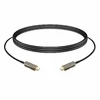
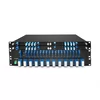
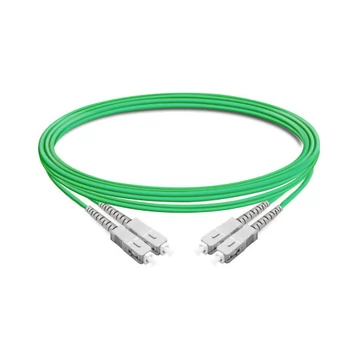
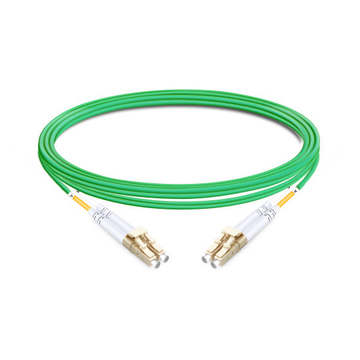
OM5 Wideband Multimode Fiber Patch Cords
OM5 wideband multimode fiber patch cords utilize 50/125 µm laser-optimized fiber designed for high-speed Ethernet applications, including 400GBASE-SR4.2 and short-wavelength division multiplexing (SWDM). Supporting multi-wavelength transmission over multimode fiber, OM5 improves bandwidth utilization and enables more efficient fiber infrastructure in compatible applications. Featuring low insertion loss, reliable optical performance, and compatibility with existing multimode systems, these patch cords are ideal for high-density data center interconnections and future network upgrades.
The Problem With Most OM5 Fiber Cables
A reliable 400G or SWDM link depends on the optical performance of its wideband multimode fiber. A cable labeled "OM5" should meet bandwidth requirements at both 850 nm and 953 nm, but the label alone does not verify compliance. If the fiber lacks the required wideband performance, multi-wavelength links may experience signal degradation or transmission errors, particularly when operating near their maximum supported distances.
OM5 is often sold as a commodity, but its wideband characteristics distinguish it from conventional multimode fiber.
A compliant OM5 cable uses 50/125 µm wideband multimode fiber (WBMMF) with a minimum effective modal bandwidth (EMB) of 4700 MHz·km at 850 nm and 2470 MHz·km at 953 nm.
These dual-wavelength bandwidth specifications are essential for applications that transmit optical signals across the extended short-wavelength range.
For example, SWDM4 technology typically uses four wavelengths—850, 880, 910, and 940 nm—to transmit multiple optical channels over a duplex fiber pair. OM5's specified wideband performance helps support reliable transmission at these wavelengths.
However, bandwidth alone does not determine the maximum transmission distance. Optical transceiver performance, chromatic dispersion, connector insertion loss, fiber attenuation, and the overall channel budget must also be considered.
Similarly, 400GBASE-SR4.2 uses two optical wavelengths, nominally 850 nm and 910 nm, across four parallel transmit fibers and four receive fibers. Its IEEE-defined reach extends to 150 meters over OM5, compared with 100 meters over OM4.
Then there is the OM3-versus-OM4-versus-OM5 question. All three use 50/125 µm laser-optimized multimode fiber and are compatible with many of the same multimode optical transceivers.
The key difference between OM4 and OM5 is their specified wavelength performance. While both provide a minimum effective modal bandwidth of 4700 MHz·km at 850 nm, OM5 additionally guarantees bandwidth performance at 953 nm.
For standard 850 nm parallel-optics applications, such as 40GBASE-SR4 and many 100GBASE-SR4 implementations, OM5 generally offers no transmission-distance advantage over OM4.
Its advantages become more significant in selected multi-wavelength SWDM and BiDi applications, as well as IEEE 400GBASE-SR4.2.
Choosing the right fiber grade helps avoid unnecessary cabling costs while ensuring the required bandwidth and transmission distance.
That is the approach FiberMall aims to bring to every product page: clear specifications, practical application guidance, and transparent product information.
OM5 Fiber Cable Specifications
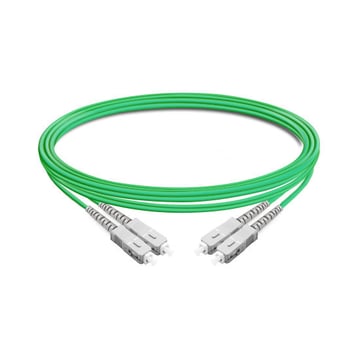
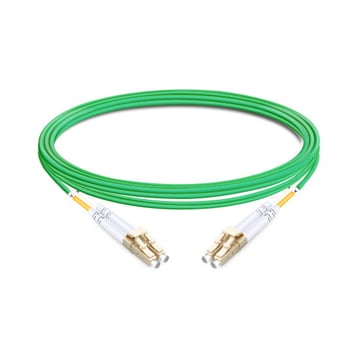
OM5 is a 50/125 µm wideband multimode fiber (WBMMF), commonly identified by its lime-green jacket under TIA color-identification conventions.
Unlike earlier multimode categories, OM5 specifies minimum effective modal bandwidth at both 850 nm and 953 nm, supporting transmission technologies that operate across multiple short wavelengths.
Its enhanced wavelength performance makes it suitable for SWDM applications and high-speed Ethernet standards such as 400GBASE-SR4.2.
The key technical specifications of OM5 multimode fiber patch cords include:
- Core/Cladding Diameter: 50/125 µm, providing compatibility with standard 50 µm multimode optical infrastructure.
- Jacket Color: Lime green, commonly used to distinguish OM5 from aqua OM3/OM4 and Erika violet OM4 cables.
- Effective Modal Bandwidth at 850 nm: ≥ 4700 MHz·km, supporting high-speed laser-optimized multimode transmission.
- Effective Modal Bandwidth at 953 nm: ≥ 2470 MHz·km, providing specified bandwidth performance for wideband multimode applications.
- Operating Wavelength Range: Approximately 850–953 nm for wideband multimode applications, depending on the optical transceiver and transmission standard.
- Fiber Attenuation at 850 nm: Commonly specified at ≤ 3.0 dB/km for cabled OM5 fiber.
- Fiber Attenuation at 953 nm: Commonly specified at ≤ 2.3 dB/km for cabled OM5 fiber. Individual bare-fiber products may specify lower attenuation values.
- Typical Light Source: VCSEL (Vertical-Cavity Surface-Emitting Laser), including multi-wavelength VCSEL implementations used in SWDM applications.
- Connector Insertion Loss: Typically ≤ 0.3 dB per mated connector pair for low-loss assemblies, depending on connector grade and test conditions.
- Connector Return Loss: Typically ≥ 30 dB for multimode PC/UPC connector assemblies, depending on connector construction and test conditions.
- Applicable Standards: ANSI/TIA-492AAAE (legacy OM5 fiber specification), IEC 60793-2-10 (A1-OM5, formerly A1a.4), ISO/IEC 11801, and relevant IEEE 802.3 Ethernet standards.
Supported Reach
OM5 supports different transmission distances depending on the Ethernet standard, optical transceiver technology, and channel configuration.
- 1 Gbps (1000BASE-SX): Supports distances of at least 550 meters in compatible installations. Longer distances may be supported depending on the optical transceiver specifications and channel performance.
- 10 Gbps (10GBASE-SR): Supports up to 400 meters under standard IEEE specifications. Certain extended-reach 10G transceivers can support up to 550 meters over OM5, subject to the manufacturer's specifications.
- 40 Gbps (40GBASE-SR4): Supports up to 150 meters over OM5 using conventional 850 nm parallel optics.
- 40 Gbps (40G SWDM4): Can support up to approximately 440 meters over OM5 with compatible SWDM4 transceivers. This is an implementation-dependent capability rather than a universal IEEE-defined reach.
- 100 Gbps (100G SWDM4): Commonly supports up to 150 meters over OM5 with compatible duplex LC SWDM4 transceivers, depending on the optical module specifications and link budget.
- 100 Gbps (100G BiDi): Certain multimode BiDi transceivers support up to 150 meters over OM5. Actual reach depends on the specific BiDi implementation.
- 100 Gbps (100GBASE-SR4): Supports the reach specified for the applicable IEEE PHY implementation. For example, IEEE 802.3bm 100GBASE-SR4 supports up to 100 meters over OM5, while later 100GBASE-SR4 implementations may specify different distances.
- 400 Gbps (400GBASE-SR4.2): Supports up to 150 meters over OM5 under IEEE 802.3cm, compared with 100 meters over OM4 and 70 meters over OM3.
These transmission distances apply to complete optical channels rather than individual patch cords.
Actual supported reach depends on optical transceiver specifications, fiber characteristics, connector quality, total channel insertion loss, and installation conditions.
For standard 40GBASE-SR4 and conventional 850 nm 100GBASE-SR4 applications, OM5 generally provides the same reach as OM4 under equivalent optical specifications.
OM5's advantages are most relevant to wideband multi-wavelength applications and selected standards such as 400GBASE-SR4.2.
For connections beyond the supported multimode distances, OS2 single-mode fiber is generally the preferred solution for 100G, 400G, and other high-speed links extending over kilometer-scale distances.
For conventional 850 nm parallel-optics links that do not require OM5's extended wavelength capabilities, OM4 multimode fiber may offer similar performance at a lower cabling cost.
Connector and Jacket Options
FiberMall offers OM5 duplex fiber patch cords in connector configurations commonly used in data centers, enterprise networks, and high-speed optical installations.
Different cable jacket options are available to meet installation and environmental requirements.
- Connectors: LC-LC, LC-SC, SC-SC, and SC-ST configurations are available for different equipment interfaces. Precision zirconia ceramic ferrules help provide accurate fiber alignment, low insertion loss, and consistent optical connections.
- PVC (OFNR): Riser-rated PVC cable is suitable for general indoor installations and vertical pathways where OFNR-rated cabling is permitted by applicable building and fire codes.
- LSZH: Low-smoke zero-halogen cable jackets reduce smoke emission and halogen-containing gas release during combustion. They are suitable for installations requiring or preferring these characteristics, subject to local fire-safety regulations.
- OFNP: Plenum-rated cable is designed for environmental air-handling spaces where plenum-rated cabling is required by applicable codes.
Selecting the appropriate connector combination and jacket rating helps ensure equipment compatibility, installation flexibility, and compliance with relevant safety requirements.
Lime Green: How to Identify OM5
OM5 fiber is commonly identified by its lime-green jacket, distinguishing it from aqua OM3/OM4 and Erika violet OM4 fiber cables.
The lime-green convention helps installers and network engineers identify wideband multimode cabling in high-density environments.
However, jacket color alone does not guarantee compliance with OM5 specifications.
A compliant OM5 fiber must meet the required effective modal bandwidth of at least 4700 MHz·km at 850 nm and 2470 MHz·km at 953 nm.
FiberMall OM5 products should be identified through their OM5 grade markings, published technical specifications, and relevant compliance documentation.
Where available, manufacturer test records can provide additional verification of the fiber's wideband optical performance.
Checking these specifications is especially important when deploying SWDM or 400GBASE-SR4.2 links that depend on transmission performance at wavelengths beyond 850 nm.
Why the Ferrule Matters
Connector ferrule quality plays an important role in maintaining low insertion loss and stable optical performance.
Poor-quality ferrules or improperly assembled connectors can cause fiber misalignment, inconsistent insertion loss, and performance degradation after repeated mating and unmating.
These issues can become particularly important in high-speed networks where the available optical power budget is limited.
FiberMall OM5 patch cords use precision zirconia ceramic ferrules designed to provide accurate fiber alignment and consistent connection performance.
Proper polishing and controlled connector assembly help reduce insertion loss and improve connection repeatability.
For multimode PC/UPC connector assemblies, return loss values of 30 dB or better are commonly specified, while insertion-loss performance depends on the connector grade and manufacturing quality.
Connector durability and insertion-loss repeatability should be evaluated according to the applicable product specifications and testing procedures.
By combining precision ferrules with controlled assembly processes, FiberMall OM5 patch cords are designed to provide reliable optical connections in high-density data center environments and enterprise networks.
OM5 vs OM3 vs OM4: When OM5 Is the Right Choice
The most useful thing a fiber supplier can do is help customers choose the appropriate multimode fiber grade, even when the correct choice is not OM5.
OM3, OM4, and OM5 all use 50/125 µm laser-optimized multimode fiber, but they differ in effective modal bandwidth, wavelength capabilities, and supported transmission distances.
OM3 Multimode Fiber
OM3 provides a minimum effective modal bandwidth of 2000 MHz·km at 850 nm.
It is designed for conventional 850 nm VCSEL-based optical transmission and is typically identified by an aqua jacket.
OM3 supports standard 10GBASE-SR connections up to 300 meters and 40GBASE-SR4 connections up to 100 meters.
For IEEE 802.3bm 100GBASE-SR4, OM3 supports up to 70 meters.
OM3 remains a practical and cost-effective option for shorter data center connections where higher-bandwidth OM4 or OM5 cabling is not required.
OM4 Multimode Fiber
OM4 provides a minimum effective modal bandwidth of 4700 MHz·km at 850 nm, offering higher bandwidth and longer supported distances than OM3.
It is commonly available with aqua or Erika violet jackets.
OM4 supports standard 10GBASE-SR applications up to 400 meters and 40GBASE-SR4 connections up to 150 meters.
For IEEE 802.3bm 100GBASE-SR4, OM4 supports up to 100 meters.
OM4 also supports many SWDM and BiDi transceivers, although the achievable distance depends on the specific module and wavelength configuration.
For standard 850 nm parallel-optics applications, OM4 generally provides the same transmission-distance capability as OM5.
OM5 Multimode Fiber
OM5 extends the bandwidth specifications of conventional laser-optimized multimode fiber across a wider wavelength range.
It provides minimum effective modal bandwidth values of 4700 MHz·km at 850 nm and 2470 MHz·km at 953 nm.
OM5 is commonly identified by its lime-green jacket and is designed to support wideband multimode applications, including short-wavelength division multiplexing.
With compatible 100G SWDM4 transceivers, OM5 can support duplex fiber links up to 150 meters.
For IEEE 400GBASE-SR4.2, OM5 supports up to 150 meters, compared with 100 meters over OM4 and 70 meters over OM3.
Its main advantages are extended wavelength performance and the additional reach available in certain multi-wavelength applications.
Which Fiber Grade Should You Choose?
Choose OM5 when you are deploying multi-wavelength SWDM4 or compatible BiDi transceivers and require the additional reach supported by OM5.
OM5 is also an appropriate choice for 400GBASE-SR4.2 links extending beyond the 100-meter OM4 limit and up to the 150-meter OM5 limit.
For networks planning to introduce additional wideband multimode applications, OM5 provides specified bandwidth performance at longer short wavelengths that may support future upgrades without replacing the fiber infrastructure.
However, OM5 is not the only fiber grade capable of supporting SWDM or BiDi transmission. These technologies can also operate over OM3 or OM4 within their supported distances.
Choose OM4 when your network uses conventional 850 nm parallel-optics interfaces, such as 40GBASE-SR4 and 100GBASE-SR4.
For these applications, OM4 generally provides the same transmission reach as OM5 while often costing less.
OM4 is also suitable for many SWDM and BiDi applications that do not require the additional reach available over OM5.
Choose OM3 when your connections operate within the supported OM3 limits, such as standard 10GBASE-SR links up to 300 meters.
For compatible applications and distances, OM3 provides reliable optical performance without the additional cost of higher-bandwidth fiber grades.
Choosing the right fiber grade allows network operators to balance performance, scalability, and total cabling cost.
Applications: Where OM5 Fiber Cables Are Used
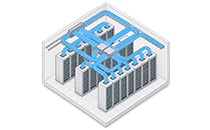
OM5 multimode fiber is designed for high-bandwidth, multi-wavelength optical connectivity in data centers and enterprise networks.
Its wideband characteristics make it particularly suitable for applications that require efficient fiber utilization, extended short-wavelength transmission, or future network upgrades.
- 400G Short-Reach Links: OM5 supports IEEE 400GBASE-SR4.2 connections up to 150 meters, compared with 100 meters over OM4. This application uses two wavelengths, nominally 850 nm and 910 nm, across four parallel transmit fibers and four receive fibers. It is suitable for high-speed switch-to-switch and data center interconnections.
- 100G SWDM4 and BiDi: Compatible SWDM4 and BiDi transceivers can transmit 100G Ethernet over a duplex fiber pair rather than the eight fibers used by traditional 100GBASE-SR4 implementations. Certain modules support up to 150 meters over OM5, providing opportunities to reduce fiber consumption and simplify high-density cabling.
- 40G SWDM4 Backbones: With compatible SWDM4 transceivers, OM5 can support 40G connections up to approximately 440 meters. This capability can be useful for extended data center links and suitable enterprise backbone applications where standard multimode solutions may not provide sufficient reach.
- Fiber-Count Reduction in High-Density Panels: Duplex SWDM and BiDi transceivers can reduce the number of fibers required for certain high-speed connections compared with conventional parallel-optics implementations. This can reduce cabling volume, patch panel density requirements, and connection complexity.
- Future Network Upgrades: OM5 is compatible with conventional OM3 and OM4 multimode applications and provides additional wavelength capabilities for selected future deployments. Organizations can install OM5 cabling for current 10G/25G connections while retaining the option to deploy compatible SWDM or other wideband multimode technologies later.
Across these applications, OM5 provides a combination of wideband optical performance, multimode compatibility, and flexibility for selected high-speed network architectures.
Its value is greatest when the network design can take advantage of multi-wavelength transmission or extended-reach standards such as 400GBASE-SR4.2.
FiberMall provides OM5 fiber patch cords alongside compatible multimode optical transceivers and MPO/MTP cabling solutions, helping customers build reliable and scalable high-speed optical networks.
OM5 Fiber Cable FAQ
What is OM5 multimode fiber?
OM5 is a 50/125 µm wideband multimode fiber (WBMMF) with a minimum effective modal bandwidth of 4700 MHz·km at 850 nm and 2470 MHz·km at 953 nm.
Its extended short-wavelength bandwidth specifications support multi-wavelength applications such as SWDM and high-speed Ethernet standards including 400GBASE-SR4.2.
What is the difference between OM3, OM4, and OM5 fiber?
All three use 50/125 µm laser-optimized multimode fiber.
OM3 provides a minimum effective modal bandwidth of 2000 MHz·km at 850 nm, while OM4 provides 4700 MHz·km at 850 nm.
OM5 matches OM4's minimum 850 nm bandwidth and additionally specifies at least 2470 MHz·km at 953 nm.
This makes OM5 particularly suitable for wideband multimode applications. However, SWDM and BiDi transceivers can also operate over OM3 and OM4 within their supported distance limits.
When should I use OM5 instead of OM4?
Choose OM5 when you need the additional reach available with compatible multi-wavelength SWDM or BiDi transceivers, or when deploying 400GBASE-SR4.2 links beyond 100 meters and up to 150 meters.
For conventional 850 nm parallel-optics applications, OM4 generally delivers the same standardized reach at a lower cabling cost.
What is SWDM4, and why does OM5 enable it?
SWDM4 (Short-Wavelength Division Multiplexing) typically uses four wavelengths—850, 880, 910, and 940 nm—to transmit multiple optical channels over a duplex fiber pair.
OM5 provides guaranteed effective modal bandwidth at both 850 nm and 953 nm, helping support transmission across this extended wavelength range.
SWDM4 can enable 100G transmission over two fibers rather than the eight fibers used by conventional 100GBASE-SR4.
OM3 and OM4 can also support SWDM4, but OM5 may provide longer transmission distances with compatible transceivers.
How far can OM5 fiber run?
OM5 supports standard 10GBASE-SR up to 400 meters, with certain extended-reach transceivers supporting up to 550 meters.
Compatible 40G SWDM4 modules can support up to approximately 440 meters, while certain 100G SWDM4 and BiDi modules support up to 150 meters.
For IEEE 400GBASE-SR4.2, OM5 supports up to 150 meters.
Standard 40GBASE-SR4 reaches up to 150 meters, while the supported reach of 100GBASE-SR4 depends on the specific IEEE PHY implementation.
Actual transmission distance depends on optical transceiver specifications and the complete channel performance.
Is OM5 backward compatible with OM4 and OM3?
Yes. OM5 is backward-compatible with conventional OM3 and OM4 50/125 µm multimode cabling systems when used with compatible optical interfaces.
OM5 patch cords can be connected to existing OM3 or OM4 infrastructure.
However, the overall channel performance is limited by the characteristics of the complete optical path, including the lower-bandwidth fiber segments, connector losses, and transceiver requirements.
What color is OM5 fiber cable?
OM5 fiber cable is commonly identified by its lime-green jacket under industry color-identification conventions.
This distinguishes it from aqua OM3/OM4 and Erika violet OM4 cables.
However, jacket color alone does not verify fiber performance. Customers should confirm the OM5 designation, dual-wavelength bandwidth specifications, and applicable compliance documentation before installation.