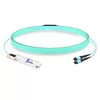
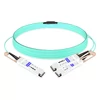
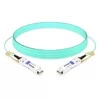
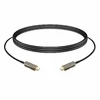
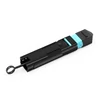
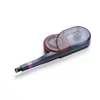
FiberMall Uniboot CS-LC High-Density Fiber Optic Patch Cord
The FiberMall Uniboot CS-LC high-density fiber optic patch cord features a single-jacket, dual-fiber design that integrates two optical fibers into one compact cable, reducing cable bulk and simplifying cable management in high-density data center racks. Featuring a CS connector on one end and an LC connector on the other, it provides a reliable, low-loss connection between compatible CS and LC interfaces. Designed for single-mode optical transmission, this patch cord offers flexibility, durability, and efficient space utilization, making it ideal for high-density interconnects, optical breakout applications, and compatible 40G, 100G, and 400G network infrastructures.
Why Uniboot Beats Standard Duplex Patch Cords
A conventional duplex LC patch cord typically consists of two individually jacketed fibers joined side by side with a clip. While this design works well in standard telecommunications environments, it can create unnecessary cable bulk and congestion in high-density data center patch panels, making cable management and port access more difficult.
A uniboot patch cord routes both fibers through a single round cable, typically 2.0 mm or 1.6 mm in diameter, depending on the configuration. By combining two fibers into one compact assembly, it can significantly reduce cable bulk compared with conventional duplex patch cords using two separate 2.0 mm cable legs. The actual space savings depend on the cable construction and connector design.
This streamlined design improves cable organization, reduces congestion around densely populated ports, and makes routine maintenance more convenient.
- Two fibers, one cable — A single uniboot assembly accommodates both transmit and receive fibers, replacing the two individually jacketed legs of a conventional duplex patch cord.
- Improved airflow management — Reduced cable bulk helps minimize obstructions around switch ports and equipment ventilation areas, supporting more efficient airflow management.
- Easier moves, adds, and changes — A compact cable assembly simplifies routing, identification, and handling during installation and maintenance.
- Field-reversible polarity options — Selected uniboot connector designs support polarity reversal without re-termination, allowing installers to adjust fiber mapping when necessary.
Uniboot patch cords generally cost more than conventional duplex patch cords. However, in high-density environments where cable organization, port accessibility, and maintenance efficiency are critical, their space-saving design can offer meaningful operational benefits.
Polarity & Field Reversal: Type A vs Type B
Polarity determines how optical fibers connect the transmitter (Tx) and receiver (Rx) across a duplex fiber link. Correct polarity is essential because the transmitter at one end must connect to the receiver at the opposite end.
Two common duplex fiber configurations are straight-through and crossed connections. These are often described using A-to-A and A-to-B polarity terminology, although connector orientation and labeling conventions must be considered when identifying the actual fiber mapping.
- Straight-through (A-to-A fiber mapping) — Fiber position A connects to position A, while position B connects to position B. This configuration maintains the corresponding fiber positions between both ends.
- Crossed (A-to-B fiber mapping) — Fiber position A connects to position B, while position B connects to position A. This configuration reverses the fiber positions between the two ends.
The required patch cord polarity depends on the overall cabling architecture, including the transceivers, adapters, patch panels, and intermediate fiber connections. A properly configured duplex channel ensures that Tx connects to Rx in both directions.
Incorrect polarity can prevent a link from establishing, even when the optical transceivers and fiber cables are otherwise compatible. Polarity problems generally result in a nonfunctional link rather than intermittent transmission, unless additional physical or connection-related faults are present.
Certain uniboot connector designs support tool-free field polarity reversal. Depending on the connector mechanism, installers may be able to release a retaining component, reposition the fiber assembly, and reassemble the connector without re-terminating the fibers.
However, not all CS-LC uniboot patch cords support field reversal, and the reversal procedure varies by connector design. The polarity configuration and field-reversal capability should therefore be confirmed for the specific product before installation.
Choose Your Connector and Length
Most conventional uniboot patch cords use LC-to-LC connectors. FiberMall's CS-LC uniboot patch cord is designed for applications requiring a transition between high-density CS interfaces and standard LC optical connections.
- CS is a compact duplex optical connector that uses two 1.25 mm ferrules in a reduced-width housing. Compared with conventional duplex LC connector assemblies, CS connectors offer higher port density and are used in selected high-density optical transceivers, breakout interfaces, and patch panels.
- LC is a widely adopted small-form-factor optical connector commonly used with SFP, SFP+, SFP28, and many QSFP-family optical transceivers. LC connectors are widely deployed in enterprise networks, data centers, and telecommunications infrastructure.
A CS-to-LC uniboot patch cord connects a compatible duplex CS interface to a duplex LC interface while maintaining a compact cable profile. It is particularly useful in high-density breakout applications where CS-equipped transceivers or patch panels connect to conventional LC-based optical equipment.
For 400G and 800G networks, CS connectors may be used on certain multiport breakout transceivers. However, connector compatibility alone does not guarantee optical interoperability. Both ends must support compatible Ethernet rates, optical wavelengths, modulation formats, transmission distances, and breakout configurations.
Connector boot design also affects accessibility and cable routing in densely populated panels.
- Standard uniboot boot — A conventional compact boot provides strain relief for the shared cable jacket and helps protect the fibers near the connector.
- Miniboot — A shorter boot reduces the space required behind the connector, making it suitable for compact installations. Minimum bend-radius requirements must still be observed.
- Push-pull tab — A pull-tab mechanism allows technicians to insert or remove compatible connectors more easily in densely populated patch panels without directly gripping the connector housing.
Available boot configurations depend on the specific CS and LC connector designs. Cable length, connector orientation, and routing clearance should be considered when selecting the appropriate assembly.
Uniboot Specifications
The FiberMall Uniboot CS-LC high-density fiber optic patch cord is designed for compact, low-loss single-mode optical connections. The following specifications describe the intended product configuration. Performance values and available options should be confirmed against the final product datasheet.
Fiber Type: OS2 single-mode optical fiber with a nominal 9/125 µm core/cladding designation, suitable for long-distance and high-speed optical transmission applications.
Fiber Count: Duplex configuration with two optical fibers integrated into a single cable jacket, supporting separate transmit and receive optical paths.
Operating Wavelength: 1310 nm and 1550 nm are common single-mode operating wavelengths. The cable may also support other wavelengths within the applicable single-mode fiber transmission windows, subject to fiber and connector specifications.
Connector Type: CS/UPC connector on one end and LC/UPC connector on the other. Custom connector combinations may be available upon request.
Cable Diameter: Standard 2.0 mm outer diameter, with a 1.6 mm option available upon request, subject to manufacturing availability.
Insertion Loss: Target maximum insertion loss of ≤ 0.3 dB per mated connector interface under specified test conditions. Actual insertion loss depends on connector quality, fiber alignment, end-face condition, and measurement procedures.
Return Loss: ≥ 50 dB for UPC-polished single-mode connector interfaces, subject to the applicable product specification and test conditions.
Cable Jacket: Low Smoke Zero Halogen (LSZH) and PVC-based jacket options. OFNR-rated constructions may be available where specifically manufactured and certified to meet the applicable flame-rating requirements.
Available Lengths: Standard length options from 0.5 m to 10 m, with customized lengths available upon request.
Bend-Insensitive Fiber: ITU-T G.657.A2 bend-insensitive single-mode fiber options, designed to reduce macrobending loss in installations requiring tighter cable routing.
OS2 single-mode fiber can be used with a wide range of optical Ethernet technologies, including compatible 1G, 10G, 25G, 40G, 100G, 400G, and higher-speed applications. However, the supported data rate and transmission distance are determined primarily by the optical transceivers, interface configurations, and overall link budget rather than by the passive patch cord alone.
In high-density environments, G.657.A2 bend-insensitive fiber can help maintain optical performance when cables must be routed around patch panels, equipment cabinets, and cable management structures. The minimum bend radius specified for the complete cable assembly must still be respected to prevent mechanical damage or excessive optical loss.
Applications
FiberMall Uniboot CS-LC fiber optic patch cords are designed for network environments where connection density, cable organization, and reliable optical performance are important.
- High-Density Data Center Cross-Connects — Connecting compatible CS and LC interfaces in densely populated racks and patch panels while reducing cable congestion and simplifying cable management.
- 400G/800G Breakout Panels — Providing duplex CS-to-LC connectivity between supported high-density breakout interfaces and compatible LC-based transceivers. The actual breakout speed and connection topology depend on the optical module specifications.
- Spine-Leaf and Top-of-Rack Networks — Supporting compact single-mode fiber connections between switches, optical modules, and patch panels in high-density network architectures, provided that the interfaces and optical specifications are compatible.
- Lab and Test Environments — Offering convenient, compact fiber connections for optical module testing, equipment validation, and network configuration changes. Field polarity reversal may be available on selected connector versions.
Frequently Asked Questions
What is a uniboot fiber cable?
A uniboot fiber cable is a duplex fiber optic patch cord that integrates two optical fibers into one shared cable jacket, typically using a compact connector boot design. Unlike conventional duplex patch cords with two separately jacketed cable legs, uniboot assemblies reduce cable bulk and simplify routing in high-density installations.
Depending on the cable dimensions and construction, uniboot designs can provide substantial space savings, making them especially useful in densely populated data center patch panels.
What's the difference between uniboot and standard duplex patch cords?
A conventional duplex patch cord typically uses two individually jacketed fibers, often with 2.0 mm cable diameters, connected by a duplex clip or similar arrangement.
A uniboot patch cord combines both fibers into a single 2.0 mm or 1.6 mm cable jacket, reducing overall cable bulk and improving cable organization.
Uniboot patch cords generally cost more than conventional duplex cables, but their compact design can improve accessibility and maintenance efficiency in high-density network environments.
How does uniboot polarity reversal work?
Field-reversible uniboot connectors allow installers to change the relationship between the two fiber positions without cutting or re-terminating the optical fibers.
Depending on the connector design, polarity reversal may involve releasing a retaining mechanism, repositioning the internal fiber assembly or connector components, and securing them in the alternate orientation.
This allows the same patch cord to support different duplex polarity requirements when the connector is specifically designed for field reversal.
Not all uniboot connectors, including CS-LC configurations, offer this function. Always verify the supported polarity configurations and follow the manufacturer's instructions before attempting reversal.
What's the difference between CS and LC connectors?
LC is a widely used small-form-factor optical connector found on many SFP-family and QSFP-family transceivers. A conventional duplex LC assembly uses two LC connectors to support bidirectional optical communication over two fibers.
CS is a more compact duplex connector that integrates two 1.25 mm ferrules into a single, narrow housing. Its reduced footprint supports higher connector density, making it suitable for selected high-density transceivers and breakout panels.
CS connectors are used in certain 400G and 800G optical module configurations, particularly where multiple independent duplex optical interfaces are required. However, not all 400G or 800G transceivers use CS connectors; LC, MPO/MTP, and other connector types are also common.
Is CS-to-LC right for my network?
Choose a CS-to-LC patch cord when connecting a compatible CS duplex interface to a standard duplex LC interface. This configuration is particularly useful for high-density breakout transceivers, optical patch panels, and network equipment requiring different connector types at each end.
For conventional LC-to-LC connections, an LC-LC duplex or uniboot patch cord is generally more appropriate.
Before selecting a CS-LC cable, verify the connector types, fiber type, polarity, optical interface compatibility, and required cable length. FiberMall offers CS-LC configurations and can provide additional connector and cable options according to project requirements.