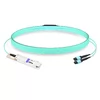
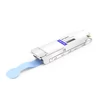
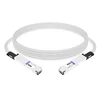
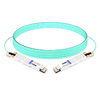
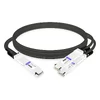
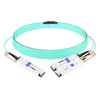
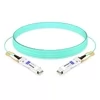
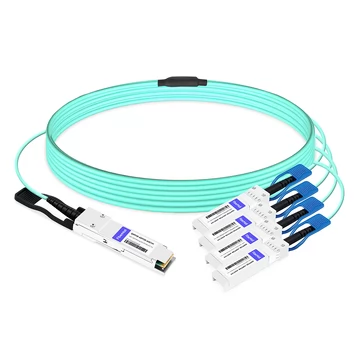
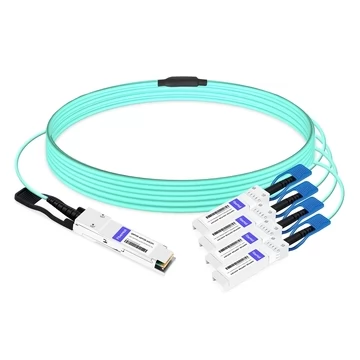
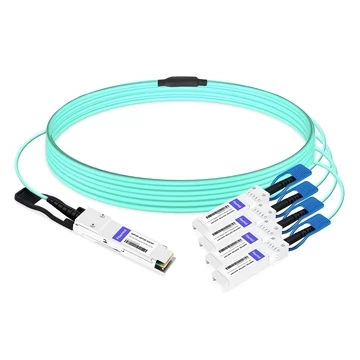
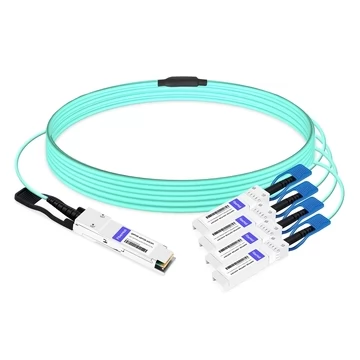
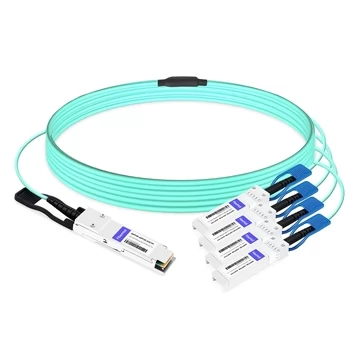
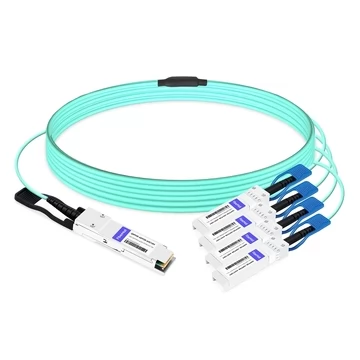
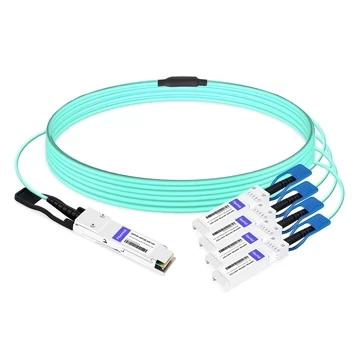
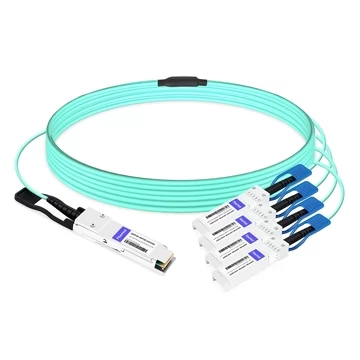
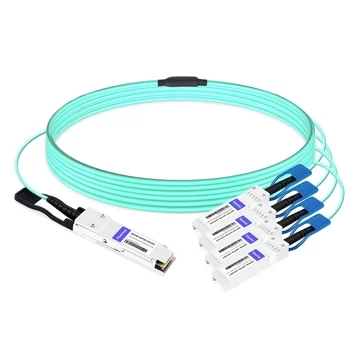
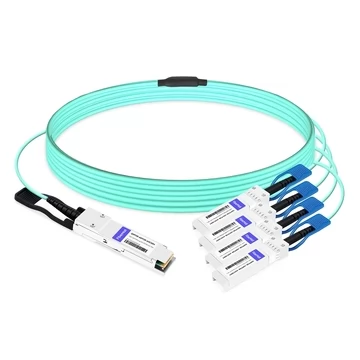
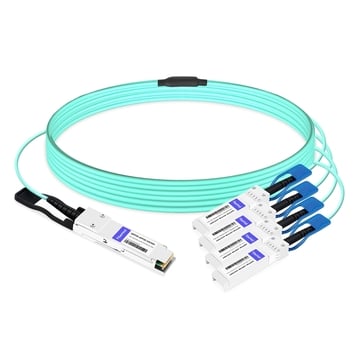
100G QSFP28 to 4×25G SFP28 Breakout AOC Cable
A 100G QSFP28 to 4×25G SFP28 breakout AOC is a factory-terminated active optical cable with one QSFP28 connector at one end and four SFP28 connectors at the other end. It allows a breakout-capable 100GbE QSFP28 port to operate as four independent 25GbE links.
This type of cable is widely used for 100GbE-to-4×25GbE Ethernet connections in data centers, cloud networks, storage environments, and Ethernet-based high-performance computing applications. Compared with copper breakout cables, it offers lower cable weight, improved routing flexibility, immunity to electromagnetic interference, and support for longer transmission distances.
The switch or network adapter connected to the QSFP28 end must support 4×25GbE port breakout. The cable does not perform protocol conversion or rate conversion on ports that do not support breakout mode.
The Real Cost of OEM Breakout AOCs
When a 100G switch port needs to fan out to four 25G endpoints, OEM breakout AOCs are often considered the safest option. However, procurement and network engineering teams frequently encounter three challenges.
1. OEM Pricing Pressure
Vendor-branded 100G QSFP28 to 4×SFP28 breakout AOCs may cost several times more than qualified third-party alternatives, especially for longer cable lengths or large-volume deployments.
2. Compatibility Uncertainty
Generic cables may fail vendor-specific EEPROM validation on switches or network adapters with strict compatibility controls. Even when a cable is electrically and optically compliant, incorrect coding may cause warning messages, unsupported-transceiver alarms, or failed links.
Compatibility also depends on more than EEPROM coding. The exact switch or NIC model, operating-system version, port breakout capability, firmware, and FEC configuration must all be considered.
3. Unclear Media Selection
Many product pages list cable specifications without clearly explaining whether a passive DAC, active copper cable, AOC, or structured optical solution is the most appropriate choice for a particular distance, power budget, and cabling environment.
Selecting the wrong media type can increase deployment costs, restrict airflow, or create avoidable signal-integrity and compatibility problems.
A 100G-to-25G Breakout AOC Built for Production Networks
FiberMall’s QSFP28 to 4×SFP28 breakout AOC is designed for reliable, high-density 100GbE-to-4×25GbE fan-out over integrated multimode fiber.
The cable separates the four 25Gb/s electrical lanes of a breakout-capable QSFP28 port into four independent SFP28 connections. It eliminates the need for separate optical transceivers and detachable fiber patch cords in fixed-length, medium-reach interconnects.
Its lightweight fiber construction helps reduce cable congestion and improve airflow in dense racks, while factory-terminated optical connections simplify installation and reduce the number of field connection points.
Key Benefits
Platform-specific coding options
The QSFP28 and SFP28 ends can be programmed for supported Cisco, Arista, Dell, Juniper, NVIDIA, HPE, Intel, and other major switch or network-adapter platforms. Mixed-vendor coding may also be available when the two ends connect to equipment from different manufacturers.
Compatibility should always be confirmed against the exact hardware model, port configuration, operating-system version, firmware, and FEC mode.
Longer reach than passive copper
Available cable lengths typically range from 1 meter to as much as 100 meters, depending on the product design and qualification. This is significantly longer than the practical reach of most passive copper breakout cables.
Lighter and more flexible routing
Integrated optical fiber is thinner and lighter than multi-lane twinax copper, making it easier to route through high-density racks, overhead cable trays, and multi-rack installations.
Immunity to electromagnetic interference
Optical signal transmission is not affected by electromagnetic interference from power cables, motors, RF equipment, or other electrically noisy environments.
Digital diagnostics support
Depending on the cable design and host platform, digital diagnostics may include temperature, supply voltage, bias current, and optical-power information. The parameters visible through the switch or NIC interface depend on the cable firmware, host software, and supported management functions.
Factory-direct pricing
FiberMall provides competitive pricing for samples, volume procurement, system integration, and OEM or ODM programs.
Technical Specifications
The cable uses one QSFP28 connector at the 100GbE end and four SFP28 connectors at the 25GbE ends.
It supports an aggregate Ethernet data rate of 100Gb/s. The physical serial line rate is four lanes of approximately 25.78125 Gb/s NRZ.
The cable is an active optical cable with integrated optical transmitters, receivers, and multimode fiber. The fiber is permanently attached to the connectors and is not designed to be disconnected or replaced in the field.
The optical engine commonly uses 850 nm VCSEL technology, although the exact optical architecture depends on the product design.
Available cable lengths generally range from 1 meter to 100 meters. The maximum supported length must be confirmed for the selected product model. Unlike detachable 100GBASE-SR4 optical links, an AOC is normally specified by its complete factory-assembled cable length rather than by a customer-selected OM3 or OM4 patch cord.
The complete cable assembly typically consumes approximately 4 to 6 watts, depending on cable length, optical-engine design, signal-conditioning functions, and operating mode. Power is supplied separately through the QSFP28 end and each of the four SFP28 ends.
The nominal supply voltage is 3.3 V.
At the QSFP28 host interface, the cable presents four 25.78125 Gb/s NRZ electrical lanes. Each SFP28 connector presents one 25.78125 Gb/s NRZ electrical lane.
The cable is designed for 100GbE-to-4×25GbE Ethernet applications and is aligned with the relevant requirements of IEEE 802.3bm and IEEE 802.3by. Form-factor and host-interface compliance may include the QSFP28 MSA, SFP28 MSA, SFF-8636, SFF-8665, SFF-8402, and related specifications, depending on the implementation.
Management communication is provided through I²C interfaces at the pluggable ends. The QSFP28 end generally uses an SFF-8636-compatible memory map, while the SFP28 ends use an SFP-family management interface. Exact page support and diagnostic functions depend on the cable firmware.
The standard commercial operating-temperature range is typically 0°C to +70°C. Industrial-temperature versions may be available for edge, telecom, or non-temperature-controlled environments.
Cable-jacket options may include OFNP, LSZH, or PVC, subject to cable length and production configuration.
The cable is hot-pluggable.
Built-In Reliability Features
Platform-specific EEPROM programming
The QSFP28 and SFP28 ends can be coded independently to match the identification and management requirements of supported switches and network adapters.
EEPROM programming improves compatibility, but it does not replace platform-level validation. Port breakout support, firmware, FEC, and operating-system compatibility must also be confirmed.
Integrated signal conditioning
The cable may use equalization, clock and data recovery, or retiming functions to maintain signal integrity across the rated cable length. The exact signal-conditioning architecture depends on the cable model.
Secure connector latching
The QSFP28 and SFP28 connectors use standard latching mechanisms to reduce the risk of accidental disconnection during installation, maintenance, or cable routing.
Bend-radius-optimized fiber
The integrated multimode fiber is designed for routing in dense cable bundles. The manufacturer’s specified minimum bend radius must still be followed to prevent optical loss or long-term cable damage.
Environmental compliance
RoHS- and REACH-compliant material options are available for international deployment requirements.
Switch Compatibility Matrix
FiberMall offers vendor-coded versions of the QSFP28 to 4×SFP28 breakout AOC. Compatibility must be confirmed using the exact switch or NIC model rather than the vendor name alone.
Cisco
Cisco-compatible versions can be supplied under the FiberMall reference:
QSFP28-4xSFP28-AOC-xM-CS
The QSFP28 end and the four SFP28 ends can be programmed for supported Cisco platforms.
Cisco’s commonly referenced QSFP-4SFP25G-CUxM products are passive copper breakout cables rather than AOCs, so they should not be treated as direct optical equivalents. The exact Cisco switch model must also support 4×25GbE breakout mode.
NVIDIA, Formerly Mellanox
NVIDIA-compatible versions can be supplied under the FiberMall reference:
QSFP28-4xSFP28-AOC-xM-ML
Common legacy NVIDIA or Mellanox references include:
MFA7A50-C003
MFA7A50-C005
MFA7A50-C010
MFA7A50-C015
MFA7A50-C020
MFA7A50-C030
Some MFA7A50 products are legacy or end-of-life references, but they remain useful for identifying the required electrical, mechanical, and coding characteristics of replacement cables.
Arista
Arista-compatible versions can be supplied under the FiberMall reference:
QSFP28-4xSFP28-AOC-xM-AR
Arista product names such as CAB-Q-4S-100G-xM generally refer to copper breakout cables, while AOC-Q-Q-100G-xM normally refers to QSFP28-to-QSFP28 AOCs rather than QSFP28-to-4×SFP28 breakout AOCs.
For this reason, compatibility should be based on the exact Arista switch model, EOS version, port breakout configuration, and coding requirements rather than an assumed equivalent OEM part number.
Dell
Dell-compatible versions can be supplied under the FiberMall reference:
QSFP28-4xSFP28-AOC-xM-DL
A known Dell reference for a 10-meter 100GbE QSFP28-to-4×25GbE SFP28 active optical breakout cable is:
Dell part number 470-ACIJ
Manufacturer reference VGTG7
Availability and part numbering may vary by region and Dell system generation.
Juniper
Juniper-compatible versions can be supplied under the FiberMall reference:
QSFP28-4xSFP28-AOC-xM-JN
Juniper reference JNP-100G-4X25G-1M is a copper breakout cable rather than an AOC. Therefore, it should not be presented as a direct optical OEM equivalent.
The correct FiberMall version should be selected according to the exact Juniper switch model, Junos OS version, port breakout capability, and FEC requirements.
HPE
HPE-compatible versions can be supplied under the FiberMall reference:
QSFP28-4xSFP28-AOC-xM-HP
Known HPE QSFP28-to-4×SFP28 active optical breakout cable references include:
845420-B21 for a 7-meter cable
845424-B21 for a 15-meter cable
Compatibility should still be confirmed against the exact HPE server, adapter, or switch platform.
Intel
Intel-compatible versions can be supplied under the FiberMall reference:
QSFP28-4xSFP28-AOC-xM-IN
Intel references such as XLDACBL1, XLDACBL3, and XLDACBL5 are 40G QSFP+ copper direct-attach cables. They are not 100G QSFP28-to-4×25G SFP28 breakout AOCs and should not be used as equivalent part numbers.
Intel compatibility must be verified according to the exact 25GbE or 100GbE network-adapter model, firmware version, supported port mode, and driver configuration.
Breakout AOC vs DAC: Which Cable Do You Need?
Not every 100GbE-to-4×25GbE interconnect should use an optical cable. Selecting the wrong media is a common cause of unnecessary cost, cable congestion, signal-integrity problems, or deployment delays.
Passive DAC
Passive direct-attach copper cables are normally used for distances of approximately 0.5 to 5 meters.
They consume little or no active cable power, typically less than 0.5 W for identification and management functions. Passive DACs are generally the lowest-cost and lowest-latency option for same-rack or adjacent-rack switch-to-server connections.
However, the maximum practical length depends on host electrical performance, cable gauge, insertion loss, and the platform’s supported FEC mode.
Active Copper Cable, ACC, or AEC
Active copper cables are commonly used for distances of approximately 3 to 10 meters, although some designs may support longer reaches.
They use active equalization or retiming to compensate for copper-channel loss. Power consumption varies considerably by architecture and may range from approximately 1 W to several watts for the complete assembly.
Active copper is appropriate when passive DAC reach is insufficient but fiber is not required.
Breakout AOC
A breakout AOC is commonly available in fixed lengths from approximately 1 meter to 100 meters, depending on the product.
The complete assembly normally consumes around 4 to 6 W. It is best suited to longer rack-to-rack connections, lightweight cable routing, dense cable bundles, and environments where electromagnetic immunity is important.
AOCs are factory terminated and cannot be repaired or reconfigured by replacing individual optical modules or patch cords.
Structured Optical Breakout
Structured optical cabling uses separate QSFP28 and SFP28 transceivers together with MPO/MTP and LC fiber cabling.
Its supported distance depends on the selected optical modules. A conventional 100GBASE-SR4-to-4×25GBASE-SR arrangement typically supports approximately 70 meters over OM3 and 100 meters over OM4.
Longer distances require appropriate extended-reach multimode or single-mode optical modules.
Structured optics are normally preferred when the deployment requires patch panels, reusable fiber infrastructure, field-replaceable transceivers, or distances beyond the available AOC range.
Rule of Thumb
When the 100G QSFP28 port and the four 25G SFP28 devices are in the same rack or in adjacent racks, a passive DAC is usually the simplest and lowest-cost choice.
When the connection exceeds the qualified passive-DAC distance, but copper is still preferred, an ACC or AEC may be suitable.
When the link requires lighter cabling, improved airflow, EMI immunity, or a fixed optical connection of more than approximately 5 meters, a breakout AOC is generally the better option.
For structured cabling, patch-panel installations, field-replaceable optics, or distances beyond the AOC’s rated length, separate optical transceivers and fiber breakout cabling should be used.
Where This Cable Delivers Value
Data Center Spine-Leaf and Top-of-Rack Networks
A QSFP28-to-4×SFP28 breakout AOC can connect one breakout-capable 100GbE switch port to four 25GbE top-of-rack switch ports, server NICs, storage interfaces, or other Ethernet endpoints.
In multi-rack environments, optical breakout cables reduce cable weight and improve airflow compared with equivalent multi-lane copper assemblies.
High-Performance Computing
In Ethernet-based HPC clusters, flexible optical breakout cables can be routed around GPU servers, storage arrays, compute nodes, and network switches where bulky copper cabling would restrict airflow or complicate cable management.
For InfiniBand deployments, the protocol, port mode, and cable qualification must be checked separately. A cable designed and coded only for Ethernet should not automatically be assumed to support InfiniBand.
100G-to-25G Migration
As network operators upgrade aggregation, leaf, or spine switches to 100GbE while existing servers and downstream devices continue to use 25GbE interfaces, breakout AOCs provide a practical migration path.
One 100GbE port can serve four existing 25GbE endpoints without requiring immediate replacement of all downstream network adapters.
Enterprise Storage and Converged Fabrics
The cable can connect 100GbE storage switches or Ethernet storage controllers to 25GbE NICs, converged network adapters, or Ethernet storage ports.
The term HBA should be avoided unless the application specifically uses a supported Fibre Channel protocol. A standard 100GbE-to-4×25GbE breakout AOC is intended primarily for Ethernet connections and does not convert Ethernet into Fibre Channel.
Telecom Edge and 5G Infrastructure
Lightweight and EMI-immune optical fan-out cabling can be useful between edge routers, aggregation switches, baseband equipment, and network appliances located in RF-dense environments.
Commercial-temperature cables should only be used in controlled indoor environments. Industrial-temperature models should be selected for outdoor cabinets, base-station sites, or other locations without controlled cooling.
Frequently Asked Questions
What Is a QSFP28 to 4×SFP28 Breakout AOC Cable?
A QSFP28 to 4×SFP28 breakout AOC is a factory-terminated active optical cable that connects one breakout-capable 100GbE QSFP28 port to four independent 25GbE SFP28 ports.
It uses integrated optical transmitters, receivers, and multimode fiber to provide longer reach and lower cable weight than most copper breakout cables.
The cable does not convert one non-breakout 100GbE port into four 25GbE ports. The QSFP28 host port must support 4×25GbE breakout or channelized operation.
What Is the Maximum Reach of a 100G QSFP28 to 4×SFP28 Breakout AOC?
Available lengths typically range from 1 meter to as much as 100 meters, depending on the product design, optical engine, fiber construction, and qualification.
Because the fiber is permanently integrated into the AOC, the cable is specified by its complete factory-assembled length rather than by an external OM3 or OM4 patch-cord selection.
The maximum supported distance should always be confirmed using the datasheet for the exact cable model.
Will This Cable Work with Cisco, Arista, Dell, Juniper, NVIDIA, or HPE Switches?
It can work with supported platforms when ordered with the correct EEPROM coding and when the host equipment supports the required port configuration.
Successful operation depends on:
The exact switch or NIC model
Support for 4×25GbE port breakout
The operating-system and firmware version
Vendor-validation behavior
The selected FEC mode
The coding required at the QSFP28 end
The coding required at each SFP28 end
For mixed-vendor links, the QSFP28 and SFP28 ends may need to be programmed independently.
What Is the Difference Between a Breakout AOC and a Breakout DAC?
A breakout AOC uses integrated fiber and optoelectronics. It provides longer reach, lower cable weight, improved routing flexibility, and immunity to electromagnetic interference.
A breakout DAC uses twinax copper. It is generally less expensive and consumes less power for short in-rack connections, but it is heavier and has a shorter practical reach.
Passive DACs are commonly used for approximately 0.5 to 5 meters. Breakout AOCs may be available in lengths from approximately 1 to 100 meters, depending on the product.
For more information, read our QSFP28 DAC vs AOC guide.
Does a QSFP28 Breakout AOC Require FEC?
FEC requirements depend on the cable design and host platform.
The 100GbE QSFP28 port and all four 25GbE SFP28 link partners must use compatible FEC settings. Some platforms require RS-FEC, while others may support BASE-R FEC or, for certain qualified low-BER links, operation without FEC.
The 100GbE and 25GbE sides should not be assumed to use identical FEC standards simply because they are part of the same cable assembly.
Always follow the switch or NIC manufacturer’s platform-specific configuration guidance. Incorrect FEC settings may cause the link to remain down, generate high error rates, or operate intermittently.
What Power Consumption Should I Expect?
A complete 100G QSFP28-to-4×SFP28 breakout AOC typically consumes approximately 4 to 6 W, depending on cable length, optical-engine design, and signal-conditioning architecture.
The QSFP28 end and each of the four SFP28 ends receive power from their respective host ports. Therefore, both the QSFP28 switch port and all four SFP28 ports must support the required module power class.
Exact maximum power consumption should be confirmed using the datasheet for the selected cable model.
Does the Cable Support DDM or DOM?
Digital diagnostics may be supported at the QSFP28 and SFP28 ends.
Depending on the cable design, available information may include temperature, supply voltage, optical transmit power, optical receive power, and bias current.
Not every host platform displays every diagnostic value. CLI visibility depends on the cable firmware, switch or NIC hardware, operating system, and supported management pages.
What Jacket Options Are Available?
Available cable-jacket options may include:
OFNP for plenum-rated installations
LSZH for low-smoke, zero-halogen environments
PVC for standard indoor applications
The required jacket should be selected according to local building regulations, fire-safety requirements, and data center installation standards.
Not every jacket type may be available in every cable length.
Can the QSFP28 and SFP28 Ends Use Different Vendor Codes?
Yes. For mixed-vendor deployments, the QSFP28 end may be coded for one equipment manufacturer while the four SFP28 ends are coded for another manufacturer.
For example, the QSFP28 end may connect to a Cisco or Arista switch while the SFP28 ends connect to Dell, HPE, or Intel server adapters.
Mixed-vendor coding should be specified when placing the order, together with the exact switch, NIC, firmware, operating-system, and FEC information.
What Warranty Does FiberMall Offer on Breakout AOCs?
FiberMall breakout AOCs are covered by the applicable standard product warranty and dead-on-arrival replacement policy.
Extended warranty, volume-support, and project-specific service terms may be available for strategic customers, system integrators, and OEM or ODM programs.
Refer to the current FiberMall warranty policy or contact the sales team for the exact coverage applicable to the selected product and order.