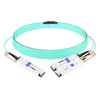
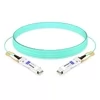
400G QSFP-DD DAC vs ACC Cables: Choose the Right Copper Solution for Your Data Center
Choosing the wrong 400G copper cable costs more than buying the most expensive option. A passive DAC may work perfectly at short reach, but it can become marginal at 2.5 to 3 meters under 400G PAM4 signaling if the host platform, cable gauge, and channel margin are not properly qualified. Active Copper Cable (ACC) extends copper reach, but it adds power and cost you may not need. Most vendors sell one or the other and hope you do not notice the gap.
FiberMall manufactures both 400G QSFP-DD DAC and ACC cables under the same roof. That means you get honest reach guidance, MSA-compliant signal integrity, and factory-direct pricing without distributor markup. Every cable is tested before shipment for signal integrity, BER performance, EEPROM coding, and multi-vendor compatibility, with ISO 9001-based quality traceability.
The 400G Cabling Problem Nobody Talks About
At 400G, PAM4 modulation packs two bits into four voltage levels. The signal-to-noise margin is tight. A passive DAC that works flawlessly at 1 meter can show rising pre-FEC bit error rate at longer reaches, especially around 2.5 to 3 meters if the host channel is not well qualified. The result may be link flapping, FEC error bursts, unstable links that appear “Up,” or intermittent packet errors under load.
Engineers know this. What they do not always know is where the practical cutoff sits for their specific rack layout, or whether Active Copper Cable is worth the extra cost and power draw.
Most suppliers publish a 3-meter passive DAC option and hope your deployment conditions match the ideal test environment. Others push ACC for every link because their margin is higher. Neither approach serves the engineer who needs the right cable for the right distance at the right cost.
DAC vs ACC: Which Copper Solution Do You Need?
FiberMall produces both passive DAC and Active Copper Cable on the same QSFP-DD platform. The correct choice depends on reach, power budget, host qualification, and rack geometry, not vendor preference. For a deeper comparison of all 400G cable types, see our complete QSFP-DD cable guide.
Passive DAC
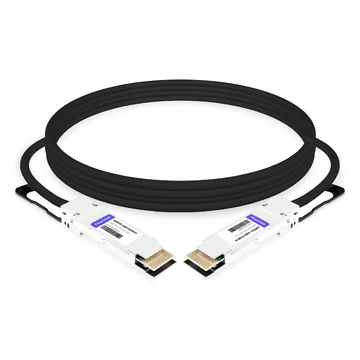
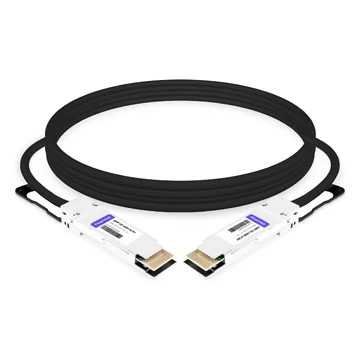
Passive DAC is the lowest-cost and lowest-power 400G copper interconnect. It uses direct twinax copper wiring with no active electronics inside the cable ends.
Passive DAC is best suited for standard in-rack Top-of-Rack-to-server links and short switch-to-switch connections. FiberMall recommends passive DAC for links up to 2 meters in normal production deployments. Selected 2.5-meter and 3-meter passive DAC links can be used when the host platform, cable gauge, and channel margin are qualified, but they should not be treated as a universal recommendation for every environment.
Passive DAC consumes less than 0.1 W per end, has near-zero latency, and offers the lowest total cost for short 400G links. However, thicker copper bundles require careful cable management, bend-radius control, and airflow planning.
Active Copper Cable
ACC adds active signal conditioning inside the connector housing. Depending on the design, this may include redrivers, equalization, or other signal-conditioning circuitry to improve PAM4 signal integrity over longer copper channels.
ACC is the better choice for links beyond the normal passive DAC comfort zone, especially 3 to 5 meters. Some ACC designs can be qualified for longer reaches, such as 7 meters, but this should be treated as a vendor-qualified and host-qualified use case rather than a general rule.
ACC typically consumes around 0.5 to 1.5 W per end. It costs more than passive DAC, but it is still significantly less expensive than AOC or optical transceiver solutions for short to medium copper reaches. Latency remains extremely low, usually limited to nanoseconds of processing delay.
Our Recommendation
Use passive DAC for standard Top-of-Rack connections under 2 meters. It is the cheapest, coolest, and most reliable 400G interconnect when the distance is short.
Choose ACC when the distance exceeds 2 meters, when cabinet geometry forces a longer copper run, or when the host channel needs additional signal margin. Do not assume every passive DAC at 3 meters is suitable for production stability. At 400G PAM4 speeds, the margin is too thin unless the cable and host platform are properly qualified.
If you need to go beyond the qualified ACC reach, FiberMall will recommend 400G AOC or optical transceiver solutions instead of selling you copper that may become unstable in production.
Why Data Center Engineers Choose FiberMall
Factory-Direct Pricing Without OEM Markup
FiberMall designs and manufactures QSFP-DD cables in-house. There is no distributor layer, no brand licensing fee, and no OEM tax. You receive MSA-compliant performance and multi-vendor compatibility at a fraction of typical OEM-branded cable pricing.
Pre-Ship Signal Integrity Testing
Every 400G cable undergoes signal integrity testing, BER verification, insertion-loss inspection, and EEPROM verification before it leaves our facility. We do not rely only on spot checks. We verify each unit to help ensure stable link performance in real production environments.
Multi-Vendor EEPROM Coding
Our cables ship with CMIS-compliant EEPROM coding configured for your target switch or NIC platform. Cisco, Arista, Juniper, Dell, HPE, NVIDIA, Mellanox, and other platforms can be supported according to your deployment requirements.
The EEPROM coding helps the host correctly recognize the cable type, length, application, vendor information, and management data. For ACC and selected active variants, Digital Diagnostic Monitoring can also report key operating information correctly. The result is fewer compatibility surprises during deployment.
QSFP-DD to OSFP Crossover Specialist
AI and HPC clusters often require mixed form factors, especially when QSFP-DD Ethernet switches connect to OSFP-based NICs or adapters. FiberMall manufactures QSFP-DD to OSFP Flat Top crossover cables in standard short lengths with the same signal integrity standards as our direct-attach lines.
For NVIDIA ConnectX-7 and similar high-speed adapters, the correct cable should always be selected according to the exact NIC SKU, switch port form factor, and host compatibility requirements.
Certifications and Standards Compliance
FiberMall 400G copper cables are manufactured under strict quality and compliance controls, including:
ISO 9001 quality management
CE European conformity
RoHS hazardous substance restriction
FCC electromagnetic compliance
QSFP-DD MSA compliance
IEEE 802.3bs and IEEE 802.3cd-related electrical requirements
CMIS-compliant management interface
SFF-8636 / SFF-8679 support where applicable for host compatibility
Stock and Speed
Standard lengths are kept in stock. Most orders ship within 48 hours. Custom lengths, labeling, packaging, and breakout configurations typically ship within 5 business days.
Technical Specifications
Electrical
Data Rate: 400 Gb/s aggregate
Electrical Lane Architecture: 8 lanes × 50G-class PAM4
Modulation: PAM4 at 26.5625 GBaud per lane
Impedance: 100 Ω ± 10%
Insertion Loss: Tested according to length and cable gauge
BER Performance: Verified under standard test conditions; target post-FEC BER below 1E-15 when used in a qualified host link
Physical Specifications for Passive DAC
Wire Gauge: Typically 30 AWG for short lengths such as 0.5 to 1.5 m; 28 AWG or 26 AWG for longer passive runs depending on length and design
Typical Use Length: 0.5 to 2 m recommended; 2.5 to 3 m only when host-qualified
Outer Diameter: Approximately 10 to 11 mm, depending on wire gauge
Minimum Bend Radius: 75 to 100 mm, depending on gauge and cable construction
Mating Cycles: Minimum 50 cycles, or higher according to connector vendor specification
Operating Temperature: 0°C to 70°C commercial range
Physical Specifications for ACC
Wire Gauge: Typically 30 AWG or 28 AWG depending on length and active design
Typical Use Length: 3 to 5 m; selected longer lengths require host and vendor qualification
Outer Diameter: Approximately 10 to 11 mm, depending on cable construction
Minimum Bend Radius: Approximately 55 mm or higher, depending on gauge
Mating Cycles: Minimum 50 cycles, or higher according to connector vendor specification
Operating Temperature: 0°C to 70°C commercial range
Management Interface
EEPROM: CMIS-compliant EEPROM coding for QSFP-DD platforms
Legacy Compatibility: SFF-8636-compatible memory mapping where required by host systems
DDM/DOM: Supported on ACC and selected active or breakout variants; passive DAC may provide limited static cable information
Hot Pluggable: Yes, QSFP-DD MSA compliant
Compliance
QSFP-DD MSA Rev 5.0
CMIS management interface
IEEE 802.3bs / IEEE 802.3cd-related 400G electrical requirements
SFF-8636 / SFF-8679 where applicable for host compatibility
RoHS
REACH
Available Configurations
Direct Attach
QSFP-DD to QSFP-DD, 400G to 400G
QSFP-DD to OSFP Flat Top for qualified OSFP-based platforms and NVIDIA-related AI/HPC deployments
Breakout / Splitter
QSFP-DD to 2× 200G QSFP56
QSFP-DD to 4× 100G QSFP56, commonly for 100GBASE-CR2 applications
QSFP-DD to 4× 100G QSFP28 only where the host platform and breakout mode are specifically validated
QSFP-DD to 8× 50G SFP56
Breakout compatibility depends on the switch ASIC, port breakout mode, host firmware, and supported lane mapping. FiberMall can help verify the correct breakout cable before deployment.
Lengths
Passive DAC standard lengths include:
0.5 m
1 m
1.5 m
2 m
2.5 m
3 m
For production stability, FiberMall recommends passive DAC up to 2 meters as the default choice. Longer passive DAC lengths should be used only after host and link qualification.
ACC standard lengths include:
1 m
2 m
3 m
4 m
5 m
7 m, available for selected qualified applications
Custom builds are available for non-standard lengths, labeling, and packaging.
What Network Engineers Say
“We deployed 800 passive DACs and 200 ACC cables across two AI training clusters. FiberMall pre-coded the EEPROMs for our Arista switches, and we did not see a single link flap during burn-in. The honest reach guidance saved us from buying ACC for every short link.”
Chen W., Senior Network Engineer, Hyperscale Cloud Provider
“Our procurement team quotes three vendors for every cable order. FiberMall consistently comes in 40–60% below distributor pricing with the same spec sheets and better lead times. We have standardized on them for 400G and 800G copper.”
Markus T., Infrastructure Procurement Manager, European Telecom Operator
“The QSFP-DD to OSFP cables were the hard part of our NVIDIA DGX deployment. FiberMall had them in stock, coded correctly, and delivered in three days. No rework. No compatibility tickets.”
Aisha R., Data Center Architect, North American AI Lab
Results our customers see:
Up to 60% cost reduction compared with OEM-branded cables
Zero compatibility rework on pre-coded and pre-qualified shipments
Sub-48-hour fulfillment on standard SKUs
Low annual cable failure rates in supported production deployments
FAQ
What is the maximum length for a 400G QSFP-DD passive DAC?
FiberMall recommends passive DAC for runs of 2 meters or less as the default production choice. Some vendors offer passive DAC lengths up to 3 meters, but at 400G PAM4 speeds the signal integrity margin becomes much tighter. A 2.5-meter or 3-meter passive DAC should be used only when the cable, host platform, and channel margin are properly qualified.
For 3 to 5 meters, ACC is usually the safer copper solution. For distances beyond the qualified ACC range, choose AOC or optical transceivers.
What is the difference between DAC and ACC cables?
DAC, or Direct Attach Copper, is passive twinax copper with no active electronics. It is the cheapest and lowest-power 400G interconnect, but it is limited to short reaches.
ACC, or Active Copper Cable, adds signal-conditioning electronics inside the connector housing, such as redrivers or equalization circuitry. This helps clean and extend the PAM4 electrical signal over longer copper runs. ACC costs more than passive DAC but remains less expensive than AOC or optical transceiver solutions for many short to medium-reach links.
Are FiberMall 400G cables compatible with Cisco, Arista, and NVIDIA switches?
Yes. FiberMall configures EEPROM coding and CMIS-compliant management information for the specific switch or NIC vendor you specify. Supported platforms include Cisco, Arista, Juniper, Dell, HPE, Extreme, NVIDIA Mellanox, and others.
Correct coding helps the host system recognize the cable type, length, supported application, and management data. For ACC and selected active variants, Digital Diagnostic Monitoring information can also be reported correctly.
When should I choose ACC over passive DAC?
Choose ACC when your link distance exceeds the normal passive DAC comfort zone, when you are connecting adjacent racks, or when cabinet geometry forces a longer copper run.
Choose passive DAC for standard in-rack Top-of-Rack-to-server connections under 2 meters. If you are unsure, send us your rack layout, switch model, NIC model, and required length. FiberMall will recommend the correct cable type based on distance, host compatibility, and signal integrity margin.
Do 400G DAC cables support breakout to 2× 200G or 4× 100G?
Yes. FiberMall manufactures QSFP-DD breakout cables in multiple configurations, including 1:2, 1:4, and 1:8 breakout options.
Common breakout configurations include:
1. QSFP-DD to 2× 200G QSFP56
2. QSFP-DD to 4× 100G QSFP56 for 100GBASE-CR2 applications
3. QSFP-DD to 4× 100G QSFP28 only on specifically validated platforms or active breakout designs
4. QSFP-DD to 8× 50G SFP56
Breakout cables let you fan out a single 400G switch port to lower-speed equipment, helping protect your existing infrastructure investment. The exact breakout mode must be supported by the switch ASIC, operating system, and target transceiver or cable form factor.
What is the power consumption of 400G DAC vs ACC vs AOC?
Passive DAC consumes less than 0.1 W per end, making it the most power-efficient 400G interconnect.
ACC typically consumes around 0.5 to 1.5 W per end, depending on the active signal-conditioning design and cable length.
AOC consumes more power because it performs electrical-to-optical and optical-to-electrical conversion. Actual power depends on vendor design and cable type, but it is generally higher than DAC or ACC.
Passive DAC is the clear winner for power efficiency and thermal budget. ACC adds modest power but remains more efficient than most optical solutions for qualified copper reaches.
What certifications do FiberMall 400G cables carry?
FiberMall cables are manufactured under ISO 9001 quality management and support CE, RoHS, FCC, and REACH compliance requirements. They are designed according to QSFP-DD MSA, CMIS, IEEE 802.3bs, IEEE 802.3cd, and applicable SFF specifications required for host compatibility.
What warranty do you offer on 400G QSFP-DD cables?
FiberMall provides a limited lifetime warranty on QSFP-DD DAC and ACC cables. If a cable fails under normal operating conditions, we replace it according to the warranty terms. Advanced replacement is available for enterprise accounts with active support contracts.