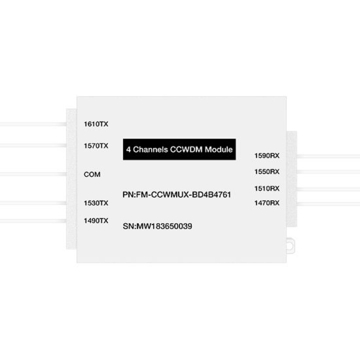
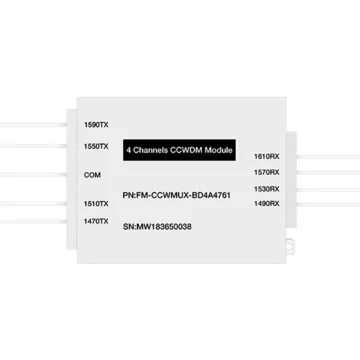
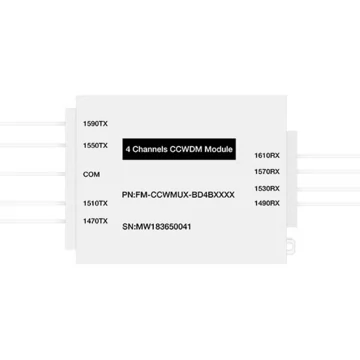
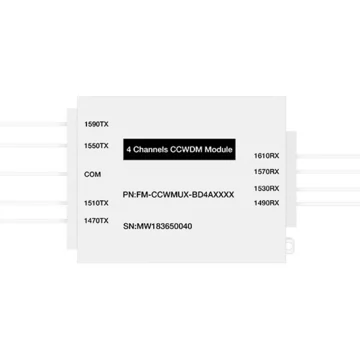
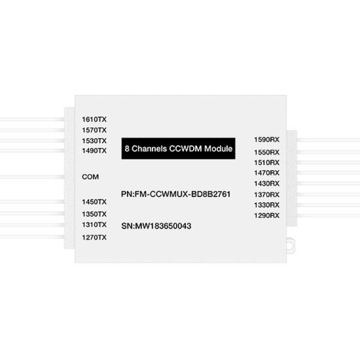
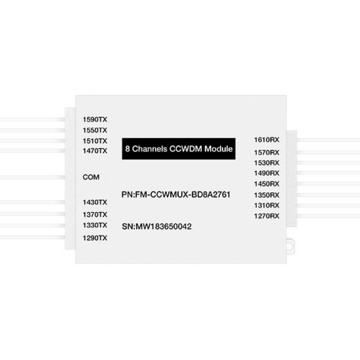
Compact CWDM Modules: High-Density WDM in a Smaller Package
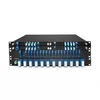
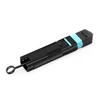
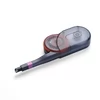
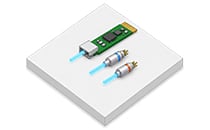
Fiber capacity is often exhausted long before rack space is fully utilized. A compact CWDM module, also known as a CCWDM module, allows network operators to combine or separate 4 to 18 wavelength channels over a single fiber or fiber pair, depending on the network topology. Compared with many conventional CWDM Mux/Demux modules, a CCWDM module can occupy approximately one-tenth of the package volume while maintaining the optical performance required for the target application.
FiberMall provides compact CWDM modules for network engineers who need high-density wavelength-division multiplexing in 5G fronthaul, FTTH aggregation, data center interconnect, metro access, and other fiber-constrained networks. The modules are designed and tested in accordance with applicable Telcordia GR-1209-CORE and GR-1221-CORE requirements. RoHS declarations and other regulatory or material-compliance documentation are available where applicable. Custom wavelength plans, connectors, fiber types, pigtail lengths, and package options are also available.
The Problem: More Capacity, Less Space
Modern optical networks are being asked to carry more services over a limited number of installed fibers. In 5G fronthaul networks, a growing number of remote radio heads and active antenna units must connect to centralized baseband resources. FTTH aggregation nodes must scale without continuously expanding the equipment-room footprint. Data center interconnect applications require greater fiber utilization and higher port density in racks that are already crowded.
Standard CWDM Mux/Demux modules solve the fiber-capacity problem, but their package size and optical loss can become limiting factors in space-constrained deployments. A conventional module may occupy approximately 110 × 80 × 12 mm or more, depending on the channel count, connector configuration, and housing design.
In many conventional cascaded CWDM architectures, light passes through a series of thin-film filters connected by internal fiber pigtails. Each additional optical interface and filter stage can contribute to insertion loss. When every decibel matters to the optical link budget and every millimeter matters to the equipment layout, engineers need a more compact and efficient WDM solution.
That is where a compact CWDM module changes the design equation.
The Solution: FiberMall Compact CWDM Modules
FiberMall compact CWDM modules use thin-film filter technology and a compact free-space micro-optical architecture to combine or separate CWDM wavelengths within a miniature package. Compared with many conventional fiber-cascaded designs, the free-space architecture reduces the number of internal fiber interconnections and helps achieve lower insertion loss, good channel uniformity, high isolation, and a significantly smaller package.
Key Benefits
• High-density form factor: Packages starting at approximately 43 × 28 × 6 mm can be integrated into compact enclosures, line cards, access devices, and 1U chassis.
• Low insertion loss: The compact free-space architecture can achieve lower optical loss than many conventional cascaded CWDM designs, although actual performance depends on channel count, connector configuration, special ports, and operating temperature.
• Broad channel support: Standard configurations include 4-channel, 8-channel, 12-channel, 16-channel, and 18-channel modules using the ITU-T G.694.2 CWDM wavelength grid.
• Industrial reliability: Standard operating-temperature options are available from −5°C to +70°C, while industrial versions can support operation from −40°C to +85°C.
• Passive operation: The modules require no electrical power or active cooling, simplifying installation and reducing system complexity.
• End-to-end optical matching: Compact CWDM modules can be paired with FiberMall CWDM transceivers to create a validated active-and-passive optical solution.
Features That Deliver
Free-Space Optical Design
Traditional cascaded CWDM modules route light through a series of fiber-coupled thin-film filters. FiberMall compact CWDM modules integrate the wavelength filters into a compact micro-optical assembly, reducing the number of internal fiber interconnections used in many conventional designs.
This architecture can help reduce insertion loss and polarization-dependent loss while also reducing the overall package size. The exact optical performance depends on the number of channels, filter arrangement, connector type, pass-through ports, and environmental requirements.
Epoxy-Free Optical Path
Selected FiberMall CCWDM designs use an epoxy-free main optical path. Reducing the use of adhesive at critical optical interfaces can improve environmental stability and minimize the effects of adhesive aging during temperature cycling or extended operation.
This design is especially valuable in outdoor cabinets, uncontrolled equipment rooms, industrial facilities, and other environments where components may experience wide temperature variations. Availability of an epoxy-free optical path should be confirmed for the specific module configuration.
Customizable Channel Configurations
FiberMall offers standard 4-channel, 8-channel, 12-channel, 16-channel, and 18-channel modules. Custom wavelength sets can also be developed for networks that do not require every channel on the full CWDM grid.
Optional monitor, express, upgrade, or pass-through ports can be added to support diagnostics, legacy services, additional wavelength bands, or cascaded WDM architectures. Because the definitions of these special ports vary between product designs, their exact passbands and functions should be confirmed in the module datasheet.
Multiple Fiber and Connector Options
FiberMall supports both single-fiber bidirectional and dual-fiber CWDM configurations.
In a dual-fiber system, one fiber carries traffic in one direction and a second fiber carries traffic in the opposite direction. The same wavelength set can generally be used at both ends.
In a single-fiber bidirectional system, both transmission directions share one fiber. Each end must therefore use a complementary transmit-and-receive wavelength plan, and the two modules must be deployed as a matched pair.
Available fiber options include ITU-T G.652.D single-mode fiber, including Corning SMF-28e+® or equivalent, and bend-insensitive ITU-T G.657.A1 or G.657.A2 fiber, depending on the product configuration.
Connector options can include LC, SC, and FC interfaces with UPC or APC polish. Custom pigtail lengths, cable jackets, fiber types, and connector combinations are available through FiberMall OEM/ODM services.
Telcordia-Based Reliability
FiberMall compact CWDM modules are designed and tested according to applicable requirements in Telcordia GR-1209-CORE and GR-1221-CORE for passive optical components. Testing may include optical performance, temperature cycling, damp heat, mechanical shock, vibration, fiber retention, and other reliability evaluations, depending on the product qualification plan.
FiberMall operates under an ISO 9001-certified quality management system. ISO 9001 applies to the organization’s quality-management processes rather than serving as a product-level optical-performance certification.
Product-level RoHS declarations and other applicable material or regulatory documentation can be provided according to the destination market and customer requirements.
Compact CWDM Module Specifications
FiberMall compact CWDM modules are available with 4, 8, 12, 16, or 18 channels. Custom channel combinations can also be provided.
The modules use the ITU-T G.694.2 CWDM grid, with nominal center wavelengths from 1271 nm to 1611 nm at 20 nm intervals. Standard nominal wavelengths therefore include 1271, 1291, 1311, 1331, and subsequent channels up to 1611 nm. Legacy wavelength labeling based on 1270–1610 nm may also be encountered in the market, so the exact wavelength plan should be confirmed when matching existing equipment.
The nominal passband is typically approximately ±6.5 nm around the specified center wavelength, subject to the final filter design and customer requirements. Center-wavelength accuracy should be specified separately from the nominal ITU grid.
Insertion loss depends on the channel count, Mux or Demux direction, connector configuration, temperature range, and inclusion of monitor, express, or upgrade ports. Representative maximum insertion-loss targets may range from approximately 1.0 dB for selected 4-channel configurations to approximately 2.5 dB for selected 18-channel configurations. The product datasheet should state whether connector loss is included.
Typical adjacent-channel isolation is at least 30 dB, while non-adjacent-channel isolation is typically at least 40 dB. Return loss is generally at least 45 dB, and directivity is typically at least 50 dB.
Polarization-dependent loss is typically no more than 0.2 dB, while polarization-mode dispersion is typically no more than 0.1 ps.
Maximum permissible optical input power depends on the module design and the measurement reference point. Selected versions may support approximately 300 mW to 500 mW at the common port. The exact rating should be confirmed for the required channel count, operating temperature, and optical architecture.
Available fiber types include ITU-T G.652.D and bend-insensitive ITU-T G.657.A1 or G.657.A2 single-mode fiber. Connector options include LC, SC, and FC with UPC or APC polish, subject to configuration.
The standard operating-temperature range is −5°C to +70°C. Industrial-grade versions support operation from −40°C to +85°C. The typical storage-temperature range is −40°C to +85°C.
Package dimensions start at approximately 43 × 28 × 6 mm, although the final size depends on channel count, fiber routing, connectors, special ports, and housing requirements.
The modules are designed and tested according to applicable Telcordia GR-1209-CORE and GR-1221-CORE requirements. RoHS and other product documentation are available where applicable.
Applications
Compact CWDM modules are protocol-transparent passive optical devices. They can operate with different Ethernet, Fibre Channel, CPRI, eCPRI, video, storage, and transport protocols because the module separates or combines wavelengths without processing the transmitted data.
Compatibility with a CWDM transceiver depends on more than the nominal wavelength alone. The center wavelength, transmitter spectrum, CCWDM passband, optical link budget, receiver sensitivity, receiver overload level, fiber topology, connector loss, chromatic dispersion, and target transmission distance must all be compatible.
Common deployment scenarios include the following.
5G Fronthaul and Backhaul
Compact CWDM modules can consolidate multiple remote radio head or active antenna unit links onto a single fiber or fiber pair. Their small package size makes them suitable for crowded outdoor cabinets, access sites, and compact aggregation equipment.
FTTH and FTTx Aggregation
CCWDM modules can help increase the capacity of existing trunk fibers between optical line terminals, aggregation sites, remote nodes, and central offices. They allow additional wavelength-based services to be introduced without immediately installing new fiber cables.
Data Center Interconnect
Compact CWDM modules improve fiber utilization between switches, routers, storage platforms, and data center facilities. Their low-profile packaging can be integrated into high-density panels, line cards, and compact passive WDM chassis.
Metro and Access Networks
CWDM channels can be added to existing metro or access fiber infrastructure to support Ethernet, storage, mobile transport, enterprise connectivity, and other wavelength-based services.
CATV and Video Distribution
Compact CWDM modules can combine video, data, monitoring, and control signals over shared fiber infrastructure, provided that the wavelength plan, optical-power levels, and passbands are compatible.
Enterprise Campus Networks
CCWDM modules can extend building-to-building connectivity and increase fiber capacity across a campus without requiring new trenching or additional backbone fibers.
Surveillance and Industrial Networks
Video, control, sensor, and Ethernet traffic can be multiplexed over existing fiber in industrial facilities, transportation networks, security systems, and other environments where fiber availability is limited.
Because compact CWDM modules are passive, they require no electrical power and no active cooling. They add no meaningful signal-processing latency because they do not perform optical-to-electrical conversion, packet processing, retiming, or digital signal processing. The physical propagation delay through the optical path is negligible for normal network applications.
Compact CWDM vs. Standard CWDM vs. DWDM
Engineers often need to choose between compact CWDM, standard CWDM, and DWDM. The correct option depends on package size, channel count, fiber availability, transmission distance, optical budget, scalability, and total system cost.
Package Size
Compact CWDM generally provides the smallest package and is well suited to line cards, access devices, small enclosures, and high-density 1U systems. A representative CCWDM package may start at approximately 43 × 28 × 6 mm.
Standard CWDM modules are often larger and may use packages around 110 × 80 × 12 mm or more, although the exact dimensions vary considerably.
DWDM modules are available in many formats, ranging from miniature passive components to full rack-mounted systems. DWDM should not automatically be described as physically larger because compact passive DWDM modules are also available.
Insertion Loss
Compact free-space CWDM designs generally offer low insertion loss, particularly in lower-channel-count configurations.
Standard CWDM insertion loss is configuration-dependent and may increase as additional thin-film filters and internal fiber interconnections are added.
DWDM insertion loss also depends on channel count, filter technology, passband width, and architecture. A DWDM Mux/Demux does not inherently have high insertion loss simply because it uses narrower channel spacing. Optical amplifiers may compensate for system-level loss in long-reach networks, but they do not reduce the insertion loss of the passive DWDM module itself.
Channel Count
Compact CWDM and standard CWDM systems can support up to 18 nominal wavelength channels on the ITU-T G.694.2 grid.
DWDM systems can support significantly more channels. Depending on channel spacing and operating band, a DWDM platform may support 40, 48, 80, 96, or more wavelength channels.
Channel Spacing
Both compact CWDM and standard CWDM use a nominal channel spacing of 20 nm.
DWDM commonly uses frequency-based channel spacing such as 100 GHz or 50 GHz, which corresponds to approximately 0.8 nm or 0.4 nm around 1550 nm. Other DWDM grid spacings and flexible-grid configurations are also available.
Transmission Reach
The transmission distance of a compact or standard CWDM system is determined by the complete optical link rather than by the passive Mux/Demux alone.
CWDM deployments commonly support distances ranging from a few kilometers to several tens of kilometers. Selected wavelength plans and long-reach CWDM transceivers may support distances approaching 80 km when transmitter power, receiver sensitivity, chromatic dispersion, fiber attenuation, connector loss, and Mux/Demux insertion loss all remain within the link budget.
DWDM is commonly used for metro, regional, and long-haul networks. With coherent transceivers, dispersion management, optical amplification, and appropriate line-system engineering, DWDM links can extend over hundreds or thousands of kilometers.
Cost
Compact CWDM generally offers a low-cost method of expanding fiber capacity, particularly when rack space or module volume is limited.
Standard CWDM is also relatively economical and is suitable for general fiber-capacity expansion where package size is less critical.
DWDM usually involves higher component and system costs because of its narrower optical passbands, tighter wavelength control, higher channel counts, and, in longer-reach systems, possible requirements for amplifiers, dispersion management, monitoring, and coherent optics.
Best-Fit Applications
Compact CWDM is best suited to space-constrained, high-density links that require a passive, low-power WDM solution.
Standard CWDM is well suited to general fiber expansion, enterprise networks, access networks, and installations where package size is not the primary constraint.
DWDM is preferred for ultra-high-capacity metro, regional, data center interconnect, and long-haul networks that require more wavelengths, longer reach, or coherent transmission.
How to Choose a Compact CWDM Module
Selecting the right compact CWDM module requires matching the optical design to the network requirements. Use the following checklist.
1. Channel Count
Determine how many wavelengths are required today and how many may be added later. An 8-channel or 16-channel module with an appropriate upgrade, express, or pass-through port may provide more flexibility when future expansion is likely.
2. Single-Fiber vs. Dual-Fiber
A single-fiber bidirectional system uses one fiber for transmission in both directions. The two endpoints must use complementary transmit and receive wavelengths and matched A/B modules.
A dual-fiber system uses one fiber for each direction. It generally allows the same wavelength plan to be used at both endpoints and can simplify network planning.
3. Wavelength Plan
Standard ITU-T G.694.2 modules use nominal wavelengths from 1271 nm to 1611 nm at 20 nm intervals.
Before using channels around the 1383 nm water-peak region, verify the type and attenuation characteristics of the installed fiber. Modern ITU-T G.652.D low-water-peak fiber generally supports operation across this wavelength region. Older fiber may exhibit significantly higher attenuation around the water peak, potentially affecting channels such as 1391 nm and nearby wavelengths.
The wavelength plan must also match the CWDM transceivers and the passbands of the Mux/Demux.
4. Connector Type
LC connectors are widely used in data centers and high-density network equipment.
SC connectors are common in telecom, access, FTTH, and outside-plant environments.
FC connectors may be preferred in some laboratory, measurement, industrial, or vibration-sensitive applications.
Select UPC or APC polish according to the equipment interface and return-loss requirements. UPC and APC connectors must not be directly mated to each other.
5. Temperature Range
A standard operating range of −5°C to +70°C is generally sufficient for controlled equipment rooms and indoor installations.
Choose an industrial-temperature version rated from −40°C to +85°C for outdoor cabinets, roadside enclosures, industrial sites, uncontrolled telecom rooms, or other harsh environments.
6. Special Ports
A monitor port can provide a small percentage of the optical signal for monitoring and diagnostics.
An express, upgrade, or pass-through port can provide a defined passband outside the installed channel set. This can allow legacy services, additional wavelength bands, or cascaded WDM modules to share the same fiber.
Because port terminology and passbands vary by design, confirm the exact optical function in the product datasheet.
7. Insertion-Loss Budget
Confirm that the total link loss remains within the optical budget of the transceivers.
The calculation should include the insertion loss of the Mux and Demux, fiber attenuation, connector loss, splice loss, patch-cord loss, engineering margin, and any additional passive components.
The receiver overload limit should also be checked on short links, particularly when high-output-power transceivers are used.
Frequently Asked Questions
What Is a Compact CWDM Module?
A compact CWDM module, or CCWDM module, is a miniaturized passive optical multiplexer or demultiplexer that combines or separates several CWDM wavelengths over a single fiber.
Duplex communication can be implemented through either a dual-fiber Mux/Demux pair or a matched single-fiber bidirectional wavelength plan.
Many CCWDM modules use a compact free-space micro-optical architecture to reduce package size and internal fiber interconnections.
What Is the Difference Between CWDM and CCWDM?
CWDM is the general coarse wavelength-division multiplexing technology defined around a wide wavelength spacing, typically 20 nm on the ITU-T G.694.2 grid.
CCWDM is a compact implementation of CWDM. It commonly uses free-space optics and thin-film filters in a miniaturized optical assembly, allowing a smaller package and potentially lower insertion loss than many conventional fiber-cascaded CWDM designs.
CCWDM does not define a different wavelength grid or network protocol. It is primarily a compact optical packaging and architecture approach.
How Many Channels Does a Compact CWDM Module Support?
FiberMall compact CWDM modules are available in standard 4-channel, 8-channel, 12-channel, 16-channel, and 18-channel configurations using the ITU-T G.694.2 CWDM grid.
Custom wavelength sets can also be developed through FiberMall OEM/ODM services.
What Is the Typical Insertion Loss of a Compact CWDM Module?
Insertion loss depends on the channel count, optical design, connector configuration, special ports, and temperature requirements.
Representative maximum values may range from approximately 1.0 dB for selected 4-channel modules to approximately 2.5 dB for selected 18-channel modules. The exact specification should be verified for the required product, including whether connector loss is included.
Compact free-space designs can achieve lower loss than many equivalent conventional cascaded CWDM designs, but this should be evaluated on a product-by-product basis.
Is Compact CWDM Passive or Active?
Compact CWDM modules are passive optical devices. They require no electrical power and generate no active electronic heat.
Because they do not perform optical-to-electrical conversion, packet processing, retiming, or digital signal processing, they add no meaningful processing latency. The optical propagation delay through the component is negligible for normal network applications.
What Connector Types Are Available?
FiberMall can provide LC, SC, and FC connector options with UPC or APC polish, depending on the configuration.
Custom connector combinations, pigtail lengths, fiber types, cable jackets, and package styles are also available.
Single-Fiber vs. Dual-Fiber CWDM: Which Should I Choose?
Choose a single-fiber bidirectional design when conserving fiber is the highest priority and only one fiber is available. A matched A/B module pair and complementary transmit-and-receive wavelengths are required.
Choose a dual-fiber design when separate transmit and receive fibers are available and simpler wavelength planning is preferred.
What Does an Express or Upgrade Port Do?
An express, upgrade, or pass-through port provides a specified wavelength band outside the primary CWDM channel set.
Depending on the product design, it may allow legacy services, additional CWDM or DWDM bands, or cascaded WDM modules to coexist on the same fiber.
The exact passband and intended use are configuration-specific and should be confirmed in the datasheet.
Can Compact CWDM Modules Operate Over Industrial Temperature Ranges?
Yes. FiberMall offers standard compact CWDM modules rated for operation from −5°C to +70°C and industrial-grade versions rated from −40°C to +85°C.
The required temperature range should be specified when ordering because it may affect filter selection, packaging, insertion-loss limits, and qualification requirements.
Are FiberMall Compact CWDM Modules Compatible with Third-Party CWDM Transceivers?
FiberMall compact CWDM modules can be used with third-party CWDM transceivers when the optical parameters are compatible.
The nominal center wavelength, transmitter spectrum, CCWDM passband, fiber topology, transmitter power, receiver sensitivity, receiver overload level, total link loss, chromatic dispersion, and target reach should all be verified.
The passive module is protocol-transparent, so it can be used with CWDM SFP, SFP+, SFP28, XFP, and other transceiver form factors when the complete optical interface is compatible.
For a validated end-to-end configuration, the CCWDM module can be paired with FiberMall CWDM transceivers and reviewed against the intended link budget.
Can I Get a Custom Wavelength or Connector Configuration?
Yes. FiberMall provides OEM/ODM customization for nominal wavelengths, channel combinations, passbands, connector types, fiber types, pigtail lengths, cable jackets, package dimensions, special ports, housing, and labeling.
Contact the FiberMall sales team with the required wavelength plan, channel count, fiber topology, connector type, operating temperature, optical-power level, package size, and target application.