56G FDR InfiniBand: AOC Cable, Transceiver, and Switch Options
In the way of seamless data movement and high-speed computing performance, 56G FDR InfiniBand Protocol is the top-of-the-pack technology that promises speed and efficiency second to no others. However, the right mix of other critical elements-AOC cables, transceivers, and switches-will determine the true potential of this speed.
Introduction to FDR InfiniBand
What is 56G FDR InfiniBand?
The 56G FDR (Fourteen Data Rate) InfiniBand technology gives enhanced performances because it revamps the speed of data-intensive applications to work with minimal delay while accessing high volumes of data. Because of actors in the FDR InfiniBand construct, 56 Gigabits per second (Gbps) ports are enabled to let servers, storage devices and other parts communicate more securely and swiftly within their high-performance computing (HPC) systems and data centers.
Extremely high results are coming for an entirely new reason: Excellent encoding of transmitted data! This is due to the use of the advance 64/66 bit encoding scheme, which provides a significant efficiency improvement for data transmission compared to previous tech like QDR (Quad Data Rate). Focused on fast data access and transfer, the FDR supply delivers minimized overhead and superior payload capacity for data transmission.
Significance in High-Performance Computing (HPC)
FDR InfiniBand system operation provides vital help for the advancement of High-Performance Computing (HPC) through super-low latency and high bandwidth required for highly complex computational tasks. Node communication becomes an overwhelming prerequisite of HPC applications when large-scale simulations, real-time data analyses, or any weather modeling tasks are run. InfiniBand offers a particularly balanced solution to these needs as it can support data rates to go up to 56Gbps and potentially reduce latencies up to 500 nanoseconds.
High-technology evidence is sufficient to demonstrate the critical need of HPC clusters. InfiniBand became pivotal to supercomputing technology of present generation; thus it has been dominating the top-performing system category for some time based on measuring global performance with the TOP500 list. The HDR InfiniBand system, unlike conventional switch designs, is relatively uncommon but delivers a maximum data transfer rate of up to 200 Gbps for cutting-edge systems like those at Oak Ridge National Laboratory.
Technical Specifications of 56G FDR
Throughput and Latency Benchmarks
Testing for FDR InfiniBand 56G, both throughput and latency must be tested to show the peak performance in high-performance computing (HPC) surroundings attributable to the capability of transmitting at 56 Gbps data per link and accompanying data transfer to other nodes during less complex conditions of multiple workloads. Hence the throughput hence sustains the work for large-scale simulations, deep learning model training, and real-time financial analytics.
The FDR InfiniBand is endowed with latencies pegged at an approximate range of between 0.7 microseconds ensuring there is always assured fast data traffic that could not possibly be anticipated even by causing mere interruption. This system would be mostly attractive in any case where systems running synchronization between workloads might also be approximating the time they would both need to process the data.
64b/66b encoding standards
The 64b/66b encoding standard is very important for the highly developed fast-speed network transmission system, especially in the mixed environments using InfiniBand and Ethernet technologies. Despite being intended for enhanced error detection, these encoding standards thus also reflect an undeniable reason for ensuring the well-balanced data-transmission efficiency through this encoding.
The 64b/66b scheme operates by transferring 64 bits of input data into 66 respective output bits that work with 2 extra bits Cr called "block delimiters." The design facilitates synchronization patterns for hardware systems that process data, allowing for fewer system resources to be consumed in regard to decoding when compared to 8b/10b that demanded 25% system resource overhead. Arms-on, the sy-stem uses 64b/66b containing 3% overhead for data transmission across communication links.
Key Benefits and Use Cases
Scalability in Data Centers
One of the most decisive features of modern data centers is their capacity for scalability, such as to manage transient needs for performance and dependability. Data centers ought to be scalable in two dimensions- vertically and horizontally-depending on the recalling case they need to contend with in meeting demand due to accelerated data growth precipitated by cloud computing, AI, and IoT.
Scalability can be either horizontal, thereby adding more servers and nodes to the network, or vertical, which entails increasing the power inside the existing hardware. Large hyperscale data centers operated by Google, Amazon, Microsoft, and so on undertake such things as: utilizing advanced cooling systems, software-defined architectures, and automation tools that provide them a better edge in scale.
Applications of 56G FDR InfiniBand in the Real World
High-Performance Computing (HPC)
Wherever communication costs could be prohibitive, 56G is preferred in various monetization and analytics applications. InfiniBand thrives upon the possessor of the requisite latency. When big byte-processing chips quickly shift memory data from node to node on all-high computational tasks, 56 Gbps back-to-back data transfers are often driven through the system. Record creation, increasing the speed and greatly reducing the rate of data transfer to 56 Gbps are dramatizations of the reality.
AI and Machine Learning Workloads
AI learning and implementation deal with a huge amount of data exchange between GPUs, CPUs, and storage systems. The 56G FDR InfiniBandsogs-optimized scaling data exchange with no bottlenecks in order to hasten the progress of AI workflows. Imagine a speed improvement of up to 40% in training with AI by accommodating InfiniBand over the alternative links.
Major CSPs
Increasingly, Cloud Infrastructures of consequence are relying on 56G FDR InfiniBand networks for dependable data performance services with ultra-low latencies. RDMA functionalities offered by InfiniBand enable efficient resource sharing between VMs and distributed storage. Large corporations like Microsoft and Oracle will be hiring InfiniBand technology to run in their hyperscale cloud infrastructure, among others, to assure their operations continue uninterrupted on their platforms.
Compatibility and Integration
Backward and Forward Compatibility in the InfiniBand Ecosystem
InfiniBand technology is a forward-compatible design with scalability across subsequent generations of hardware. As a result, back-ward compatibility is critical to enabling multiple generations of hardware in meeting its criteria for use. When upgrading an integrated InfiniBand system through expansions or else replacing an old device, a true model of backward compatibility ought to avoid necessitating an upgrade alongside any of the previously installed hardware.
Complementing backward compatibility at the architectural level, InfiniBand provides its standards around more flexible protocols akin to serviceability in any future hardware design. Technology standards protect compatibility as new speeds such as HDR (200Gbps) or NDR (400Gbps) are embraced. Such a setup would confirm that even the newly introduced cables and devices could work with older models (having lower speeds).
The Right Components for Maximum Performance
Developing production-related businesses and their high-end scientific research and supercomputing projects set very high standards for what is named as one of the peppiest performances anywhere in the world. Hence, the selection of the right parts is very essential in gaining the best performance from any configuration. Such components normally range from processors, network interconnection interfaces, and memory bandwidth and storage solutions.
According to the most recent industry analyses, InfiniBand HDR systems demonstrate an improvement of up to 200% in data transfer rates for other alternatives, rendering them much more effective for data-intensive applications in terms of computing. Memory technologies, too, are stepping up with HBM3 indicating 819GB/s of job bandwidth. They will find themselves amidst AI and machine learning workloads where the fast data transfer is critical to making them perform within the tight timetables or even in real-time.
Comparative Analysis with Other Standards
56G FDR vs. EDR InfiniBand
1. Bandwidth and Throughput
The 56G FDR InfiniBand is capable of driving data at 56 Gb/s per lane at the maximum possible rate, well-suited for many enterprise as well as high-performance computing (HPC) workloads. EDR InfiniBand, then, marked a significant performance leap, offering a peak data rate of 100 Gb/s per lane, doubling the throughput of FDR InfiniBand in real-world terms.
2. Latency improvement:
EDR InfiniBand improves one more step against the perceptional barrier of FDR InfiniBand—further latency improvement. Whereas FDR operates at 0.7-1 microsecond spaces in this dimension, EDR IB lowers this by more than a 100 nanoseconds, thereby guaranteeing lightning-fast response times required for fast processing operations, such as real-time implications and very large-scale simulations.
3. Scalability and Efficiency.
The InfiniBand EDR is another way to connect a more comprehensive mix of devices in a tremendously large node-to-node communication module having superb bandwidth relating to high-bandwidth higher-end levels within link networks compared to the ED system. This scaling is chiefly aimed at handling the increasing loads on the system upon EDR while providing consistent performance.
Frequently Asked Questions (FAQs)
What Stands as Options in 56GB FDR InfiniBand QSFP Transceivers?
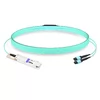
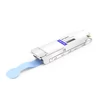
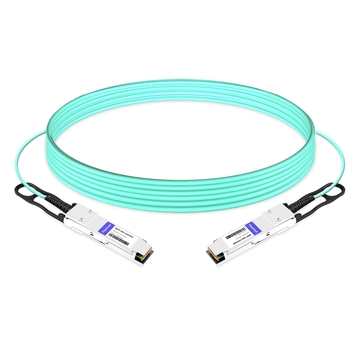
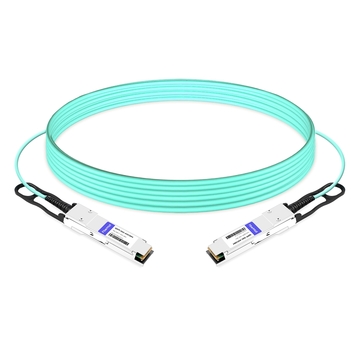
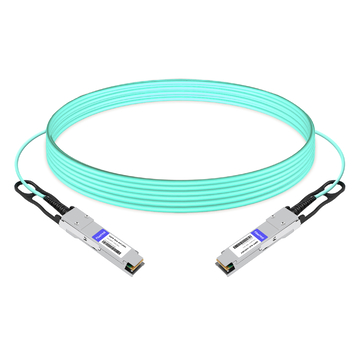
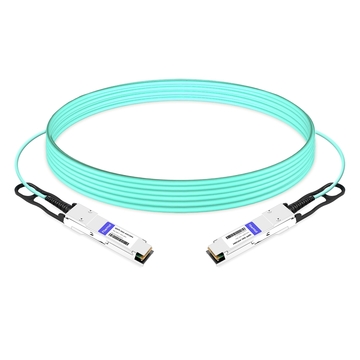
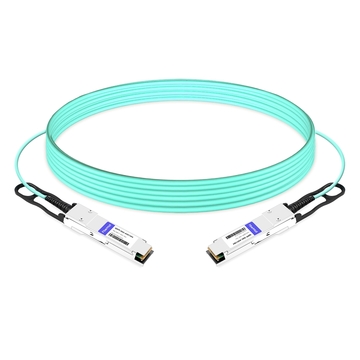
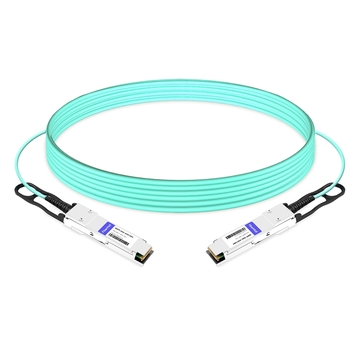
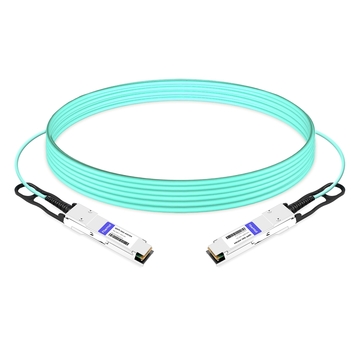
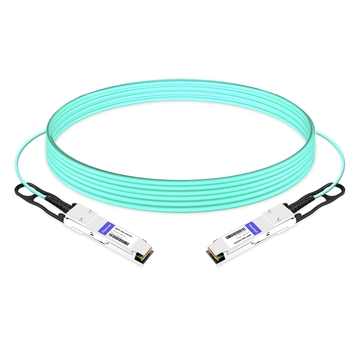
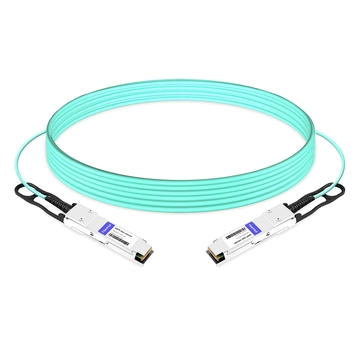
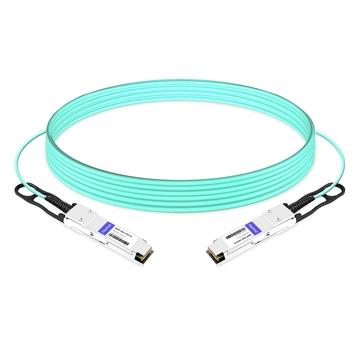
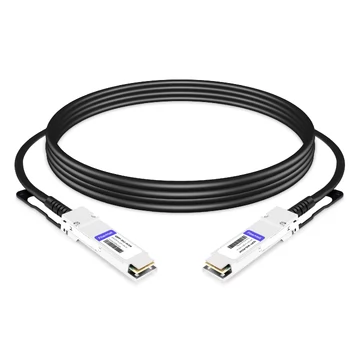
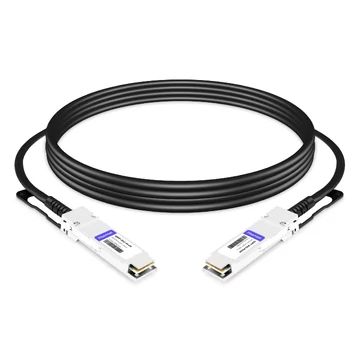
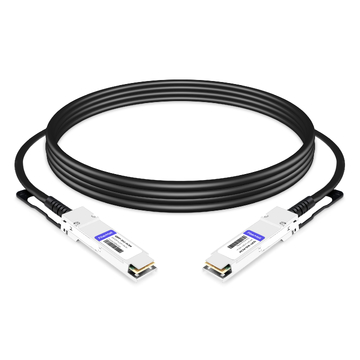
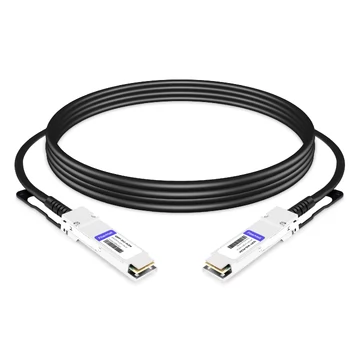
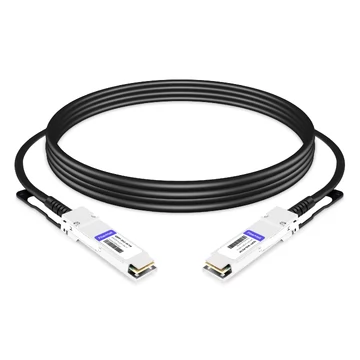
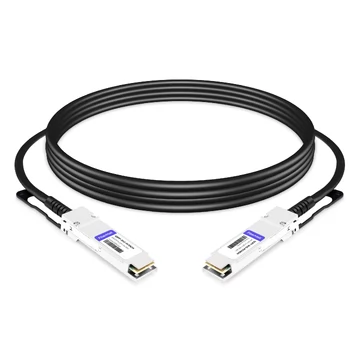
Major vendor-branded Mellanox transceivers and third-party MSA-compliant QSFPs guarantee a wide array of 56g FDR InfiniBand QSFP transceivers. Direct- Attach Copper (DAC)s in short distances of 3m, 5m, and 10m work well in the chip-to-chip/top-of-rack spines while active optical cable (AOC) assemblies [for distances] spanning 30m or 98ft and its own optical transceivers for direct plug into the compatible switch and QSFP port.
Which is better-DAC or active optical cable for 56g infiniband cables?
Although DACs might be cost-effective for the very short run (typically 1m-10m, excellent low latency for FDR QSFP), active optical cables (AOCs) and optical transceivers can greatly extend this reach (3m, 5m, 10m, 30m, 60m, 98ft) and offer greater isolation of electromagnetic noise. For 56G InfiniBand, AOCs can work well in deployments where switch-to-switch or switch-to-hyperconverged cluster connections extend beyond the permitted distance range for copper.
Up to which switch models can 56g fdr infiniband QSFP modules be used?
For example, Mellanox (now part of NVIDIA) frequently use 56G FDR InfiniBand QSFP modules with switches, but often Cisco and other vendor switches may have FDR QSFP compatibility. When accessing a switch compatibility matrix, QSFP part numbers from a qualified vendor confirm that the switch firmware supports 56G FDR rates.
Could an active optical link expect to carry a full 56G bit rate adequate for InfiniBand FDR?
Yes, InfiniBand FDR QSFP ports are 56G rate Lane Aggregation for FDR schemes to be thrust through a certified active optical cable. The AOC must be from the MSA and factory-tested on both Mellanox or Cisco to ensure compliance and, depending upon your preferences, should come in 3m, 5m, 10m, 30m, 98ft.