H3C 10G Switches: Models, Features, Optics & Deployment Guide
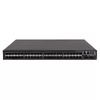
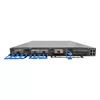
The H3C 10G switch portfolio is designed for enterprise campus aggregation, core networks, and data center environments, offering a range of high-density 10GbE access and high-speed uplink capabilities. Depending on the model, these switches can provide up to 48 10G SFP+ ports together with 40G or 100G uplinks. They also support technologies such as VXLAN, H3C IRF2 virtualization, and M-LAG for scalable network virtualization and device-level redundancy.
H3C 10G Switch Series: Find the Right Model for Your Network
Each H3C 10G switch series targets a distinct deployment scenario. Here is how to choose.
S6520X Series — Campus Aggregation & High-Density Enterprise Access
The S6520X is a high-performance 10G aggregation switch family designed for campus distribution layers and high-density enterprise aggregation deployments. The S6520X-30HC-EI provides 24× 1G/10G SFP+ ports and 2× 40G/100G QSFP28 ports, with each QSFP28 port capable of breakout into four 25GE interfaces. H3C specifies a box switching capacity of 2.56 Tbps for the S6520X-EI family, while the S6520X-30HC-EI itself has a port switching capacity of 1.2 Tbps.
IRF2 allows up to nine compatible S6520X-EI switches to operate as a single logical system, simplifying management and improving resiliency and scalability. The series also supports VXLAN and EVPN functions on supported software releases, making it suitable for modern overlay networking and multi-tenant campus environments.
Best for: University campus aggregation, enterprise distribution layers, large-scale branch aggregation, and multi-tenant building networks requiring high-density 10G connectivity with 40G or 100G uplinks.
S6805 Series — High-Density Data Center Top-of-Rack
The S6805 series is H3C's dedicated high-density data center access and Top-of-Rack platform. The S6805-54HF provides 48× 10G SFP+ ports and 6× 40G/100G QSFP28 ports, with a switching capacity of 2.16 Tbps and forwarding capacity of approximately 1,001.7 Mpps. It is designed for high-density server connectivity in enterprise and cloud data centers.
The S6805 supports IRF2.0, rather than IRF3, and supports up to nine IRF member devices. It also supports M-LAG, VXLAN, MP-BGP EVPN, and data center lossless Ethernet technologies such as PFC and ECN. H3C provides specific RDMA and RoCE deployment guidance for the S6805 platform.
The S6805 is designed for 1U rack deployment and supports both front-to-rear and rear-to-front airflow through different fan configurations, making it suitable for hot-aisle/cold-aisle data center layouts.
Best for: Data center top-of-rack server access, high-density 10G server farm connectivity, storage network access, and leaf-spine fabric deployments requiring 100G uplinks.
S5560X Series — Enterprise Access with 10G Uplinks
The S5560X series bridges the gap between Gigabit access and higher-speed aggregation requirements. Depending on the model, it provides 24 or 48 Gigabit Ethernet access ports together with four fixed 10GE ports and an expansion slot. Expansion modules can provide additional 10G, 25G, or 40G connectivity on supported models.
PoE-capable variants can power wireless access points, IP phones, surveillance cameras, and other Ethernet-powered devices. IRF2 supports up to nine member switches, allowing multiple physical devices to operate as a single logical system and reducing management complexity across larger access-layer deployments.
Best for: Enterprise wiring closets, branch office access layers, PoE device connectivity, and deployments where Gigabit access combined with 10G uplinks provides the right balance of performance and cost.
S5590 Series — High-Speed Enterprise Aggregation with 25G/100G Options
The S5590-EI series is a high-performance Layer 3 campus aggregation and small-to-medium enterprise core platform. Depending on the model, it combines Gigabit, Multi-Gigabit, 10G, 25G, 40G, and 100G interfaces.
For example, the S5590-24UXM4YC-EI provides four 10G/25G SFP28 ports, while models such as the S5590-32UN4X4Y2CC-EI and S5590-48UN4Y2CC-EI provide 10G/25G SFP28 interfaces together with 40G/100G QSFP28 ports. H3C positions the S5590-EI primarily for campus aggregation and SME core applications rather than as a dedicated AI cluster switch.
The series also supports IRF2, M-LAG, advanced Layer 3 routing, telemetry, and other enterprise networking functions, providing a migration path toward higher-speed campus and enterprise aggregation networks.
Best for: High-bandwidth campus aggregation, SME core networks, Multi-Gigabit access aggregation, 25G uplinks, and selected deployments requiring 40G or 100G upstream connectivity.
Complete Your Deployment: Compatible Optics & Cables for Every H3C 10G Switch
This is where FiberMall adds value beyond the switch itself: compatible optical transceivers and cabling can help complete the physical-layer deployment while matching the required distance, fiber type, and interface speed.
10G SFP+ Transceivers for H3C Switches
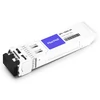
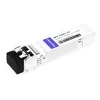
10G SFP+ SR is designed for short-range multimode fiber connections. Typical maximum reach is approximately 300 meters over OM3 fiber and 400 meters over OM4 fiber. It is commonly used for intra-building links, equipment-room connections, and short data center interconnects. H3C lists 10G multimode SFP+ modules with these reach characteristics.
10G SFP+ LR uses single-mode fiber and typically supports transmission distances of up to 10 km. It is suitable for floor-to-floor, building-to-building, campus backbone, and longer enterprise aggregation links.
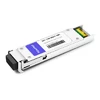
10G SFP+ ER typically supports approximately 40 km over single-mode fiber and is used for longer campus, metropolitan, and aggregation connections where standard LR reach is insufficient.
10G SFP+ ZR commonly refers to extended-reach 10G optical modules designed for approximately 80 km transmission. Unlike 10GBASE-SR and 10GBASE-LR, ZR naming is generally vendor-specific rather than an IEEE 802.3 Ethernet PMD designation, so link budgets and platform compatibility should be checked carefully.
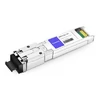
10G SFP+ BIDI modules use different transmit and receive wavelengths to carry bidirectional traffic over a single strand of single-mode fiber. Depending on the module pair, typical distances range from approximately 10 km to 40 km or longer. They are especially useful in fiber-constrained environments.
Always verify the exact H3C switch model, software release, supported transceiver list, optical budget, and fiber type before deployment. H3C publishes dedicated transceiver documentation covering supported SFP+ specifications.
Direct-Attach and Active Optical Cables
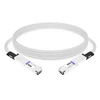
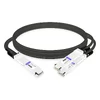
10G SFP+ DAC (Passive Copper) — Passive SFP+ DAC is the lowest-cost and lowest-power choice for short connections. H3C-qualified cable lengths vary by platform, with short lengths such as 1 m, 3 m, and 5 m commonly supported. Compatible third-party DAC products may also be available in longer lengths, such as 7 m, but these should be validated with the specific switch and NIC combination before deployment. H3C's S6805 documentation, for example, lists supported SFP+ cables and optical cables separately.
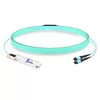
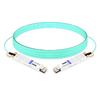
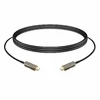
10G SFP+ AOC (Active Optical) — AOC provides a lighter, thinner, EMI-resistant alternative to copper for longer connections. H3C-qualified AOC lengths depend on the specific platform, while compatible third-party SFP+ AOCs may be available from a few meters to considerably longer distances. For FiberMall-compatible AOCs, the exact supported length should be verified against the target H3C switch model and firmware rather than assuming that every H3C platform supports all AOC lengths.
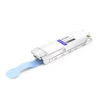
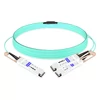
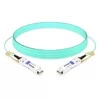
100G QSFP28 DAC / AOC — These cables can be used with compatible H3C 100G QSFP28 uplink ports. Passive QSFP28 DAC is generally used for short rack-level connections, while AOC is better suited to longer connections where lower cable weight and easier routing are priorities. Maximum supported distance depends on the specific H3C platform and cable qualification.
H3C vs. Cisco vs. Arista: How 10G Enterprise Switches Compare
Enterprise buyers evaluating H3C 10G switches often compare them with Cisco Catalyst and Nexus platforms and Arista 7000-series switches. However, these product families cover different campus and data center roles, so comparisons should be made between specific models rather than treating entire families as directly equivalent.
10G Port Density
H3C platforms such as the S6805-54HF provide up to 48× 10G SFP+ ports together with 6× 100G QSFP28 ports. S6520X models offer configurations with 24 or 48 10G SFP+ ports and multiple 40G or 100G uplink options.
Cisco Nexus 9300 and Arista 7050X families also include high-density 10G, 25G, 40G, and 100G configurations, but port counts vary substantially by model. Cisco Catalyst 9300 and Arista 720XP, meanwhile, are more campus-oriented product families and should not be treated as direct one-to-one equivalents to data center ToR switches.
Switching Capacity
H3C S6805-54HF provides 2.16 Tbps of switching capacity, while the S6520X-EI family specifies a 2.56 Tbps box switching capacity, with individual models having different port switching capacities.
Cisco Nexus and Arista data center platforms cover a much wider range of switching capacities depending on generation and model. Therefore, using one fixed switching-capacity figure for all H3C, Cisco, and Arista platforms is not technically meaningful.
Network OS
H3C S6520X, S6805, and S5560X platforms use H3C's Comware operating system, with these product generations primarily based on Comware 7.
Cisco uses IOS XE on Catalyst enterprise platforms and NX-OS on Nexus data center switches.
Arista uses EOS across its enterprise and data center switching portfolio.
Stacking / Virtualization
H3C uses IRF2 to combine compatible physical switches into one logical device. S6520X, S6805, and S5560X support up to nine IRF members according to their respective platform specifications.
Cisco uses different technologies depending on the platform, including StackWise on supported Catalyst switches and vPC for multi-chassis redundancy on Nexus platforms.
Arista uses MLAG to provide active-active multi-chassis link aggregation and device redundancy. Arista's 7050X family also supports technologies such as VXLAN and ECMP for scalable data center fabrics.
VXLAN / EVPN
H3C S6520X, S6805, and selected S5590-EI platforms support VXLAN and EVPN functionality, although specific features depend on the switch model and software release. S6805 explicitly supports MP-BGP EVPN as a VXLAN control plane.
Cisco Nexus and many modern Catalyst platforms support VXLAN/EVPN in applicable deployment scenarios.
Arista EOS also supports VXLAN/EVPN across supported data center platforms, including 7050X-series deployments.
Typical Price Position
H3C is often positioned as a cost-competitive alternative to Cisco and Arista, particularly for organizations that require enterprise routing, virtualization, campus networking, and data center features without being tied to a specific vendor ecosystem.
However, a fixed statement such as "20–40% cheaper than Cisco" cannot be applied reliably across all projects. Actual pricing depends heavily on the exact switch model, licensing, support contract, region, distributor, project size, and negotiated discount.
Third-Party Optics
H3C switches may operate with compatible third-party optical modules, but this should not be described as unrestricted or guaranteed third-party support. H3C equipment can identify non-H3C transceivers and generate warning or log messages. H3C's support documentation states that it does not guarantee the normal operation of transceivers that are not sold by H3C or assume maintenance responsibility for those third-party modules.
Cisco's behavior toward third-party optics varies by platform, operating system, configuration, and support policy.
Arista also supports standards-based optical interfaces, but third-party module operation and vendor support should still be verified against the relevant hardware and support agreement.
For any vendor, the safest approach is to validate the exact transceiver, switch model, software release, and support policy before deploying third-party optics at scale.
Global Warranty and Support
H3C support is generally delivered through H3C and its authorized channel and partner network.
Cisco typically combines hardware warranty coverage with optional Cisco support contracts and service offerings.
Arista provides support through Arista and its authorized sales and service channels.
Exact warranty and service coverage varies by product, region, seller, and contract.
H3C provides many of the Layer 2, Layer 3, virtualization, VXLAN/EVPN, redundancy, and management capabilities required by modern enterprise and data center networks. For organizations that do not require Cisco-specific platforms such as Catalyst Center or ACI, H3C can provide a mature and cost-competitive alternative.
Rather than assigning an arbitrary percentage such as "80–90% feature parity" or "50–70% of the cost," buyers should compare specific models based on port density, forwarding performance, feature licenses, management ecosystem, support coverage, and total project pricing.
Frequently Asked Questions
What is the difference between H3C S6520X, S6805, and S5560X series switches?
The S6520X series is primarily designed for campus aggregation and high-density enterprise networking, with models offering 10G SFP+ interfaces and 40G or 100G uplinks.
The S6805 series is a dedicated data center access and Top-of-Rack platform. The S6805-54HF provides 48× 10G SFP+ ports and 6× 100G QSFP28 ports and supports data center features including VXLAN, MP-BGP EVPN, M-LAG, and lossless Ethernet technologies.
The S5560X series is primarily an enterprise Gigabit access and aggregation platform, typically providing 24 or 48 GE ports plus four fixed 10GE interfaces and optional higher-speed expansion interfaces. PoE-capable models are suitable for enterprise access environments requiring powered endpoints.
Are third-party SFP+ transceivers compatible with H3C switches? Will they void my warranty?
Third-party SFP+ transceivers can operate on many H3C switches when their electrical interface, EEPROM coding, and optical specifications are compatible. However, this does not mean that H3C officially guarantees every MSA-compliant third-party module.
H3C equipment can identify non-H3C transceivers and may generate warnings or log messages. H3C explicitly states in its support documentation that it does not guarantee the normal operation of transceivers not sold by H3C and does not assume maintenance responsibility for those third-party modules.
This is different from saying that installing any third-party optic automatically voids the entire switch warranty. Warranty treatment depends on the applicable H3C warranty terms, reseller agreement, region, and whether a third-party component contributed to the failure.
FiberMall-compatible transceivers should therefore be tested and validated against the specific H3C switch model and software release before large-scale deployment.
What cables and optics do I need for H3C 10G SFP+ ports?
It depends on your reach and deployment scenario.
For short in-rack server-to-ToR or switch-to-switch connections, a passive 10G SFP+ DAC is usually the lowest-cost and lowest-power option. The maximum validated length should be checked against the specific H3C platform.
For longer rack-to-rack links where low cable weight and EMI immunity are important, use a compatible 10G SFP+ AOC.
For multimode fiber links, 10G SFP+ SR commonly supports up to approximately 300 m over OM3 and 400 m over OM4 fiber.
For single-mode connections up to approximately 10 km, use 10G SFP+ LR. Longer-distance applications can use ER, ZR, or BIDI optics where supported.
FiberMall supplies DAC, AOC, and optical transceiver options for H3C platforms, but each product should be matched to the exact switch model, software version, fiber type, and required transmission distance.
What is H3C IRF stacking, and which 10G switches support it?
IRF, or Intelligent Resilient Framework, is H3C's switch virtualization technology. It allows multiple compatible physical switches to operate as one logical device, providing unified management and enabling link aggregation and redundancy across member switches.
The S6520X-EI, S6805, and S5560X-EI discussed here use IRF2, and their current H3C specifications list support for up to nine IRF members.
IRF can simplify management because the fabric is managed as a single logical system and can improve resiliency by distributing links and services across multiple physical members.
IRF member switches must meet H3C's hardware and software compatibility requirements. They do not universally have to be the exact same model in every H3C product family; supported model combinations and software requirements should be checked in the applicable IRF compatibility and configuration documentation.
Do H3C 10G switches support VXLAN, EVPN, and SDN?
Yes, selected H3C 10G switch families support VXLAN and EVPN, but exact capabilities vary by model and software release.
The S6805 supports VXLAN and MP-BGP EVPN and can operate in EVPN-VXLAN data center fabrics.
The S6520X-EI supports VXLAN-related capabilities and is included in H3C configuration examples for advanced overlay and M-LAG deployments.
The S5590-EI family also supports advanced campus virtualization functions, including IRF2 and M-LAG, with VXLAN/EVPN availability depending on model and software version.
H3C switches can also integrate with H3C's network management and SDN ecosystem. Specific controller integration, OpenFlow support, EVPN route types, and feature licensing should always be checked against the exact switch software release rather than assumed across the entire product family.
How does H3C compare to Cisco and Arista for 10G enterprise switching?
H3C provides a mature Comware-based networking platform with enterprise and data center functions including IRF, M-LAG, Layer 3 routing, VXLAN, EVPN, telemetry, and high-speed uplinks on supported switch families.
Cisco's main advantages include its broad global enterprise ecosystem, Catalyst and Nexus product portfolios, Catalyst Center and ACI integration, and extensive worldwide support infrastructure.
Arista is particularly strong in data center networking, automation, telemetry, and EOS-based programmability, with MLAG and VXLAN/EVPN widely used across its data center platforms.
H3C is often attractive to organizations looking for standards-based enterprise and data center networking with competitive acquisition costs. However, claims such as "80–90% feature parity" or a fixed "50–70% of Cisco's cost" should be avoided unless they are based on a specific model-to-model comparison and current project pricing.
What is the warranty on H3C switches purchased from FiberMall?
Warranty coverage for H3C switches purchased through FiberMall should follow the applicable manufacturer and reseller terms for the specific product, region, and order. Customers should confirm the exact warranty period and RMA process when purchasing a switch rather than assuming the same warranty applies to every H3C model.
FiberMall's currently published warranty policy states that standard stock products are eligible for a 30-day no-reason return and refund, subject to the stated terms and exclusions. FiberMall also currently lists a 3-year warranty for fiber optic transceivers and a 1-year warranty for DAC and AOC cables.
FiberMall can act as the customer's point of contact for products purchased through its sales channel, but the exact support and RMA process for H3C-branded hardware should be confirmed for the specific purchase.
Before ordering switches, transceivers, or cables, review the applicable product warranty, return policy, compatibility requirements, and regional support terms.