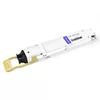
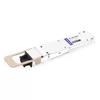
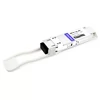
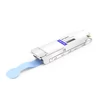
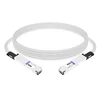
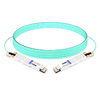
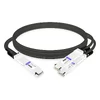
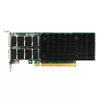
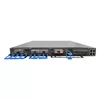
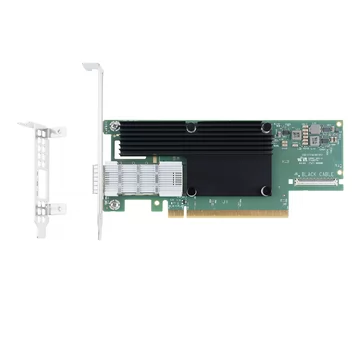
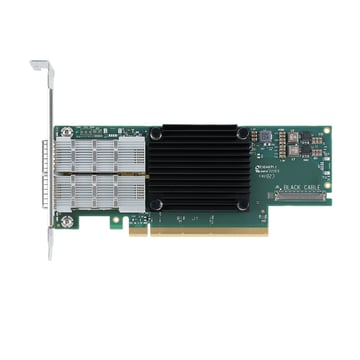
200G QSFP56 NIC
You're pushing a server, GPU host, or storage node to 200 Gigabit for AI, HPC, or NVMe-oF traffic. You pick a card, then spend a week untangling whether it is a true 200G adapter or a configurable 2×100G model, which QSFP56 transceiver has been validated for it, and whether that QSFP-DD or QSFP112 module you already own is actually compatible with the host port.
A 200G NIC is only half the link. The other half is the media — the transceiver, DAC, or AOC — plus the host port configuration, lane signaling, FEC, firmware, and driver support. If those do not match, the Ethernet link may not come up or may not operate at the intended speed. RDMA compatibility is a separate consideration: an RDMA mismatch affects RDMA functionality and application performance rather than basic Ethernet link establishment.
A Bare 200G Card Leaves Four Decisions Unanswered
Every major retailer sells the 200G NIC by itself and leaves the hard part to you. That is exactly where 200G deployments go sideways, because a QSFP56 port is not media-agnostic the way a copper RJ45 port is — and at 200G, the mistakes are expensive.
The form-factor and electrical-interface mismatch. Buyers often assume that QSFP56, QSFP-DD, and QSFP112 are interchangeable because they belong to the broader QSFP family. They are not. A 200G QSFP56 host interface uses four 50G PAM4 electrical lanes. A 400G QSFP-DD interface typically uses eight 50G PAM4 lanes, while QSFP112 uses four lanes at approximately 100G per lane. QSFP-DD host ports are designed to support backward compatibility with earlier QSFP modules, but that does not mean a QSFP-DD module can be used in a standard QSFP56 host. Likewise, QSFP112 may look mechanically similar to QSFP56, but a QSFP56 host does not provide the 100G-per-lane electrical signaling required by a QSFP112 device unless the platform explicitly supports it.
The 200G vs 2×100G confusion. The Intel E830-CQDA2 is a good example of why the label "200G NIC" needs context. Its default configuration is 2×100GbE. Using Intel's Ethernet Port Configuration Tool (EPCT), it can be reconfigured as 1×200GbE on Port 1, in which case Port 2 has no connectivity. Other supported configurations include 4×50G, 2×50G, and 8×25G using appropriate breakout cables. It is therefore a configurable adapter capable of 200GbE — not a native dual-200G card delivering two simultaneous 200GbE links.
Vendor and platform compatibility. A 200G QSFP56 transceiver may be electrically and mechanically MSA-compliant while still requiring validation against the NIC's firmware, NVM, management interface, FEC behavior, and supported media list. An optic that operates correctly in one switch or adapter should not automatically be assumed to work in every other QSFP56 host. For production deployments, the safest approach is to use optics, DACs, or AOCs that have been tested with the exact adapter and firmware version.
RDMA capability. AI/ML, HPC, and storage buyers also need to determine whether their workload actually requires RoCEv2 or iWARP. That decision is separate from basic Ethernet connectivity. Importantly, Intel's current specifications for the retail E830-CQDA2 list both iWARP/RDMA and RoCEv2/RDMA as unsupported. If hardware RDMA is mandatory, you need to select a NIC that explicitly supports the required RDMA transport rather than assuming every 200GbE controller provides it.
200G QSFP56 NICs Available from FiberMall
FiberMall's 200G QSFP56 NIC offering is designed for high-bandwidth server, storage, virtualization, and data-center connectivity. Intel E830-based designs provide PCIe 5.0/4.0 host connectivity, intelligent offloads, SR-IOV, Dynamic Device Personalization (DDP), DPDK support, and precision timing capabilities that can reduce host CPU overhead and improve packet-processing efficiency. They should not, however, be marketed as hardware RoCEv2 or iWARP adapters when using the E830-CQDA2 controller.
200G Single-Port: This configuration provides one 200G QSFP56 connection for a server, GPU host, storage target, or high-bandwidth uplink that needs one full 200GbE path. The exact PCIe interface, supported lower-speed modes, bracket options, and media compatibility should be confirmed against the specific NIC SKU.
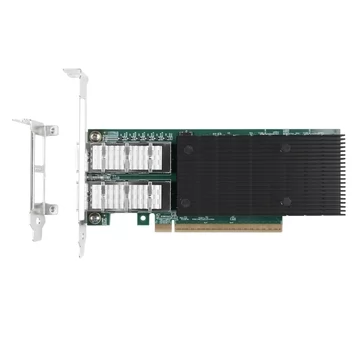
Configurable E830-CQDA2: The Intel E830-CQDA2 provides two QSFP-family cages. Its default configuration is 2×100GbE using QSFP28 media. It can be reconfigured with EPCT to operate as 1×200GbE using QSFP56 media on Port 1, with Port 2 disabled in that mode. The adapter also supports 50G and 25G breakout configurations. Its host interface is PCIe 5.0 x8 or PCIe 4.0 x16.
200G Single-Port QSFP56
One QSFP56 port delivers a clean 200GbE path for a host that needs a single high-bandwidth connection to a 200G switch port. Depending on the controller, NIC design, firmware, and configured port mode, lower Ethernet rates may also be supported.
For an Intel E830-based implementation, key capabilities include intelligent network offloads, SR-IOV, DDP, DPDK, IEEE 1588 Precision Time Protocol v2, and Precision Time Measurement. DDP allows the controller's programmable pipeline to classify supported traffic instead of pushing all packet-parsing work to the CPU, helping increase throughput and reduce host CPU overhead.
200G Configurable Dual-Cage E830-CQDA2
The E830-CQDA2 uses two physical cages to provide flexibility across multiple Ethernet configurations. In its default mode, both cages operate at 100GbE for 2×100G connectivity. When configured for 1×200G, only Port 1 is active with 200G QSFP56 media, and Port 2 does not provide connectivity.
Intel also documents 4×50G, 2×50G, and 8×25G configurations through EPCT and appropriate breakout cabling. This makes the card useful for dual-homed 100G servers, virtualization hosts, or systems that need to migrate from 100G to a single 200G connection without replacing the adapter.
The E830-CQDA2 connects to the host through PCIe 5.0 x8 or PCIe 4.0 x16 and ships in standard PCIe form factor with low-profile and full-height brackets. It supports DDP, DPDK, SR-IOV, IEEE 1588 PTP v2, and other hardware offloads designed to improve packet-processing efficiency.
Match the 200G Media to Your Reach
The NIC stays the same, but the transceiver, DAC, or AOC you install determines the optical medium, fiber type, connector, and practical link distance. The exact media must also be supported by the NIC and its firmware.
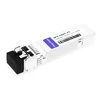
200GBASE-SR4: Designed for short-reach multimode-fiber connections. A typical 200G QSFP56 SR4 uses an MPO-12 connector and supports up to 100 meters over OM4 multimode fiber. It is well suited to intra-rack, adjacent-rack, and short data-hall server-to-switch connections.
200GBASE-DR4: A parallel single-mode option commonly used for approximately 500-meter data-center links, typically using an MPO/MTP interface. It is suitable for row-to-row and larger data-hall connections. However, because Intel's E830-CQDA2 product brief explicitly lists 200GBASE-CR4, SR4, LR4, and FR4 rather than DR4, a DR4 module should be validated against the exact E830 adapter and firmware before deployment.
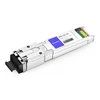
200GBASE-FR4: Uses wavelength-division multiplexing over duplex single-mode fiber, normally with an LC duplex connector, and supports links up to 2 km. It is suitable for longer data-center, building-to-building, and campus links. NVIDIA, for example, specifies 200GbE QSFP56 FR4 optics with duplex LC and a 2 km reach.
200G QSFP56 DAC: A passive copper direct-attach cable is normally the lowest-cost and lowest-power choice for very short links. Typical server-to-switch deployments use lengths of approximately 0.5 to 3 meters, although the exact supported maximum depends on the cable and host platform. DAC is ideal for same-rack connectivity.
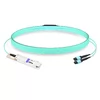
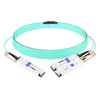
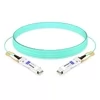
200G QSFP56 AOC: An active optical cable provides a fixed optical assembly with QSFP56 modules permanently attached at both ends. Unlike a detachable optical transceiver link, there is no user-accessible MPO connector between the module and cable. AOCs are typically used when DAC is too short but a separate transceiver-and-fiber installation is unnecessary, with product families commonly available for multi-rack distances up to around 100 meters.
Breakout support is host-dependent. On the E830-CQDA2, Intel officially documents 4×50G and 8×25G breakout configurations. Its 2×100G mode uses the adapter's two physical cages and should not be confused with splitting a single 200G Port 1 into two 100G interfaces. Other 200G platforms do support 200G-to-2×100G DAC and AOC assemblies, so the cable alone does not determine whether breakout will work — the host must explicitly support that breakout mode.
QSFP56 vs QSFP-DD vs QSFP112: Which Module Actually Fits
The ports can look similar at a glance. The electrical lane architecture and host support are not the same.
A QSFP56 interface carries four electrical lanes operating at approximately 50G PAM4 per lane for 200G total bandwidth.
A 400G QSFP-DD interface typically doubles the lane count to eight 50G PAM4 electrical lanes. QSFP-DD host ports were designed with backward compatibility for earlier QSFP form factors, but backward compatibility works from the newer host toward legacy modules; it does not make a QSFP-DD module a supported device for a standard QSFP56 host.
A QSFP112 interface uses four electrical lanes operating at approximately 100G per lane for 400G total bandwidth. Newer QSFP112 host cages can support some older QSFP56 and QSFP28 devices, but that does not mean an older QSFP56 host can drive a QSFP112 module at its native rate.
The rule for a 200G E830 connection is therefore simple: use a validated 200G QSFP56 optic, DAC, or AOC for the 1×200G configuration. Do not assume that a QSFP-DD or QSFP112 module will operate simply because it belongs to the QSFP family.
When you buy the NIC and optics together from FiberMall, the goal is to validate the host, module, firmware, fiber type, and target link mode as a complete connection rather than treating each component as an isolated purchase.
If your roadmap points to 400G later, that becomes a QSFP-DD, QSFP112, or OSFP host-platform decision. It is better to make that decision at the NIC and switch architecture stage rather than discovering the incompatibility after purchasing the optics.
200G or 2×100G: What Your Port Config Actually Gives You
"200G card" can mean different things depending on the adapter, and that difference can change the architecture of the entire host.
A native dual-200G NIC has two independent ports that can each operate at a full 200GbE simultaneously, providing up to 400 Gbps of aggregate line-rate bandwidth.
The Intel E830-CQDA2 is not a native dual-200G adapter. Its default configuration is 2×100GbE, for 200 Gbps of aggregate Ethernet bandwidth across the two ports. When configured as 1×200GbE, Port 1 carries the 200G connection and Port 2 has no connectivity.
If you're consolidating two 100G links or need a single 200G uplink, the configurable E830-CQDA2 can be an economical and flexible choice. If you need two simultaneous 200G paths — for example, where a design genuinely requires 400 Gbps of aggregate host-facing Ethernet capacity — you need a different adapter platform with two independent 200G-capable ports.
That distinction should be confirmed before the card is purchased, not after it is installed in the rack.
RoCEv2 or iWARP: Pick the RDMA Your Workload Needs
At 200G, RDMA can significantly reduce software overhead and latency for workloads designed to use it. Both RoCEv2 and iWARP provide remote memory-access mechanisms, but they use different transports and network architectures.
RoCEv2 transports RDMA traffic over routable UDP/IP. High-performance RoCE deployments commonly use carefully engineered Ethernet fabrics with QoS, ECN, congestion control, and — where the design requires it — Priority Flow Control. RoCE is widely used in high-performance Ethernet environments, including AI and HPC clusters, particularly with NICs designed for GPU and RDMA acceleration.
iWARP implements RDMA over TCP/IP. Because TCP provides reliable transport, iWARP can operate across conventional routed IP networks without requiring the same lossless-Ethernet design traditionally associated with RoCE. It has been used in storage and other RDMA applications where compatibility with existing TCP/IP infrastructure is important.
However, the NIC must actually support the RDMA protocol.
Intel's current E830-CQDA2 specifications list both iWARP/RDMA and RoCEv2/RDMA as "No." Therefore, the E830-CQDA2 should not be positioned as an RDMA NIC for RoCEv2 or iWARP workloads.
If hardware RDMA is mandatory, select an adapter that explicitly supports it. Intel's E810 family includes models supporting both iWARP and RoCEv2, while NVIDIA ConnectX-6 Dx is an Ethernet adapter designed with advanced RoCE capabilities and supports up to a single 200GbE port or two 100GbE ports. ConnectX-6 Dx should not be described as an InfiniBand adapter; it is an Ethernet product.
The decision therefore is not simply "RoCEv2 or iWARP on the E830." It is first whether your application requires RDMA, and if it does, whether the selected NIC explicitly supports the RDMA transport and operating system you intend to deploy.
Driver Compatibility: Intel E830 and the ice Driver
Driver support is one of the most important considerations when deploying a high-speed NIC, particularly when the adapter will remain in production for years.
The E830 family uses Intel's ice Linux driver. Intel's current support matrix lists E830-CQDA2 support across multiple enterprise Linux distributions, including current RHEL, SLES, Ubuntu, and Debian releases. However, this does not mean every older distribution includes a sufficiently recent in-box driver for full E830 functionality. Intel specifically notes that E830 requires an appropriately recent ice driver, so the driver and NVM versions should be checked as part of deployment.
Linux — The E830-CQDA2 is supported through the ice driver on current supported Linux distributions. For older kernels or distributions, you may need to install a newer Intel driver package rather than relying on the version shipped with the operating system.
VMware ESXi — Do not assume universal inbox support. Intel directs customers to VMware's hardware compatibility information, and support depends on the exact adapter, ESXi release, system vendor, firmware, and driver combination. Intel release documentation has introduced E830 support for specific ESXi releases, but production deployments should still be checked against the current VMware/Broadcom compatibility matrix.
Windows Server — Do not describe the E830-CQDA2 as universally supported by an inbox Windows Server driver. Intel's current retail-adapter operating-system matrix does not list Windows Server 2019, 2022, or 2025 support for the E830-CQDA2 SKU, even though Intel distributes broader Ethernet driver packages covering multiple adapters. Always verify the exact adapter SKU against Intel's current support matrix before deployment.
DPDK — Intel explicitly identifies the E830 as DPDK-enabled for user-space packet processing and high-performance networking applications.
That matters for a card that may sit in a remote cabinet or production server for years. You want a NIC with a clearly documented driver, firmware, NVM, and operating-system support path rather than assuming that every member of a controller family has identical software support.
200G QSFP56 NIC FAQ
What is the difference between a 200G NIC and a 2×100G NIC?
A true native dual-200G NIC has two independent ports capable of operating at 200GbE simultaneously, giving up to 400 Gbps of aggregate bandwidth.
The Intel E830-CQDA2 works differently. Its default configuration is 2×100GbE. It can be reconfigured with EPCT as 1×200GbE on Port 1, but Port 2 then loses connectivity. It therefore provides either two 100G links or one 200G link, rather than two simultaneous 200G links.
The right choice depends on whether you need two 100G connections, one 200G connection, or two independent 200G connections.
Which transceivers, DAC, and AOC cables work with a 200G QSFP56 NIC?
Use a 200G QSFP56 optic, DAC, or AOC that has been validated for the exact NIC, firmware, target speed, FEC configuration, and link partner.
Common 200G QSFP56 optical options include 200GBASE-SR4 for approximately 100 m over OM4 multimode fiber and 200GBASE-FR4 for up to 2 km over duplex single-mode fiber. Parallel single-mode 200G DR-class optics can provide approximately 500 m reach, but compatibility should be confirmed for the specific host.
For the E830-CQDA2 specifically, Intel's product brief lists 200GBASE-CR4, SR4, LR4, and FR4 in 200GbE QSFP56 mode. If you plan to use a PMD not explicitly listed — such as a particular DR4 implementation — validate it before deployment.
For short runs, passive 200G QSFP56 DACs provide low cost and power consumption. AOCs extend the practical cable distance using permanently attached optical modules and fiber.
MSA compliance alone should not be treated as a guarantee of compatibility with every NIC.
Will a QSFP-DD or QSFP112 module work in a 200G QSFP56 port?
Do not assume so.
QSFP-DD uses an eight-lane electrical architecture and is designed so newer QSFP-DD host ports can accept earlier QSFP-family modules. That backward compatibility does not mean a QSFP-DD module is supported in a standard four-lane QSFP56 host.
QSFP112 uses four approximately 100G-per-lane electrical lanes. Although its mechanics are closely related to other QSFP form factors, a QSFP56 host normally provides only four approximately 50G-per-lane interfaces and cannot operate a QSFP112 module at its native signaling rate unless the host explicitly supports that mode.
For an E830-CQDA2 configured as 1×200GbE, use a validated 200G QSFP56 module, DAC, or AOC.
Do I need RoCEv2 or iWARP for AI/ML, HPC, or NVMe-oF storage?
It depends on the workload and network architecture.
RoCEv2 is widely used in high-performance Ethernet fabrics where applications benefit from low-latency, direct-memory networking. iWARP provides RDMA over TCP/IP and can be useful in environments that prefer standard routed TCP transport.
But not every 200G NIC supports either protocol.
The Intel E830-CQDA2 currently lists iWARP/RDMA: No and RoCEv2/RDMA: No. If your AI, HPC, or NVMe-oF architecture requires hardware RDMA, choose an RDMA-capable NIC rather than purchasing an E830-CQDA2 under the assumption that 200GbE automatically includes RDMA.
What OSes and drivers does the Intel E830 200G NIC support?
The E830-CQDA2 uses Intel's ice driver under Linux. Intel currently documents support for multiple RHEL, SLES, Ubuntu, and Debian releases, although a sufficiently recent ice driver may be required for full E830 functionality.
VMware ESXi support must be checked against the exact adapter, ESXi version, OEM platform, firmware, and VMware/Broadcom compatibility information.
Intel's current retail-adapter matrix does not list Windows Server support for the E830-CQDA2, so it should not be advertised as an automatically supported inbox Windows Server NIC without SKU-specific validation.
DPDK is supported for high-performance user-space packet processing.
Do you sell the NIC and the 200G optics as a tested kit?
Yes. This is FiberMall's core differentiator. FiberMall can supply the 200G NIC together with the appropriate QSFP56 transceiver, DAC, AOC, and fiber cabling as a compatibility-tested link solution.
Rather than assuming that any MSA-compliant module will work, the NIC, optical module, firmware, port configuration, FEC, and target switch interface can be validated as a complete system before shipment.
One purchase order, one shipment, one warranty path — and one engineering team accountable for the entire link.
Do you offer volume pricing for multi-server 200G deployments?
Yes. Volume pricing is available for multi-card, multi-host, and OEM/ODM deployments. Our engineering team can provide complete bill-of-materials pricing covering the NIC, transceiver or DAC/AOC, and cabling.
For large deployments, the configuration should also specify the required port mode — such as 1×200G, 2×100G, or a supported breakout configuration — together with the server platform, operating system, switch model, fiber type, and required reach so that the complete link can be validated before deployment.
Custom bracket configurations and private-label branding are also available for qualifying OEM/ODM projects.