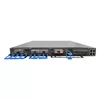
You're building an AI cluster that needs 800G — a trillion-parameter training workload, a 100K+ XPU-scale fabric, or an HPC system that has already outgrown 400G. You select the adapter, and then discover that the real deployment questions begin: Which fabric should you choose? Which optical form factor does the platform support? Will the 800G transceiver actually interoperate with your NIC and switch?
At 800G, the network adapter is only half of the link. The other half is the optical interface. Unlike previous Ethernet generations, 800G deployments involve multiple electrical architectures, optical form factors, and ecosystem choices. Selecting the wrong combination can result in compatibility issues, unexpected redesign costs, or expensive deployment delays.
A Bare 800G Card Leaves Five Decisions Unanswered
Every vendor and OEM configurator can provide an 800G-class NIC, but the difficult engineering decisions remain with the buyer. At this speed level, mistakes are significantly more expensive than they were at 100G, 200G, or 400G.
The form-factor decision.
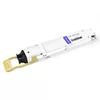
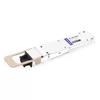
800G deployments may use different pluggable form factors depending on the platform, including OSFP-based and QSFP-DD-based solutions. The module, cage design, electrical interface, and switch-side port must all be matched correctly.
An optical module that fits physically may still fail to operate if the electrical signaling, firmware compatibility, or vendor coding does not match the platform.
The fabric decision.
An 800G host interface can be deployed in different AI networking environments, including InfiniBand-based fabrics, Ethernet-based AI networks, and emerging Ultra Ethernet Consortium (UEC)-aligned architectures.
The choice determines the complete cluster design. Selecting the wrong adapter can limit interoperability, increase operational complexity, or prevent the system from achieving the expected AI workload performance.
The native 800G versus dual 400G decision.
The term "800G NIC" can describe different architectures.
A native 800G adapter provides one physical port delivering a single 800G connection.
A dual-port 400G adapter provides two independent 400G links that together provide 800G aggregate bandwidth.
These two designs are not equivalent. A deployment requiring a single 800G connection to one switch port requires a native 800G interface, not a pair of aggregated 400G ports.
The thermal design decision.
At 800G, thermal management becomes a critical part of the optical and system design.
OSFP-based modules may use different mechanical and thermal implementations, including flat-top and heatsink-assisted designs. The module, cage, airflow design, and platform thermal solution must be matched to ensure stable operation under sustained AI workloads.
The vendor compatibility decision.
High-speed optical modules contain EEPROM information and platform identification data used by network devices for compatibility checking.
A transceiver designed for one switch or NIC platform may require specific coding or validation before operating correctly in another system.
For AI clusters, buying the NIC, optics, and cables as a validated combination can significantly reduce deployment risk.
800G NIC Options from FiberMall
FiberMall provides 800G networking solutions based on leading AI networking platforms, including NVIDIA ConnectX-8-class adapters and Broadcom Thor Ultra-class Ethernet AI adapters.
Different AI fabrics require different approaches. There is no single 800G adapter architecture that fits every deployment scenario, so the correct NIC should be selected according to the switch platform, network protocol, and workload requirements.
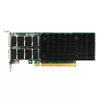
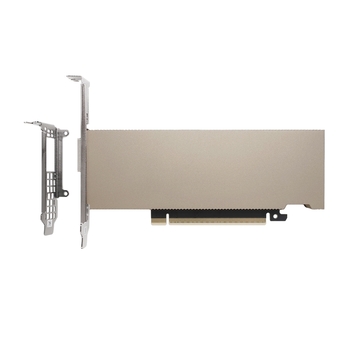
800G Single-Port Adapter
Controller:
NVIDIA ConnectX-8-class adapter
Form Factor:
OSFP-based 800G interface (platform dependent)
Interface:
PCIe 6.0 x16
Best For:
Next-generation AI/HPC clusters, InfiniBand-based fabrics, and high-performance Ethernet AI networks.
A single-port 800G adapter is designed for environments that require maximum bandwidth from one physical connection. It enables direct connection to next-generation 800G switching platforms while supporting advanced RDMA-based workloads.
800G Ethernet AI Adapter
Controller:
Broadcom Thor Ultra-class AI Ethernet adapter
Form Factor:
OSFP-based 800G Ethernet interface
Interface:
PCIe 6.0 x16
Best For:
Open Ethernet AI fabrics, UEC-aligned architectures, and multi-vendor AI networking environments.
Thor Ultra-class adapters are designed for Ethernet-native AI clusters, combining high-speed networking with advanced congestion management, multipath optimization, and AI workload acceleration features.
Dual-Port 2×400G Adapter
Controller:
NVIDIA ConnectX-8-class adapter
Form Factor:
2×400G optical interfaces
Interface:
PCIe 6.0 x16
Best For:
Ethernet AI fabrics requiring flexible 400G connectivity and aggregated 800G bandwidth.
A dual-port 400G adapter provides two independent 400G links. While the combined bandwidth equals 800G, it should not be confused with a single native 800G connection.
Match the 800G Media to Your Reach
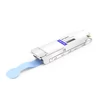
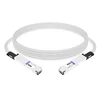
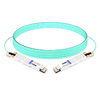
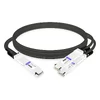
The NIC determines the electrical interface, while the transceiver, DAC, or AEC cable determines the optical reach.
FiberMall supplies and validates complete 800G connectivity solutions, including adapters, optical modules, and cables, to ensure interoperability before deployment.
800G SR8
Reach: Up to 100 meters
Connector / Fiber:
MPO-16, multimode fiber
Typical Use:
Intra-rack and adjacent-rack AI server connections.
800G DR8
Reach: Up to 500 meters
Connector / Fiber:
MPO-16, single-mode fiber
Typical Use:
Row-to-row and large data hall connections.
800G 2×FR4
Reach: Approximately 2 kilometers
Connector / Fiber:
LC duplex, single-mode fiber
Typical Use:
Short-reach data center interconnect and campus links.
800G FR4
Reach: Approximately 2 kilometers
Connector / Fiber:
LC duplex, single-mode fiber
Typical Use:
Data center interconnect and metro-scale connections.
800G LR4
Reach: Approximately 10 kilometers
Connector / Fiber:
LC duplex, single-mode fiber
Typical Use:
Longer-reach data center and metropolitan network connections.
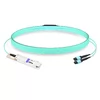
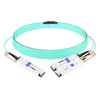
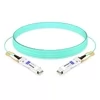
800G OSFP DAC
Reach:
Short-distance direct connections, typically several meters
Typical Use:
Same-rack and adjacent-rack deployments requiring the lowest cost and power consumption.
800G AEC / AOC
Reach:
Depending on implementation, typically tens of meters and beyond DAC distance limitations.
Typical Use:
Multi-rack AI clusters where passive copper cables are insufficient.
OSFP vs QSFP-DD: Understanding 800G Module Compatibility
At 800G, physical compatibility becomes one of the most important deployment considerations.
Although optical modules may look similar externally, different form factors use different mechanical designs, electrical interfaces, thermal solutions, and signaling architectures.
OSFP-Based 800G Solutions
OSFP is currently one of the primary form factors used for high-performance 800G optical networking.
An OSFP module can support different electrical architectures depending on the generation and platform implementation, including:
· 8×100G PAM4 electrical lanes
· 8×112G PAM4 electrical lanes
The exact implementation depends on the NIC, switch, and optical module design.
OSFP provides advantages for AI infrastructure because of its larger thermal envelope, which helps support higher-speed optical engines and sustained high-bandwidth workloads.
QSFP-DD Based 800G Solutions
QSFP-DD extends the traditional QSFP form factor by using eight electrical lanes.
It enables 800G Ethernet solutions through high-density switch platforms while maintaining backward compatibility with many existing QSFP-based deployments.
However, QSFP-DD and OSFP are mechanically different.
An OSFP module cannot be inserted into a QSFP-DD cage, and a QSFP-DD module cannot be installed into an OSFP port.
The correct form factor must be selected according to both the NIC and switch hardware.
The 800G Compatibility Rule
The correct 800G deployment requires matching three elements:
· NIC port interface
· Switch port interface
· Optical module or cable form factor
A successful physical connection does not always guarantee link operation. Firmware support, EEPROM coding, optical standards, and vendor validation may also affect compatibility.
When purchasing an 800G NIC solution, validating the complete link — adapter, transceiver, cable, and switch — before deployment is critical.
InfiniBand XDR, 800GbE Ethernet, or UEC: Choosing the Right AI Fabric
At 800G, the networking fabric is not just a bandwidth decision. It determines the complete architecture of the AI cluster.
Different workloads, GPU platforms, and operational requirements may lead to different networking choices.
InfiniBand-Based AI Fabrics
InfiniBand remains a major choice for large-scale AI and HPC environments because of its optimized RDMA architecture, low latency, and mature collective communication ecosystem.
Next-generation InfiniBand XDR platforms target 800G-class connectivity and are designed for future AI supercomputer deployments.
For organizations building large NVIDIA-based AI infrastructures, InfiniBand remains a high-performance option when maximum GPU-to-GPU communication efficiency is required.
800GbE Ethernet AI Fabrics
Ethernet continues to evolve for AI workloads.
Modern AI Ethernet solutions combine:
· High bandwidth Ethernet switching
· RDMA over Converged Ethernet (RoCE)
· Advanced congestion control
· Multipath networking
· AI workload optimization
Broadcom Thor Ultra-class adapters are designed for Ethernet-based AI infrastructures that require high performance while maintaining multi-vendor flexibility.
Ultra Ethernet Consortium (UEC) Aligned Networks
The Ultra Ethernet Consortium focuses on improving Ethernet for large-scale AI and HPC environments.
UEC technologies aim to provide:
· Better congestion management
· Improved multipath capability
· More efficient AI communication
· Greater interoperability across vendors
A UEC-aligned Ethernet architecture can help organizations build AI clusters without depending on a single networking ecosystem.
Avoiding the Native 800G vs 2×400G Confusion
One of the most common mistakes in 800G deployments is confusing aggregate bandwidth with a native 800G connection.
A native 800G adapter provides:
· One physical port
· One 800G link
A dual-port 400G adapter provides:
· Two independent 400G links
· 800G total aggregate bandwidth
Both solutions may deliver similar total bandwidth, but they are designed for different network topologies.
If the requirement is a single 800G connection between a host and switch, a native 800G interface is required.
Thermal Design: Flat-Top and Heatsink-Assisted Optical Modules
High-speed optical networking introduces significant thermal challenges.
At 800G, optical modules consume more power than previous generations, making mechanical and airflow design increasingly important.
OSFP solutions may include different thermal implementations, such as:
· Flat-top modules cooled mainly by system airflow
· Heatsink-assisted modules designed for enhanced thermal transfer
The correct module design must match the NIC or switch cage and cooling architecture.
Using an incompatible thermal design may result in:
· Poor cooling performance
· Reduced optical reliability
· Link instability under sustained workload conditions
For AI clusters running continuous training workloads, thermal validation is as important as optical compatibility.
Driver and Platform Compatibility
A high-performance 800G adapter requires stable software support.
Hardware performance alone is not sufficient. Production AI environments depend on mature drivers, operating system compatibility, and acceleration software support.
NVIDIA ConnectX-8-Class Platforms
NVIDIA networking adapters are designed to support:
· Linux enterprise distributions
· RDMA workloads
· DPDK applications
· AI communication frameworks
· GPU networking acceleration technologies
NVIDIA software ecosystems, including OFED-based drivers and acceleration frameworks, are widely used in AI and HPC environments.
Broadcom Thor Ultra-Class Platforms
Broadcom AI Ethernet adapters are designed for Ethernet-based AI networking environments.
Typical software support includes:
· Linux networking stacks
· RoCEv2-based communication
· Ethernet acceleration features
· AI cluster networking applications
Driver availability and long-term software maintenance should always be considered before deploying large-scale 800G infrastructure.
Why Complete 800G Link Validation Matters
An 800G deployment is not only about selecting a NIC.
The complete connection includes:
· Server adapter
· PCIe platform
· Optical module
· Fiber cable
· Switch port
· Network software stack
A mismatch in any component can reduce performance or prevent the link from operating correctly.
FiberMall provides complete 800G connectivity solutions, including NICs, optical transceivers, DAC/AEC cables, and fiber assemblies, helping customers validate compatibility before large-scale deployment.
800G NIC FAQ
Does my 800G NIC require OSFP or QSFP-DD?
It depends on the specific NIC and switch platform.
OSFP and QSFP-DD are two different mechanical form factors used in high-speed networking.
The module must match:
· The NIC port type
· The switch port type
· The supported optical standard
Always confirm compatibility before selecting the transceiver.
What is the difference between an 800G NIC and a 2×400G NIC?
An 800G NIC can refer to either:
· A single physical 800G connection
· Two independent 400G connections providing 800G aggregate bandwidth
These architectures are different.
A single-port 800G deployment requires a native 800G interface, while dual-port 400G designs provide flexibility for networks built around multiple 400G connections.
Which transceivers and cables work with an 800G NIC?
Common 800G optical solutions include:
· 800G SR8 for short multimode links
· 800G DR8 for longer single-mode data center links
· 800G FR4-class solutions for extended reach
· 800G LR4-class solutions for longer-distance connections
Cable options include:
· Passive DAC for short connections
· AEC for longer copper-based connections
· AOC for flexible multi-rack deployments
The correct solution depends on distance, switch interface, and network architecture.
Do I Need InfiniBand XDR, 800GbE Ethernet, or UEC for My AI Cluster?
The right choice depends on the workload, GPU platform, operational requirements, and long-term networking strategy.
Choose InfiniBand-based networking when:
· You need maximum performance for large-scale AI training
· Your cluster is built around NVIDIA AI infrastructure
· Low latency and optimized collective communication are critical
InfiniBand provides a highly optimized RDMA networking environment for AI and HPC workloads.
Choose 800GbE Ethernet when:
· You prefer open networking ecosystems
· You require multi-vendor interoperability
· Your infrastructure already uses Ethernet-based operations and management
Modern Ethernet AI networks can deliver high-performance RDMA communication through technologies such as RoCEv2, advanced congestion control, and optimized network software.
Choose UEC-aligned Ethernet architectures when:
· You want an open AI networking ecosystem
· You need improved interoperability between vendors
· You are designing large-scale AI clusters for future expansion
The optimal architecture depends on the complete system design, including GPUs, switches, NICs, software stack, and operational requirements.
NVIDIA ConnectX-8-Class Adapter vs Broadcom Thor Ultra-Class Adapter — Which Should I Choose?
There is no universal answer because the two platforms target different networking philosophies.
Choose an NVIDIA ConnectX-8-Class Adapter If You Need:
· InfiniBand-based AI fabrics
· NVIDIA ecosystem integration
· Advanced RDMA acceleration
· AI/HPC workloads requiring optimized GPU communication
NVIDIA networking solutions are widely adopted in AI infrastructure because of their close integration with GPU computing platforms and communication software.
Choose a Broadcom Thor Ultra-Class Adapter If You Need:
· Ethernet-native AI networking
· Open ecosystem flexibility
· UEC-aligned architecture
· Multi-vendor switching environments
Broadcom's Ethernet AI networking approach focuses on high-performance Ethernet fabrics designed for large-scale AI workloads.
The correct choice should be based on the entire cluster architecture rather than the NIC alone.
What Is the Ultra Ethernet Consortium (UEC)?
The Ultra Ethernet Consortium is an industry initiative focused on improving Ethernet for AI and HPC workloads.
Traditional Ethernet was not originally designed for extremely large-scale distributed AI training. AI workloads require:
· High bandwidth
· Low latency communication
· Efficient congestion handling
· Large-scale multipath networking
· Reliable RDMA transport
UEC aims to enhance Ethernet technologies to better support these requirements while maintaining interoperability across vendors.
A UEC-aligned architecture can help organizations build large AI clusters using Ethernet while avoiding dependence on a single networking ecosystem.
Is the OSFP Module on My 800G NIC Flat-Top or Heatsink-Assisted?
The correct thermal design depends on the specific NIC and switch platform.
800G optical modules generate significant heat, so mechanical compatibility is critical.
Before deployment, verify:
· Module mechanical design
· Cage specification
· Thermal solution
· System airflow
Using the wrong optical module design may cause:
· Improper installation
· Insufficient cooling
· Reduced link stability under continuous workloads
For AI infrastructure operating 24/7, thermal validation should be included in the network design process.
Do You Sell the NIC and 800G Optics as a Tested Kit?
Yes.
FiberMall provides complete high-speed networking solutions, including:
· 800G-class NIC solutions
· Optical transceivers
· DAC and AEC cables
· Fiber assemblies
Instead of purchasing each component separately and troubleshooting compatibility issues later, customers can validate the complete link solution before deployment.
A complete 800G connection includes:
· Server adapter
· Optical module
· Cable assembly
· Switch port compatibility
· Software support
FiberMall helps customers reduce deployment risk by providing matched and tested networking components.
800G Deployment Checklist
Before deploying an 800G AI network, confirm the following:
1. Confirm the Network Fabric
Determine whether the cluster uses:
· InfiniBand
· Ethernet AI networking
· UEC-aligned Ethernet architecture
The fabric choice affects NIC selection, switch selection, and software configuration.
2. Verify NIC and Switch Compatibility
Confirm:
· Port type
· Optical form factor
· Supported speed
· Firmware compatibility
· Vendor validation requirements
3. Select the Correct Optical Solution
Choose the optical module according to:
· Distance requirement
· Fiber type
· Switch interface
· Power budget
Typical options include:
· SR8 for short multimode connections
· DR8 for longer single-mode data center links
· FR4-class solutions for extended reach
· LR4-class solutions for longer-distance connections
4. Check Thermal Requirements
At 800G, thermal design is part of the network architecture.
Verify:
· Optical module cooling
· Switch airflow
· Rack thermal design
· Operating environment
5. Validate Software Support
Confirm support for:
· Operating system drivers
· RDMA stack
· Network acceleration frameworks
· Cluster communication software
The Future Path: From 800G Toward 1.6T Networking
800G is becoming the foundation for next-generation AI infrastructure, but the evolution will continue toward 1.6T networking.
Future deployments will introduce:
· Higher-speed SerDes
· New optical module architectures
· Increased thermal requirements
· Advanced AI networking protocols
Organizations planning new AI clusters should consider future scalability when selecting:
· Switch platforms
· NIC architectures
· Optical form factors
· Fiber infrastructure
A carefully designed 800G deployment can provide a migration path toward future high-performance networking generations.
Final Thoughts: 800G Is Not Just a Speed Upgrade
Moving from 400G to 800G is not simply a bandwidth increase.
It requires careful consideration of:
· Network fabric
· NIC architecture
· Optical compatibility
· Thermal design
· Software ecosystem
· Future scalability
The wrong combination of components can create expensive compatibility problems.
The right combination can provide the high-bandwidth, low-latency foundation required for modern AI clusters, HPC environments, and large-scale distributed computing.
FiberMall provides complete 800G networking solutions, helping customers select compatible NICs, optical modules, and cables for reliable AI infrastructure deployment.
From server adapters to optical connectivity, FiberMall helps simplify the transition to next-generation 800G networks.