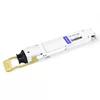
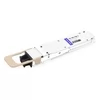
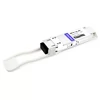
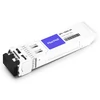
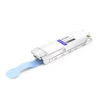
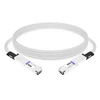
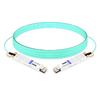
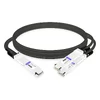
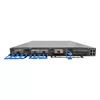
You're standing up a 400G host for an AI training node, an HPC cluster, or a hyperscale storage tier. You pick a card, then spend the next week untangling whether the port is QSFP-DD, QSFP112-DD, OSFP, or QSFP112; whether the switch on the other side is Ethernet or InfiniBand; and whether the 400G transceiver you specified is actually supported by the NIC and switch.
A 400G NIC is only half the link. The other half is the optics — and at 400G, the form factor, electrical lane configuration, fabric type, firmware support, and transceiver compatibility can all be easy and expensive to get wrong.
A Bare 400G Card Leaves Four Decisions Unanswered
Many vendors and OEM configurators sell the 400G NIC separately and leave the optics and cabling decisions to you. That is where many 400G deployments become complicated, because a high-speed pluggable port is not media-agnostic in the same way as an RJ45 Ethernet port. At 400G, the module form factor, electrical interface, firmware, FEC mode, and platform qualification all matter.
The form-factor mismatch. At 400G, several common pluggable form factors coexist. QSFP-DD uses an eight-lane Double Density QSFP architecture, while QSFP112 uses four high-speed electrical lanes capable of approximately 100G per lane. OSFP is also an eight-lane form factor and supports multiple generations of SerDes rates. A specific 400G OSFP implementation may use four 100G electrical lanes, but OSFP itself should not be defined as a four-lane form factor.
The modules should therefore be matched to the host cage and supported electrical interface rather than selected on speed alone. QSFP-DD, QSFP112, and OSFP should not be assumed to be directly interchangeable. Some host platforms support backward compatibility within the QSFP family, and OSFP-to-QSFP adapters also exist for supported applications, but compatibility still depends on the host platform and module.
The fabric choice. A 400G host interface may be InfiniBand NDR or 400GbE Ethernet, and that choice affects the architecture of the entire cluster. NVIDIA ConnectX-7 is available in configurations supporting InfiniBand and Ethernet, while Broadcom BCM57608 is an Ethernet controller designed for 400GbE, RoCEv2, cloud, AI, HPC, and storage networking.
Pick the wrong fabric and you may either pay for capabilities you do not need or end up with an Ethernet-only adapter that cannot participate directly in an InfiniBand NDR fabric.
The native-400G vs. 2×200G confusion. Intel's E830 family is a platform offering speeds of up to 200GbE per port. A dual-port E830-CQDA2 configuration can provide two 200GbE interfaces, giving up to 400Gb/s of aggregate network bandwidth, but that is not the same thing as a native single-port 400GbE NIC. Buyers who need one physical 400G link to one 400G switch port should distinguish carefully between single-port 400GbE and dual-port 200GbE architectures.
Vendor qualification and firmware compatibility. High-speed optical modules carry management information and operate within specific electrical, thermal, FEC, and firmware requirements. Some NICs and switches are relatively open to third-party optics, while others use validated-module lists or platform-specific qualification rules. An optic that works in one 400G switch or NIC should not automatically be assumed to work in another simply because the mechanical form factor matches.
This is a common source of support issues in 400G server upgrades, which is why testing the NIC, optic, cable, and switch-side configuration as a complete link is important.
400G NICs Available from FiberMall
FiberMall builds its 400G NIC offering around two important controller families in this performance tier: the NVIDIA ConnectX-7 for InfiniBand and Ethernet AI/HPC applications, and the Broadcom BCM57608 "Thor2" for high-performance 400GbE Ethernet.
No single controller is ideal for every fabric, so the NIC should be matched to the target switch, protocol, form factor, and workload.
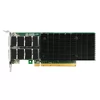
400G Single-Port QSFP-DD / QSFP112-DD — Broadcom BCM57608 (Thor2). This option is built around the Broadcom BCM57608 controller and provides a single 400GbE interface through an eight-lane QSFP-DD-family cage. Broadcom's reference P1400GD adapter uses QSFP112-DD and PCIe 5.0 x16, with up to 400Gb/s of aggregate Ethernet throughput. It is well suited to AI/ML scale-out Ethernet, cloud infrastructure, NVMe storage, HPC, and other high-bandwidth Ethernet applications.
400G Single-Port OSFP — NVIDIA ConnectX-7. ConnectX-7 is available with a single OSFP networking port supporting up to 400Gb/s InfiniBand NDR or 400GbE Ethernet on applicable SKUs. It uses a PCIe Gen 5.0/4.0 x16 host interface and is particularly well suited to AI, HPC, GPU networking, and NVIDIA InfiniBand or Ethernet fabrics. NVIDIA's current ConnectX-7 specifications identify the 400G OSFP configuration as a single-port OSFP design.
400G QSFP112 — NVIDIA ConnectX-7. ConnectX-7 is also available in QSFP112 configurations. Depending on the specific adapter SKU, this can include a single 400GbE QSFP112 interface or dual QSFP112 interfaces operating at up to 200Gb/s per port, with a maximum aggregate bandwidth of 400Gb/s for the ConnectX-7 device. The exact port speed and protocol capability must therefore be checked against the specific NVIDIA part number rather than inferred from the number of QSFP112 cages.
400G Single-Port QSFP-DD / QSFP112-DD — Broadcom BCM57608 (Thor2)
One high-speed port delivers a clean 400GbE path for a host that needs a single maximum-bandwidth connection to a 400G Ethernet switch.
The BCM57608 supports network rates from 25GbE through 400GbE, eight high-speed SerDes lanes, PCIe 5.0 x16, RoCEv2, hardware-based congestion control including DCQCN, TruFlow flow processing, SR-IOV, and inline kTLS/QUIC encryption offload. Broadcom also supports peer-memory capabilities and GPU-oriented networking functions, making Thor2 suitable for Ethernet-based AI scale-out as well as cloud and storage applications.
400G Single-Port OSFP — NVIDIA ConnectX-7
This is one of the key adapters used in modern AI and HPC networking. ConnectX-7 supports up to 400Gb/s InfiniBand NDR or 400GbE Ethernet on supported single-port OSFP SKUs, providing a flexible option for environments that need either InfiniBand or Ethernet.
ConnectX-7 supports GPUDirect RDMA and can be used in NVIDIA networking architectures that leverage technologies such as GPUDirect Storage and SHARP-based in-network computing. NVIDIA's networking software stack also supports features including RDMA, virtualization, and hardware security/offload capabilities, depending on the specific adapter SKU and software configuration.
For a native 400G OSFP link, the current ConnectX-7 stand-up card architecture uses a single OSFP port rather than two independent 400G OSFP ports. This is an important distinction when calculating host bandwidth and switch-port requirements.
400G QSFP112 — NVIDIA ConnectX-7
ConnectX-7 silicon is also available behind QSFP112 cages. QSFP112 provides four high-speed electrical lanes and is widely used for 100G-per-lane host-side interfaces.
A single-port ConnectX-7 QSFP112 implementation can support a 400G connection where the specific SKU provides 400GbE capability. NVIDIA also offers dual-port QSFP112 ConnectX-7 adapters in which each port can operate at up to 200Gb/s on applicable models, providing 400Gb/s aggregate bandwidth rather than 800Gb/s.
QSFP112 is also used in NVIDIA BlueField-3 and ConnectX-7 host-side ecosystems. NVIDIA Spectrum-4 switches, however, commonly use OSFP-based switch-side interfaces, so the host-side and switch-side module form factors do not necessarily have to be identical when an appropriate cable or optical solution is used.
Match the 400G Media to Your Reach
The NIC stays the same, but the transceiver, DAC, or AOC installed in the port determines the transmission medium and reach. The correct choice also depends on the NIC's supported electrical interface, FEC requirements, module power, firmware, and switch-side configuration.
FiberMall supplies and tests the NIC and media pairing so that the link can be validated as a complete system rather than assembled from unverified components.
400GBASE-SR8 — up to 100 m. SR8 is intended for short-reach multimode fiber connections. A typical implementation uses eight parallel transmit and eight parallel receive fibers through an MPO-16 connector. Standard reach is approximately 70 m over OM3 and 100 m over OM4 multimode fiber. It is useful for short data-center server-to-switch and switch-to-switch links.
400GBASE-DR4 — up to 500 m. DR4 uses four parallel 100G-class optical lanes over single-mode fiber and typically uses an MPO-12 connector. It is a common choice for row-to-row or larger data-hall links and can also support 4×100G breakout architectures when both endpoints support the required mode.
400GBASE-FR4 — up to 2 km. FR4 multiplexes four optical wavelengths onto duplex single-mode fiber and uses a duplex LC interface. It is useful for longer data-center, building-to-building, and campus connections where parallel fiber is undesirable.
400G LR4 / LR8 — approximately 6 to 10 km depending on implementation. Long-reach 400G modules generally use duplex single-mode fiber and LC connectors. IEEE 400GBASE-LR4-6 defines a 6 km class, while LR8 and a number of LR4 MSA/vendor implementations are offered for reaches of up to 10 km. These modules are appropriate for campus and metro-access applications where longer single-mode links are required.
400G QSFP-DD DAC — typically up to about 3 m, with longer qualified options on some platforms. Passive direct-attach copper provides the lowest-cost and lowest-power option for short same-rack links. Cable reach depends on the host SerDes and cable design; for example, Broadcom specifies support for qualified DAC cables of up to 5 m with BCM57608.
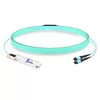
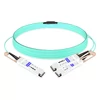
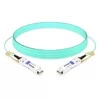
400G QSFP-DD AOC — typically up to 100 m. An active optical cable uses integrated optical transceivers at both ends and fixed multimode fiber between them. Unlike a detachable SR8 transceiver link, the fiber is permanently attached to the AOC modules, so there is no separate MPO patch cord at the module interface. AOC is useful for multi-rack links where passive DAC is too short but removable transceivers are not required.
Where supported by the NIC, firmware, switch port, and cable, a 400G interface may also be configured for breakout operation. Typical architectures include 400G-to-2×200G or 400G-to-4×100G, but breakout capability should always be verified for the exact adapter and switch SKU rather than assumed from the connector alone.
FiberMall can supply the corresponding breakout DAC or AOC together with the NIC so that lane mapping and link compatibility can be checked before deployment.
QSFP-DD vs OSFP vs QSFP112: Which Module Actually Fits
The ports can look similar at first glance, but the form factors and electrical interfaces are different.
A QSFP-DD interface uses eight high-speed electrical lanes in a Double Density QSFP architecture. Early 400G QSFP-DD implementations commonly use eight approximately 50G PAM4 electrical lanes, while newer QSFP-DD-family interfaces can support higher SerDes rates.
An OSFP interface is also an eight-lane form factor. OSFP was designed with a larger thermal envelope and has evolved from 400G using 50G-per-lane electrical signaling to 800G and 1.6T generations using higher per-lane SerDes rates. In NVIDIA 400G NDR applications, a specific OSFP module or host interface may operate using four 100G lanes, but the OSFP form factor itself contains eight high-speed electrical lanes.
A QSFP112 interface provides four high-speed electrical lanes capable of approximately 100G per lane, allowing a single-port 400G interface in a compact QSFP-class form factor.
These form factors should not be treated as universally interchangeable. A QSFP-DD module cannot simply be inserted into an OSFP cage, and an OSFP module cannot be inserted directly into a QSFP112 cage. However, the broader compatibility picture is more nuanced than saying that no adapters exist: OSFP-to-QSFP adapters are available for supported backward-compatibility applications, and individual QSFP-family host cages may support selected earlier-generation QSFP modules. Platform documentation should always be checked before mixing generations or form factors.
The rule for a 400G NIC is simple: match the transceiver or cable to the card's supported cage and electrical interface, then verify that the media, FEC, port mode, and switch-side interface are also compatible.
When you buy the NIC and optics together from FiberMall, the objective is to enforce those compatibility checks before shipment so that the components arrive configured for the intended Ethernet or InfiniBand link rather than leaving the customer to validate each component independently.
If your roadmap points to 800G later, that becomes a separate QSFP-DD- or OSFP-based 800G architecture decision. It is worth planning deliberately rather than assuming that every 400G host port can simply be upgraded to an 800G module.
InfiniBand NDR or 400GbE Ethernet: Pick the Fabric Your Cluster Needs
At 400G, the fabric choice is an architectural decision. The adapter, switch, cabling, management model, and application stack all need to align, so the interconnect should be selected before the first node is racked.
InfiniBand NDR with ConnectX-7 is widely used in large AI training and HPC clusters. A supported ConnectX-7 OSFP configuration can operate at 400Gb/s NDR using four 100Gb/s InfiniBand lanes. The NVIDIA ecosystem also supports GPUDirect RDMA and fabric-level capabilities such as SHARP that are designed to improve collective communication performance in GPU and HPC workloads.
If you're building a large AI/HPC fabric in which GPU-to-GPU collective performance and InfiniBand-native features are priorities, ConnectX-7 with NDR is a strong choice.
400GbE Ethernet with RoCEv2 is a practical alternative for cloud, storage, and general-purpose data centers that want to maintain a converged Ethernet architecture. Broadcom BCM57608 supports RoCEv2 with hardware-based congestion-control capabilities, including DCQCN, while continuing to operate over standard Ethernet infrastructure.
That makes Thor2 suitable for NVMe storage, virtualization, cloud infrastructure, and Ethernet-native AI scale-out networks where Ethernet interoperability and operational consistency are priorities.
The Intel E830 comparison is also important. E830 supports up to 200GbE per port. A dual-port E830 adapter can therefore provide two independent 200G links and as much as 400Gb/s of aggregate bandwidth, but it is not the same as a native single-port 400GbE adapter. If the requirement is one physical 400G link — one NIC port, one 400G media interface, and one corresponding switch port — choose a native 400GbE adapter such as an appropriate ConnectX-7 or BCM57608-based design.
Driver Compatibility: Strong OS Support on Both Controllers
The driver ecosystem at 400G is mature on both NVIDIA ConnectX-7 and Broadcom BCM57608, but the driver package and name depend on the operating system.
NVIDIA ConnectX-7 uses the mlx5 driver family in Linux and is supported across major Linux distributions. NVIDIA also provides MLNX_OFED/MLNX_EN packages for Linux when additional networking and RDMA functionality is required. Windows uses NVIDIA WinOF-2, while VMware environments use the corresponding NVIDIA VMware networking software rather than a Linux mlx5 package.
Broadcom BCM57608 (Thor2) uses the bnxt_en Linux Ethernet driver together with Broadcom's RoCE software stack where required. Broadcom also provides signed driver packages for supported Windows Server and VMware ESXi environments, as well as DPDK and RDMA support.
That matters for a card that may remain in a remote server or data-center rack for years. Long-term operating-system and driver support are just as important as the raw 400G link rate.
A common comparison at 400G is NVIDIA ConnectX-7 versus Broadcom BCM57608. ConnectX-7 provides the option of InfiniBand NDR as well as Ethernet and is deeply integrated into NVIDIA's AI/HPC networking ecosystem. BCM57608 is focused on high-performance Ethernet and provides 400GbE, RoCEv2, TruFlow, inline security offloads, and PCIe 5.0.
ConnectX-7 can carry a price premium depending on the exact SKU, form factor, crypto options, and market conditions. For standard 400GbE workloads such as cloud, storage, virtualization, and Ethernet-native AI, a BCM57608-based adapter can therefore be an attractive alternative. If the deployment specifically requires InfiniBand NDR or NVIDIA's InfiniBand ecosystem, ConnectX-7 is the appropriate choice.
400G NIC FAQ
Does my 400G NIC need OSFP, QSFP-DD, or QSFP112 — and does it depend on the switch?
Yes. The NIC-side form factor and electrical interface must be supported by the adapter, and the media selected must also be compatible with the switch side.
QSFP-DD is an eight-lane QSFP-family architecture widely used for Ethernet. OSFP is an eight-lane form factor widely used in high-density Ethernet and NVIDIA InfiniBand/Ethernet systems. QSFP112 uses four approximately 100G electrical lanes and is used on selected ConnectX-7 and BlueField-3 host interfaces.
The interfaces are not universally interchangeable through direct insertion. Check the NIC's cage, supported SerDes mode, module specifications, FEC requirements, and switch-side interface before ordering.
What is the difference between a 400G NIC and a 2×200G NIC?
A native single-port 400G NIC carries one 400Gb/s link through one physical port. Depending on the adapter, that may be an OSFP, QSFP112, QSFP-DD, or QSFP112-DD interface.
A 2×200G NIC provides two independent 200Gb/s ports for 400Gb/s aggregate bandwidth. Intel's E830-CQDA2 is an example of a platform supporting up to 200GbE per port. NVIDIA also offers dual-port ConnectX-7 QSFP112 configurations with up to 200Gb/s per port on applicable SKUs.
If you need one 400G connection to one switch port, choose a native single-port 400G configuration rather than assuming that two 200G interfaces are equivalent.
Which transceivers, DAC, and AOC cables work with a 400G NIC?
Common 400G media options include 400GBASE-SR8 for short multimode links, DR4 for up to 500 m of parallel single-mode fiber, FR4 for up to 2 km over duplex single-mode fiber, and long-reach LR-class optics for longer single-mode applications.
For short connections, passive DAC and AOC solutions are also available.
However, MSA compliance and matching mechanical form factor alone do not guarantee interoperability. The module or cable must also match the NIC's supported electrical lane configuration, FEC mode, firmware, port configuration, power and thermal limits, and any vendor qualification requirements.
FiberMall can code and test the selected module or cable against the card before shipping so that the complete host-side link is validated rather than relying only on the module's nominal 400G specification.
Do I need InfiniBand NDR or 400GbE Ethernet (RoCEv2) for my AI/HPC cluster?
It depends on the cluster architecture.
InfiniBand NDR with ConnectX-7 provides a 400Gb/s InfiniBand option designed for high-performance AI and HPC fabrics and integrates with NVIDIA technologies such as GPUDirect RDMA and SHARP-enabled fabrics.
400GbE Ethernet with RoCEv2 provides RDMA over an Ethernet infrastructure. Broadcom BCM57608 supports 400GbE and hardware-assisted RoCEv2 congestion control, making it suitable for cloud, storage, HPC, and Ethernet-native AI networks.
FiberMall carries both approaches and can match the NIC and optical media to the topology.
NVIDIA ConnectX-7 vs Broadcom BCM57608 — which 400G adapter should I choose?
Choose ConnectX-7 if you need InfiniBand NDR, NVIDIA's AI/HPC networking ecosystem, GPUDirect RDMA, or a NIC that can support both InfiniBand and Ethernet on the appropriate SKU.
Choose Broadcom BCM57608 (Thor2) if you're building a 400GbE Ethernet fabric for cloud, storage, virtualization, HPC, or Ethernet-native AI and want features including RoCEv2, TruFlow, PCIe 5.0, and inline security offloads.
Both controller families have mature operating-system and driver ecosystems, but the exact supported OS, driver package, optical module, and port configuration should be checked against the specific adapter SKU.
Do you sell the NIC and the 400G optics as a tested kit?
Yes. This is FiberMall's core differentiator. FiberMall can supply the 400G NIC together with the matching OSFP, QSFP112, QSFP-DD, or QSFP112-DD transceiver, DAC/AOC, and fiber cabling as one compatibility-tested order.
Instead of validating the NIC, optical module, cable, and firmware configuration independently, the complete link can be checked as a system before shipment. That gives the customer one purchase order, one shipment, and one engineering team responsible for the interoperability of the link.
Do you offer volume pricing for multi-node 400G deployments?
Yes. Volume pricing is available for multi-card, multi-node, and OEM/ODM deployments. The engineering team can provide bill-of-materials pricing covering the NIC, transceiver or DAC/AOC, and associated cabling.
Custom bracket configurations and private-label branding can also be discussed for volume and OEM projects.