

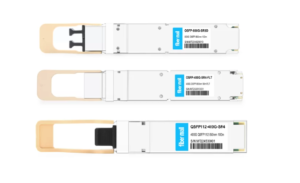
What Form Factors Are Used for 400G Optics and Cables?

Picture of FiberMall

FiberMall

Answered on 9:55 am

There are two form factors defined for 400G optical modules and cables:

  • The OSFP: The OSFP stands for “Octal Small Form-factor Pluggable”. It is described as an “Octal” module because the electrical interface of an OSFP connector consists of 8 electrical lanes, running at 50Gb/s each, for a total bandwidth of 400Gb/s.
  • The QSFP-DD: The QSFP-DD stands for “Quad Small Form-factor Pluggable (QSFP) – Double Density (DD)”. The electrical interface of a QSFP-DD connector also has 8 electrical lanes, running at 50Gb/s each, for a total bandwidth of 400Gb/s. The QSFP-DD form factor is similar to the QSFP form factor, except a second row of electrical contacts has been added to increase the number of high-speed electrical lanes from 4 (in a QSFP) to 8 (in a QSFP-DD).

People Also Ask

Analysis of Management Methods for Unmanaged InfiniBand Switches

Why Unmanaged IB Switches Have No Web-UI 1) Positioning and Functional Simplification  2) Differences in Protocol Stack  3) Reducing Cost and Complexity  How to Manage and Configure Unmanaged IB Switches Although there is no Web-UI, they can be managed via the following methods: 1) Connect to the Subnet Manager via

Analysis of Core Port Ratios in Intelligent Computing Center Network Design

Two Key Design Principles for GPU Cluster Networks The Definition of Core Ports In a typical Spine-Leaf (CLOS) network architecture for intelligent computing centers: Consistent Access-to-Core Port Ratios The number and bandwidth of “downlink ports” (used to connect servers) on a Leaf switch should maintain a fixed and sufficient ratio—typically 1:1

NVIDIA Spectrum-X Network Platform Architecture Whitepaper

Improving AI Performance and Efficiency AI workload demands are growing at an unprecedented rate, and the adoption of generative AI is skyrocketing. Every year, new AI factories are springing up. These facilities, dedicated to the development and operation of artificial intelligence technologies, are increasingly expanding into the domains of Cloud

NVIDIA GB200 NVL72: Defining the New Benchmark for Rack-Scale AI Computing

The explosive growth of Large Language Models (LLM) and Mixture-of-Experts (MoE) architectures is fundamentally reshaping the underlying logic of computing infrastructure. As model parameters cross the trillion mark, traditional cluster architectures—centered on standalone servers connected by standard networking—are hitting physical and economic ceilings. In this context, NVIDIA’s GB200 NVL72 is

In-Depth Analysis Report on 800G Switches: Architectural Evolution, Market Landscape, and Future Outlook

Introduction: Reconstructing Network Infrastructure in the AI Era Paradigm Shift from Cloud Computing to AI Factories       Global data center networks are undergoing the most profound transformation in the past decade. Previously, network architectures were primarily designed around cloud computing and internet application traffic patterns, dominated by “north-south” client-server models. However,

Related Articles

800g sr8 and 400g sr4

800G SR8 and 400G SR4 Optical Transceiver Modules Compatibility and Interconnection Test Report

Version Change Log Writer V0 Sample Test Cassie Test Purpose Test Objects:800G OSFP SR8/400G OSFP SR4/400G Q112 SR4. By conducting corresponding tests, the test parameters meet the relevant industry standards, and the test modules can be normally used for Nvidia (Mellanox) MQM9790 switch, Nvidia (Mellanox) ConnectX-7 network card and Nvidia (Mellanox) BlueField-3, laying a foundation for
Read More »
Unmanaged InfiniBand Switches

Analysis of Management Methods for Unmanaged InfiniBand Switches

Why Unmanaged IB Switches Have No Web-UI 1) Positioning and Functional Simplification  2) Differences in Protocol Stack  3) Reducing Cost and Complexity  How to Manage and Configure Unmanaged IB Switches Although there is no Web-UI, they can be managed via the following methods: 1) Connect to the Subnet Manager via
Read More »
ai cluster

Analysis of Core Port Ratios in Intelligent Computing Center Network Design

Two Key Design Principles for GPU Cluster Networks The Definition of Core Ports In a typical Spine-Leaf (CLOS) network architecture for intelligent computing centers: Consistent Access-to-Core Port Ratios The number and bandwidth of “downlink ports” (used to connect servers) on a Leaf switch should maintain a fixed and sufficient ratio—typically 1:1
Read More »
NVIDIA Spectrum-X Network Platform

NVIDIA Spectrum-X Network Platform Architecture Whitepaper

Improving AI Performance and Efficiency AI workload demands are growing at an unprecedented rate, and the adoption of generative AI is skyrocketing. Every year, new AI factories are springing up. These facilities, dedicated to the development and operation of artificial intelligence technologies, are increasingly expanding into the domains of Cloud

Read More »
nvidia

NVIDIA GB200 NVL72: Defining the New Benchmark for Rack-Scale AI Computing

The explosive growth of Large Language Models (LLM) and Mixture-of-Experts (MoE) architectures is fundamentally reshaping the underlying logic of computing infrastructure. As model parameters cross the trillion mark, traditional cluster architectures—centered on standalone servers connected by standard networking—are hitting physical and economic ceilings. In this context, NVIDIA’s GB200 NVL72 is

Read More »
Report on 800G Switches

In-Depth Analysis Report on 800G Switches: Architectural Evolution, Market Landscape, and Future Outlook

Introduction: Reconstructing Network Infrastructure in the AI Era Paradigm Shift from Cloud Computing to AI Factories       Global data center networks are undergoing the most profound transformation in the past decade. Previously, network architectures were primarily designed around cloud computing and internet application traffic patterns, dominated by “north-south” client-server models. However,

Read More »
Scroll to Top