
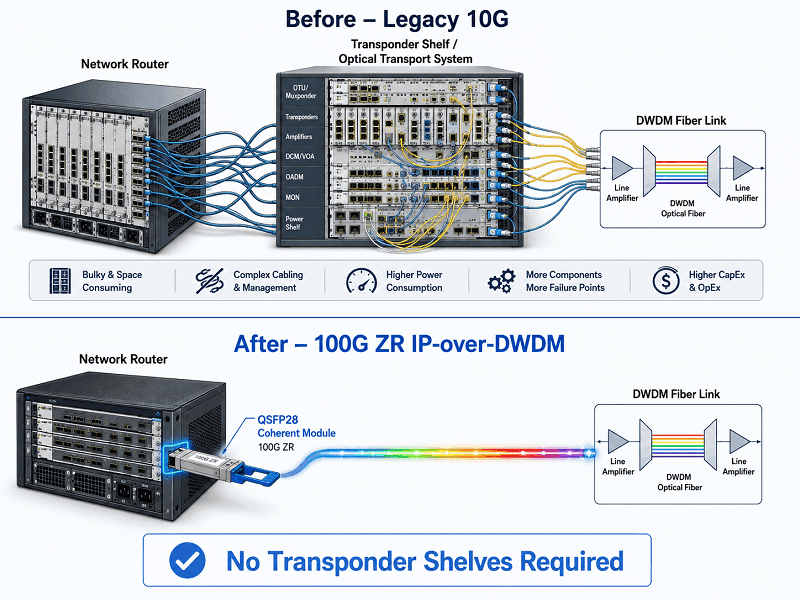
For years, upgrading metro and regional networks from 10G to 100G required dedicated optical transport equipment, including transponder shelves, line cards, and additional optical infrastructure. That approach worked, but it added cost, power consumption, and operational complexity.
100G ZR QSFP28 changes this model.
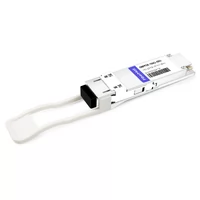
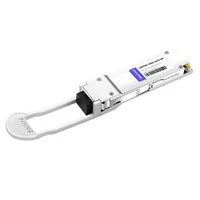
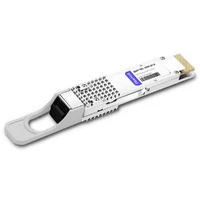
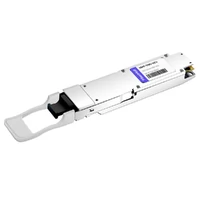
A 100G ZR module is a pluggable digital coherent optics (DCO) transceiver that allows routers and switches with QSFP28 ports to transmit 100GbE over long-distance fiber links using coherent optical technology. Instead of deploying a separate transport system, operators can directly connect IP equipment to the optical network using a compact coherent module.
The key advantage is simple:
A single QSFP28 coherent module can replace multiple lower-speed optical wavelengths while using existing fiber infrastructure.
For operators upgrading legacy 10G DWDM networks, 100G ZR provides a practical migration path:
- Higher bandwidth without adding new fiber
- Lower power consumption than traditional transponder systems
- Direct router-to-router optical connectivity
- DWDM wavelength flexibility for metro networks
This guide explains what a 100G ZR module is, how coherent technology works, how it compares with 100GBASE-ZR4, where it fits compared with ZR+ and 400G ZR, and what should be considered before deployment.
What Is a 100G ZR Module?
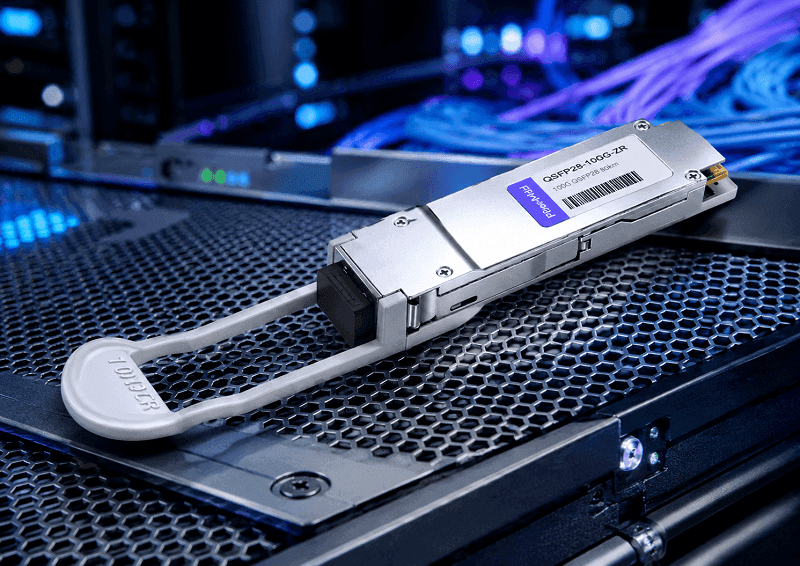
A 100G ZR module is a pluggable digital coherent optics (DCO) transceiver in the QSFP28 form factor that carries a single 100 GbE signal over one tunable C-band wavelength. It follows the IEEE 802.3-2022 100GBASE-ZR spec (Clause 154, the published 802.3cw project), the OIF 100G ZR implementation agreement, and ITU-T G.709.2 for its staircase forward error correction. Reach runs about 80 km on unamplified dark fiber, up to 300 km with amplifiers and dispersion compensation.
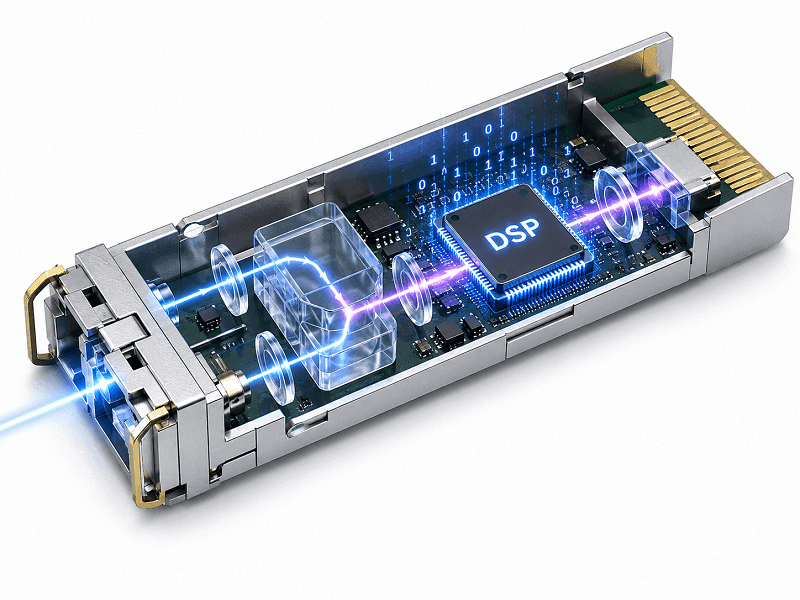
The “coherent” part is the whole story. Instead of switching a laser on and off the way direct-detect modules do, a coherent module encodes data on the phase and polarization of the light. A digital signal processor (DSP) inside the module rebuilds the optical field at the far end. That’s how a module the size of a stick of gum carries 100 Gbps on a single wavelength, shrugs off dispersion that would wreck a non-coherent signal, and tunes to any channel on the DWDM grid.
That last bit is what makes it interesting. If you have a dark fiber pair and a spare 100G port, a 100G ZR turns that pair into a full DWDM-capable transport link. Want to see the whole coherent family before you commit? The coherent optical module guide walks through every speed from 100G to 800G and how they fit together.
100G ZR vs ZR4: Don’t Confuse the Names
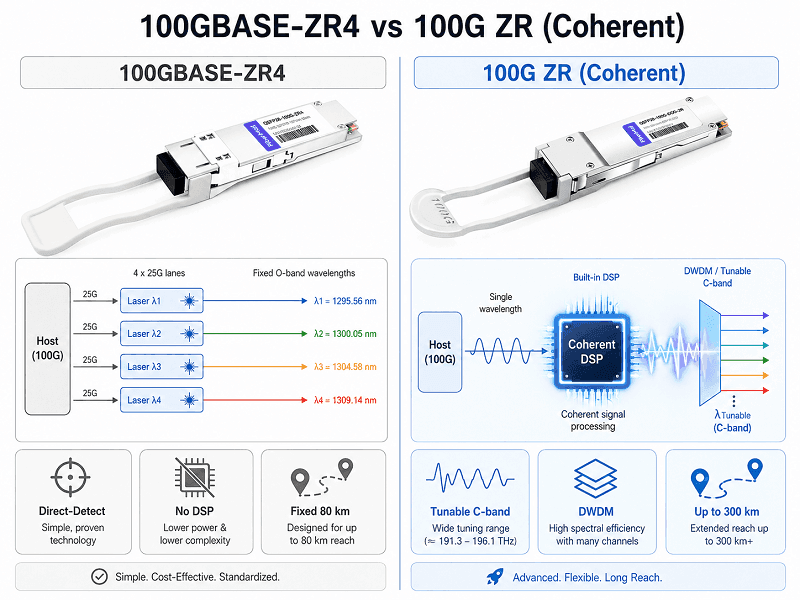
Here’s where buyers lose money. 100GBASE-ZR4 and 100G ZR are not the same module, and they are not compatible with each other.
ZR4 is a direct-detect part: four 25G lanes running non-return-to-zero (NRZ) on fixed LAN-WDM wavelengths in the O-band. It reaches about 80 km over a dedicated fiber pair, has no DSP, can’t tune to a DWDM channel, and leans on the host’s RS-FEC. ZR, the coherent one, uses DP-DQPSK on a single tunable C-band wavelength, carries its own DSP, and is DWDM-native by design.
| Feature | 100GBASE-ZR4 | 100G ZR (coherent) |
| Detection | Direct-detect (IMDD) | Digital coherent (DCO) |
| Modulation | 4 x 25G NRZ | DP-DQPSK, single carrier |
| Wavelength | LAN-WDM O-band, fixed | C-band tunable, 50/100 GHz grid |
| Reach | ~80 km | 80 km unamplified / 300 km amplified |
| DSP | No | Built-in coherent DSP |
| DWDM | No | Yes, tunable |
| FEC | RS-FEC on host | Staircase FEC (G.709.2) |
| Power draw | ~2.5-3.5W | ~5-6W |
Daniel, an IT director at a regional bank, learned this the hard way. He needed to connect two data centers about 90 km apart, searched for a 100G ZR, and picked a module priced like a bargain at $1,900. It was a ZR4.
It passed on the 90 km link for about two weeks, then started dropping packets as chromatic dispersion accumulated on the fiber. The coherent module he actually needed cost more than twice as much, but it ran the same link with margin to spare.
So which one do you need? For a fixed 80 km point-to-point link, no DWDM, a single fiber pair, and the lowest possible cost, ZR4 still makes sense. The moment you need a DWDM channel, longer reach, or a ROADM, you need the coherent ZR. Our QSFP28 module types guide covers the whole direct-detect family, including SR4, LR4, CWDM4, and ZR4, so you can see where each one fits.
100G ZR QSFP28 Specifications
Let’s get the numbers on the table.
| Parameter | 100G ZR QSFP28 (coherent) |
| Form factor | QSFP28 (SFF-8636) |
| Standard | IEEE 802.3-2022 100GBASE-ZR; OIF 100G ZR MSA |
| Modulation | DP-DQPSK, single carrier, ~27.95 GBd |
| FEC | Staircase FEC, ITU-T G.709.2 (OTU4) |
| Wavelength | C-band tunable, 191.3-196.1 THz |
| Grid | 50 GHz / 100 GHz DWDM |
| Client interface | CAUI-4 / 100GbE |
| Connector | Duplex LC, single-mode |
| Rx sensitivity | ~-30 dBm |
| Transmit power | -8 to -4 dBm (0 dBm high-power variant) |
| Power draw | 4.5-6.5W (max 5.5W commercial, 6W industrial) |
| Temperature | 0 to 70 C commercial; -40 to 85 C industrial |
| Management | CMIS 5.2 / SFF-8636 DDM |
The power draw deserves attention. A coherent DSP needs power, and 5-6W sits at the ceiling of what a standard QSFP28 cage can dissipate. That’s exactly why 100G is the only coherent speed in this form factor: 400G coherent requires the larger QSFP-DD or OSFP package, so you won’t find a 400G ZR here. Our complete QSFP28 100G guide walks through the form factor family and its power limits in more depth.
How Does 100G ZR Work?
Coherent detection sounds exotic, but the idea is straightforward. Imagine you can’t hear a radio station unless you also have the station’s reference tone to tune against. Coherent receivers do the optical version: a local oscillator laser mixes with the incoming light inside a 90-degree hybrid, which reveals the amplitude, phase, and polarization of the signal all at once.
The DSP then handles what used to require a rack of hardware. It compensates chromatic dispersion and polarization mode dispersion in software, and the staircase FEC corrects the errors that remain. That’s the entire reason a tiny QSFP28 can span 300 km: the fiber impairments get undone mathematically instead of with dispersion-compensation modules and optical filters.
DP-DQPSK means the data rides on two polarizations, each phase-modulated at four levels. Plainly: more bits per symbol, so one 27.95 GBd carrier carries a full 100 Gbps. For the deeper transmit-and-receive chain, the coherent pillar’s how coherent optics work section goes component by component.
100G ZR vs ZR+ vs 400G ZR: Where Does 100G Fit?
100G ZR sits at the edge of the coherent family, and that’s its job. It’s the low-power, low-cost entry point: one wavelength, coherent reach, DWDM tuning, without the port density or power budget of a 400G line card.
A rough decision flow:
- Need a single coherent wavelength at the edge, dark fiber, modest power? Choose 100G ZR.
- Need longer reach (450-600+ km) or a ring/mesh topology? Step up to ZR+ or OpenZR+.
- Need 400G DCI capacity between data centers? Look at 400G ZR QSFP-DD.
The reach math usually decides it. 100G ZR handles metro and edge distances comfortably. Once you cross into regional links measured in hundreds of kilometers, ZR+ or OpenZR+ flex their higher-order modulation and open FEC.
And for DCI trunk capacity, 400G is where the industry standardized. Our ZR vs ZR+ vs OpenZR+ comparison breaks down the standards, and the 400G ZR QSFP-DD buying guide covers the DCI workhorse end of the family.
The 10G-to-100G Migration Case
The real reason to care about 100G ZR is what it does to a 10G DWDM network. One coherent wavelength replaces ten 10G wavelengths. No new fiber, no new line system, no transponder shelves: just a module that plugs into a router port and adds a tunable wavelength to the existing 100 GHz grid. Analyst firm Cignal AI frames it as roughly a tenfold capacity increase on the same infrastructure, and calls 100G ZR/ZR+ the fastest-growing coherent pluggable product, around a 40% CAGR between 2025 and 2028.
The economics come from IP-over-DWDM. When the optical layer lives inside the router instead of in separate transponder gear, operators report 20-39% total-cost-of-ownership reductions. The broader pluggable WDM story points the same direction: WDM pluggables carried over half of all WDM bandwidth in 2025, and Cignal AI projects that climbing toward 80% by 2030.
What actually changes in your network?
- Amplifier power: a 100G coherent wavelength needs a solid OSNR budget, so EDFA placement may need review.
- Fiber quality: coherent is forgiving, but span loss still sets your reach.
- Switch support: the host must run a software release with CMIS and coherent initialization, which most major vendors added in 2023+ releases.
- Port power: the module draws 5-6W, so confirm the QSFP28 port and chassis can supply and cool it.
The migration is real, and it’s why operators like Meera are finally getting budget approved. A 10G ring at capacity becomes a 100G asset with one module swap per end. FiberMall’s own 400G ZR/ZR+ coherent transceiver launch news shows how fast this family moved from announcement to mainstream.
100G ZR Deployment: Metro & Edge DCI
Deployment falls into three buckets, and the reach target decides which one you’re in.
Unamplified dark fiber runs about 80 km. Here the limit is loss, not dispersion. A typical 100G ZR link budget sits around 22 dB, so you’re counting connectors, splices, and fiber attenuation. No amplifier needed if your span stays inside budget.
Amplified DWDM reaches 120 km and beyond. Once you add an EDFA, dispersion becomes the constraint, and 100G ZR with its built-in DSP handles that well up to roughly 120 km. Past that, you add dispersion compensation to stretch toward 300 km.
A DWDM mux is required in almost every realistic deployment. A 100G ZR transmits on a tunable C-band wavelength, and the mux combines it with other wavelengths onto a shared fiber pair. For a single wavelength on a dedicated pair, you can skip it, but the moment you run more than one link, the mux pays for itself.
That’s the math Naveen’s team hit at a regional ISP when they connected three edge sites to their core. Each link ran about 70 km on leased dark fiber. Rather than lease three separate fiber pairs, they put a DWDM mux on each end, tuned the three 100G ZR modules to three channels, and ran everything on one pair. The muxes cost less than two months of the extra fiber lease.
Do you need an amplifier? Run the loss budget first. If the total span loss plus a 3-4 dB margin fits within the module’s budget, no. If you’re near the edge, add one EDFA: it usually serves multiple channels on the same fiber pair, so the cost per wavelength stays low.
Our coherent optics for data center interconnect article goes deeper on topology, and the DWDM/CWDM transceiver products page shows what the rest of the link looks like.
100G ZR Compatibility
Compatibility is where coherent deployments stall, and the first gotcha has nothing to do with the module itself.
Not every QSFP28 port can feed a 100G ZR. Coherent modules draw 5-6W continuous, while many switch line cards budget their QSFP28 ports for 3.5-4W direct-detect optics. If the port’s power ceiling sits below the module’s draw, the module powers up, then drops into a CMIS LowPwr state and never initializes. It looks dead, but it’s just underfed.
Check the port power class, the line-card thermal design, and the airflow direction before you order.
Then there’s firmware. Coherent modules need the host to run CMIS management and a coherent bring-up sequence, which only arrived in recent software releases. Cisco, Juniper, and Arista all support 100G ZR on specific platforms, but support is release-dependent. And vendor EEPROM validation still applies: Cisco platforms may flag an uncoded third-party module as unsupported, though the service unsupported-transceiver override exists in IOS-XE and NX-OS, with the usual warranty caveats.
Before you deploy, confirm with your supplier:
- Exact switch model and NOS version
- Port power ceiling and thermal budget
- CMIS support and coherent initialization in the firmware
- FEC mode, since both ends must agree
- Module coding and firmware revision
- Link distance, fiber type, and span loss
The checks look like standard transceiver procurement, but coherent optics punish misses harder because of the DSP bring-up. Our QSFP28 compatibility checklist walks through the full verification, and the QSFP28 troubleshooting guide covers the CMIS power-class failures in detail.
100G ZR Cost & Pricing (2026)
Here’s the honest pricing picture, and it’s a big reason third-party coherent modules keep winning deals.
| Module type | Typical price (2026) |
| 100GBASE-ZR4 (non-coherent) | ~1,300-2,500 |
| 100G ZR QSFP28 DCO (third-party) | ~3,900-7,500 |
| 100G ZR QSFP28 DCO (high-power / industrial) | ~5,500-9,000+ |
| 100G ZR QSFP28 DCO (OEM list) | $12,500+ |
Yes, the coherent module costs two to three times a ZR4. It also does something a ZR4 physically cannot: it puts 100G on a DWDM channel, tunes across the C-band, and reaches 300 km. If you need any of that, the ZR4 price is the wrong comparison.
Against OEM, third-party savings are substantial. OEM list prices for coherent 100G ZR routinely exceed 12,500, so a compatible module at 4,000- 7,500 represents a 40-70% saving. The honest caveat: the coherent ecosystem is younger than standard client optics, and the DSP and FEC implementations are complex enough that OEM tuning and support carry real value on long-haul links. For metro and edge DCI, lab-validated third-party modules are a mainstream choice.
Per gigabit, the TCO story gets better. Replacing ten 10G wavelengths with one 100G coherent wavelength collapses per-port transport cost, and doing it inside an existing router eliminates the transponder shelf entirely. Our coherent module price guide has the fuller 2026 pricing breakdown, and the QSFP28 price guide covers the wider QSFP28 family.
Troubleshooting 100G ZR Link Issues
Most 100G ZR link failures aren’t exotic. Start with the physical layer: roughly 80% of module-level issues trace back to dirty connectors. Clean the duplex LC ends, inspect the fiber, and re-test before you change anything else.
Then look at error performance, not just link state. A green LED isn’t acceptance. On Cisco NX-OS, show controller coherentDSP exposes pre-FEC BER and OSNR, which tell you how much margin the link actually has. On Juniper, the coherent diagnostics do the same job.
If pre-FEC BER climbs but post-FEC stays clean, you’re running near the edge of the link budget.
The common non-physical failures:
- Power-class mismatch: module stuck in LowPwr with no alarm. Verify the port’s power budget.
- CMIS decode failure: older firmware misreads the module as unknown type. Update the NOS.
- FEC mismatch: both ends must use the same FEC mode, or you get flapping and CRC errors.
- Dispersion over-tolerance: past 120 km without dispersion compensation, the DSP runs out of correction range.
Swap-test isolation works like any optic: move the suspect module to a known-good port, then move a known-good module to the suspect port. If the fault follows the module, it’s the optics. If it stays with the port, it’s the switch.
Maya hit a variant of this on a 95 km link that kept dropping traffic. The physical layer checked out, link state was up, and nothing in the standard interface counters looked wrong.
She pulled the coherent DSP telemetry and found pre-FEC BER climbing steadily. The module was running a FEC mode the far-end switch didn’t expect, and the errors were accumulating silently. One command on both ends and the link was clean. Ten minutes, once she knew where to look.
FAQ
What is a 100G ZR module?
A 100G ZR module is a pluggable coherent (DCO) transceiver in the QSFP28 form factor that carries a single 100 GbE signal on one tunable C-band DWDM wavelength, reaching about 80 km unamplified and up to 300 km with amplification and dispersion compensation.
100G ZR vs ZR4: what’s the difference?
ZR4 is direct-detect: four 25G lanes on fixed O-band wavelengths, about 80 km reach, no DSP, no DWDM. 100G ZR is coherent: a single tunable C-band wavelength with a built-in DSP, DWDM-native, and 300 km capable. They don’t interoperate.
How far can a 100G ZR transmit?
About 80 km on unamplified dark fiber, up to 120 km amplified, and up to 300 km with dispersion compensation.
Does 100G ZR need a DWDM mux?
Yes, for any realistic multi-wavelength deployment. The module transmits on a tunable C-band wavelength, and a mux combines it with other wavelengths onto shared fiber.
How much power does a 100G ZR QSFP28 use?
Typically 4.5-6.5W, with commercial modules at or below 5.5W and industrial variants up to 6W. Confirm your QSFP28 port can supply and cool it.
Is 100G ZR compatible with Cisco and Juniper?
Yes, on supported platforms with recent software releases. Confirm CMIS support, port power, and FEC mode, and check vendor EEPROM validation for third-party modules.
Final Thoughts
100G ZR QSFP28 is the low-power coherent entry point that makes metro and edge DCI practical on a budget. It’s the module you reach for when you need coherent reach, DWDM tuning, and a QSFP28 form factor, and it is not the ZR4 you’ll see priced two or three times cheaper.
The key takeaways:
- 100G ZR is coherent; ZR4 is direct-detect. They don’t interoperate, and the name collision costs buyers real money.
- It fits the QSFP28 power envelope, which is exactly why 100G is the only coherent speed in this form factor.
- Deployment is straightforward: 80 km unamplified, up to 300 km with amplifiers and dispersion compensation, and a DWDM mux on any multi-wavelength link.
- Check port power, CMIS support, FEC mode, and vendor coding before you order, since coherent optics are less forgiving than standard modules.
- Third-party 100G ZR DCO modules run 3,900 – 7,500 versus 12,500+ OEM list, and replace a bank of 10G wavelengths for a fraction of the old transport cost.
If you’re evaluating a 100G ZR module for a metro or edge link, talk to our networking engineers about your distances, fiber, and port budget. And if you’re building out the DWDM side of the link, our DWDM and CWDM transceiver solutions show what a complete deployment looks like.
Related Products:
-
 QSFP28-100G-ZR4 100G QSFP28 ZR4 1296-1309nm LWDM 80km LC SMF DDM Transceiver Module
$1500.00
-
QSFP28-100G-DCO-ZR 100G Coherent QSFP28 DCO C-band Tunable Optical Transceiver Module
$3600.00
-
QSFP-DD-100G-DCO 100G Coherent QSFP-DD DCO C-band Tunable Optical Transceiver Module
$5500.00
-
OSFP-100G-DCO 100G Coherent OSFP-DCO C-band Tunable Optical Transceiver Module
$6500.00
-
CFP2-100G-DCO 100G Coherent CFP2-DCO C-band Tunable Optical Transceiver Module
$6000.00
-
CFP-100G-DCO 100G Coherent CFP-DCO C-band Tunable Optical Transceiver Module
$5500.00