
Priya manages networking for a regional cloud provider with two data centers sitting 80 km apart on dark fiber. For years, connecting them at 400G meant a pair of transponder shelves, a rack of extra gear, and a power bill her finance team kept questioning.
Then she swapped them for two 400G ZR QSFP-DD modules that plugged straight into her routers. The shelves went away. The link came up faster than the old one ever did. And the whole conversation about transport costs stopped being a recurring argument.
Her situation is more common than most people realize. 400ZR is now the most widely adopted coherent technology in optical networking, and it has basically become the default answer for data center interconnect (DCI) and metro transport. Analysts at Cignal AI estimate that 400ZR and ZR+ pluggables carried roughly half of all deployed telecom coherent bandwidth in 2025.
Yet when engineers actually research 400G ZR QSFP-DD modules, they mostly find vendor spec sheets and list prices that make transponder shelves look reasonable by comparison. A Cisco QDD-400G-ZR-S lists at over $110,000. That number alone scares off a lot of buyers who never get far enough to learn what these modules actually cost in practice.
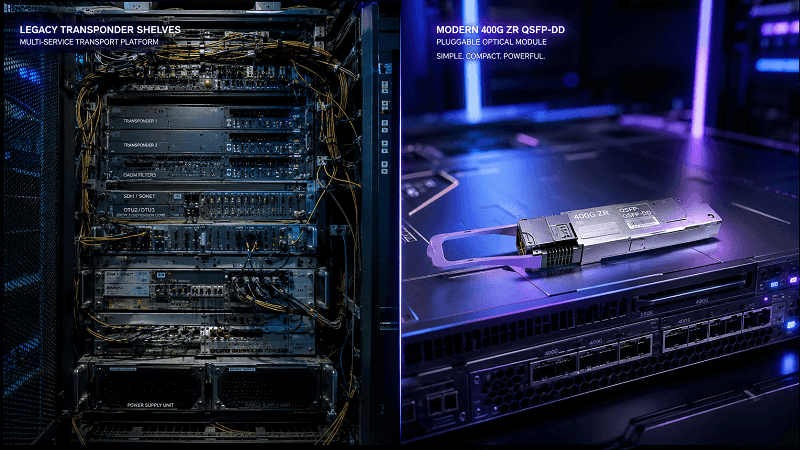
This guide sorts out the confusion. You’ll learn what a 400G ZR QSFP-DD is, how the OIF 400ZR standard defines it, how to choose between ZR, ZR+, and OpenZR+, and what deployment, compatibility, and pricing actually look like in 2026. If you’re newer to coherent optics in general, our complete guide to coherent optical modules covers the full family from 100G ZR through 800G ZR+.
What Is a 400G ZR Transceiver?
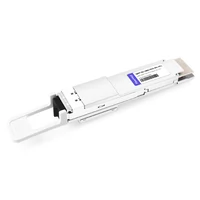
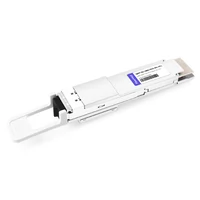
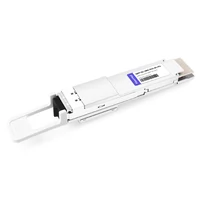
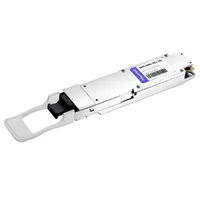
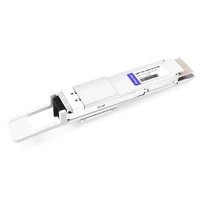
A 400G ZR transceiver is a pluggable digital coherent optics (DCO) module that transmits a single 400 GbE signal over a DWDM wavelength at distances up to 80-120 km. It complies with the OIF 400ZR Implementation Agreement, which guarantees multi-vendor interoperability, and the IEEE 802.3ct 400GBASE-ZR standard.
The word “coherent” is the part that matters. Instead of just turning a laser on and off the way direct-detection modules do, a coherent module encodes data on the amplitude, phase, and polarization of the light. A built-in digital signal processor (DSP) recovers the full optical field on the receiving end. That’s why a module the size of a stick of gum can push 400 Gbps across 100 km of fiber without any dispersion-compensation hardware.
So what does the “ZR” actually mean? It’s a reach designation. In the OIF’s naming, ZR modules are designed for metro-range links, typically 80 km amplified. You’ll also see ZR+ and OpenZR+, which stretch that reach considerably, but the plain 400G ZR is the interoperable, standardized workhorse.
Key Characteristics at a Glance
| Feature | 400G ZR QSFP-DD |
| Standard | OIF 400ZR, IEEE 802.3ct (400GBASE-ZR) |
| Form factor | QSFP-DD (also OSFP) |
| Modulation | DP-16QAM, single carrier ~60 Gbaud |
| Wavelength | Tunable C-band, 75/100 GHz grid |
| FEC | OIF concatenated FEC (C-FEC) |
| Reach | 80-120 km amplified |
| Connector | Duplex LC, single-mode |
| Client interface | 400GAUI-8 / 400GbE |
| Power | 15-20W typical |
| Management | CMIS 5.0 |
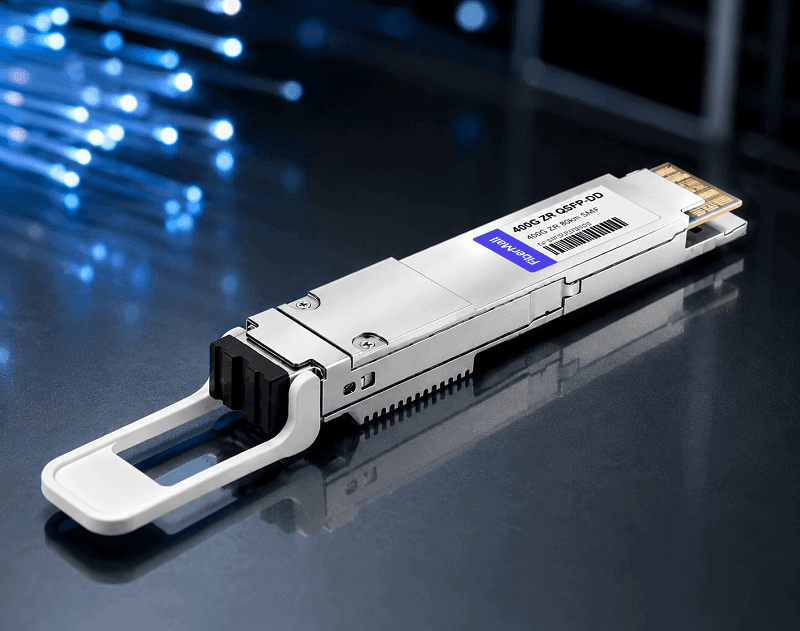
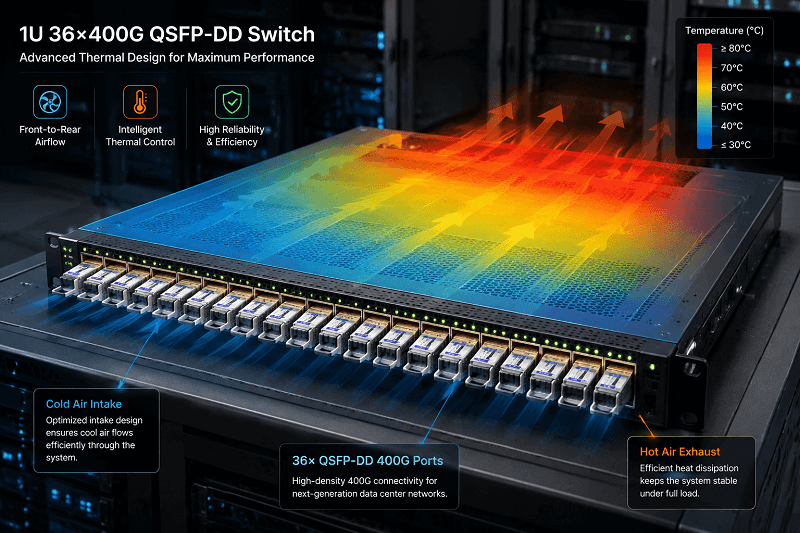
The 400G ZR QSFP-DD form factor is the dominant packaging for these modules, and for good reason. A QSFP-DD port gives you up to 36 ports in a 1U switch, roughly four times the density of the older CFP2-DCO modules that coherent optics used to require.
Not every 400G QSFP-DD module is coherent, though. The SR8, DR4, FR4, and LR4 direct-detect variants serve much shorter reaches, and our 400G QSFP-DD module types guide covers that whole family.
How Does 400G ZR Work?
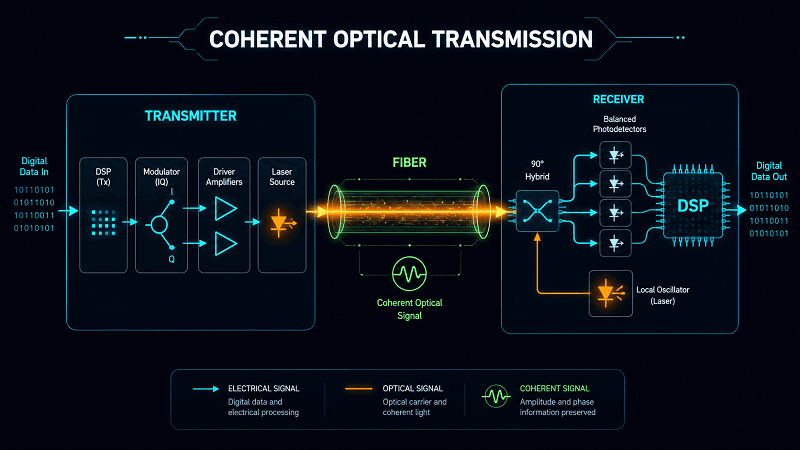
Picture trying to hear a radio station by simply detecting that a signal is present. You’d get nothing useful. Coherent detection works more like tuning in a station with a reference tone: the receiver mixes the incoming light with a locally generated laser signal, which reveals the amplitude, phase, and polarization all at once.
That reference laser is called the local oscillator, and it’s the core of why coherent wins on distance. Because the receiver reconstructs the full optical field, the DSP can mathematically undo the distortions the fiber introduces. Chromatic dispersion and polarization mode dispersion get compensated in software instead of with bulky hardware. Forward error correction fixes the bits that still come in wrong.
A 400G ZR module carries a lot more electronics than a standard QSFP28. On the transmit side, a tunable laser generates a stable C-band wavelength, and a coherent driver modulator encodes the data onto it. On the receive side, an integrated coherent receiver mixes the signal with the local oscillator through a 90-degree optical hybrid and balanced photodetectors. The DSP does the heavy lifting on both ends.
If you want the deeper mechanics of the transmit and receive chain, the coherent optical module guide walks through each component and the modulation formats in detail.
400G ZR vs ZR+ vs OpenZR+: Which Standard Fits?
The biggest source of confusion for buyers is the difference between 400G ZR, ZR+, and OpenZR+. They sound similar, but they solve different problems.
| Feature | 400G ZR | ZR+ | OpenZR+ |
| Standard | OIF 400ZR | Vendor-defined | OpenZR+ MSA |
| Line rates | 400G only | 100G-400G | 100G-400G |
| Modulation | Fixed DP-16QAM | Flexible (QPSK/8QAM/16QAM) | Flexible |
| FEC | C-FEC | C-FEC or oFEC | OpenFEC (oFEC) |
| Reach | ~80-120 km | ~450-600 km | ~480-1,000+ km |
| Power | ~15-18W | ~20-25W | ~20-25W |
| Best for | Point-to-point DCI | Metro/regional, ROADMs | Metro rings, multi-rate |
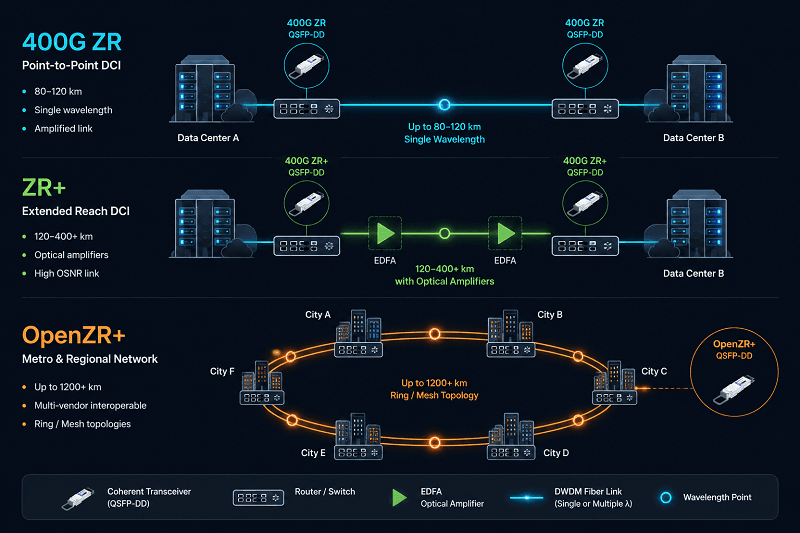
The simple version: 400G ZR is the interoperable, standardized option for links up to about 120 km. ZR+ is an umbrella term for extended-reach pluggables that go beyond the OIF spec, but it’s not a single standard, so behavior varies by vendor. Nokia’s 400ZR/ZR+ modules, for example, cover that extended range in QSFP-DD. OpenZR+ is a formal MSA that brings flexible rates and oFEC to the table while keeping better interoperability than proprietary ZR+ implementations.
How do you actually choose? Start with distance and topology.
- Under 80 km, point-to-point, no ROADMs: Standard 400G ZR. Simple, interoperable, lowest cost.
- Under 120 km with ROADMs: You’ll likely need a high-power ZR+ variant to carry the extra loss.
- Over 120 km: ZR+ or OpenZR+.
- Ring or mesh topology, or mixed 100G-400G rates: OpenZR+ gives you the multi-rate flexibility.
One practical note for anyone evaluating options: a lot of buyers land on 400G ZR because it’s what their switch vendor supports out of the box, then discover they actually needed OpenZR+ for a ring topology. Do the topology homework before you commit. The comparison table above captures the practical difference between the three standards.
400G ZR Deployment: DCI and Metro with IP-over-DWDM
The reason 400G ZR exploded in popularity is that it makes IP-over-DWDM practical. Instead of a separate optical transport layer with transponders and muxponders, coherent modules plug directly into router and switch ports and push wavelengths onto existing fiber. Industry analysis puts the equipment, power, and space savings at 30-50% compared to traditional transport, and Cisco cites over 66% cost optimization with a router plus QDD-ZR/ZR+ architecture.
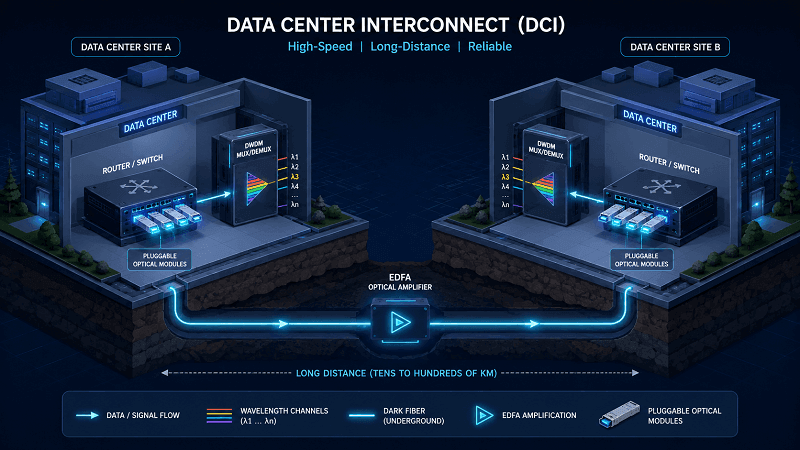
The typical deployment is a point-to-point DCI link. Two data centers 80-120 km apart on dark fiber, a 400G ZR QSFP-DD in a router on each end, and a DWDM mux/demux to combine wavelengths if you’re running more than one. No transponder shelf. No separate management domain.
Do You Need an Optical Amplifier?
Almost certainly yes for 400G ZR. The module’s transmit power is modest, so on links near the 80-120 km range you’ll add an EDFA to keep the optical signal-to-noise ratio within spec. The good news is that one EDFA can often serve multiple 400G ZR modules on the same fiber pair, which keeps the cost per link low.
Does 400G ZR Need a DWDM Mux?
Yes. A 400G ZR module transmits on a specific tunable C-band wavelength, and a mux combines it with other wavelengths onto a shared fiber. If you’re running a single wavelength on a dedicated fiber pair, you can technically skip the mux, but any realistic deployment with multiple links will need one.
When Naveen’s team connected four campus buildings to their core data center, they assumed each link needed its own fiber pair. It turned out a single pair with a DWDM mux on each end and four 400G ZR modules cost them a fraction of leasing four pairs. The mux paid for itself in one month of fiber lease savings. That’s the kind of math that keeps IP-over-DWDM projects funded.
For a deeper look at DCI architectures and cabling, the coherent optical module guide covers the full picture, and the deployment math above is the part that drives the buying decision.
400G ZR QSFP-DD Compatibility
Compatibility is where a lot of 400G ZR deployments stall, and it’s rarely the optics that are at fault.
The main hurdle is vendor EEPROM validation. Cisco, Arista, and Juniper all check the module’s EEPROM against their acceptance logic, and a third-party module with the wrong coding image gets rejected with an “unsupported transceiver” error. Cisco platforms have the global service unsupported-transceiver override, but that can affect warranty coverage and isn’t a real fix for a mismatch.
The same optical hardware often needs different coding images to pass Cisco vs. Arista validation.
Then there’s the power class problem. QSFP-DD modules are rated by power class up to Class 8, and 400G ZR+ coherent modules can draw up to 19.5-25W. If the port’s configured power budget is lower than the module’s advertised class, the module fails to initialize, often stuck in a CMIS LowPwr state with no obvious alarm. The module sits there physically installed but operationally dead.
Before you deploy, verify these with your supplier:
- Exact switch model and NOS version
- Port mode and speed (100G/200G/400G or breakout)
- Power ceiling for the port
- FEC mode required by the platform
- Module coding / firmware revision
- Actual link distance and fiber type
The same checks apply to standard modules, but coherent optics are less forgiving because of the DSP bring-up sequence. A thorough QSFP-DD compatibility checklist walks through what to confirm, and our QSFP-DD troubleshooting guide covers the CMIS power-class and state-machine failures in detail.
Power, Thermal, and Port Density Planning
A 400G ZR QSFP-DD draws 15-20W, which is roughly four times what a 100G QSFP28 direct-detect module uses. Multiply that by 36 ports in a 1U switch and you’re managing a serious thermal load, north of 600W for a fully populated line card. If you’re weighing the QSFP-DD family against QSFP28 and OSFP more broadly, our complete QSFP-DD transceiver guide walks through the form-factor trade-offs.
The QSFP-DD form factor also sits close to its thermal ceiling for coherent optics. Standard 400G ZR modules stay within budget, but high-power ZR+ variants at 20-25W can exceed what a dense QSFP-DD cage can dissipate. That’s where OSFP, with its larger package and integrated heat sinks, becomes the safer choice.
A few practical points from real deployments:
- Check blanking panels are in place; empty cages disrupt airflow and raise temperatures on populated ports.
- Mind thermal shadowing. In belly-to-belly cage arrangements, upper-row modules can run 10-15°C hotter than lower rows. A module that survives in one position may fail in another.
- Match power class to the port budget, not just the module. A power-class mismatch fails silently.
- Plan cooling for the worst case: if you mix 400G ZR modules across a chassis, assume every port could run at its maximum draw.
Our QSFP-DD power and thermal guide has the full planning methodology, including chassis-level calculations. And if you’re weighing OSFP, our OSFP guide covers the thermal and density trade-offs.
400G ZR Cost & Pricing (2026)
Here’s the part nobody likes to talk about, and it’s exactly why transponder shelves still show up in purchase orders: the list prices are absurd.
Cisco’s QDD-400G-ZR-S lists at roughly 110,900. Huawei 400G Base−ZR QSFP−DD modules appear on price lists near $ 785,000, with aggressive discounts bringing them down to around $82,000. Nobody sane pays list for these, but the sticker shock alone sends buyers down the wrong path.
Third-party compatible modules change the math completely:
| Module | Typical Price (2026) |
| 400G ZR QSFP-DD (third-party compatible) | ~6,000-9,000 |
| 400G ZR+ / OpenZR+ (third-party) | ~8,000-16,000+ |
| 400G ZR OEM list | $100,000+ |
That’s a 55-90% saving versus OEM list prices, depending on the variant. But there’s an honest caveat: coherent ZR/ZR+ optics are the one category where OEM still holds some advantage. The ecosystem for compatible coherent modules is younger than for standard client optics, and the DSP and FEC implementations are complex enough that OEM tuning and warranty support carry measurable value. For long-haul DCI links over 80 km, most buyer guides recommend OEM or rigorously lab-validated third-party modules.
The underlying hardware is often identical. The lasers, merchant DSPs, and photodiodes come from the same supply chain. The differentiators are the EEPROM coding, branding, and support framework. So the question isn’t whether compatible modules work, it’s whether you’re willing to verify compatibility on your specific platform.
When you add it up, the TCO story is hard to argue with. A 400G ZR pluggable costs a fraction of a transponder-shelf port and does the same job in a router that already exists. Our coherent module price guide has the full 2026 pricing breakdown across 400G ZR, 800G ZR+, and DCO modules.
Troubleshooting 400G ZR Link Issues
When a 400G ZR link misbehaves, the fix is usually simple, but the diagnostics take some getting used to. Here’s the order of operations that resolves most issues.
Start with the physical layer. Connector contamination is the leading cause of parallel optic failures, and coherent links are no exception. Clean the duplex LC connectors, inspect the fiber, and re-test before you touch anything else.
Then check the error performance, not just the link state. A green LED is not acceptance. On Cisco NX-OS, show controller coherentDSP reveals pre-FEC BER and OSNR, which tell you how much margin the link actually has. On Arista, show interfaces transceiver and the FEC counters do the same job.
If pre-FEC BER is climbing but post-FEC is clean, you’re running near the edge of the link budget.
The most common non-physical failures:
- Power-class mismatch: Module stuck in LowPwr, no alarm. Verify the port’s power budget against the module’s advertised class.
- CMIS decode failure: Older firmware misreads CMIS 4.0 variable offsets, showing the module as “unknown type.” Update the NOS.
- FEC mismatch: Both ends must use the same FEC mode. A mismatch causes flapping or high CRC.
- Vendor coding rejection: “Unsupported transceiver” means the EEPROM coding doesn’t match the platform’s acceptance logic.
One swap-test point worth remembering: when you isolate a fault, change one component at a time. Move the suspect module to a known-good port, then move a known-good module to the suspect port. If the link follows the module, it’s the optics. If it stays with the port, it’s the switch.
Maya hit a classic version of this on a 60 km link that kept dropping packets. Everything checked out on the physical layer, and the link state was up. Turned out the module was running a FEC mode the far-end switch wasn’t expecting, and the errors were accumulating silently.
One command on both ends and the link was clean. The whole fix took ten minutes once she knew what to look at.
FAQ
What is a 400G ZR transceiver?
A 400G ZR transceiver is a pluggable coherent optical module that carries a single 400 GbE signal over one tunable DWDM wavelength for up to 80-120 km. It complies with the OIF 400ZR Implementation Agreement and the IEEE 802.3ct standard, and it plugs directly into router or switch ports.
400G ZR vs ZR+ vs OpenZR+: which should I choose?
Use 400G ZR for interoperable point-to-point links up to about 120 km. Choose ZR+ or OpenZR+ for longer reach, ring or mesh topologies, or flexible 100G-400G rates. OpenZR+ offers the best multi-vendor interoperability of the extended-reach options.
How far can 400G ZR transmit?
Standard 400G ZR modules reach 80-120 km over amplified DWDM links. High-power ZR+ variants reach 450-600+ km, and OpenZR+ regional configurations can stretch further with the right line system.
Does 400G ZR need a DWDM mux?
Yes, for any realistic multi-wavelength deployment. A 400G ZR module transmits on a tunable C-band wavelength, and a DWDM mux combines it with other wavelengths onto shared fiber.
How much power does a 400G ZR QSFP-DD use?
Typically 15-20W, with high-power ZR+ variants drawing up to 25W. Plan the chassis thermal budget accordingly, since a fully populated QSFP-DD line card can exceed 600W.
Final Thoughts
400G ZR QSFP-DD modules took the optical transport world by storm for one reason: they made 400G DCI and metro transport dramatically simpler and cheaper than the transponder shelves they replace.
The key takeaways to remember:
- 400G ZR is the OIF-standardized, interoperable workhorse for DCI links up to 120 km.
- QSFP-DD is the dominant form factor, with OSFP as the high-power alternative.
- Choose ZR for point-to-point, ZR+ or OpenZR+ for longer reach, rings, and flexible rates.
- Budget for an EDFA on most links, and check power class, FEC, and vendor coding before deployment.
- Third-party 400G ZR modules deliver 55-90% savings over OEM list prices, but verify compatibility on your platform.
If you’re evaluating 400G ZR modules for your network, talk to our networking engineers about which standard and form factor fits your distances and budget. And if you’re building out DWDM infrastructure, explore our DWDM and CWDM transceiver solutions to see what a complete link looks like.
Related Products:
-
 QSFP-DD-400G-DCO-ZR+-HTx 400G Coherent High TX Power QSFP-DD DCO OpenZR+ C-band Tunable Optical Transceiver Module
$5500.00
QSFP-DD-400G-DCO-ZR+-HTx 400G Coherent High TX Power QSFP-DD DCO OpenZR+ C-band Tunable Optical Transceiver Module
$5500.00
-
Arista QDD-400G-ZRP Compatible 400G Coherent High TX Power QSFP-DD DCO OpenZR+ C-band Tunable Optical Transceiver Module
$5500.00
-
QSFP-DD-400G-DCO-ZR-HTx 400G Coherent High TX Power QSFP-DD DCO ZR C-band Tunable Optical Transceiver Module
$5200.00
-
OSFP-400G-DCO-ZR+ 400G Coherent OSFP-DCO ZR+ C-band Tunable Optical Transceiver Module
$7000.00
-
QSFP-DD-400G-DCO-ZR+ 400G Coherent QSFP-DD DCO C-band Tunable Optical Transceiver Module
$4680.00
-
QSFP-DD-400G-DCO-ZR 400G Coherent QSFP-DD DCO C-band Tunable Optical Transceiver Module
$4550.00
-
OSFP-400G-DCO-ZR 400G Coherent OSFP-DCO ZR C-band Tunable Optical Transceiver Module
$7000.00
-
CFP2-400G-DCO 400G Coherent CFP2-DCO C-band Tunable Optical Transceiver Module
$6500.00