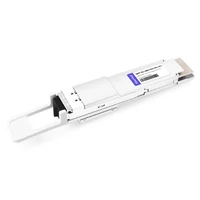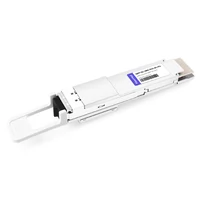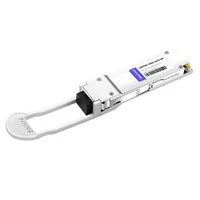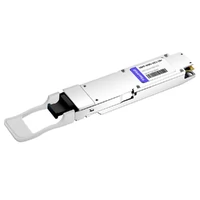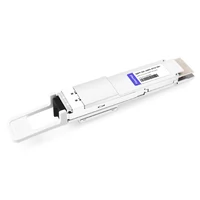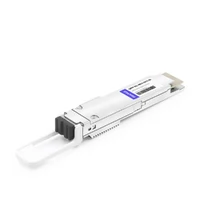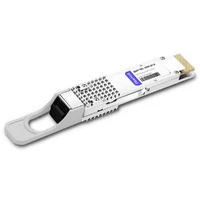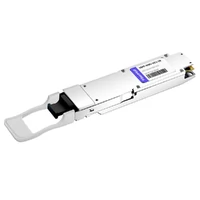

Priya manages the network for a regional healthcare system. She needed to connect her primary data center to a disaster recovery site 80 kilometers away. Her vendors offered two very different paths: a full DWDM line system with transponder shelves, or a pair of coherent 400G ZR modules dropped straight into existing router ports.
The price difference was not small. Neither was the footprint.
That’s the coherent data center interconnect story in a nutshell. Coherent pluggables turned inter-site connectivity from a specialty telecom project into a module you can order like any other transceiver. If you’re planning a DCI link right now, skip the guesswork and talk to our networking experts about which module family fits your distances and budget. Otherwise, here’s the full breakdown.
What Is Data Center Interconnect (DCI)?
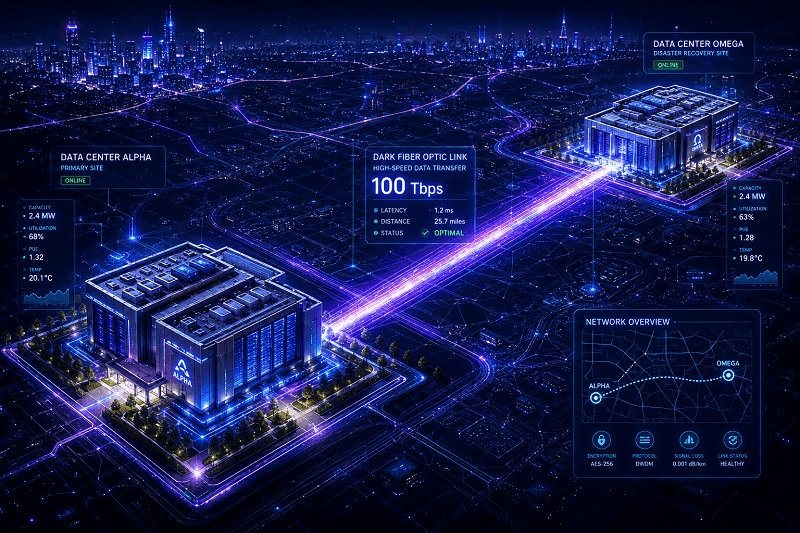
Data center interconnect, or DCI, is the network technology that links two or more geographically separate data centers so they can act as a single system. It moves data between facilities for disaster recovery, workload mobility, multi-site clustering, hybrid cloud, and the growing “scale-across” AI deployments that spread GPU clusters across buildings.
The reasons for building DCI have changed over the years. A decade ago it was mostly disaster recovery and synchronous replication between a primary site and a backup. Today east-west traffic dominates, and teams link facilities to pool compute, share storage, and keep applications running through a regional outage.
Topology matters before optics do. Most DCI links start as simple point-to-point connections between two sites. Add a third or fourth facility and you’re looking at hub-and-spoke, where a central site connects to satellites, or a partial mesh. Full mesh sounds resilient but gets expensive fast, so it’s usually reserved for small, critical environments.
There is also a layer question. Layer 2 DCI extends VLANs across sites with EVPN-VXLAN, which makes live VM migration and broadcast domains possible. Layer 3 DCI routes between sites with BGP or MPLS, which scales better and contains failure domains.
Most design guidance recommends Layer 3 as the default and Layer 2 only when a workload genuinely needs adjacency. Pick the layer model before you pick the optics, because it shapes how much bandwidth and latency your coherent data center interconnect must deliver.
Why Coherent Optics Are the Default for DCI
Direct-detect optics still carry most short-reach traffic inside a building. They top out quickly at DCI distances. A 400G DR4 module reaches 500 meters, FR4 gets to 2 kilometers, and LR4 pushes to 10 kilometers. Beyond that, PAM4 needs amplification and dispersion compensation, and at 400G or 800G it becomes impractical past roughly 10 kilometers.
Coherent detection changes the reach math entirely. The receiver mixes the incoming signal with a local oscillator laser, recovers amplitude, phase, and polarization, and lets a DSP clean up what the fiber did to the signal. That’s why coherent modules work down around -35 to -45 dBm receiver sensitivity, a solid 20 dB better than direct detect.
The practical result: 400G over 80 to 120 kilometers from a single module, no separate transponder, no line system. If you want the full engineering comparison, our coherent vs direct detection guide walks through both technologies side by side.
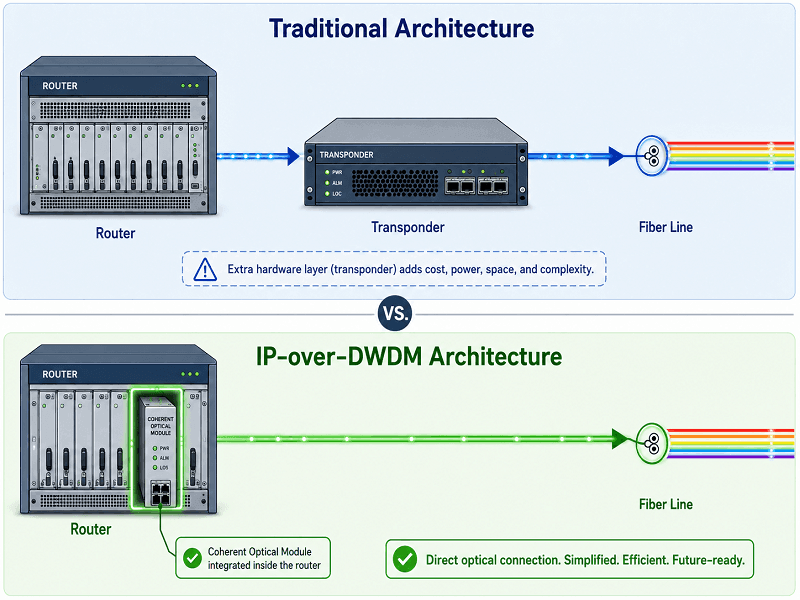
The architecture shift is called IP-over-DWDM. Instead of grey optics feeding a transponder shelf that converts to a colored wavelength, a coherent ZR module in the router sources a DWDM-ready wavelength directly. One layer of equipment disappears. One management plane runs the link.
Coherent pluggables are now the primary engine of DCI growth according to Cignal AI. They lead the market in deployed bandwidth.
Dark Fiber vs DWDM: The Physical-Layer Decision
Before choosing a module, you choose how the fiber itself is handled. This decision drives everything downstream, including which coherent part you can run.
Dark Fiber DCI
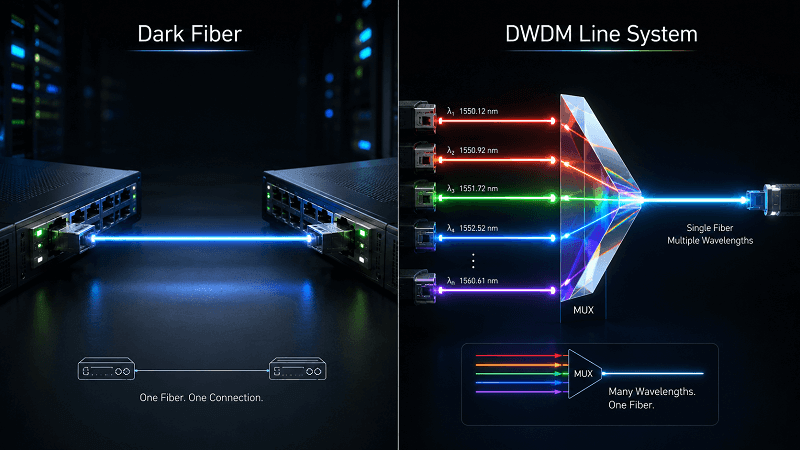
Dark fiber means you lease a fiber pair with no active electronics on it and light it yourself. You own the optics, so you control the budget, the wavelengths, and the monitoring. For a point-to-point metro link, a single dark fiber pair with 400G ZR modules on both ends is about as simple as DCI gets.
Unamplified dark fiber with pluggable EDFAs can carry tens of terabits over links up to roughly 120 kilometers, a model used extensively in access and aggregation networks. The catch is capacity growth. When you need more bandwidth on dark fiber, you either add fiber pairs or introduce a mux.
DWDM DCI
A DWDM line system puts multiple wavelengths on a single fiber pair through multiplexers, amplifiers, and often ROADMs. It scales capacity by adding wavelengths instead of fiber. It also extends reach, because ZR+ and OpenZR+ modules can traverse amplified systems and ROADM hops out to hundreds of kilometers.
| Factor | Dark Fiber | DWDM Line System |
| Optics | You bring them (ZR or ZR+) | You bring them (ZR+), or grey + transponder |
| Capacity scaling | Add pairs or add a mux | Add wavelengths |
| Reach at 400G | ~120 km (400ZR) | 400 to 1,400 km (ZR+/OpenZR+) |
| ROADMs | No | Yes |
| Line system cost | None (passive fiber) | Amplifiers, mux, ROADM gear |
| Best fit | 2 to 3 sites, point-to-point | Rings, mesh, multi-service |
So the pattern is fairly clean. Two sites in the same metro, no future mesh, tight budget? Dark fiber with 400G ZR. Multiple sites, ROADM rings, or reach beyond 120 kilometers? A DWDM line system with ZR+ or OpenZR+. Many operators start on dark fiber and add DWDM when the second or third wavelength shows up. NVIDIA’s DCI topology guide covers this split in detail if you want the reference-level treatment.
The Coherent DCI Module Family: 100G ZR to 800G ZR+
Coherent modules now span a full range of speeds and form factors, and each one has a place in DCI. When you’re choosing DCI optics, the differences come down to reach, power, and which standard they follow. Our complete guide to coherent optical modules is the pillar reference for the whole family.
100G ZR: Coherent at the Edge
100G ZR lives in a QSFP28 and draws only about 5 watts. It runs DP-DQPSK under the IEEE 100GBASE-ZR standard and reaches 80 to 300 kilometers unamplified. For disaster recovery links and edge aggregation, this is the module that brings coherent sensitivity down to a price point small teams can justify.
400G ZR: The DCI Workhorse
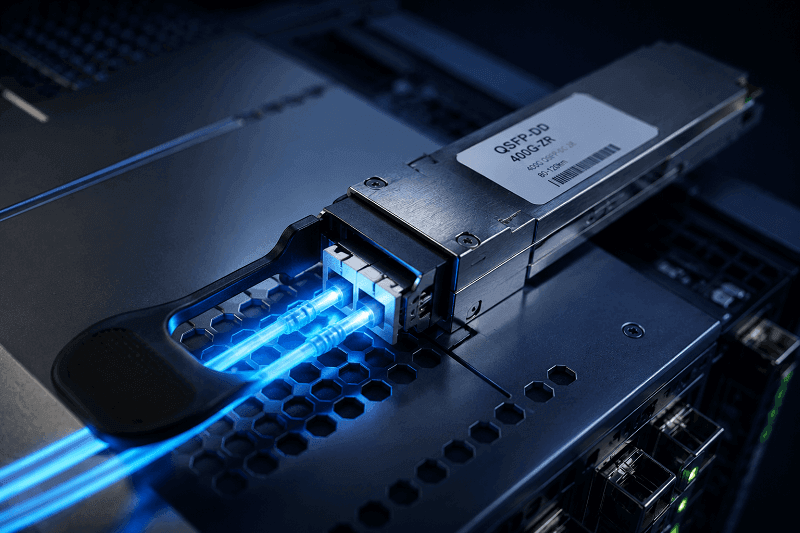
The OIF 400ZR implementation agreement standardized a 400G, single-wavelength, pluggable coherent module aimed squarely at data center interconnect. It runs DP-16QAM around 60 Gbaud with C-band tunability and constant-composition FEC. Reach lands at 80 to 120 kilometers on amplified links and 40 to 80 kilometers unamplified.
That covers most metro DCI, which is why hyperscalers adopted it so quickly. Our 400G ZR QSFP-DD buying guide breaks down the ordering and compatibility details.
ZR+ and OpenZR+: Reach When You Need It
400G ZR stops at roughly 120 kilometers. ZR+ and OpenZR+ extend that with tunable modulation (16QAM down to QPSK), higher launch power, and oFEC. You can run 400G on a clean link or drop to 300G, 200G, or 100G to hold margin on a hard one.
Single-amplifier links reach 400 to 800 kilometers, and multi-amplifier DWDM systems push further. The ZR vs ZR+ vs OpenZR+ comparison is the place to go when the choice comes down to these three.
800G ZR and ZR+: The AI Generation
800ZRx is the emerging standard for AI-scale DCI. It ships in high-power OSFP and QSFP-DD packages, uses L-band wavelengths to add capacity, and targets the scale-across networks that interconnect GPU clusters. Cignal AI expects 800ZRx growth to surpass every earlier coherent generation, with 800G ZR/ZR+ shipments climbing at a 145% compound rate through 2029. Our 800G ZR coherent module guide covers the ramp.
| Module | Form Factor | Rate | DCI Reach | Power | Standard |
| 100G ZR | QSFP28 | 100G | 80-300 km | ~5 W | IEEE 100GBASE-ZR |
| 400G ZR | QSFP-DD / OSFP | 400G | 80-120 km | 15-20 W | OIF 400ZR |
| 400G ZR+ / OpenZR+ | QSFP-DD / OSFP | 100-400G | 400-1,000+ km | 20-25 W | OpenZR+ MSA |
| 800G ZR / ZR+ | OSFP / QSFP-DD | 800G | Metro to AI scale-across | 20+ W | OIF 800ZR |
How to Design and Build a Coherent DCI Link
Building a coherent DCI link comes down to a few decisions made in order: link budget, module selection, form factor, cabling, and compatibility.
Start with the Link Budget
Distance is not the whole story. Fiber loss from connectors, splices, patch panels, and mux insertion loss all eat into the budget, and so does OSNR on amplified spans. A shorter but messy route can be harder to support than a longer clean one.
Estimate total loss, add operational margin, and only then decide which module’s sensitivity you actually need.
Pick the Module by Reach
A reach-driven decision tree works in practice:
- Under 80 km, point-to-point, no ROADMs: standard 400G ZR
- Under 120 km with ROADMs: high-power 400G ZR variant
- Over 120 km, or ring/mesh, or multi-rate needs: ZR+ or OpenZR+
- AI scale-across at 800G: 800G ZR / ZR+
We asked a team at a regional cloud provider about their 40 kilometer AZ-to-AZ link. They quoted direct-detect first because the price looked right. Then they ran the numbers on fiber pairs.
Each 400G direct-detect link needed multiple strands, while a single 400G ZR pair carried the whole thing with margin to spare. They built the DCI with two ZR modules and one fiber pair, and the spare strands went to redundancy.
Form Factor, Power, and Thermal
Not every switch port handles a coherent module. A QSFP-DD faceplate supports roughly 36 ports per 1U at about 15 watts per module, while OSFP accepts the 20 to 25 watt modules used for ZR+ and 800G. Verify the host is qualified for the module’s power class under CMIS before you commit.
A fully loaded faceplate that can’t cool a 20 watt optic is a common failure point. And it shows up exactly when you need the link most.
Cabling and Connectors
Coherent ZR modules use a single single-mode fiber pair with LC duplex connectors. That is one of their quiet advantages: no MPO breakout, no polarity diagram, just two fibers. The parallel direct-detect side is where MPO-16 and MPO-12 come in. Keep connectors clean and fiber routed with diversity; DCI optical budgets are tight, and troubleshooting across sites is slow.
Compatibility and Monitoring
Confirm the module against your switch vendor’s supported list, and check EEPROM, CMIS, and firmware compatibility. Coherent modules expose real telemetry: pre-FEC BER, OSNR, chromatic dispersion, and polarization effects, not just Tx and Rx power.
That telemetry is what lets you catch a degrading link before it drops. It’s the operational advantage that rarely shows up in a spec sheet.
Coherent DCI Economics and Total Cost of Ownership
Module price is the visible number, but it’s not the deciding one. A pair of 400G ZR modules at bulk pricing can cost around $1,000 total. A 400G transponder shelf with optics costs an order of magnitude more, eats rack space, and draws multiples of the power. For metro DCI, pluggable coherent wins on total cost of ownership almost every time.
The savings stack up on several lines. IP-over-DWDM with coherent pluggables cuts equipment, power, and space by 30 to 50% by removing the transponder layer. Dark fiber leases shrink because one coherent wavelength carries what used to need multiple direct-detect pairs. Management simplifies because the router monitors the line optics through the same tools as everything else.
Power deserves a straight look. Coherent modules draw more than direct-detect ones: 15 to 20 watts against 8 to 14 at 400G. But the comparison is misleading on its own, because coherent removes the line-system power that direct-detect links needed at distance.
Factor in the fiber-pair lease, the EDFA rack, and the cooling, and the 36-month cost lands in coherent’s favor for most metro DCI.
The market is betting on this trajectory. The [global DCI market was valued at roughly 15.6 billion in 2025] and is projected to reach 37.4 billion by 2032. Dell’Oro expects the optical transport market to grow 16% in 2026 to over $18 billion, with DCI leading the way.
Our coherent module pricing guide has the cost data in one place.
Coherent DCI for AI: Scale-Out, Scale-Across, and 800G
AI changed DCI from a capacity question into a topology one. Scale-up grew a single cluster inside one building. Scale-out spread compute across racks and then across a campus. Scale-across goes further: GPU clusters physically distributed across metro distances, connected as one logical training fabric.
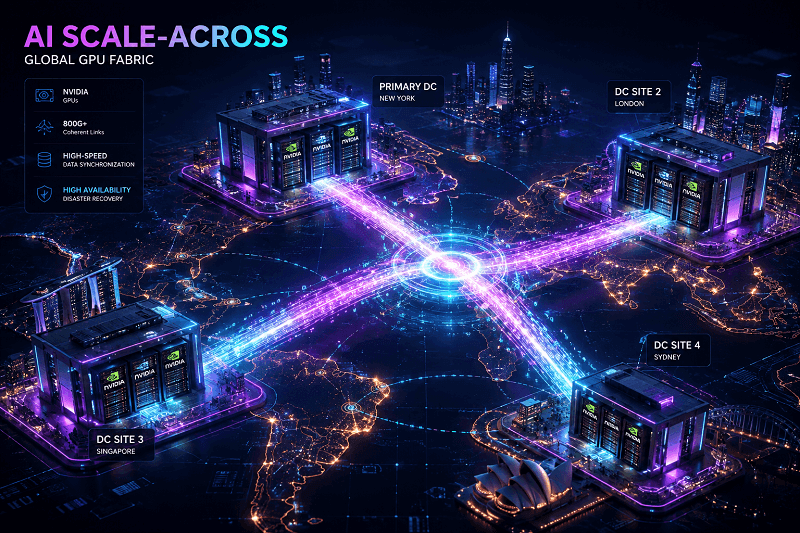
That is where 800G coherent DCI comes in. Hyperscalers are deploying 800ZR+ pluggables for scale-across now, with Meta among the first to run large deployments and Microsoft operating a large 400G ZR/ZR+ footprint. Nokia projects the 800G coherent interface market will pass one million units a year by 2030.
Datacom optical component revenue hit a record $7.7 billion in Q1 2026, more than double the prior year. High-speed 400G+ module shipments climbed 145%.
The optics requirement is brutal. AI training wants hundreds of gigabits per connection between sites, low latency, and no packet loss. A single 800G coherent wavelength on one fiber pair delivers that, where direct-detect would need parallel lanes and multiple pairs.
L-band capacity and 1.6T coherent are already on the roadmap to keep up. If you’re designing AI-scale DCI, the 800G ZR guide is where to start.
Coherent Data Center Interconnect FAQ
What is data center interconnect (DCI)?
DCI is the technology that links two or more geographically separate data centers so they can share resources and operate as a single environment. It supports disaster recovery, workload mobility, multi-site clustering, and hybrid cloud.
How far can 400G ZR reach?
The OIF 400ZR standard supports 80 to 120 kilometers on amplified links and 40 to 80 kilometers unamplified. That covers most metro DCI applications.
Dark fiber vs DWDM: which is better?
Dark fiber suits point-to-point links up to roughly 120 km with full control and low latency. DWDM scales capacity on the same fiber and extends reach with ZR+/OpenZR+, but costs more in line-system equipment.
Does 400G ZR need amplification?
Not always. Unamplified 400G ZR works over dark fiber to roughly 40 to 80 kilometers. Beyond that, or with ROADMs in the path, you need EDFA amplification or a ZR+ variant.
What is the difference between ZR and ZR+ for DCI?
400G ZR is a fixed-configuration standard module for point-to-point metro links. ZR+ and OpenZR+ add tunable modulation, higher launch power, and oFEC, which extend reach to hundreds of kilometers and add rate flexibility.
How many fiber pairs does coherent DCI need?
One. Coherent modules use a single single-mode fiber pair with LC duplex connectors, which is a major simplification over parallel direct-detect modules.
Is coherent worth it for DCI links under 10 km?
Usually not. Direct-detect FR4 and LR4 modules cover links up to 10 km at lower cost and power. Coherent becomes compelling past that boundary, and at 400G/800G the crossover is getting shorter.
Build Your DCI Link with Confidence
Coherent data center interconnect has moved from specialist telecom gear to a standard ordering decision. Two sites and a dark fiber pair in the metro? 400G ZR. Longer reach, ROADMs, or multi-rate needs? ZR+ or OpenZR+. AI scale-across at 800G? The 800ZRx generation is ready.
Start with the link budget, not the module. Pick dark fiber or DWDM, size the module by reach, check the power class against your switch, and use the telemetry once it is live. That sequence covers the majority of real deployments.
Sizing a coherent DCI link for your own network? Send us your distances and link budget and the FiberMall engineering team will map them against the ZR family and DWDM options side by side. Talk to our networking experts, or browse our DWDM transceiver lineup for the short-reach side of the equation.
Related Products:
-
 OSFP-800G-DCO-ZR+-HTx 800G Coherent High TX Power OSFP DCO ZR+ C-band Tunable Optical Transceiver Module
$12000.00
-
OSFP-800G-DCO-ZR-HTx 800G Coherent High TX Power OSFP DCO ZR C-band Tunable Optical Transceiver Module
$11000.00
-
QSFP-DD-800G-DCO-ZR+-HTx 800G Coherent High TX Power QSFP-DD DCO ZR+ C-band Tunable Optical Transceiver Module
$12000.00
-
QSFP-DD-800G-DCO-ZR-HTx 800G Coherent High TX Power QSFP-DD DCO ZR C-band Tunable Optical Transceiver Module
$11000.00
-
QSFP-DD-400G-DCO-ZR+-HTx 400G Coherent High TX Power QSFP-DD DCO OpenZR+ C-band Tunable Optical Transceiver Module
$5500.00
-
QSFP-DD-400G-DCO-ZR-HTx 400G Coherent High TX Power QSFP-DD DCO ZR C-band Tunable Optical Transceiver Module
$5200.00
-
QSFP28-100G-DCO-ZR 100G Coherent QSFP28 DCO C-band Tunable Optical Transceiver Module
$3600.00
-
OSFP-400G-DCO-ZR+ 400G Coherent OSFP-DCO ZR+ C-band Tunable Optical Transceiver Module
$7000.00
-
QSFP-DD-400G-DCO-ZR+ 400G Coherent QSFP-DD DCO C-band Tunable Optical Transceiver Module
$4680.00
-
QSFP-DD-400G-DCO-ZR 400G Coherent QSFP-DD DCO C-band Tunable Optical Transceiver Module
$4550.00
-
QSFP-DD-100G-DCO 100G Coherent QSFP-DD DCO C-band Tunable Optical Transceiver Module
$5500.00
-
OSFP-400G-DCO-ZR 400G Coherent OSFP-DCO ZR C-band Tunable Optical Transceiver Module
$7000.00