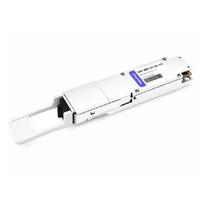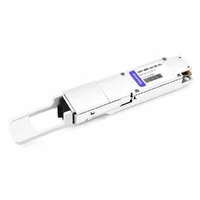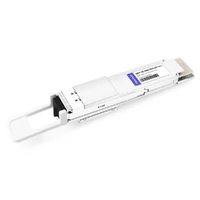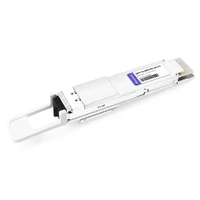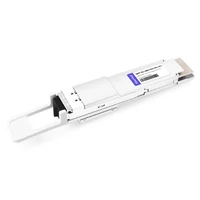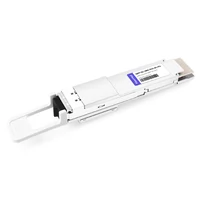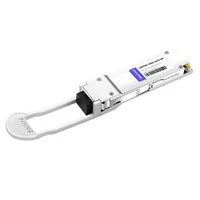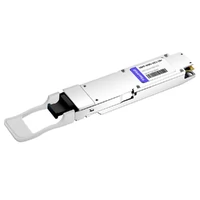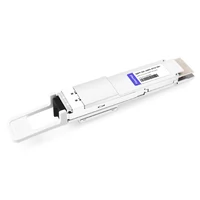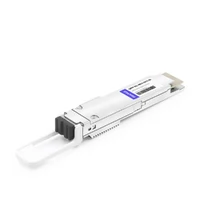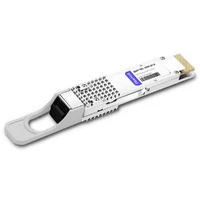

Priya runs transport for a regional cloud provider, and she learned about coherent optical module standards the hard way. She ordered “OpenZR+” 400G modules from two vendors to replace a pair of transponder shelves, assuming the name meant they would talk to each other. They didn’t. Both modules were OpenZR+ in name. One was running a mode the other didn’t support, and her supposedly interoperable upgrade turned into a week of firmware wrangling.
Her mistake wasn’t the equipment. It was assuming one label covered the whole picture.
Here’s the part vendor pages skip: a coherent module isn’t governed by a single standard. It sits inside a layered stack of them, and each layer does a different job. A module can nail the mechanical form factor, advertise a 400GbE client, and still break interoperability on the optical line because its DSP doesn’t follow the OIF 400ZR agreement. That’s exactly the trap Priya hit.
This guide untangles the stack. You’ll learn what each coherent optical module standard actually guarantees, what it leaves open, and how to tell which modules will truly interoperate before you buy. We’ll cover form factors, OIF 400ZR and 800ZR, the OpenZR+ and OpenROADM MSAs, and the CMIS management layer, then close with a roadmap to 1.6T. If you’re weighing which coherent family fits your network right now, our complete guide to coherent optical modules is the place to start, and our engineers are happy to help with a specific deployment.
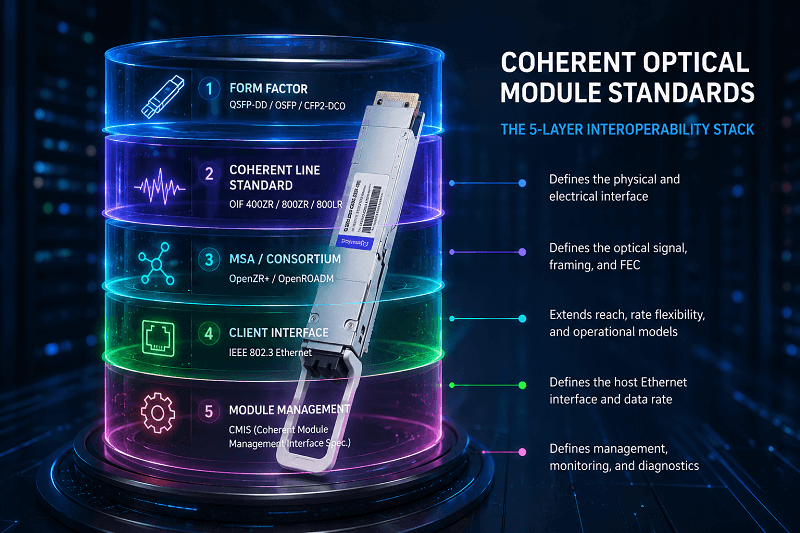
The Coherent Standards Stack: Five Layers, One Module
Every coherent pluggable sits under at least five standards layers. They work together, but they’re maintained by different bodies and solve different problems:
1. Form factor, which defines the physical and electrical interface (QSFP-DD, OSFP, CFP2-DCO).
2. The coherent line standard, which defines the optical signal and framing (OIF 400ZR, OIF 800ZR).
3. The MSA or consortium program, which extends reach and rate flexibility (OpenZR+, OpenROADM).
4. The client-side Ethernet standard, which defines the host interface (IEEE 802.3ct and the wider 802.3 family).
5. Module management, which defines how the host reads and configures the module (CMIS and its coherent extensions).
Understanding the stack changes how you read a spec sheet. When a module is described as “400ZR-compliant,” that’s layer 2. When it’s “OpenZR+,” that’s layer 3. When the data sheet lists “CMIS 5.3,” that’s layer 5. Most compatibility problems in the field trace back to a module that satisfies one layer and quietly fails another, which is a useful lens for every section below.
Layer 1: Form Factors, QSFP-DD, OSFP, and CFP2-DCO
The form factor is the physical shell and electrical edge connector. It decides which ports the module fits, how much power it can draw, and how many ports fit in a rack unit.
Three form factors carry nearly all coherent modules today:
- QSFP-DD, the workhorse. Eight electrical lanes, up to roughly 24 watts, and 32 to 36 ports per 1RU switch. QSFP-DD dominates 400G deployments, and QSFP-DD800 extends it to 800G.
- OSFP, built for heat. Eight lanes with a taller body and integrated thermal solution. It’s the preferred home for high-power 800G modules and the likely path to 1.6T via OSFP224 and OSFP-XD.
- CFP2-DCO, the legacy telecom option. Bigger, higher launch power, room for a larger DSP. You’ll still find it in transponder shelves and long-haul line cards, though pluggables are eating that market.
The form factor guarantees physical compatibility and nothing more. A QSFP-DD module will always seat in a QSFP-DD port. Whether it interoperates on the line side is a separate question, answered by the next layers. Our QSFP-DD 400G/800G guide digs into the mechanical and thermal details if you’re choosing between form factors.
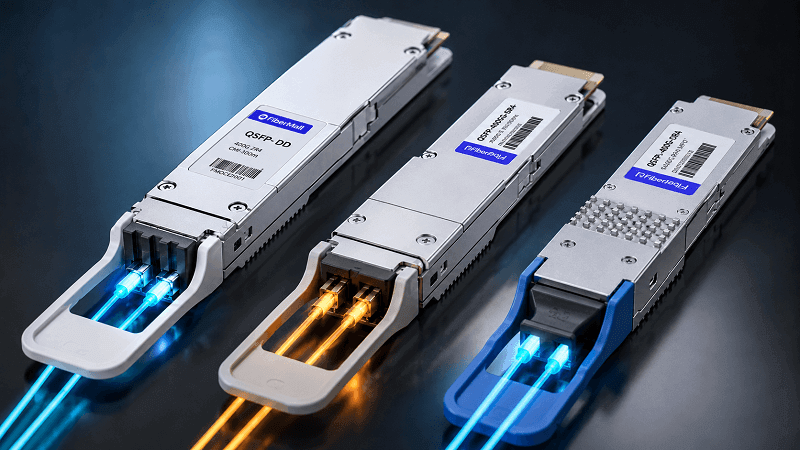
Layer 2: Coherent Line Standards, OIF 400ZR, 800ZR, and 800LR
The line standard is what most engineers mean when they talk about coherent standards. These are Implementation Agreements published by the Optical Internetworking Forum, or OIF, and they define the optical signal on the fiber.
OIF 400ZR
OIF 400ZR is the foundation. Released in March 2020 and mirrored by IEEE 802.3ct (400GBASE-ZR), it defines a single-wavelength 400G coherent interface for data center interconnect. The specifics: DP-16QAM at roughly 60 Gbaud, concatenated FEC, a 400GbE client, C-band tunability, and reach of 80 to 120 kilometers on an amplified single span. Power lands around 15 watts. The whole design leans toward simplicity, because the point of 400ZR is low-cost, dependable, point-to-point DCI. Our 400G ZR QSFP-DD buying guide covers the module side in depth.
What 400ZR guarantees, and this matters, is multi-vendor interoperability. Because the signal format, FEC, and framing are fixed, a 400ZR module hosted in a Cisco router talks to a 400ZR module hosted in a Juniper or Arista one. That guarantee is the entire reason coherent pluggables replaced proprietary line systems in DCI.
OIF 800ZR and 800LR
OIF 800ZR, released October 2024, does the same job at 800G. DP-16QAM at 118.2 Gbaud, OFEC with 15.3 percent overhead and 11.6 dB net coding gain, 150 GHz channel spacing, and a design target under 40 watts. It carries 1x800GbE, 2x400GbE, 4x200GbE, or 8x100GbE client signals. The first multi-vendor 800ZR demonstration ran at ECOC 2024, and the ecosystem shipped through 2025 and 2026 in QSFP-DD800 and OSFP form factors.
OIF 800LR is the newer short-reach addition, tuned for links of 10 kilometers or less. It supports 800GE or 2x400GE at lower power and latency than full ZR, which makes it interesting for intra-data-center and campus coherent links where the distance is short but the capacity demand is brutal.
The OIF standards guarantee line interoperability at a fixed rate. What they don’t do is flex the rate. A 400ZR is 400G, full stop. For rate-reach flexibility you move up a layer.
Layer 3: MSA Programs, OpenZR+ and OpenROADM
Multi-source agreements (MSAs) take the OIF base and add flexibility. Two matter for coherent modules: OpenZR+ and OpenROADM.
What Is OpenZR+?
OpenZR+ is a multi-source agreement formed in May 2020 by seven founding companies, including Cisco, Juniper, Inphi (now part of Marvell), and NTT. It builds on OIF 400ZR and adds a stronger open FEC (oFEC) for higher net coding gain, which translates into longer reach. The agreement supports flexible line rates from 100G up through 400G, plus a 4x100GE multiplexing mode, and reach of 480 to over 1,000 kilometers with amplification. Version 2.0, published in July 2022, added parameters for 75 GHz grid spacing.
For 800G, the OpenZR+ MSA published a white paper in 2025 rather than a separate spec, pointing to the OIF 800ZR agreement and the OpenROADM 800G W-port specification. The result is a flexible 800G mode with interoperable probabilistic constellation shaping (PCS), reaching about 450 kilometers at 800G, 900 at 600G, and 1,800 at 400G. The OpenZR+ MSA documents page holds the current specs, and the 800G white paper explains the PCS approach.
What Is OpenROADM?
OpenROADM is a carrier-grade MSA founded in 2016 and spearheaded by AT&T. It’s not just a pluggable spec. It defines a whole disaggregated transport architecture, with ROADMs, transponders, and pluggable optics as separately controlled functions managed through open APIs and NETCONF/YANG data models. The goal is simple: let an operator mix modules and line systems from different vendors inside the same ROADM network without being locked in.
On the module side, OpenROADM’s W-port digital specification defines framing and interoperable PCS. Version 6.0, released in December 2023, covered 400G, 600G, and 800G, with optical spec updates in April 2024 and March 2025. At OFC 2025, members demonstrated the first multi-vendor 800G pluggable ROADM link, running CFP2-DCO and QSFP-DD optics with PCS. For service-provider networks, OpenROADM is usually the layer-three answer, because it’s built around OTN clients and ROADM traversal rather than pure Ethernet DCI.
If the difference between OIF, OpenZR+, and OpenROADM still feels blurry, our 400G ZR vs ZR+ vs OpenZR+ comparison walks the same trade-offs at the buying-decision level.
Layers 4 and 5: Client Ethernet and CMIS Management
Two more layers round out the stack, and they’re the ones most troubleshooting tickets trace back to.
Layer 4: Client-Side Ethernet
The client layer defines how the module talks to the host router or switch. IEEE 802.3ct defines 400GBASE-ZR as the client for 400ZR. For 800ZR, the client can be 800GE, 400GE, 200GE, or 100GE depending on how the module maps the aggregate bandwidth. This layer matters because it decides whether a module slots into your existing faceplate and which switch generations can drive it. A module that nails the optical line but exposes a client your hardware doesn’t support is a paperweight.
Layer 5: CMIS and C-CMIS
CMIS, the Common Management Interface Specification, is the OIF standard for reading and controlling pluggable modules over the two-wire management interface. It handles power classes, DSP status, optical performance monitoring, and mode selection. The current version is CMIS 5.3, with 5.4 anticipated within 2026, and the OIF’s coherent extensions, C-CMIS, are at 1.4 with 1.5 on the way. CMIS is backward compatible, which is why a modern host can usually manage an older module.
The feature that trips up newcomers is APPSEL, short for application select. A single DCO module can advertise the set of applications it supports, and the host picks one, for instance 400ZR mode versus an OpenZR+ mode. Choose the wrong APPSEL code and the module runs in a mode that doesn’t match the far end, which is precisely the failure Priya hit. Media ID tables, maintained in SFF-8024, list the codes for 400ZR, 800ZR variants, and OpenZR+ modes so you can confirm a module supports what its spec sheet claims.
Interoperability in Practice: What “Multi-Vendor” Really Means
The word “interoperable” gets thrown around loosely, so here’s a more honest tiering based on what each layer actually delivers:
- Tier 1, fully standardized. OIF 400ZR. Fixed mode, demonstrably interoperable across DSP vendors. If both ends are true 400ZR, they connect.
- Tier 2, MSA-defined with caveats. OpenZR+ within a tested mode envelope. Interoperability is proven, but it can depend on matching firmware, DSP generation, and operating mode. The OpenZR+ MSA’s LightRiver tests in 2023 validated 400G modules from five vendors on Cisco 8201 and Juniper PTX10001-36MR routers, clean post-FEC at receiver OSNR of 24 dB or below, over a 75-kilometer DCI span and a 430-kilometer metro link. That’s real, but it’s interoperability within a defined envelope, not a blanket promise.
- Tier 3, matched pair. High-performance ZR+ and PCS modes beyond the tested envelope. You get the reach, but you may need matched pairs from one vendor or at least matching firmware.
- Tier 4, single vendor. Proprietary extended modes. Fully functional, zero interoperability. This is the trap in a lot of “ZR+” marketing, and the reason Priya’s two “OpenZR+” modules refused to cooperate.
So how do you verify before you buy? Check which mode a module implements against the applicable IA or MSA. Read the CMIS APPSEL codes and media IDs rather than trusting the marketing name. And for anything past 120 kilometers, ask whether the far-end vendor has tested against your near-end vendor. Juniper’s coherent standards and interoperability reference is a solid, vendor-neutral place to confirm the mode tables.
Which Coherent Optical Module Standard Fits Which Network?
Putting the stack to work, here’s the standard-to-network mapping that settles most decisions.
| Standard | Best Fit | Reach | Client | Form Factors |
| OIF 400ZR | Point-to-point DCI | 80-120 km | 400GbE | QSFP-DD, OSFP |
| OIF 800ZR | High-capacity DCI | 80-120 km | 800G/400G/200G/100G | QSFP-DD800, OSFP |
| OIF 800LR | Intra-DC, campus | Up to 10 km | 800GE / 2x400GE | QSFP-DD, OSFP |
| OpenZR+ | Metro, regional, mixed rates | 480-1,000+ km | 100G-400G (800G with PCS) | QSFP-DD, OSFP |
| OpenROADM | Carrier ROADM, OTN | Metro to long-haul | 100G/200G/400G + OTN | CFP2-DCO, QSFP-DD |
Three questions settle the choice. First, how far? Under 120 kilometers, point to point, and OIF ZR is the cheap, interoperable answer. Past that, you’re in ZR+ or OpenROADM territory. Second, do you need rate flexibility? If one fiber has to carry 100G and 400G services, OpenZR+ is the only clean way to do it. Third, whose network is it? A service provider running OTN and ROADMs should be looking at OpenROADM, not a data-center-centric ZR part.
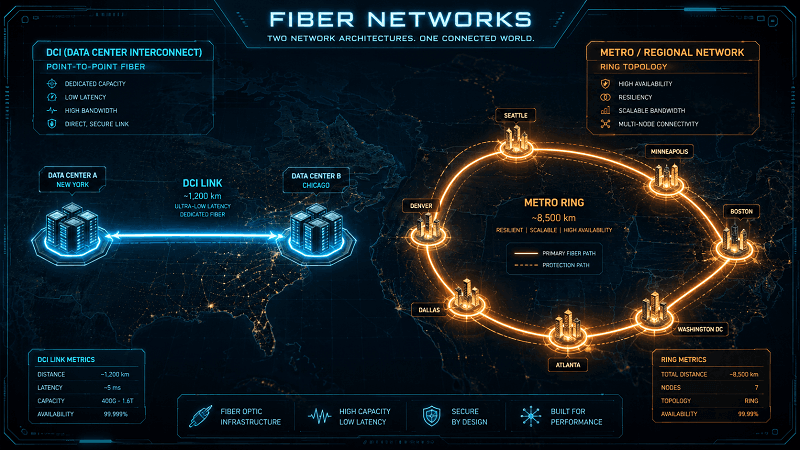
There’s a mini-story here from our own deployments. A hyperscaler customer ran four data centers in a metro ring, roughly 140 kilometers between the farthest pair. They started with 400G ZR on the short links and OpenZR+ on the long ones, but managing two standards in one ring got old fast. They standardized on OpenZR+ everywhere, ran the short links at 400G and the long ones at 300G, and never touched the hardware again. The rate-reach flexibility isn’t a nice-to-have once you’ve lived with it; it’s the whole point.
For a deeper look at the DCI side of this, our coherent data center interconnect guide covers link design, dark fiber versus amplified DWDM, and cabling.
The Coherent Standards Roadmap: 800G Today, 1.6T Next
The standards work is not done, and that’s worth knowing before you commit to a platform. 800G ZR/ZR+ is the fastest-growing coherent segment, with Cignal AI projecting a 145% compound annual growth rate through 2029. The OIF is already working beyond it, on 800LR, 1600ZR, 1600ZR+, and CL (C-band L-band) interfaces. Expect 200G-baud lanes and L-band expansion to be the levers.
For a buyer today, the practical takeaway is form-factor-forward. Choose a platform and module that leave an upgrade path. OSFP and QSFP-DD800 faceplates are the ones positioned for 800G now and 1.6T later; a QSFP-DD 400G-only faceplate is a harder place to be in three years. Our 800G ZR/ZR+ guide and the coherent optical module guide both walk through this upgrade logic if you want the longer version.

FAQ: Coherent Optical Module Standards
What are the coherent optical module standards?
Coherent optical module standards are a layered set of specifications governing pluggable coherent transceivers. The layers cover form factor (QSFP-DD, OSFP, CFP2-DCO), coherent line interface (OIF 400ZR, 800ZR), rate-reach extension (OpenZR+, OpenROADM), client Ethernet (IEEE 802.3), and management (CMIS). Each layer is defined by a different body and guarantees different things.
What is the OIF 400ZR standard?
OIF 400ZR is an Optical Internetworking Forum Implementation Agreement for a single-wavelength 400G coherent interface used in data center interconnect. It specifies DP-16QAM at about 60 Gbaud, concatenated FEC, reach of 80 to 120 kilometers, and a 400GbE client, with multi-vendor interoperability as its defining promise.
What is OpenZR+?
OpenZR+ is a multi-source agreement that extends OIF 400ZR with open FEC and flexible line rates from 100G to 400G. It targets metro and regional links of 480 to more than 1,000 kilometers, and its 800G white paper adds interoperable PCS modes referencing OIF 800ZR and OpenROADM specifications.
What is OpenROADM?
OpenROADM is a carrier-grade multi-source agreement, founded in 2016 under AT&T’s leadership, that defines a disaggregated optical transport architecture. It specifies interoperable ROADMs, transponders, and pluggable optics with open NETCONF/YANG management, plus W-port digital and optical specifications for 100G to 800G.
What is CMIS in optical modules?
CMIS, the Common Management Interface Specification, is the OIF standard for reading and configuring pluggable optical modules over the two-wire management interface. It controls power class, DSP status, optical performance monitoring, and application selection (APPSEL). The current version is 5.3, with 5.4 expected within 2026.
Is 400ZR interoperable with OpenZR+?
Not by default. A 400ZR module and an OpenZR+ module use different FEC and framing, so they can’t carry traffic together in their native modes. Some modules support both modes and can be switched between them via CMIS APPSEL, but both ends must be configured to the same mode for the link to come up.
Conclusion
Coherent optical module standards look intimidating until you see them as layers. Form factor decides what the module fits. OIF 400ZR and 800ZR guarantee interoperable line performance at a fixed rate. OpenZR+ and OpenROADM add reach and flexibility, each for a different kind of network. Client Ethernet and CMIS decide whether your host can actually drive and manage the thing.
The one habit that will save you real money is checking every layer before you buy. Verify the form factor, confirm the exact mode against the applicable standard, read the CMIS APPSEL codes, and ask the interoperability question out loud: tested against whom, in which mode, over how far? “OpenZR+” on the box is a starting point, not an answer.
If you’re planning a coherent link, our 400G ZR buying guide and 100G ZR guide break down the module choices, and the coherent vs direct-detection comparison helps you confirm coherent is even the right answer for your distances. When you’re ready to spec something, talk to our networking experts and we’ll help you match a standard and module to your actual fiber. The standards stack is navigable, and the payoff for getting it right is a link that just works.
Related Products:
-
 OSFP-800G-DCO-ZR+-HTx 800G Coherent High TX Power OSFP DCO ZR+ C-band Tunable Optical Transceiver Module
$12000.00
-
OSFP-800G-DCO-ZR-HTx 800G Coherent High TX Power OSFP DCO ZR C-band Tunable Optical Transceiver Module
$11000.00
-
QSFP-DD-800G-DCO-ZR+-HTx 800G Coherent High TX Power QSFP-DD DCO ZR+ C-band Tunable Optical Transceiver Module
$12000.00
-
QSFP-DD-800G-DCO-ZR-HTx 800G Coherent High TX Power QSFP-DD DCO ZR C-band Tunable Optical Transceiver Module
$11000.00
-
QSFP-DD-400G-DCO-ZR+-HTx 400G Coherent High TX Power QSFP-DD DCO OpenZR+ C-band Tunable Optical Transceiver Module
$5500.00
-
QSFP-DD-400G-DCO-ZR-HTx 400G Coherent High TX Power QSFP-DD DCO ZR C-band Tunable Optical Transceiver Module
$5200.00
-
QSFP28-100G-DCO-ZR 100G Coherent QSFP28 DCO C-band Tunable Optical Transceiver Module
$3600.00
-
OSFP-400G-DCO-ZR+ 400G Coherent OSFP-DCO ZR+ C-band Tunable Optical Transceiver Module
$7000.00
-
QSFP-DD-400G-DCO-ZR+ 400G Coherent QSFP-DD DCO C-band Tunable Optical Transceiver Module
$4680.00
-
QSFP-DD-400G-DCO-ZR 400G Coherent QSFP-DD DCO C-band Tunable Optical Transceiver Module
$4550.00
-
QSFP-DD-100G-DCO 100G Coherent QSFP-DD DCO C-band Tunable Optical Transceiver Module
$5500.00
-
OSFP-400G-DCO-ZR 400G Coherent OSFP-DCO ZR C-band Tunable Optical Transceiver Module
$7000.00