

- FiberMall
FiberMall
Answered on 9:55 am
There are two form factors defined for 400G optical modules and cables:
- The OSFP: The OSFP stands for “Octal Small Form-factor Pluggable”. It is described as an “Octal” module because the electrical interface of an OSFP connector consists of 8 electrical lanes, running at 50Gb/s each, for a total bandwidth of 400Gb/s.
- The QSFP-DD: The QSFP-DD stands for “Quad Small Form-factor Pluggable (QSFP) – Double Density (DD)”. The electrical interface of a QSFP-DD connector also has 8 electrical lanes, running at 50Gb/s each, for a total bandwidth of 400Gb/s. The QSFP-DD form factor is similar to the QSFP form factor, except a second row of electrical contacts has been added to increase the number of high-speed electrical lanes from 4 (in a QSFP) to 8 (in a QSFP-DD).
People Also Ask
USFP AI Factory Networking: How 400G/Lane Optics Reshape the AI Fabric
USFP (Ultra-Dense Small Form Factor Pluggable) is the new optical transceiver form factor from NVIDIA and Cisco that brings 400 Gb/s-per-lane electrical signaling to AI factory networking. Announced at OCP Global Summit 2026, it packs 16 full-duplex lanes into an OSFP-sized footprint, roughly 6.4 Tb/s per module, with a published path
1.6T and 3.2T Optical Transceivers: The Next-Gen Speed Guide for AI Data Centers
1.6T optical transceivers are emerging as the next step in high-speed connectivity for AI data centers, while 3.2T remains an early-stage technology direction. For hyperscale computing clusters, these architectures can increase bandwidth per port and support continued network scaling. Actual latency and energy-efficiency benefits depend on the transceiver design, host
USFP vs XPO vs OSFP-XD: The Next-Gen Pluggable Form Factor War
USFP, XPO, and OSFP-XD are three next-generation pluggable optical form factors designed to address growing bandwidth demands in AI networks, from 1.6T and 3.2T to 12.8T and beyond. The short answer: OSFP-XD has commercially listed 1.6T modules, XPO is being developed as a high-density, liquid-cooled solution with commercial deployment anticipated
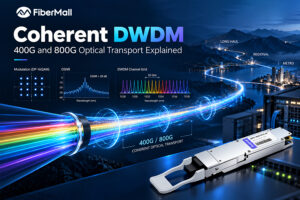
Coherent DWDM: 400G and 800G Optical Transport Explained
Consider an illustrative 640 km regional route between two carrier hotels. Rafael’s team needs a fourfold capacity increase, and a proposal promises that moving from 400G to 800G per wavelength will deliver it. The optical modules may be capable of 800G, but the grid tells a different story. Under the
4-Node DGX Spark Cluster Setup: From Hardware BOM and Cabling to First Boot and 200G Interconnect
Building a 4-node NVIDIA DGX Spark cluster involves more than simply connecting four powerful AI systems. The real challenges often lie in the details: a machine without native USB-A ports, a switch port that refuses to establish a link, or a firmware update that fails unexpectedly and requires system recovery. This
Related Articles

800G SR8 and 400G SR4 Optical Transceiver Modules Compatibility and Interconnection Test Report
Version Change Log Writer V0 Sample Test Cassie Test Purpose Test Objects:800G OSFP SR8/400G OSFP SR4/400G Q112 SR4. By conducting corresponding tests, the test parameters meet the relevant industry standards, and the test modules can be normally used for Nvidia (Mellanox) MQM9790 switch, Nvidia (Mellanox) ConnectX-7 network card and Nvidia (Mellanox) BlueField-3, laying a foundation for

USFP AI Factory Networking: How 400G/Lane Optics Reshape the AI Fabric
USFP (Ultra-Dense Small Form Factor Pluggable) is the new optical transceiver form factor from NVIDIA and Cisco that brings 400 Gb/s-per-lane electrical signaling to AI factory networking. Announced at OCP Global Summit 2026, it packs 16 full-duplex lanes into an OSFP-sized footprint, roughly 6.4 Tb/s per module, with a published path

DWDM Network Design: Link Budget & Planning Guide
A 40-wavelength link on a 100 GHz grid ran cleanly for two years. Then the team expanded it to 96 wavelengths on a 50 GHz grid, and channels near the middle of the band began showing errors. Nothing in the design document explained why. The document had a power budget.

1.6T and 3.2T Optical Transceivers: The Next-Gen Speed Guide for AI Data Centers
1.6T optical transceivers are emerging as the next step in high-speed connectivity for AI data centers, while 3.2T remains an early-stage technology direction. For hyperscale computing clusters, these architectures can increase bandwidth per port and support continued network scaling. Actual latency and energy-efficiency benefits depend on the transceiver design, host

USFP vs XPO vs OSFP-XD: The Next-Gen Pluggable Form Factor War
USFP, XPO, and OSFP-XD are three next-generation pluggable optical form factors designed to address growing bandwidth demands in AI networks, from 1.6T and 3.2T to 12.8T and beyond. The short answer: OSFP-XD has commercially listed 1.6T modules, XPO is being developed as a high-density, liquid-cooled solution with commercial deployment anticipated
Coherent DWDM: 400G and 800G Optical Transport Explained
Consider an illustrative 640 km regional route between two carrier hotels. Rafael’s team needs a fourfold capacity increase, and a proposal promises that moving from 400G to 800G per wavelength will deliver it. The optical modules may be capable of 800G, but the grid tells a different story. Under the

4-Node DGX Spark Cluster Setup: From Hardware BOM and Cabling to First Boot and 200G Interconnect
Building a 4-node NVIDIA DGX Spark cluster involves more than simply connecting four powerful AI systems. The real challenges often lie in the details: a machine without native USB-A ports, a switch port that refuses to establish a link, or a firmware update that fails unexpectedly and requires system recovery. This
Related Posts
- Impact of Active Electrical Cables (AEC) on Optical Module Replacement
- The Differences Between MPO and MTP
- Cisco’s Second Dip into Silicon Photonics
- OCP EMEA 2025: FiberMall Demonstrates 800G Pluggable Optical Modules with Immersion Cooling Systems
- Understanding DAC and AOC Cables for Data Centers: Key Differences and Uses
