


There are a few different ways to do this (as discussed earlier in this document), summarized below.
i) OSFP-400G-DR4 (or QDD-400G-DR4) to 4 x QSFP-100G-DR over 500m SMF
Connect up to 4 x QSFP-100G-DRs to a single OSFP-400G-DR4 (or QDD-400G-DR4). The QSFP-100G-DR can plug into any Arista 100G QSFP port.

ii) OSFP-400G-XDR4 (or QDD-400G-XDR4) to 4 x QSFP-100G-FR over 2km SMF
Connect up to 4 x QSFP-100G-FRs to a single OSFP-400G-XDR4 (or QDD-400G-XDR4). The QSFP-100G-FR can plug into any Arista 100G QSFP port.

iii) OSFP-400G-PLR4 (or QDD-400G-PLR4) to 4 x QSFP-100G-LR over 10km SMF
Connect up to 4x QSFP-100G-LRs to a single OSFP-400G-PLR4 (or QDD-400G-PLR4). The QSFP-100G-LR can plug into any Arista 100G QSFP port.

iv) H-O400-4Q100-xM (or H-D400-4Q100) to 4x QSFP100 ports with Active Copper DACs, 1m-5m
Connect up to 4x 100G QSFP ports to a single 400G OSFP or QSFP-DD port. The QSFP end of the active breakout DAC includes a gearbox chip that converts 2x50G PAM-4 electrical signals into a 4x 25G NRZ interface, the modulation format used in legacy 100G QSFP ports.

v) OSFP-400G-2FR4 to 2 x QSFP-100G-CWDM4 over 2km SMF
If an OSFP port is configured for 2 x 100G (i.e. 200G total bandwidth), the OSFP-400G-2FR4 module can be used to connect to 2 x QSFP-100G-CWDM4 transceivers over duplex single-mode fibers.
Configuring an OSFP port for 200G total bandwidth means each of the 8 electrical lanes to/from the OSFP operates at 25Gb/s NRZ, the same modulation format used in legacy 100G QSFP ports.

vi) OSFP-400G-SRBD (or QDD-400G-SRBD) to 4x QSFP-100G-SRBD or 4x 100G-SR1.2 QSFPs over 100m MMF
Connect up to 4x QSFP-100G-SRBD, or 4x 100G-SR1.2 QSFPs to a single 400G-BIDI module.

vii) OSFP-400G-SR8 (or QDD-400G-SR8) to 2 x QSFP-100G-SR4 QSFPs over 100m MMF
If an OSFP port is run at 200G total bandwidth, the OSFP-400G-SR8 module can be used to connect to 2 x QSFP-100G-SR4 transceivers using a multimode breakout cable.

viii) Passive DAC breakout cable using CAB-O-2Q-400G-xM / CAB-O-2Q-200G-xM or CAB-D-2Q-400G-xM / CAB-D-2Q-200G-xM
If the OSFP or QSFP-DD port is run at 200G total bandwidth, a passive DAC breakout cable can be used to connect an OSFP or QSFP-DD port into 2x 100G QSFP ports.

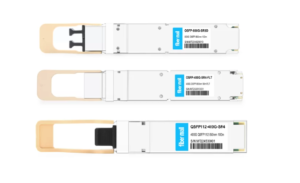
800G SR8 and 400G SR4 Optical Transceiver Modules Compatibility and Interconnection Test Report
Version Change Log Writer V0 Sample Test Cassie Test Purpose Test Objects:800G OSFP SR8/400G OSFP SR4/400G Q112 SR4. By conducting corresponding tests, the test parameters meet the relevant industry standards, and the test modules can be normally used for Nvidia (Mellanox) MQM9790 switch, Nvidia (Mellanox) ConnectX-7 network card and Nvidia (Mellanox) BlueField-3, laying a foundation for

QSFP112 Module Types: VR4, SR4, DR4, FR4 and LR4 Compared
Send a request for “a 400G QSFP112 module” to three different vendors and you may receive three different recommendations. One vendor may quote a DR4. Another may suggest a DR4+. A third may ask about your installed fiber infrastructure and explain that neither option matches your deployment requirements. That is not

QSFP112 vs OSFP: Choosing the Right 400G Form Factor
At first glance, QSFP112 and OSFP look like two competing form factors for high-speed networking. Both appear in 400G systems, both support PAM4 signaling, and both are widely used in AI and HPC infrastructure. But treating this as a simple “QSFP112 or OSFP?” decision misses the bigger picture. The right
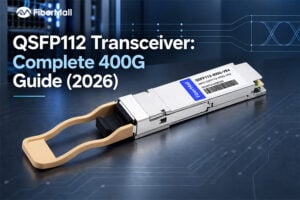
QSFP112 Transceiver: Complete 400G Guide (2026)
Ask five network engineers whether they should deploy QSFP112 or QSFP-DD for a 400G network, and you may get five different answers. Both form factors can support 400G, both are widely available, and both have legitimate advantages depending on the platform. The right choice depends on your switch or NIC

QSFP112 NVIDIA AI Clusters: ConnectX-7 and BlueField-3
You cannot directly install a QSFP112 transceiver into an NVIDIA Quantum-2 or Spectrum-4 switch port. These switch platforms use OSFP-based cages, while QSFP112 is designed primarily for NVIDIA adapter-side and DPU-side connectivity. This difference often causes confusion when engineers deploy NVIDIA 400G AI networks. A common assumption is that the

FiberMall Analyzes the UPO NPO Framework for 224G and 6.4T Optical Interconnect
The 2026 Open Data Center Conference (ODCC) and the inaugural Compute Expo provided a clearer view of how optical interconnect architectures may evolve inside AI data centers as electrical interconnect scaling becomes increasingly challenging. The event highlighted UPO (Ultra Performance Optics), an NPO (Near-Package Optics) framework developed through ODCC ecosystem

GPT-6 Astra: How Many Optical Transceivers Did Its 100,000-GPU Training Run Actually Need?
OpenAI’s largest training run to date used more than 100,000 GPUs at its Stargate infrastructure in Texas. Everyone is benchmarking GPT-6 Astra. Far fewer people are asking what kind of network was required to connect a six-figure GPU cluster. The answer is more complicated than simply saying “100,000 GPUs equals