
- Felisac
Harry Collins
Answered on 2:16 am
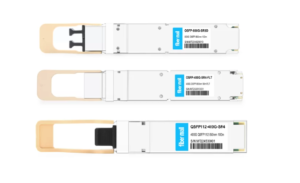
The maximum power consumption of 400G OSFP and QSFP-DD transceivers depends on the type and specification of the products. However, some general comparisons can be made based on the following information:
OSFP allows higher power consumption of 12~15W, while the QSFP-DD allows lower power consumption of 7~12W.
The QSFP-DD ZR variant has a maximum power consumption of 12W.
The QSFP-DD ZR Plus variant has a maximum power consumption of 15W.
Coherent DWDM transceivers may draw up to as much as 24W per port.
People Also Ask
Key Design Principles for AI Clusters: Scale, Efficiency, and Flexibility
In the era of trillion-parameter AI models, building high-performance AI clusters has become a core competitive advantage for cloud providers and AI enterprises. This article deeply analyzes the unique network requirements of AI workloads, compares architectural differences between AI clusters and traditional data centers, and introduces two mainstream network design
Google TPU vs NVIDIA GPU: The Ultimate Showdown in AI Hardware
In the world of AI acceleration, the battle between Google’s Tensor Processing Unit (TPU) and NVIDIA’s GPU is far more than a spec-sheet war — it’s a philosophical clash between custom-designed ASIC (Application-Specific Integrated Circuit) and general-purpose parallel computing (GPGPU). These represent the two dominant schools of thought in today’s AI hardware landscape.
InfiniBand vs. Ethernet: The Battle Between Broadcom and NVIDIA for AI Scale-Out Dominance
The Core Battle in High-Performance Computing Interconnects Ethernet is poised to reclaim mainstream status in scale-out data centers, while InfiniBand continues to maintain strong momentum in the high-performance computing (HPC) and AI training sectors. Broadcom and NVIDIA are fiercely competing for market leadership. As artificial intelligence models grow exponentially in
From AI Chips to the Ultimate CPO Positioning Battle: NVIDIA vs. Broadcom Technology Roadmap Showdown
In the era driven by artificial intelligence (AI) and machine learning, global data traffic is multiplying exponentially. Data center servers and switches are rapidly transitioning from 200G and 400G connections to 800G, 1.6T, and potentially even 3.2T speeds. Market research firm TrendForce predicts that global shipments of optical transceiver modules
H3C S6550XE-HI Series 25G Ethernet Switch: High-Performance 25G/100G Solution for Campus and Metro Networks
The H3C S6550XE-HI series is a cutting-edge, high-performance, high-density 25G/100G Ethernet switch developed by H3C using industry-leading professional ASIC technology. Designed as a next-generation Layer 3 Ethernet switch, it delivers exceptional security, IPv4/IPv6 dual-stack management and forwarding, and full support for static routing protocols as well as dynamic routing protocols including
Switching NVIDIA ConnectX Series NICs from InfiniBand to Ethernet Mode: A Step-by-Step Guide
The NVIDIA ConnectX Virtual Protocol Interconnect (VPI) series network interface cards (NICs)—including models such as ConnectX-4, ConnectX-5, ConnectX-6, ConnectX-7, and ConnectX-8 (commonly abbreviated as CX-4/5/6/7/8)—represent a rare class of dual-mode adapters in the industry. A single card enables seamless switching between InfiniBand (IB) and Ethernet physical networks without hardware replacement.
Related Articles

800G SR8 and 400G SR4 Optical Transceiver Modules Compatibility and Interconnection Test Report
Version Change Log Writer V0 Sample Test Cassie Test Purpose Test Objects:800G OSFP SR8/400G OSFP SR4/400G Q112 SR4. By conducting corresponding tests, the test parameters meet the relevant industry standards, and the test modules can be normally used for Nvidia (Mellanox) MQM9790 switch, Nvidia (Mellanox) ConnectX-7 network card and Nvidia (Mellanox) BlueField-3, laying a foundation for

Key Design Principles for AI Clusters: Scale, Efficiency, and Flexibility
In the era of trillion-parameter AI models, building high-performance AI clusters has become a core competitive advantage for cloud providers and AI enterprises. This article deeply analyzes the unique network requirements of AI workloads, compares architectural differences between AI clusters and traditional data centers, and introduces two mainstream network design

Google TPU vs NVIDIA GPU: The Ultimate Showdown in AI Hardware
In the world of AI acceleration, the battle between Google’s Tensor Processing Unit (TPU) and NVIDIA’s GPU is far more than a spec-sheet war — it’s a philosophical clash between custom-designed ASIC (Application-Specific Integrated Circuit) and general-purpose parallel computing (GPGPU). These represent the two dominant schools of thought in today’s AI hardware landscape.

InfiniBand vs. Ethernet: The Battle Between Broadcom and NVIDIA for AI Scale-Out Dominance
The Core Battle in High-Performance Computing Interconnects Ethernet is poised to reclaim mainstream status in scale-out data centers, while InfiniBand continues to maintain strong momentum in the high-performance computing (HPC) and AI training sectors. Broadcom and NVIDIA are fiercely competing for market leadership. As artificial intelligence models grow exponentially in

From AI Chips to the Ultimate CPO Positioning Battle: NVIDIA vs. Broadcom Technology Roadmap Showdown
In the era driven by artificial intelligence (AI) and machine learning, global data traffic is multiplying exponentially. Data center servers and switches are rapidly transitioning from 200G and 400G connections to 800G, 1.6T, and potentially even 3.2T speeds. Market research firm TrendForce predicts that global shipments of optical transceiver modules

H3C S6550XE-HI Series 25G Ethernet Switch: High-Performance 25G/100G Solution for Campus and Metro Networks
The H3C S6550XE-HI series is a cutting-edge, high-performance, high-density 25G/100G Ethernet switch developed by H3C using industry-leading professional ASIC technology. Designed as a next-generation Layer 3 Ethernet switch, it delivers exceptional security, IPv4/IPv6 dual-stack management and forwarding, and full support for static routing protocols as well as dynamic routing protocols including

Switching NVIDIA ConnectX Series NICs from InfiniBand to Ethernet Mode: A Step-by-Step Guide
The NVIDIA ConnectX Virtual Protocol Interconnect (VPI) series network interface cards (NICs)—including models such as ConnectX-4, ConnectX-5, ConnectX-6, ConnectX-7, and ConnectX-8 (commonly abbreviated as CX-4/5/6/7/8)—represent a rare class of dual-mode adapters in the industry. A single card enables seamless switching between InfiniBand (IB) and Ethernet physical networks without hardware replacement.