


Yes. A QSFP (40G or 100G) module can be inserted into an OSFP port by using a simple, completely passive, mechanical adapter. This adapter is available from Arista, with part number ADPT-O-Q-100G. The adapter and the adapter with a QSFP plugged into it, are shown below.

When using a QSFP module in an OSFP port, the OSFP port must be configured for a data rate of 100G (or 40G), instead of 400G.
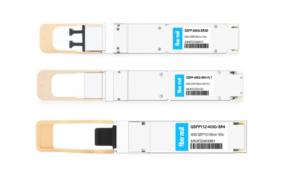
800G SR8 and 400G SR4 Optical Transceiver Modules Compatibility and Interconnection Test Report
Version Change Log Writer V0 Sample Test Cassie Test Purpose Test Objects:800G OSFP SR8/400G OSFP SR4/400G Q112 SR4. By conducting corresponding tests, the test parameters meet the relevant industry standards, and the test modules can be normally used for Nvidia (Mellanox) MQM9790 switch, Nvidia (Mellanox) ConnectX-7 network card and Nvidia (Mellanox) BlueField-3, laying a foundation for

USFP Connector Explained: The 2D Array and Two-Step Insertion
The USFP connector is the electrical interface that connects a USFP optical module to the host system in a switch or SuperNIC. It uses a two-dimensional (2D) array connector with a two-step insertion design, in which high-speed contacts engage after the module is inserted. The biggest challenge in scaling pluggable

NVIDIA H200 Burn-In Test and Maintenance: A Complete Delivery Checklist
An H200 burn-in test is essential for validating GPU stability, memory integrity, interconnect performance, and cooling behavior before an NVIDIA H200 server enters production. The NVIDIA H200 Tensor Core GPU features 141 GB of HBM3e memory and up to 4.8 TB/s of memory bandwidth. H200 SXM configurations support up to

ROADM Architecture: Degrees, CDC, and WSS Explained
A 20-degree ROADM site can consume three equipment cabinets, more than a hundred circuit boards, and around 400 fibers inside the building. The wavelengths move in software. The hardware does not. In one engineering example documented by ZTE, a node of this scale requires substantial cabinet space, board capacity, and

USFP Thermal Design: 100W Power Dissipation Without Embedded Cooling
The USFP thermal design is intended to support up to 100W of power dissipation per module without a dedicated embedded cooling circuit. In a host-cooled implementation, heat can be transferred from the module through a thermal interface material (TIM) to a host-side heat sink, which may use chassis airflow or
DWDM Amplifier Guide: EDFA Types, Specs & Selection
Dmitri ordered six amplifiers for a metro build. All were C-band, specified for a 40-channel configuration, and listed as boosters. Two had 17 dB of gain and a listed “saturated optical power” value of +3 dBm. The other four had 25 dB of gain and a listed value of −5

USFP AI Factory Networking: How 400G/Lane Optics Reshape the AI Fabric
USFP (Ultra-Dense Small Form Factor Pluggable) is the new optical transceiver form factor from NVIDIA and Cisco that brings 400 Gb/s-per-lane electrical signaling to AI factory networking. Announced at OCP Global Summit 2026, it packs 16 full-duplex lanes into an OSFP-sized footprint, roughly 6.4 Tb/s per module, with a published path