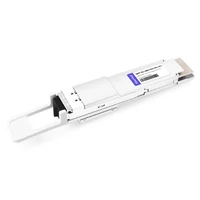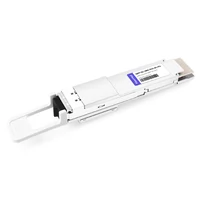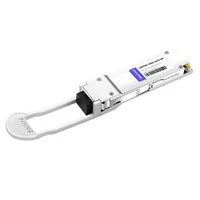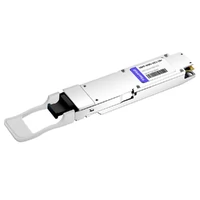

Marisol runs a regional data center pair about 85 kilometers apart. Her vendor quoted 400G direct-detect optics for the link, and the price looked great on paper. But when her team tested them over the actual fiber, the error rates climbed past what the link budget allowed.
The modules worked fine in the lab at 1 km. Over 85 km, they didn’t.
That is the practical difference between coherent vs direct detection in a nutshell: both carry 400G, but they behave very differently over real fiber. Direct detect is simpler and cheaper at short distances. Coherent detection wins the moment reach, sensitivity, or flexibility matter. This article breaks down how each technology works, where each one belongs, and how to pick between them without guessing.
If you are sizing optics for a specific link right now, skip straight to our engineers for a compatibility and reach review. Otherwise, here’s the full breakdown.
What Is Direct Detection (IMDD)?
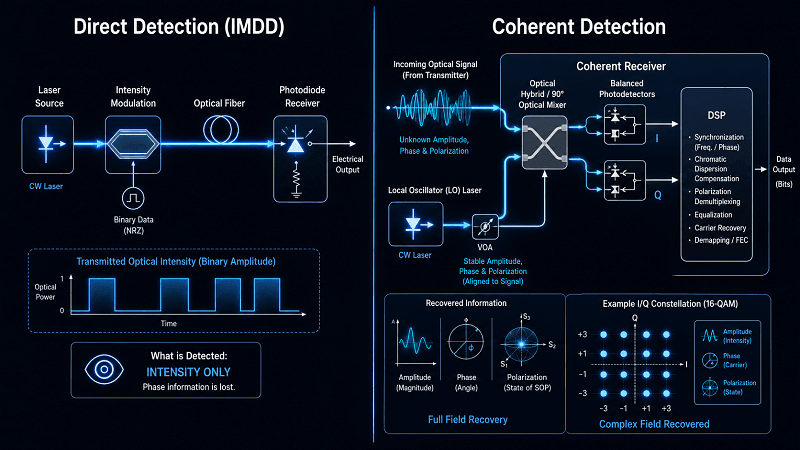
Direct detection, also called intensity modulation with direct detection, is the older and simpler of the two. The transmitter simply turns the laser on and off (or shifts intensity) to encode 0s and 1s. The receiver uses a photodetector that converts light intensity straight into an electrical signal.
No local laser, no complex processing. The name IMDD covers the whole approach.
This is the technology inside most SFP, SFP+, QSFP, and QSFP28 modules you already own. Our QSFP28 transceiver guide walks through the common variants if you want the full family tree.
Why IMDD Got This Far
Three reasons.
First, it’s cheap. A direct-detect receiver is essentially a photodiode and a transimpedance amplifier.
Second, it’s proven. Vendors have shipped these modules for two decades. Third, at short distances it’s genuinely good enough. Inside a data center, where fiber runs are measured in meters, IMDD carries 100G and 400G without breaking a sweat.
The Limits Appear Fast
The problems show up when you push distance or density. Direct detect encodes only amplitude, so it wastes a huge chunk of the optical spectrum.
Dispersion smears the pulses over distance, and noise hits an amplitude-modulated signal harder than it would hit a phase-modulated one. Add wavelength drift from the uncooled lasers, and you have a real ceiling around 10 km for serious link budgets.
What Is Coherent Detection?
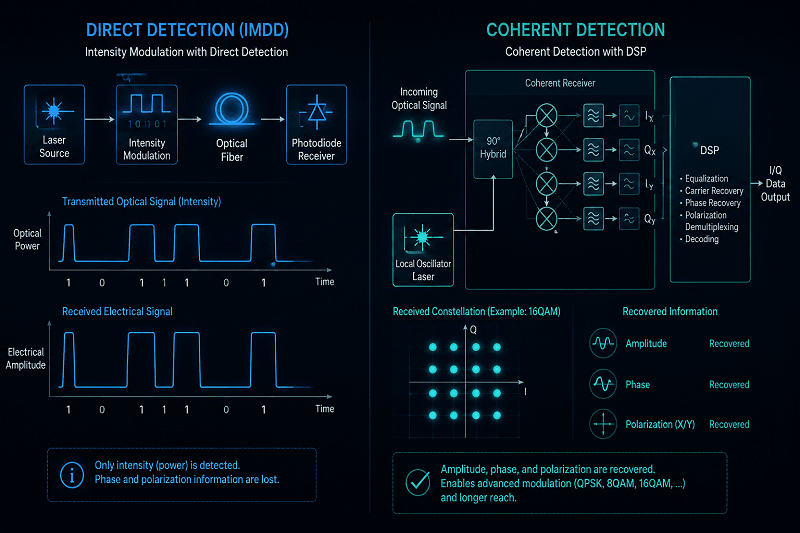
Coherent detection takes a completely different approach. Instead of measuring light intensity, the receiver mixes the incoming signal with a local oscillator laser.
That mixing recovers the full optical field: amplitude, phase, and polarization. The result is a receiver that can decode quadrature amplitude modulation like QPSK, 8QAM, and 16QAM, and can separate two polarizations on the same wavelength.
That one design change unlocks two things direct detect can’t touch.
Sensitivity Is the Big One
A coherent receiver’s sensitivity sits roughly 20 dB better than IMDD. Concretely, coherent receivers work down around -35 to -45 dBm, while typical direct-detect receivers top out near -18 to -22 dBm. That 20 dB is not a rounding error. It roughly quadruples the usable reach on a given fiber link, or lets you run the same reach with cheaper, less powerful optics.
Spectrum Efficiency Follows
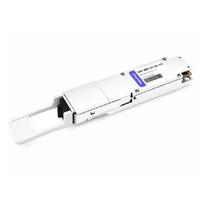
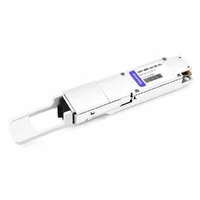
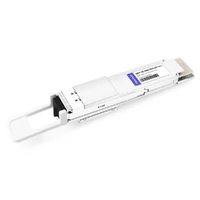
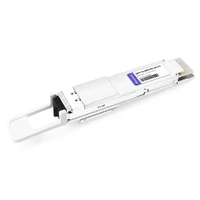
Because coherent encodes phase and polarization, a single wavelength carries far more bits per hertz. That’s why the industry can push 400G and 800G onto one coherent channel. QSFP-DD coherent modules pack this into a familiar, hot-pluggable form factor. Our QSFP-DD transceiver guide covers the mechanical side if you need the form factor details.
Coherent vs Direct Detection: The Key Differences
Here’s the honest side-by-side. It keeps the headline numbers you’ll actually use in a link budget.
| Parameter | Direct Detect (IMDD) | Coherent |
| Encoding | Amplitude only | Amplitude, phase, polarization |
| Receiver sensitivity | -18 to -22 dBm | -35 to -45 dBm |
| Typical reach | 100 m to 10 km | 80 km to 2,000+ km |
| 400G reach (unamplified) | Roughly 500 m to 2 km | 40 km |
| 400G reach (amplified) | Not practical | 80 to 120 km |
| Power draw (400G) | 8 to 14 W | 15 to 20 W |
| Relative module cost | Lower | Higher (DSP-heavy) |
| Best fit | Intra-DC, access, campus | Metro, long-haul, DCI |
The reach gap is the one that surprises most engineers. A 400G direct-detect link, in practice, tops out around 2 km even with high-performance parts. A 400G ZR coherent module covers 40 km unamplified and 80 to 120 km with amplification, per the OIF 400ZR implementation agreement. Same speed. Very different footprint.
For a fuller treatment of where each form factor slots into your network, the coherent optical module guide ties it all together.
Reach: Where Each Technology Wins
Reach is usually the deciding factor, so let’s map it to real distances.
Inside the Data Center (Under 500 m)
Direct detect, no contest. Coherent adds nothing here except cost and power. If you’re connecting racks, use DAC, AOC, or short-reach IMDD optics. This is not a debate.
Campus and Access (500 m to 10 km)
Still mostly direct detect. Single-mode PAM4 optics handle this range cleanly, and the price difference versus coherent is dramatic. Most enterprises never need coherent in the access layer.
Metro and DCI (40 to 120 km)
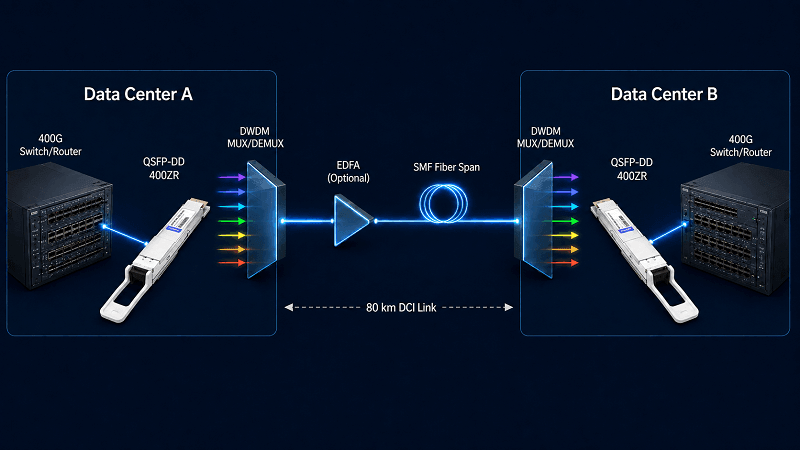
This is the battleground. A 400G ZR coherent module shines here, and this is exactly what OIF designed it for. If you have two data centers 60 km apart and you want 400G between them, coherent 400G ZR is the standard answer. The 400G ZR QSFP-DD guide walks through real deployment details.
Here’s a story that makes it concrete. A regional ISP we work with ran 100G links between two PoPs on QSFP28 optics, about 70 km apart. The links worked, but they needed four wavelengths to carry 400G total, plus separate mux/demux gear on both ends.
When they moved to a single 400G ZR QSFP-DD coherent module per link, they cut the transponder count from four to one and dropped the mux hardware entirely. Same aggregate capacity, a fraction of the equipment.
Long-Haul and Subsea (500 to 2,000+ km)
Coherent only. This range was built for coherent detection, and no realistic direct-detect system gets anywhere close. Regeneration costs explode, and coherent’s sensitivity is the whole reason these links are economical.
Power and Cost: The Real Trade-off
Coherent wins on reach. It loses on power and upfront cost, and pretending otherwise sets you up for a bad surprise on the electric bill.
A 400G direct-detect module typically draws 8 to 14 W. A 400G coherent module runs 15 to 20 W. Per module, that’s not a huge gap. Multiply it across 100 links and you’re suddenly budgeting kilowatts. In a power-capped facility, that matters.
Cost is more lopsided. Coherent DSPs and the local oscillator lasers drive module prices well above direct-detect equivalents. The DSP alone can account for 20 to 40% of a coherent module’s bill of materials.
That’s the price of the sensitivity and reach we covered above.
But the cost picture flips when you account for the whole link. Consider an operator field trial on a 2,253 km link. They measured roughly 35% capital expense savings and about 84% operating expense savings versus the older alternative, mostly from cutting amplifiers, regenerators, and the truck rolls to service them.
Cheap modules on a route that needs regenerators stop being cheap in a hurry.
This is where the coherent module price guide earns its keep. It breaks down what you actually pay per module, per reach class, so you can model the trade-off instead of guessing.
When to Choose Coherent vs Direct Detection
Let’s make the decision rule simple.
Choose direct detection when:
- Your links stay under 10 km, ideally under 2 km
- You need the lowest module price and power draw
- You’re working inside a data center or a campus
- You have standard single-mode or multimode fiber already in place
Choose coherent when:
- Your links run 40 km or more
- You need 400G or 800G on a single wavelength
- You want to reduce transponder count and mux hardware
- You’re connecting data centers or metro POPs
- You want headroom to upgrade reach later
There’s also a hybrid path worth naming. Pluggable coherent modules mean you can start with IMDD in the access layer and coherent in the metro layer, then shift the boundary as traffic grows. That’s the model most large operators are moving toward, and it’s why QSFP-DD coherent modules are getting so much attention. The 400G ZR vs ZR+ vs OpenZR comparison shows how the coherent family itself splits into options.
The 10 km Battleground
The honest answer is that the 2 to 10 km range is where the technology choice gets genuinely murky.
Direct detect can technically reach 10 km, but only with high-cost parts, tight link budgets, and no headroom for aging fiber or dirty connectors. Coherent is overkill at 10 km, but it gives you margin you never have to think about.
What tips the scale? Budget and growth. If the link is a one-off and the fiber is clean, IMDD works. If this link is the backbone of a region and you expect it to carry more traffic in three years, the coherent premium buys insurance.
This is exactly the kind of decision worth a second opinion. Send us the link distance, fiber type, and expected growth, and our engineering team will tell you which technology actually fits.
Coherent vs PAM4 for 400G Short Reach
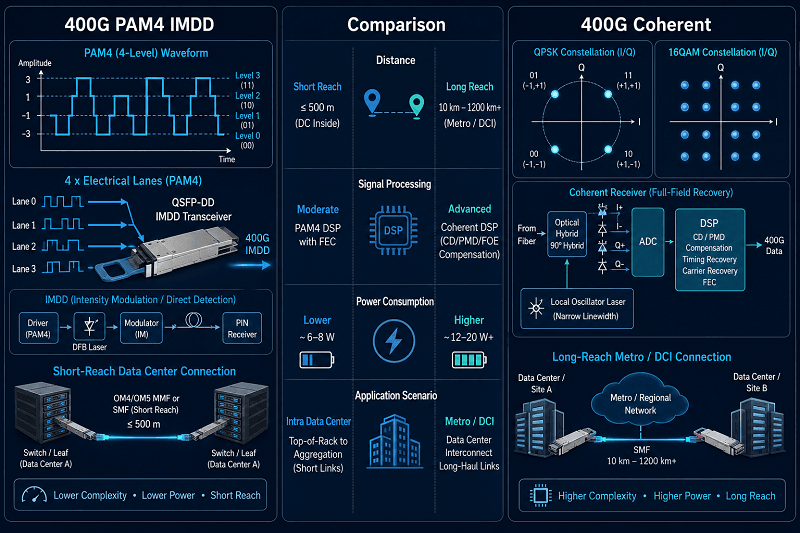
For 400G inside a building, the real contest is usually coherent vs PAM4, not coherent vs plain IMDD. PAM4 is a flavor of direct detection that sends four amplitude levels per symbol instead of two, so each symbol carries 2 bits. That’s how vendors squeeze 100G onto one lane and 400G onto four lanes.
At short reach, PAM4 wins. The modules are cheaper, they run cooler, and the signal processing needed to clean up the eye diagram is modest. That’s why 400G-DR4 and 400G-FR4 QSFP-DD modules dominate switch-to-switch links under 2 km.
The catch shows up when you extend reach. PAM4’s four levels sit close together, so noise eats the margin fast. Past 2 km, and certainly past 5 km, the error correction load climbs and the link budget gets thin. Coherent, with its roughly 20 dB sensitivity advantage, simply doesn’t have that problem.
So the practical split for 400G today looks like this:
- Under 2 km: PAM4 direct detect (400G-DR4, 400G-FR4)
- 2 to 40 km: the grey zone, decided by budget and fiber quality
- 40 km and up: coherent 400G ZR
That three-way split is worth remembering, because it maps directly to module cost.
Coherent vs Direct Detection FAQ
What is the main difference between coherent and direct detection?
Coherent detection recovers amplitude, phase, and polarization using a local oscillator laser. Direct detection recovers only light intensity. That single difference drives the entire gap in sensitivity, reach, and spectral efficiency.
Which has longer reach, coherent or direct detect?
Coherent, by a wide margin. Typical coherent reach spans 80 to 2,000+ km, while IMDD practical reach tops out around 10 km.
Is coherent faster than direct detection?
Not inherently. Both can carry 400G. Coherent carries it farther and more efficiently per wavelength. The speed ceiling for both keeps rising; the distance advantage is what separates them.
Why is coherent detection more expensive?
Coherent modules need a DSP, a local oscillator laser, and precision optics. The DSP alone can be 20 to 40% of the bill of materials. Direct detect modules are essentially a photodiode and amplifier.
Do I need coherent for 400G?
Not always. For links under 2 km, PAM4 direct detect handles 400G fine. For 40 km or more, you essentially need coherent, which is what 400G ZR modules provide.
Conclusion
Coherent vs direct detection comes down to three numbers: sensitivity, reach, and cost. Direct detect wins on price and power under 10 km. Coherent wins on everything past that, and its 20 dB sensitivity advantage makes long links possible at all.
Run this quick check before you buy. Measure the link distance and count the intermediate sites. Add up the total transponder and mux hardware, not just the module price. And if you’re on the fence between 2 and 10 km, build in the reach headroom now, because retrofitting coherent later costs far more than buying it the first time.
When the numbers point toward coherent, we can help you spec it correctly. Talk to our engineers with your link distances and traffic plans, and we’ll map the right modules to each segment of your network.
Related Products:
-
 OSFP-800G-DCO-ZR+-HTx 800G Coherent High TX Power OSFP DCO ZR+ C-band Tunable Optical Transceiver Module
$12000.00
-
OSFP-800G-DCO-ZR-HTx 800G Coherent High TX Power OSFP DCO ZR C-band Tunable Optical Transceiver Module
$11000.00
-
QSFP-DD-800G-DCO-ZR+-HTx 800G Coherent High TX Power QSFP-DD DCO ZR+ C-band Tunable Optical Transceiver Module
$12000.00
-
QSFP-DD-800G-DCO-ZR-HTx 800G Coherent High TX Power QSFP-DD DCO ZR C-band Tunable Optical Transceiver Module
$11000.00
-
QSFP-DD-400G-DCO-ZR+-HTx 400G Coherent High TX Power QSFP-DD DCO OpenZR+ C-band Tunable Optical Transceiver Module
$5500.00
-
QSFP-DD-400G-DCO-ZR-HTx 400G Coherent High TX Power QSFP-DD DCO ZR C-band Tunable Optical Transceiver Module
$5200.00
-
QSFP28-100G-DCO-ZR 100G Coherent QSFP28 DCO C-band Tunable Optical Transceiver Module
$3600.00
-
OSFP-400G-DCO-ZR+ 400G Coherent OSFP-DCO ZR+ C-band Tunable Optical Transceiver Module
$7000.00
-
QSFP-DD-400G-DCO-ZR+ 400G Coherent QSFP-DD DCO C-band Tunable Optical Transceiver Module
$4680.00
-
QSFP-DD-400G-DCO-ZR 400G Coherent QSFP-DD DCO C-band Tunable Optical Transceiver Module
$4550.00
-
QSFP-DD-100G-DCO 100G Coherent QSFP-DD DCO C-band Tunable Optical Transceiver Module
$5500.00
-
OSFP-400G-DCO-ZR 400G Coherent OSFP-DCO ZR C-band Tunable Optical Transceiver Module
$7000.00