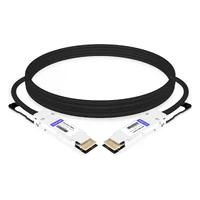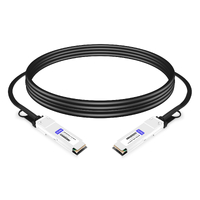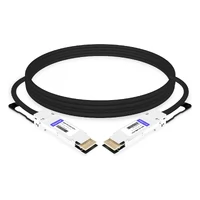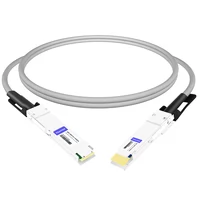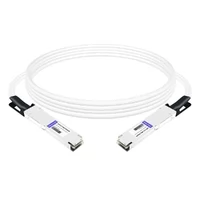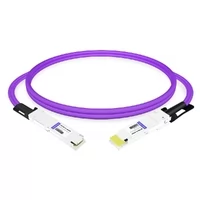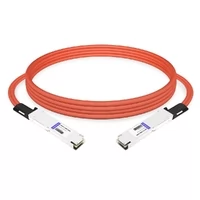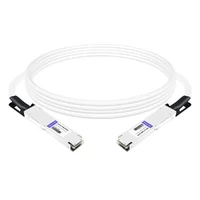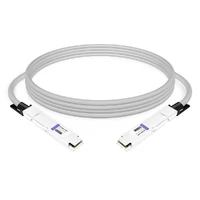

A DAC cable, or direct attach copper cable, is a fixed-length twinax copper cable assembly with transceiver-style connectors permanently attached to both ends. It connects servers, switches, and storage devices over short distances without requiring separate optical transceivers. Because it carries electrical signals over copper rather than converting them to optical signals, a passive DAC generally offers low cost, low power consumption, and low latency for short data center links.
That’s the short answer. For network engineers planning top-of-rack (ToR) cabling, the details matter: where passive copper reaches its limits, what active variants add, and when DAC should give way to optical cabling.
What Is a DAC Cable?
A direct attach copper (DAC) cable is a shielded twinaxial copper cable assembly with transceiver-form-factor connectors, such as SFP+, SFP28, QSFP28, or QSFP-DD, permanently attached to each end. It plugs directly into compatible switch, server, or storage ports.
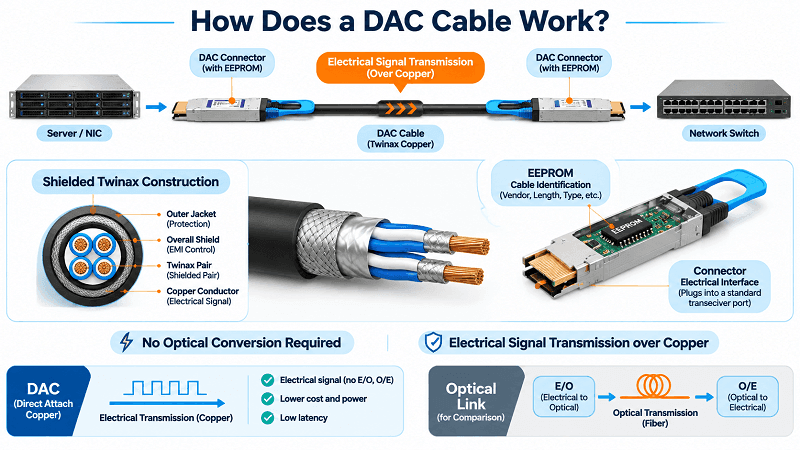
Unlike an optical link, a DAC cable does not perform electrical-to-optical conversion. The signal travels electrically over copper from end to end. By eliminating optical transmitters and receivers, DAC avoids optical conversion and can reduce cost and power consumption for short-reach connections. Passive DACs also avoid active signal-conditioning electronics within the cable.
Each end of a DAC cable typically contains an EEPROM that identifies the cable to the host device. Depending on the interface and implementation, the EEPROM can report information such as the vendor, part number, cable length, and cable type. The host reads this information to identify the cable and apply the appropriate port settings or compatibility checks.
A DAC cable is also fixed-length. It is not designed to be re-terminated or spliced in the field like a fiber jumper, so accurate distance planning matters before you order.
How Does a DAC Cable Work?
A DAC cable uses twinax construction: shielded pairs of conductors designed to carry high-frequency electrical signals while controlling signal loss and crosstalk. Effective shielding and cable construction become increasingly important as signaling rates rise, particularly with PAM4 signaling.
The connectors at both ends are more than simple plugs. They contain the electrical interface and cable-identification components required for the host to recognize the assembly in a compatible pluggable port. A DAC uses the same general port form factor as a corresponding optical module, but it is an electrical cable assembly rather than an optical transceiver.
The host’s SerDes (serializer/deserializer) transmits and receives the electrical signal across the copper link. In a passive cable, there are no active signal-conditioning components in the cable itself. The achievable reach therefore depends on the host’s signal capabilities, cable gauge, cable construction, connector performance, and the overall channel-loss budget.
Passive vs. Active DAC: ACC and AEC Explained
DAC cables come in two broad families: passive and active.
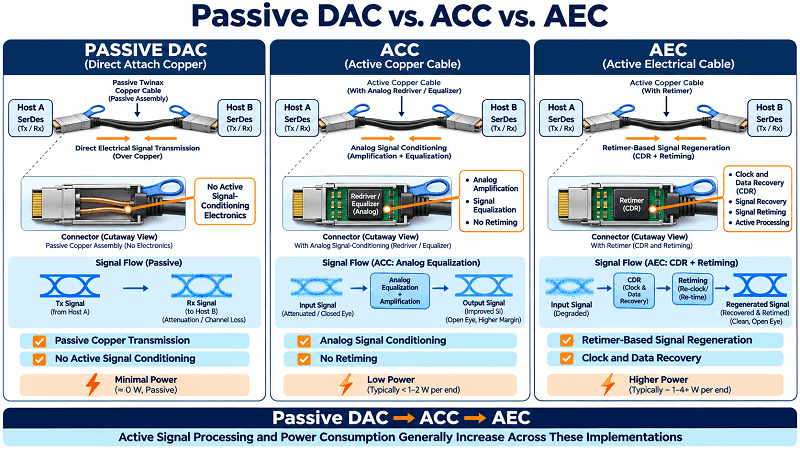
Passive DAC contains no active signal-conditioning electronics. It relies on the host’s SerDes and channel equalization to transmit and receive the signal. Passive cables generally consume very little power, add minimal latency, and cost the least. They are the default choice for short, in-rack links when the host platform supports the required cable length.
Active copper cables add electronics to condition the signal and extend reach. Two common types are:
- ACC (Active Copper Cable): Uses analog redrivers or equalizers to compensate for signal loss and improve signal integrity without retiming the data. ACC can extend usable reach beyond passive copper, but it does not recover and retime the data in the same way as a retimer-based solution.
- AEC (Active Electrical Cable): Uses retimers, typically with clock and data recovery (CDR), to recover and retime the signal. AEC can support longer copper links than passive DAC in many applications, at the cost of higher power consumption and price.
As a broad rule, active circuitry and power consumption generally increase from passive DAC to ACC to AEC. However, reach and power depend on the specific cable design, data rate, and host platform; this is not a universal ranking for every product.
DAC Cable Types, Speeds, and Form Factors
DAC cables use connector form factors that correspond to those of optical transceivers, allowing them to plug into compatible ports. The supported data rate and cable type must still match the host device and port configuration.
Common Form Factors
- SFP+: 10G Ethernet over a single lane.
- SFP28: 25G Ethernet over a single lane.
- QSFP+: 40G Ethernet over four 10G lanes.
- QSFP28: 100G Ethernet over four 25G lanes.
- QSFP56: 200G Ethernet over four 50G PAM4 lanes.
- QSFP-DD and OSFP: 400G Ethernet over eight 50G PAM4 lanes.
For a closer look at how these ports differ, see our guide to SFP and QSFP port differences.
DAC Cable Distance Limits
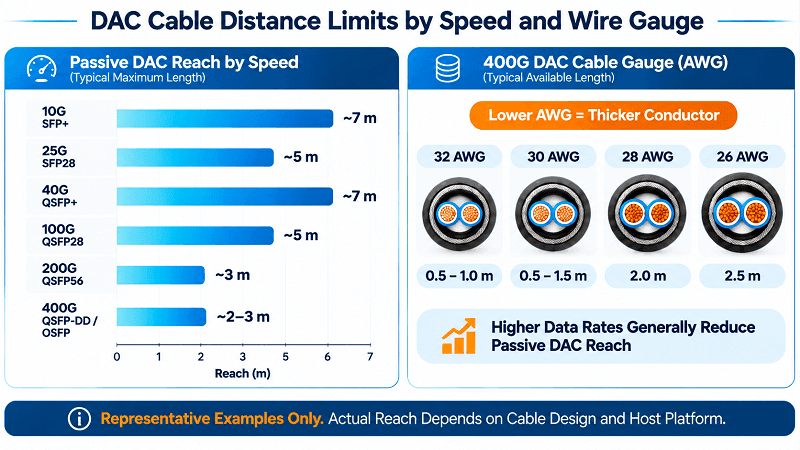
Copper reach generally shrinks as signaling rates rise because higher-frequency signals are more sensitive to channel loss and other signal-integrity limits. A 10G or 40G passive DAC may reach about 7 m in supported configurations, while a 400G passive DAC typically reaches around 2–3 m. Actual limits depend on the cable and host specifications.
The cable’s wire gauge (AWG) also affects practical length. A lower AWG number indicates a thicker conductor, which can help reduce conductor loss and support longer reach. However, AWG alone does not determine the maximum length; cable construction, connector design, signaling rate, and host signal performance also matter.
| 400G Passive DAC AWG | Typical maximum length |
| 32 AWG | 0.5–1.0 m |
| 30 AWG | 0.5–1.5 m |
| 28 AWG | 2.0 m |
| 26 AWG | 2.5 m |
These are representative examples, not universal limits or an industry-wide AWG-to-length specification. Always check the cable manufacturer’s datasheet and the host platform’s supported-cable list.
This table summarizes typical passive reach examples by speed and form factor:
| Form factor | Speed | Signaling | Max passive reach |
| SFP+ | 10G | 1×10G NRZ | ~7 m |
| SFP28 | 25G | 1×25G NRZ | ~5 m |
| QSFP+ | 40G | 4×10G NRZ | ~7 m |
| QSFP28 | 100G | 4×25G NRZ | ~5 m |
| QSFP56 | 200G | 4×50G PAM4 | ~3 m |
| QSFP-DD / OSFP | 400G | 8×50G PAM4 | ~2–3 m |
These figures are practical examples rather than guaranteed limits for every product. Always confirm the supported reach for the exact cable, switch, and NIC combination.
Active copper can extend these distances. ACC may add a few meters of usable reach beyond passive copper, while some AEC products support reaches of around 7 m or more. The actual maximum depends on the cable design, connector combination, data rate, and host platform.
Breakout DAC Cables
DAC cables are also available as breakout assemblies, which split a single high-speed port into multiple lower-speed ports. A 400G QSFP-DD to 4×100G breakout cable, for example, connects one 400G switch port to four 100G devices. Breakout DACs are widely used to connect high-density leaf switches to servers or storage in AI and hyperscale deployments.
DAC vs. AOC vs. Optical Transceiver Module
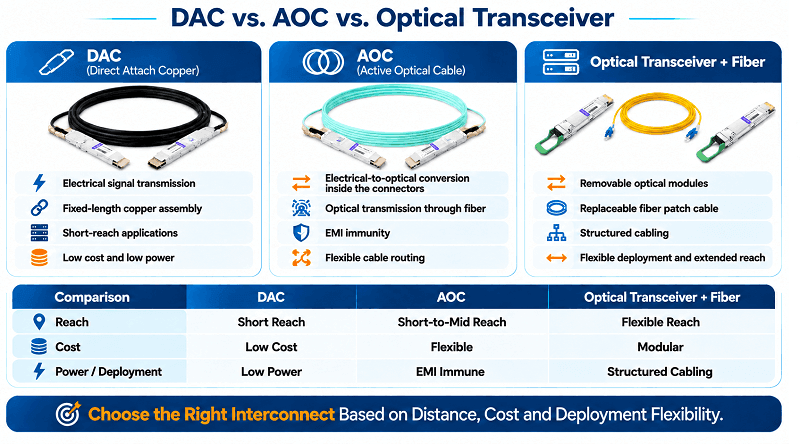
Choosing the right interconnect comes down to distance, budget, and flexibility. DAC, AOC, and optical transceivers each occupy a different part of that trade-off.
DAC (copper) is best suited to the shortest links. It is often the lowest-cost and lowest-power option for supported short-reach connections, but its reach is limited to a few meters and the cable is generally thicker and stiffer than fiber.
AOC (Active Optical Cable) integrates optical transceivers into a fixed-length fiber cable, with the optical ends permanently attached. It converts electrical signals to optical signals at one end and back to electrical signals at the other. AOC reach depends on the data rate and product design; available lengths range from a few meters to around 100 m in some product families. AOC is generally lighter and more flexible than DAC, and its optical signal path is immune to electromagnetic interference. It typically costs more and consumes more power than a passive DAC.
Optical transceiver plus fiber is the most flexible option. Separate modules and patch cables can be replaced independently, support patch panels and structured cabling, and provide reach from short-reach data center links to tens of kilometers, depending on the optical standard and fiber type. SR optics are designed for short-reach applications, while LR and ER optics support longer distances. This option may cost more up front, but the fiber infrastructure can be reused across compatible applications.
A practical rule of thumb, sometimes called the “7-meter wall”:
- Up to ~3–5 m: Passive DAC is often the lowest-cost and lowest-power choice, provided the host supports the required cable.
- ~3–15 m: Consider ACC, AEC, or AOC, depending on the data rate, routing, cable density, and platform support.
- ~15–100 m: AOC is a common choice for many data center applications; optical transceivers and fiber may also be suitable.
- Over 100 m: Optical transceivers plus fiber are generally the practical choice.
These ranges are guidelines, not fixed industry limits. Always check the reach specifications for the exact product and application.
For more on the optical side of this decision, see our introduction to optical transceiver modules.
Cost per Port and Power Consumption
The cost argument for DAC is strongest at short range. Depending on the data rate and vendor, a single optical transceiver can cost more than an entire DAC cable assembly. As a result, a pair of optical modules plus a fiber jumper can cost several times as much as an equivalent DAC connection. Actual price differences vary by product, vendor, volume, and compatibility coding.
Power tells a similar story. A passive DAC has no active signal-conditioning electronics and generally consumes very little power, although its management circuitry and host power allocation vary by product. For comparison, a 25G SFP28 optical transceiver may draw around 1.2 W, while a 100G QSFP28 optical transceiver may draw around 3.5 W per end. These are approximate examples; check the datasheet for the specific transceiver.
Consider a data center team adding 400G leaf-to-spine links within a single row. For each 3 m link, a passive QSFP-DD DAC replaces two 400G optical transceivers and the associated fiber jumper. The eight lanes in a typical 400G QSFP-DD electrical interface are signal lanes, not separate optical modules. Multiply the savings across hundreds of ports, and the difference can be significant, without adding optical conversion to the link.
FiberMall supplies factory-direct DAC and AOC cables from 10G to 400G for exactly these deployments. Explore FiberMall DAC cable options to review form factors and reach for your topology.
When to Use a DAC Cable
DAC cables are the right tool for short, high-volume links where cost per port, power consumption, and low latency are important.
Top-of-rack switching. The classic use case is a server connecting to a ToR switch within the same rack or an adjacent rack. These links are almost always under 5 m, which passive DAC handles cleanly.
Switch-to-switch within a row. Short spine-to-leaf or leaf-to-leaf connections inside a row often sit in the ACC/AEC or short AOC range.
AI and high-density compute. GPU clusters and AI training racks favor short, dense interconnects where power and cost per port are critical. Breakout DAC cables connect a single high-speed port to multiple lower-speed endpoints.
Lab and staging environments. Fixed-length, plug-and-play DAC cables simplify temporary or test topologies where reconfiguration is frequent.
DAC is not the right tool for long runs, structured cabling through patch panels, or links that must be re-terminated in the field. In those cases, optical transceivers and fiber—or AOC for supported short- to mid-distance links—are usually a better fit.
DAC Cable Compatibility and Vendor Coding
Compatibility is a common source of DAC cable issues. Each end typically contains an EEPROM that identifies the cable. Some switch vendors configure their platforms to accept only cables with approved vendor identifiers or supported coding. As a result, a cable that meets the relevant electrical requirements may still trigger an “unsupported transceiver” or “unknown vendor” message if its coding is not accepted by the host.
MSA (Multi-Source Agreement) specifications help standardize mechanical dimensions, electrical interfaces, and management requirements for compatible form factors. However, MSA compliance does not guarantee universal compatibility across all switch brands, models, or software versions. Some platforms require specific EEPROM coding or formal product qualification.
When selecting a DAC cable, verify three things: the form factor and data rate match the port, the cable length matches the physical run, and the cable’s coding is supported by the specific switch or NIC platform. FiberMall DAC cables are designed to meet applicable MSA requirements and are tested for compatibility with supported networking platforms. Confirm the exact device model and required vendor coding before ordering to reduce the risk of compatibility issues.
DAC Cable Advantages and Limitations
Advantages
- Often one of the lowest-cost options per port for supported short-reach links.
- Very low power consumption for passive cables.
- Low latency, with no optical-to-electrical conversion in the cable.
- Simple plug-and-play deployment, with no optical fiber end-face cleaning or inspection required.
- Passive construction has fewer active components that can fail.
Limitations
- Short reach that generally decreases as signaling rates increase.
- Thicker and stiffer than fiber, which can restrict cable routing and airflow in dense racks.
- Fixed length; cannot be re-terminated in the field.
- Potential vendor-compatibility issues if EEPROM coding is not accepted by the host platform.
DAC Cable FAQs
How far can a DAC cable transmit?
A passive DAC cable typically reaches up to about 5 m, with some 10G or 40G products supporting lengths of around 7 m. Higher data rates generally shorten passive reach; a 400G passive DAC commonly reaches around 2–3 m. Active copper cables (ACC and AEC) can extend reach, with some AEC products supporting around 7 m or more. Always check the specifications for the exact cable and host platform.
What is the difference between passive and active DAC?
A passive DAC has no active signal-conditioning electronics and relies on the host’s SerDes and channel equalization. An active DAC adds signal-conditioning circuitry: ACC typically uses an analog redriver, while AEC uses a retimer, usually with clock and data recovery, to extend reach. Active cables generally consume more power and cost more than passive DACs.
DAC vs. AOC cable: which should I choose?
Choose DAC for short links—often under about 5m—where cost, power, and low latency matter most. Choose AOC when you need a longer or more flexible cable run and the required length is supported by the product. AOC is commonly used for short- to mid-distance links, but its maximum reach depends on the data rate and cable model.
Do DAC cables work with any switch?
A DAC cable works only when the switch has a compatible port, supports the cable’s data rate and configuration, and accepts its EEPROM coding. MSA compliance helps standardize the interface, but it does not guarantee that every switch will accept every DAC cable. Check the compatibility list for the exact switch model and software version.
What is a breakout DAC cable?
A breakout DAC cable splits one high-speed port into several lower-speed ports. A 400G QSFP-DD to 4×100G breakout, for example, connects a single 400G port to four 100G devices.
Related Products:
-
 QDD-200G-PC50CM 0.5m (1.6ft) 200G QSFP-DD to QSFP-DD Passive Direct Attach Copper Twinax Cable
$45.00
-
QSFP56-200G-PC50CM 0.5m (1.6ft) 200G QSFP56 to QSFP56 PAM4 Passive Direct Attach Copper Twinax Cable
$45.00
-
QSFPDD-400G-PC50CM 0.5m (1.6ft) 400G QSFP-DD to QSFP-DD PAM4 Passive Direct Attach Copper Twinax Cable
$70.00
-
QSFP-DD-400G-AC3M 3m (10ft) 400G QSFP-DD to QSFP-DD PAM4 Active Direct Attach Copper Twinax Cable
$350.00
-
QDD-OSFP-FLT-PC50CM 0.5m (1.6ft) 400G QSFP-DD to OSFP Flat Top PAM4 Passive Direct Attached Cable
$154.00
-
OSFP-FLT-400G-PC50CM 0.5m (1.6ft) 400G NDR OSFP to OSFP PAM4 Passive Direct Attached Cable, Flat top on one end and Flat top on other
$110.00
-
QDD-OSFP-FLT-AEC50CM 0.5m (1.6ft) 400G QSFP-DD to OSFP Flat Top PAM4 Active Electrical Copper Cable
$1200.00
-
OSFP-FLT-800G-AC3M 3m (10ft) 800G Twin-port 2x400G OSFP to 2x400G OSFP InfiniBand NDR Active Copper Cable, Flat top on one end and Flat top on the other
$600.00
-
OSFP-FLT-800G-PC2M 2m (7ft) 2x400G OSFP to 2x400G OSFP PAM4 InfiniBand NDR Passive Direct Attached Cable, Flat top on one end and Flat top on the other
$300.00
-
OSFP-800G-PC50CM 0.5m (1.6ft) 800G Twin-port 2x400G OSFP to 2x400G OSFP InfiniBand NDR Passive Direct Attach Copper Cable
$105.00