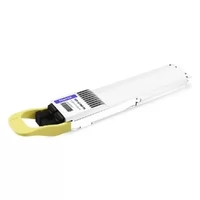

The 2026 Open Data Center Conference (ODCC) and the inaugural Compute Expo provided a clearer view of how optical interconnect architectures may evolve inside AI data centers as electrical interconnect scaling becomes increasingly challenging.
The event highlighted UPO (Ultra Performance Optics), an NPO (Near-Package Optics) framework developed through ODCC ecosystem collaboration with participation from Tencent and other industry partners, including cloud providers, switch and server vendors, optical component suppliers, and connector manufacturers.
The framework was demonstrated together with engineering hardware rather than concept-only presentations. Exhibits included a 102.4T NPO network switch based on Broadcom’s Tomahawk 6 switch ASIC with 128 × 800G MPO16 optical interfaces, a 512-GPU single-tier all-optical scale-up fabric using self-developed 3.2T NPO optical modules, and the ETH-X Ultra all-optical compute node reference design.
For FiberMall and the network operators we serve, the significance is clear. NPO has progressed from an architectural concept toward practical engineering implementations with defined technical roadmaps. This evolution will influence how optical connectivity layers are designed for future 224G-based AI fabrics.

What the UPO Framework Defines
UPO is not a single optical module product specification. Instead, it provides an NPO framework that defines multiple density classes and integration approaches, allowing system designers to balance bandwidth density, cost, serviceability, signal integrity, and thermal requirements based on different application scenarios.
Three Product Types: XD, HD and SD
| Product Type | Bandwidth Density | Optical Engine | Light Source | Socket Footprint | Typical Fit |
| Type 1 – XD (Extreme Density) | Highest | 2.5D high-density silicon photonics | External (ELSFP) | 19.18 × 31.93 mm, 0.43 × 0.6 mm pad pitch | Space-constrained systems requiring maximum density and strict signal integrity |
| Type 2 – HD (High Density) | Balanced | 2.5D / 2D silicon photonics | Internal or external | 23.07 × 38.07 mm, 0.6 × 0.6 mm pad pitch | Broad system compatibility and faster adoption based on existing silicon photonics platforms |
| Type 3 – SD (Standard Density) | Standard | 2.5D / 2D silicon photonics | Mainly internal | 28.17 × 43.07 mm, 0.6 × 0.6 mm pad pitch | Systems with sufficient board space and cost-sensitive deployment scenarios |
The three product categories address different design priorities.
XD focuses on maximizing optical density and minimizing footprint.
SD emphasizes simplified integration and lower deployment cost.
HD provides a balance between density, compatibility, and implementation complexity, making it a practical transition path for many existing silicon photonics designs.
Four Integration Methods
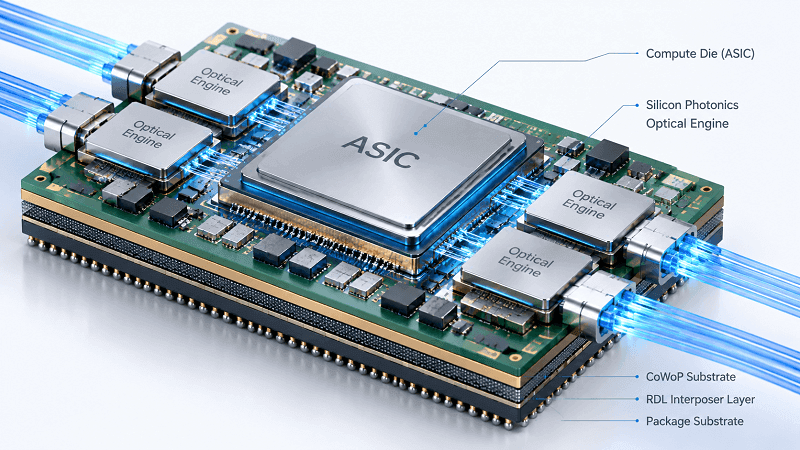
The UPO framework defines multiple approaches for integrating optical engines with computing and switching platforms, ranging from conventional board-level implementations to more advanced high-density packaging solutions.
The four integration approaches include:
On-PCB
The optical engine is mounted on the PCB, representing the most conventional NPO implementation approach. This method provides relatively simple manufacturing and maintenance advantages while shortening the electrical connection compared with front-panel pluggable optics.
On-Substrate
The optical engine is integrated on the same substrate as the main ASIC package. This approach further reduces electrical channel length and improves signal integrity for higher-speed interconnects.
Over-Substrate
A fan-out interconnect structure is mounted above the ASIC substrate, enabling higher interconnect density and shorter electrical paths for advanced system architectures.
On-CoWoP
The optical engine is integrated onto the main chip’s CoWoP (Chip-on-Wafer-on-Package) substrate. This approach targets the highest-density applications where signal integrity, packaging efficiency, and bandwidth scalability are critical.
Performance, Reliability and Serviceability
Across the UPO framework, the architecture targets 224G-class electrical lane signaling, supporting optical interconnect modules in the 6.4T to 7.2T class depending on implementation efficiency and system design.
The roadmap also includes future scaling toward 448G-per-lane signaling and 12.8T-class optical modules.
For reliability and maintenance, the design focuses on several key features:
- Field-replaceable optical modules
- Solderless socket-based connection
- Alignment pins combined with clamped backplane structures
- Pluggable FAU (D-FAU), allowing fiber assemblies to be handled separately from optical engines
The UPO V1.0 framework was introduced in September 2026. Type 2-HD and Type 1-XD socket implementations, 6.4T-class UPO modules, and complete system demonstrations are expected to progress through sampling and validation phases during 2026, with 448G-per-lane and 12.8T-class solutions targeted in future roadmap development.
Why 224G Per Lane Is the Inflection Point
Moving to 224G per lane represents a significant transition for AI data center interconnect architectures.
At higher SerDes speeds, electrical channel challenges become increasingly difficult. Parameters such as insertion loss, return loss, and crosstalk degrade rapidly over longer traces, increasing the difficulty of maintaining sufficient link margin.
These challenges make traditional long-reach electrical connections more dependent on advanced equalization and DSP-based retiming solutions, which can increase system power consumption and silicon complexity.
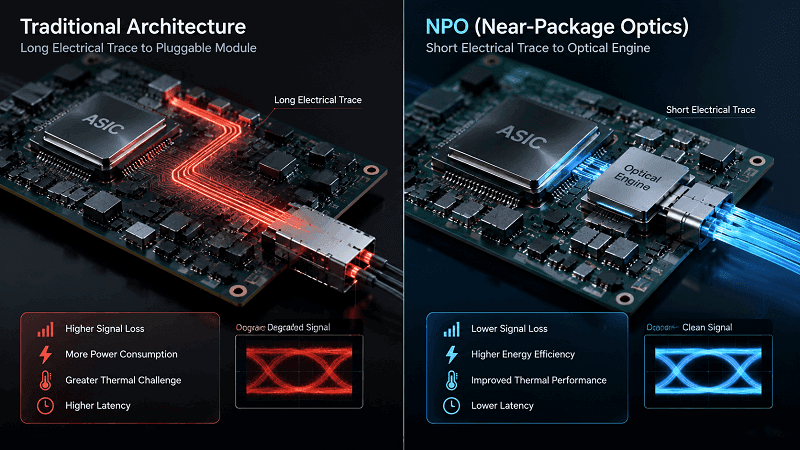
This is why 224G-class signaling is considered a critical milestone for next-generation optical interconnect architectures. By placing optical engines closer to switching or computing ASICs, NPO reduces electrical channel length and improves the feasibility of lower-power direct-drive architectures.
NPO vs Pluggable Optics Comparison
| Parameter | Pluggable Optics (OSFP, 224G-class) | NPO 6.4T-Class (32 × 224G-class lanes) |
| Bandwidth per module | Approximately 1.6T (8 × 224G-class lanes) | Approximately 6.4T-class |
| Bandwidth density | 1× | Approximately 4× |
| Power per bit | ~15 pJ/bit (representative industry estimate for 1.6T at ~24W) | ~6 pJ/bit (example implementation including 26W optical module + 13W external laser source) |
| Electrical channel | Front-panel connector + module PCB + longer motherboard traces | Shorter PCB routing between ASIC and optical engine |
| Drive architecture | Linear drive becomes increasingly challenging at higher speeds | Shorter channels improve feasibility of linear-drive architectures |
| Upgrade approach | Module-level replacement | Optical engine/module-level replacement with future 448G roadmap |
| Maintenance model | Field-pluggable module | Field-replaceable optical engine and pluggable FAU |
The key advantages are higher bandwidth density and improved energy efficiency. Based on representative system assumptions, NPO architectures can achieve significantly lower energy per bit compared with traditional pluggable implementations.
However, the primary architectural improvement is not only power reduction. The more important change is the shortened electrical path between the switch ASIC or accelerator and the optical engine, which improves signal integrity and enables higher-speed scaling.
Inside the First Generation of NPO Hardware
102.4T NPO Network Switch (TCS9610-128O0)
The reference switch demonstrated at ODCC integrates 102.4 Tbps switching capacity in a 4RU chassis and exposes the capacity through 128 × 800G optical interfaces.
Key features include:
- Broadcom Tomahawk 6 switch ASIC with 102.4 Tbps switching capacity
- 4RU chassis supporting 128 × 800G MPO16 optical interfaces
- Optical engines positioned close to the switch ASIC, reducing die-to-die channel loss to below 16 dB
- VPD (Vertical Power Delivery) architecture for improved power distribution efficiency
- Optical conversion module power reduction compared with conventional architectures
- Compatibility with 3.2T-class NPO optical modules
- Support for multiple ELSFP remote laser sources with field replacement capability
- 2+2 redundant power supplies and 7+1 redundant fans, with liquid cooling reserved for future versions
ETH-X Ultra All-Optical Compute Node
The compute-node reference design applies the same optical integration concept closer to GPU systems.
Key specifications include:
- 87.8 mm (H) × 537 mm (W) × 964 mm (D), approximately 30 kg
- New GPU module specification designed for domestic accelerator platforms, exceeding OCP OAM 2.0 requirements in PCB area, bandwidth capability, and power delivery capability
- Standard GPU module size of 115 mm × 253 mm supporting approximately 2,500 W per module
- Three 3.2T / 6.4T-class NPO optical modules per GPU module, supporting both NPO and NPC architectures
- Approximately 2U optical compute node architecture with 4 GPUs and 1–2 CPUs using hybrid air-liquid cooling

Three Engineering Challenges the Industry Had to Solve
The development of NPO systems requires solving several practical engineering challenges.
1. Module Mounting and Contact Reliability
LGA-based optical sockets require precise mechanical control.
With multiple optical modules installed in dense configurations, accumulated manufacturing tolerances can affect contact reliability.
Solutions include:
- Small cover plates combined with elastic silicone pads to absorb tolerance variation
- Large cover plates with spring screws to maintain continuous pressure
- Interlocking backplane structures to prevent PCB deformation
These designs can maintain mechanical flatness within approximately 0.05 mm.
2. Fiber Routing
High-density NPO architectures introduce significant fiber management complexity.
With multiple NPO optical groups and external laser sources inside a chassis, routing paths, bend radius control, and maintenance accessibility become critical design considerations.
Solutions include:
- Dedicated fiber routing trays
- Fiber slack management structures
- Specialized assembly tooling
3. Layout and Thermal Management
Placing optical engines closer to switching ASICs improves signal integrity but increases local thermal density.
Engineers address this challenge through:
- VPD vertical power delivery to optimize board layout
- Shorter power delivery paths
- Heat pipe solutions to relocate heat away from high-temperature regions
What NPO Changes in Optical Layer Planning
FiberMall’s assessment is that NPO will primarily reshape the scale-up fabric and GPU-to-GPU interconnect layer, while traditional pluggable optics will continue to play an important role in scale-out networking and inter-data-center connectivity for the foreseeable future.
This evolution creates several practical considerations for network architects.
Pluggable Optics Remain Critical for Scale-Out Networks
NPO does not replace all optical transceiver applications.
Pluggable 800G and 1.6T optical transceivers will continue to serve as the primary connectivity solution for:
- Rack-to-rack connections
- Row-level networking
- Data center hall interconnects
- Data center-to-data center links
NPO mainly targets high-density short-reach connections inside AI compute systems, where reducing electrical channel length becomes increasingly important.
FiberMall’s 800G OSFP and QSFP-DD transceiver portfolio, including solutions such as 800G DR8 and 2 × 400G FR4 modules, supports compatibility validation with mainstream 400G and 800G platforms, with future expansion toward 1.6T optical solutions.
The Optical Fiber Infrastructure Becomes a Key Constraint
As optical port density increases, the supporting fiber infrastructure becomes increasingly important.
A single 4RU switch supporting 128 × 800G MPO16 optical interfaces requires:
- High-density fiber management
- Low-loss connectors
- Strict insertion loss control
- Proper cleanliness and inspection processes
With higher-density optical fabrics, connector quality and fiber infrastructure move from general best practice to critical system requirements.
A Rate-Agnostic Optical Layer Becomes More Valuable
As electrical interfaces become more challenging to scale, maintaining a flexible and reusable optical layer becomes increasingly important.
A reconfigurable optical infrastructure can protect long-term investment by allowing network operators to adjust fabric topology without major physical recabling.
FiberMall’s optical circuit switching solutions, including OCS 3D Matrix Switches supporting up to 192 × 192 and 320 × 320 port configurations, and MOS Cascaded Matrix Switches, enable dynamic optical path reconfiguration for large-scale AI workloads.
For example, optical circuit switching can allow operators to modify network connection patterns based on different AI training requirements.
The Serviceability Model Is Changing
Traditional pluggable optics combine multiple functions into a single replaceable module.
NPO architectures separate different components through designs such as:
- External laser sources
- Pluggable FAUs
- Replaceable optical engines
This approach creates a more modular maintenance model where:
- Laser sources
- Fiber assemblies
- Optical engines
can potentially be serviced independently.
As a result, spare inventory planning, maintenance procedures, and warranty strategies need to adapt to this new architecture.
Cooling Becomes an Optical Design Consideration
Higher optical density increases thermal requirements.
A 4RU NPO switch chassis designed for air cooling with future liquid-cooling support, together with GPU compute systems using hybrid air-liquid cooling, demonstrates that thermal design is becoming closely connected with optical architecture decisions.
Future optical interconnect selection will increasingly depend on:
- Bandwidth requirements
- Power efficiency
- Mechanical integration
- Available thermal envelope

What to Ask Before Committing to a 224G Optical Fabric
For network operators evaluating NPO or other 224G-class optical interconnect solutions, FiberMall recommends requesting detailed validation data from suppliers before committing to deployment.
Key evaluation items include:
1. Measured 224G-Class Electrical Performance
Request actual measurement data rather than simulation-only results, including:
- S-parameters
- Crosstalk measurements
- Connector electrical performance
- Transmitter and receiver validation data
- TDECQ and error-rate test results
2. Optical Link Budget Analysis
A complete optical link budget should consider:
- Worst-case fiber path
- Patch panels
- Connector insertion loss
- Optical components
- Potential DWDM elements
3. Connector and Socket Qualification
Qualification reports should cover:
- Mating cycle reliability
- Mechanical pressure tolerance
- Socket flatness
- Contact reliability
4. FAU and Fiber Assembly Specifications
Important information includes:
- FAU specifications
- Minimum bend radius
- Fiber routing requirements
- Assembly tooling requirements
5. Thermal Validation
Thermal performance should be evaluated under:
- Intended airflow conditions
- Expected power levels
- Future liquid-cooling transition scenarios
6. Serviceability Planning
Maintenance planning should reflect the separation between:
- Laser source
- Fiber assembly
- Optical engine
rather than following traditional pluggable transceiver replacement models.
Frequently Asked Questions
What is NPO (Near-Package Optics)?
NPO, or Near-Package Optics, places the optical engine closer to the switch or compute ASIC compared with traditional front-panel pluggable optics.
By shortening the high-speed electrical channel between the ASIC and optical conversion point, NPO improves signal integrity at higher SerDes speeds and can reduce the need for power-intensive DSP retiming solutions.
What is UPO (Ultra Performance Optics)?
UPO is an NPO framework introduced through ODCC ecosystem collaboration.
It defines multiple optical product categories, including:
- XD (Extreme Density)
- HD (High Density)
- SD (Standard Density)
and multiple integration approaches:
- On-PCB
- On-Substrate
- Over-Substrate
- On-CoWoP
The framework targets 224G-class electrical lane signaling, 6.4T-class optical modules, and future scaling toward 448G-per-lane and 12.8T-class solutions.
Why Does 224G Per Lane Make NPO Attractive?
At 224G-class signaling speeds, electrical channel loss, return loss, and crosstalk become increasingly difficult to manage over longer traces.
By moving optical conversion closer to the ASIC, NPO reduces electrical channel distance, improves link margin, and helps enable more power-efficient architectures.
Representative implementations indicate that NPO can achieve lower energy per bit compared with conventional pluggable approaches.
How Much Bandwidth Density Does NPO Add?
A 6.4T-class NPO optical module using 32 × 224G-class lanes provides approximately four times the bandwidth density of a 1.6T-class pluggable module using 8 × 224G-class lanes.
A 102.4T-class NPO switch architecture demonstrates how this higher density can be applied in large-scale AI networking systems.
Do NPO and Optical Circuit Switches Compete?
No.
They operate at different layers.
NPO focuses on reducing the electrical distance between optical engines and ASICs inside switches or compute systems.
Optical circuit switches operate at the network fabric layer by dynamically changing optical paths and topology.
Together, these technologies can complement each other by improving both bandwidth density and network flexibility.
Should Operators Continue Deploying 800G and 1.6T Pluggable Optics?
Yes.
NPO mainly targets short-reach, high-density scale-up connections inside AI compute architectures.
Pluggable 800G and 1.6T optical transceivers will continue to support many rack-level, data center-level, and external connectivity applications.
When Will 448G Optical Interconnect Arrive?
The UPO roadmap targets future development toward 448G-per-lane signaling and 12.8T-class optical modules following the evolution of 224G-class systems.
The exact commercial deployment timeline will depend on ecosystem maturity, manufacturing readiness, and system validation progress.
Outlook: NPO Evolution Toward 448G and Beyond
Several conclusions can be drawn from the ODCC demonstrations and emerging NPO hardware ecosystem.
Optical Integration Is Moving Closer to Computing Silicon
As electrical scaling becomes more challenging, optical conversion continues moving closer to high-performance computing and switching silicon.
Compared with CPO (Co-Packaged Optics), NPO provides a more serviceable architecture by maintaining replaceable optical components while achieving shorter electrical paths.
Standardized Frameworks Enable Ecosystem Development
By defining different density classes and integration approaches, frameworks such as UPO provide system designers with multiple implementation options instead of a single fixed architecture.
This approach helps balance:
- Bandwidth density
- Cost
- Reliability
- Serviceability
while preparing the industry for future 448G-class optical interconnect.
Industrialization Requires Ecosystem Collaboration
The demonstration of:
- 102.4T-class switching systems
- All-optical compute node designs
- 3.2T-class NPO modules
shows progress toward practical deployment.
However, large-scale adoption will require continued development across:
- Optical engines
- Packaging
- Fiber assemblies
- Connectors
- Thermal solutions
- System validation
FiberMall’s Role in Next-Generation Optical Connectivity
For AI data center operators, the key challenge is not only adopting NPO technology, but designing an optical infrastructure that can support future bandwidth evolution.
This requires:
- High-performance 800G and 1.6T optical transceivers
- Flexible optical circuit switching solutions
- High-density MPO fiber assemblies
- Accurate link budget analysis
- Host compatibility testing
- Wavelength planning
FiberMall provides optical transceivers, optical circuit switching solutions, and high-density fiber connectivity products designed for next-generation AI data center networks.
To discuss optical transceiver selection, optical circuit switching, or optical layer planning for 224G-class interconnect architectures, contact FiberMall’s technical team.
Related Products:
-
 NVIDIA MMA4Z00-NS Compatible 800GBASE 2 x SR4/SR8 OSFP PAM4 850nm 100m DOM Dual MPO-12 MMF Optical Transceiver Module
$550.00
NVIDIA MMA4Z00-NS Compatible 800GBASE 2 x SR4/SR8 OSFP PAM4 850nm 100m DOM Dual MPO-12 MMF Optical Transceiver Module
$550.00
-
NVIDIA MMA4Z00-NS-FLT Compatible 800GBASE 2 x SR4/SR8 OSFP RHS/Flat Top PAM4 850nm 100m DOM Dual MPO-12 MMF Optical Transceiver Module
$600.00
-
NVIDIA MMS4X00-NM Compatible 800GBASE 2 x DR4/DR8 OSFP IHS/Closed Finned Top PAM4 1310nm 500m DOM Dual MTP/MPO-12 SMF Optical Transceiver Module
$600.00
-
NVIDIA MMS4X00-NM-FLT Compatible 800GBASE 2 x DR4/DR8 OSFP Flat Top PAM4 1310nm 500m DOM Dual MTP/MPO-12 SMF Optical Transceiver Module
$650.00
-
NVIDIA MMS4X50-NM Compatible 800G 2x FR4 OSFP IHS/Closed Finned Top PAM4 1310nm 2km DOM Dual Duplex LC SMF InfiniBand NDR Optical Transceiver Module
$1000.00
-
NVIDIA MMS4A00 (980-9IAH1-00XM00) Compatible 1.6T 2 x DR4/DR8 OSFP224 PAM4 1311nm 500m IHS/Finned Top Dual MPO-12 SMF Optical Transceiver Module
$1500.00
-
NVIDIA MMS4X50-NM Compatible 1.6T 2xFR4/FR8 OSFP224 PAM4 1310nm 2km IHS/Finned Top Dual Duplex LC SMF Optical Transceiver Module
$1800.00
-
NVIDIA MMS4A00-RHS Compatible 1.6T 2xDR4/DR8 OSFP224 PAM4 1311nm 500m RHS/Flat Top Dual MPO-12/APC InfiniBand XDR SMF Optical Transceiver Module
$2000.00