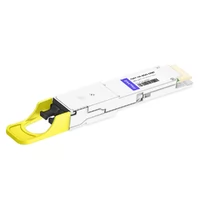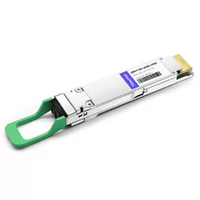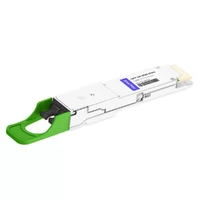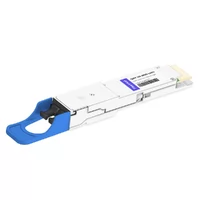

David repeated his examination of the spreadsheet three times during the morning hours. His team had budgeted $2.3 million for a complete switch refresh to support 800G. The lead engineer discovered a solution through his Reddit research about QSFP-DD 800G modules, which he found worked with their current 400G QSFP-DD switches.
David thought, “That can’t be right.” The switch vendor confirmed the information. A firmware update. That’s all they needed. The backward compatibility saved his project $1.8 million and three months of deployment time.
If you’re facing 800G decisions, you’re probably where David was. You must decide between different form factors while you handle migration issues, power system operation, and thermal performance uncertainties. The guide provides practical deployment instructions, which include module comparisons and the migration path for saving your budget
What you’ll learn: The actual distinctions between 800G QSFP-DD and OSFP, power consumption by module type, fiber requirements (spoiler: your 400G fiber probably works), and when you should deploy versus wait for 1.6T.
New to QSFP-DD? Start with our complete QSFP-DD guide for fundamentals.
Quick Reference: 800G Transceiver Types
All 800G modules compared in one view:
| Module Type | Reach | Fiber | Connector | Use Case |
| SR8 | 100m | OM4 multimode | MTP-16 or MTP-12 | Intra-rack, AI clusters |
| DR8 | 500m | OS2 single-mode | MTP-12 APC | Intra-building spine-leaf |
| 2FR4 | 2km | OS2 single-mode | LC duplex | Long-reach, breaks to 2×400G |
| FR4 | 2km | OS2 single-mode | LC duplex | Standard long-reach |
| LR4 | 10km | OS2 single-mode | LC duplex | DCI, campus interconnect |
Key insight: SR8 and DR8 use parallel optics (8 lanes). FR4/LR4 use 4 wavelengths at 200G each.
Understanding 800G QSFP-DD
What Makes 800G Different
800G delivers more speed than 400G because it provides double the lanes and increased signaling capacity.
400G QSFP-DD operates through 8 lanes, which transmit data at 50G PAM4 (8×50G = 400G). 800G QSFP-DD doubles that to 8 lanes at 100G PAM4 (8×100G = 800G). The form factor remains unchanged. The electrical interface doubles.
Switch design requires this information. An 800G-capable switch ASIC can handle 51.2T of total bandwidth. The system includes 64 ports, which operate at 800G. The same port density that gave you 25.6T at 400G now doubles your fabric capacity.
The timing isn’t accidental. AI/ML clusters generate more bandwidth demand than traditional workloads. A single NVIDIA H100 GPU pushes 400G of network traffic. A DGX H100 system with 8 GPUs saturates 3.2T. Scale that to 512 GPUs, and you need 800G at your spine layer just to maintain non-blocking connectivity.
Learn more about choosing the right transceiver in our optical transceiver selection guide.
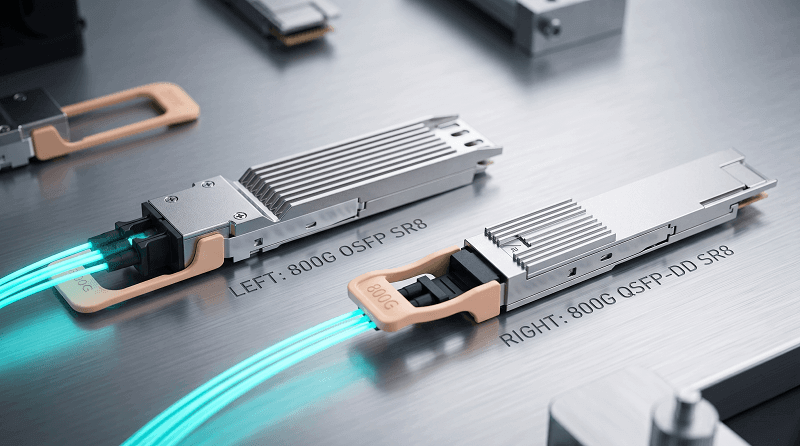
QSFP-DD vs OSFP at 800G
Here’s the decision that trips up most architects.
800G QSFP-DD standard supports existing 400G QSFP-DD systems. The two systems use identical ports and switches. The system needs a firmware update, but does not require any new hardware installation. The module combines two 400G interfaces into a single physical unit.
OSFP 800G was specifically designed to support 800G and all future bandwidth requirements. The product has a larger physical design than its previous version. The system provides improved thermal management, which operates effectively between 15 and 20 watts per module effectively. OSFP 400G exists as a separate standard, which does not allow any backward compatibility with QSFP-DD systems.
The decision matrix is simple:
| Deployment Type | Recommended Form Factor | Why |
| Existing 400G QSFP-DD infrastructure | QSFP-DD 800G | Backward compatibility saves hardware costs |
| Greenfield build, AI-focused | OSFP | Better thermal, future-proofed for 1.6T |
| Mixed environment | QSFP-DD | Flexibility to mix 400G and 800G |
Reddit insight: “QSFP-DD, if you have existing 400G QSFP-DD. OSFP is greenfield. Simple as that.”
800G Module Types Deep Dive
SR8 (Short Reach 8-lane)
The SR8 system operates over a distance of 100 meters, which utilizes OM4 multimode fiber. The system serves as the primary link between AI clusters through their intra-rack connections.
The 8-lane parallel design uses either MTP-16 (all 8 lanes in one row) or MTP-12 (using the outer 8 positions of a 12-fiber connector). Current deployments prefer MTP-12 because it works with existing MTP infrastructure.
The system requires between 12 and 15 watts of power. The power consumption exceeds 400G SR8 by 50 percent while the system achieves double the bandwidth.
Best for: GPU-to-switch connections within the same rack and top-of-rack to spine connections in high-density AI clusters.
DR8 (Direct Reach 8-lane)
The DR8 system transmits signals through its 500-meter range when using OS2 single-mode fiber. The SR8 system uses an 8-lane parallel design that operates with single-mode optical technology.
The MTP-12 APC connector is standard. The angled polish (APC) reduces back reflection, which matters at 100G lane rates.
SR8 requires 15-18W power consumption, which exceeds SR8 requirements. The single-mode lasers draw more power than VCSELs used in multimode modules.
Best for: Spine-leaf connections within the same data center building, 400G to 800G migration scenarios using breakout cables.
2FR4 (Dual 4-lane)
2FR4 presents its most exciting features through its dual operational system, which combines four 200G wavelength streams to create a single fiber pair transmission system. The system operates at a distance of two kilometers.
The LC duplex connector matches existing 100G/400G single-mode infrastructure. The system automatically creates two 400G FR4 connections from its 2FR4 configuration. The user requires a special breakout cable to transform one 800G port into two 400G ports.
The 800G modules reach their maximum power usage between 16 and 20 watts. The power requirements of the DSPs for PAM4 operation at 200G per wavelength exceed normal limits.
Best for: Mixed 400G/800G environments, longer spine connections between different network points, and all migration paths.
FR4 and LR4
FR4 (2km) and LR4 (10km) use the same four-wavelength approach as 2FR4, but as native 800G, not dual 400G.
Your current single-mode fiber plant remains operational because LC duplex connectivity allows its existing infrastructure to work without modification. The 10km reach of LR4 enables DCI and metro applications that parallel 800G modules cannot support.
Best for: Data center interconnect, campus networks, metro applications.
Power Consumption and Thermal Planning
800G uses 50% more power than 400G. Plan accordingly. For detailed thermal planning guidance, see our QSFP-DD power and thermal guide.
Here’s the power reality by module type:
| Module Type | Power per Module | 32-Port Switch Total | Thermal Output |
| 400G DR4 | 10-12W | 320-384W | 1,090-1,310 BTU/hr |
| 800G DR8 | 15-18W | 480-576W | 1,640-1,970 BTU/hr |
| 800G 2FR4 | 16-20W | 512-640W | 1,750-2,180 BTU/hr |
Based on 32 ports (16 ports at 800G = 32 ports at 400G equivalent bandwidth)
Thermal Planning Implications
The additional 150-200W per switch becomes a substantial power increase when you compute the total power needs for 100 switches within a fabric. The system shows an increase of 15-20kW power requirements because of this additional thermal load.
Switch power supplies need headroom. The 32-port 800G switch requires 800-1000W for optics power while the switch itself requires 400-600W. The minimum power requirement for each switch should be set at 1.5kW.
The cooling calculations require adjustments. Hot aisle containment becomes essential at 800G densities. Some data centers are moving to liquid cooling for top-of-rack switches in AI clusters.
Reddit insight: “Power is the real issue. 800G modules pull 15-20W vs 10-12W for 400G. Plan your thermal budget.”
Fiber and Cable Requirements
Your 400G fiber works for 800G. Mostly. For complete cable specifications, refer to our QSFP-DD cable compatibility guide.
Fiber Types for 800G
OM4 multimode handles SR8 to 100 meters. The fiber used for 400G SR8 operates through identical installation methods. For 100G lanes, you must maintain clean cable runs that meet required specifications because they are more affected by modal dispersion.
OS2 single-mode works for all single-mode 800G types (DR8, 2FR4, FR4, LR4). No changes needed. Your 10G signals from ten years ago still function through the same fiber network that now supports 800G connections.
MTP-12 APC is the connector standard for parallel 800G (SR8, DR8). The angled polish matters more at 100G lane rates. APC and UPC connectors should not be mixed because they use different standards.
The LC duplex system supports 2FR4, FR4, and LR4. The same patch cables you have been using remain available for use.
Breakout Configurations
Breakout cables get bulky at 800G.
| Configuration | Cable Type | Fiber Count | Notes |
| 800G → 4×200G | MTP-16 to 4×MTP-8 | 16 fibers | Thickest option |
| 800G → 2×400G | MTP-12 to 2×MTP-12 | 12 fibers | Common for migration |
| 800G 2FR4 → 2×400G FR4 | LC duplex to 2×LC duplex | 2 fibers | Cleanest breakout |
Reddit insight: “800G breakout cables are beasts. 4×200G breakouts are noticeably thicker than 400G equivalents. Cable management matters.”
400G to 800G Migration Path
The migration path is easier than you think.
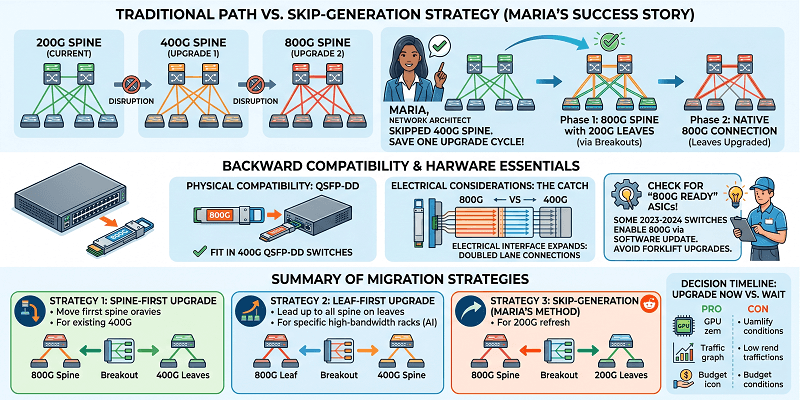
Maria had to decide between two competing options. Her team was on 200G spine switches. The obvious path led to 400 GB, which required an upgrade to 800G within a few years. Her CFO wanted to reduce operational disruptions.
“What if we skip 400G for the spine?” Maria asked. “Go straight to 800G and use breakouts to connect the 200G leaves.”
They did. The 800G spine provided them with three years of operational capacity. The team removed breakouts as they upgraded their leaves to 400G because they needed to establish native connections. The spine was operational for 800G because the leaves reached that capacity.
Her skip-generation strategy cut one full upgrade cycle from their roadmap.
Backward Compatibility
QSFP-DD 800G modules fit in 400G QSFP-DD switches with a catch. For a complete overview of 400G modules, see our 400G QSFP-DD module types guide.
The physical form factor remains unchanged. The electrical interface expands its capacity through doubled lane connections. Most 400G QSFP-DD switches need hardware upgrades to support 800G electrical signaling.
But some can. Some switch platforms that manufacturers released between 2023 and 2024 included 800G-capable ASICs, yet restricted their operation to 400G through software. A firmware update enables 800G functionality.
Check your switch specifications. Look for “800G ready” or similar language. Contact your vendor. The backward compatibility might enable you to avoid a forklift upgrade.
Migration Strategies
Strategy 1: Spine-first upgrade
- Upgrade spine switches to 800G
- Keep leaf switches at 400G using 800G→2×400G breakout cables
- Upgrade leaves to 800G natively over time
- Best for: Existing 400G deployments with healthy leaf switches
Strategy 2: Leaf-first upgrade
- Upgrade leaf switches to 800G where needed
- Connect to existing 400G spine using 800G→2×400G breakout
- Upgrade the spine when saturated
- Best for: Specific high-bandwidth racks (AI training clusters)
Strategy 3: Skip-generation
- Jump straight from 200G to 800G for the spine
- Use breakouts to maintain 200G leaf connectivity
- Upgrade leaves over 18-24 months
- Best for: 200G environments due for refresh
When to Upgrade
Upgrade now if:
- Building AI/ML infrastructure with 100+ GPUs
- The current fabric is oversubscribed during peak
- Existing hardware is due for replacement anyway
Wait if:
- Traditional workloads with stable bandwidth needs
- Budget constraints (800G still carries premium pricing)
- Can meet needs with 400G for 12+ months
Reddit insight: “800G is shipping now. If you’re building today, spec 800G-capable switches even if you start with 400G optics.”
800G in AI Clusters
AI is driving 800G adoption faster than any previous speed transition.
AI Workload Bandwidth Requirements
The single NVIDIA H100 GPU produces 400G of network traffic, which it uses for scale-out communication. The connection to other GPUs in the cluster operates through Ethernet or InfiniBand instead of NVLink.
The H200 produces higher output because it surpasses previous generations. The upcoming generation will achieve 800G output capacity for each GPU unit.
The mathematical process will continue without interruption. A 1,024-GPU cluster requires its two GPUs to establish non-blocking connectivity. The system requires 400T of total bandwidth because each GPU operates at 400G. The system requires 800G to either reduce switch requirements by half or expand cluster capacity to double its current size.
800G Spine-Leaf for AI
The standard design for AI networks establishes two spine layers that connect to multiple leaf switches through complete non-blocking paths.
Leaf layer: The system establishes connections between the leaf layer and GPU devices. The current standard operates at 400G, but the system will move to 800G when GPU usage increases.
Spine layer: The spine layer combines all leaf switches into one unified system. The industry now uses 800G as its standard bandwidth. Some hyperscalers now implement 800G technology at their leaf points while they plan to use 1.6T technology for their spine connections.
The NVIDIA Quantum-2 platform (InfiniBand) and Spectrum-X (Ethernet) both emphasize 800G for large-scale AI. ConnectX-7 NICs handle 400G. The ConnectX-8 system enables data transmission at 800G.
AI requires lossless networking for its operations. The implementation of RoCEv2 (RDMA over Converged Ethernet) needs proper setup of both PFC and ECN. 800G switches provide the necessary buffering capacity and scheduling capabilities to maintain lossless performance during large-scale operations.
1.6T Roadmap Preview
What comes after 800G? 1.6T is closer than you think.
1.6T Timeline
The IEEE 802.3dj task force is standardizing 1.6T Ethernet now. Expect final specifications in 2026. Products should follow in 2026-2027.
The signaling will likely be 200G PAM4 lanes—8 lanes at 200G for 1.6T total. That’s evolutionary from 800G’s 100G lanes.
QSFP-DD1600
The QSFP-DD MSA is already defining QSFP-DD1600. Same form factor. Same backward compatibility promise—1.6T, 800G, and 400G in the same port.
The power will increase. Expect 20-25W per module. Thermal design becomes even more critical.
Investment Protection
If you’re deploying 800G now, you’re not painting yourself into a corner. QSFP-DD1600 will fit the same switches as 800G QSFP-DD. The upgrade path is built in.
Deploy 800G now if:
- You need the bandwidth today
- Your switches are QSFP-DD1600-ready
- AI workloads are driving immediate requirements
Consider waiting if:
- 800G meets your needs for 24+ months
- You’re in a conservative industry with slower adoption
- Budget favors waiting for 1.6T maturity
FAQ
Can I use 800G QSFP-DD in 400G switches?
The 800G QSFP-DD connector can work with 400G switches under specific conditions. Your switch needs two requirements, which are an 800G-capable ASIC and firmware that the vendor enables. The switch specifications will show you 800 G-ready terminology. Physical compatibility is guaranteed. The switch hardware generation will determine electrical compatibility.
Which connector should I use for 800G between QSFP-DD and OSFP?
Choose QSFP-DD if you have existing 400G QSFP-DD infrastructure or need backward compatibility. Choose OSFP for new AI projects which prioritize thermal performance and 1.6T future-proofing above all other factors.
What is the power consumption rate for 800G?
The power consumption per module ranges from 15 to 20 watts, depending on the module type. The power consumption exceeds 400G by a range between 50 and 60 percent. You need to establish your power supply system for switches and your cooling system for the data center operations.
What is the fiber that provides the same specifications as 800G?
The system needs OM4 fibers for SR8 multimode operation. The system needs OS2 fibers for all other single-mode applications. The system requires MTP-12 APC connectors to connect its parallel optics components. The system requires LC duplex connectors to connect its wavelength-multiplexed modules. Your existing 400G fiber infrastructure works unchanged.
When should I upgrade to 800G?
Upgrade now if building AI/ML infrastructure with 100+ GPUs or if your current fabric is oversubscribed. You should wait until your workloads are stable and your 400G system can meet your needs for the next 12 months.
Is 800G worth it for non-AI workloads?
The answer to this question remains negative because the situation has not changed. A 400G capacity is usually enough to support normal enterprise workload demands. 800G provides value for high-frequency trading and video processing and scientific computing applications. Most enterprises should stay on 400G until 800G pricing normalizes.
Conclusion
David’s story isn’t unique. The 800G transition seems daunting until you understand the backward compatibility and migration options. The design of QSFP-DD 800G enables it to function with 400G switches according to its intended purpose.
Key takeaways:
- QSFP-DD 800G maintains backward compatibility with 400G infrastructure
- Power consumption jumps 50%—plan thermal budgets accordingly
- Your 400G fiber works for 800G. No cable plant replacement needed.
- Skip-generation strategies (200G→800G) can simplify upgrade cycles
- AI clusters are driving adoption, but traditional workloads may wait
The 1.6T horizon doesn’t invalidate 800G investment. QSFP-DD1600 will fit the same ports. Deploy 800G when your bandwidth requirements demand it.
Ready to plan your 800G deployment? Contact FiberMall’s technical team for migration planning, module selection, and compatibility verification. We’ve guided dozens of data centers through the 400G to 800G transition.
Explore our complete range of 800G QSFP-DD transceivers and high-speed optical connectivity solutions for your next-generation network infrastructure.
Related Products:
-
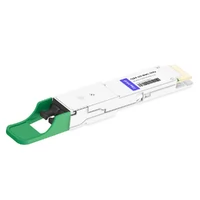
 QSFP-DD-800G-DR8D QSFP-DD 8x100G DR PAM4 1310nm 500m DOM Dual MPO-12 SMF Optical Transceiver Module
$1000.00
-
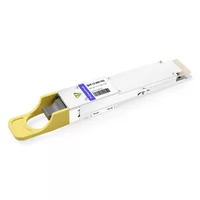
QSFP-DD-800G-FR8L QSFP-DD 800G FR8 PAM4 CWDM8 2km DOM Duplex LC SMF Optical Transceiver Module
$3000.00
-
QSFP-DD-800G-2LR4L QSFP-DD 2x400G LR4 PAM4 CWDM4 10km Dual duplex LC SMF FEC Optical Transceiver Module
$2000.00
-
QSFP-DD-800G-2LR4 QSFP-DD 2x400G LR4 PAM4 CWDM4 10km Dual CS SMF FEC Optical Transceiver Module
$2100.00
-
QSFP-DD-800G-2FR4L QSFP-DD 2x400G FR4 PAM4 CWDM4 2km DOM Dual duplex LC SMF Optical Transceiver Module
$1800.00
-
QSFP-DD-800G-LR8D QSFP-DD 8x100G LR PAM4 1310nm 10km Dual MPO-12 SMF FEC Optical Transceiver Module
$1500.00
-
QSFP-DD-800G-LR8 QSFP-DD 8x100G LR PAM4 1310nm 10km MPO-16 SMF FEC Optical Transceiver Module
$1450.00
-
QSFP-DD-800G-FR8D QSFP-DD 8x100G FR/DR8+ PAM4 1310nm 2km DOM Dual MPO-12 SMF Optical Transceiver Module
$1300.00
-
QSFP-DD-800G-FR8 QSFP-DD 8x100G FR PAM4 1310nm 2km DOM MPO-16 SMF Optical Transceiver Module
$1200.00
-
QSFP-DD-800G-2FR4 800G QSFP-DD 2FR4 PAM4 1310nm 2km DOM Dual CS SMF Optical Transceiver Module
$1900.00
-
QSFP-DD-800G-DR8 800G-DR8 QSFP-DD PAM4 1310nm 500m DOM MTP/MPO-16 SMF Optical Transceiver Module
$1000.00
-
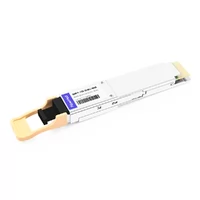
QSFP-DD-800G-SR8 800G SR8 QSFP-DD 850nm 100m OM4 MMF MPO-16 Optical Transceiver Module
$750.00