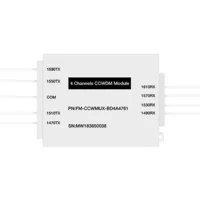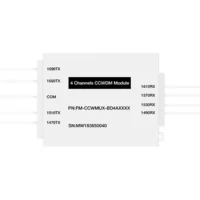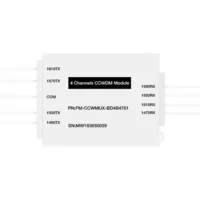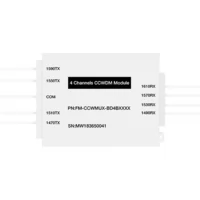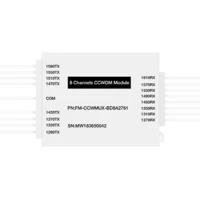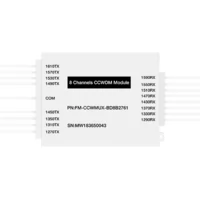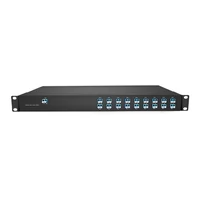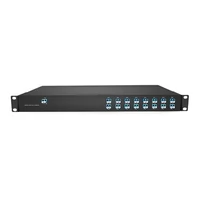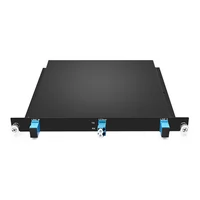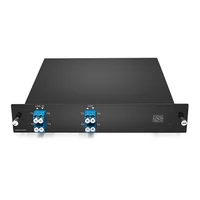

A CCWDM (Compact CWDM) module performs the same wavelength multiplexing and demultiplexing functions as a conventional CWDM module, but uses a more compact optical architecture. By integrating thin-film filters into a free-space micro-optical assembly, it reduces internal fiber interconnections and can lower insertion loss while significantly reducing package size.
Both technologies use the same 20 nm CWDM wavelength grid, so compatible CWDM transceivers can operate with either type. The difference lies in construction, optical performance, packaging, and cost.
The advantages, however, are not uniform. A compact module does not automatically deliver lower insertion loss than every conventional CWDM configuration. Its performance depends on channel count, fiber topology, wavelength allocation, and the specific product being compared.
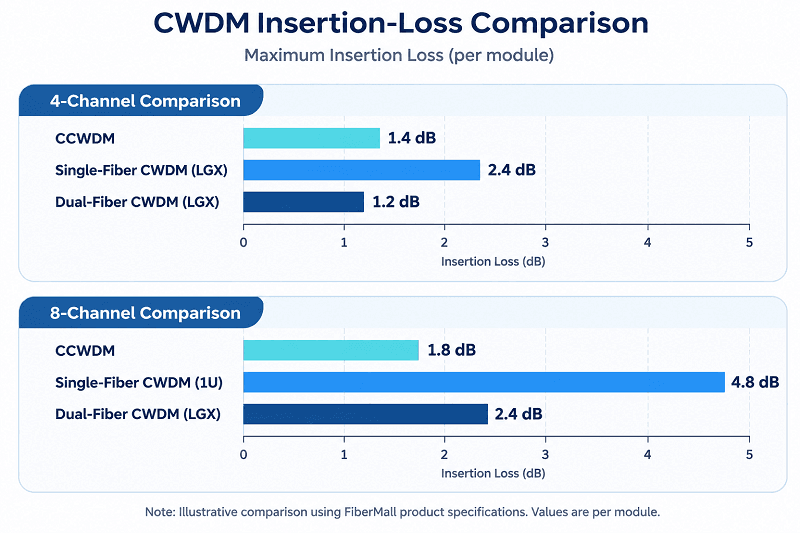
Consider a 4-channel deployment. FiberMall’s compact CWDM module specifies a maximum insertion loss of 1.4 dB per module. Its conventional 4-channel single-fiber CWDM alternative specifies 2.4 dB, while the dual-fiber LGX version specifies 1.2 dB.
The comparison changes again at eight channels. The compact module specifies 1.8 dB, compared with 4.8 dB for the conventional single-fiber 1U module and 2.4 dB for the dual-fiber LGX version.
This article explains the optical mechanism, compares actual product specifications and prices, and identifies when compact CWDM is the better investment.
Key Takeaways
- CCWDM and conventional CWDM use the same 20 nm ITU-T G.694.2 wavelength grid. The difference is optical construction and packaging, not transmission protocol.
- Compact free-space architecture reduces internal fiber interconnections and collimator-pair losses.
- At four channels, FiberMall’s CCWDM has 1.0 dB lower specified insertion loss than its single-fiber conventional CWDM alternative, but 0.2 dB higher loss than its dual-fiber LGX alternative.
- At eight channels, the CCWDM has 3.0 dB lower specified insertion loss than the single-fiber 1U alternative and 0.6 dB lower loss than the dual-fiber LGX alternative.
- These figures are per module. A complete link normally includes both a MUX and a DEMUX, so both devices must be included in the link budget.
- Compact CWDM is particularly useful in space-constrained installations. Conventional LGX and 1U modules can remain the better choice when rack mounting, labeling, maintenance, or specific fiber configurations matter more.
What Is CCWDM?
CCWDM stands for Compact Coarse Wavelength Division Multiplexing. It is a miniaturized implementation of CWDM that uses thin-film filters in a compact free-space optical assembly.
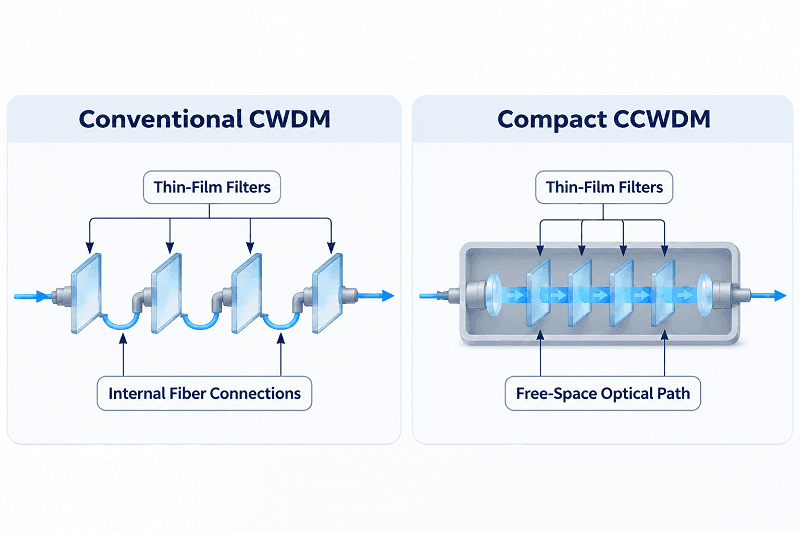
Unlike many conventional CWDM modules, which connect individual three-port filters through internal fiber pigtails and splices, CCWDM integrates the optical components into a shared micro-optical structure.
The result is a smaller package with fewer internal fiber connections and potentially lower insertion loss.
The wavelength grid remains unchanged
CCWDM follows the same ITU-T G.694.2 CWDM wavelength grid as conventional CWDM.
The grid defines nominal center wavelengths from 1271 nm to 1611 nm at 20 nm intervals. Product catalogs may use the corresponding rounded labels of 1270 nm to 1610 nm.
This means CCWDM does not introduce a new wavelength standard or require a different transmission protocol.
However, transceiver compatibility still depends on the exact wavelength allocation.
For example, a single-fiber bidirectional CCWDM system requires complementary transmit and receive wavelengths at the two endpoints. The A-side and B-side modules must be matched to the corresponding transceiver wavelength plan.
The passband is also a product specification rather than an automatic guarantee of the wavelength-grid standard. FiberMall’s 4-channel and 8-channel products discussed here specify an ITU ±6.5 nm passband.
For more information, see the ITU-T G.694.2 CWDM wavelength grid.
A note on CCWDM terminology
In this article, CCWDM refers specifically to compact CWDM modules.
It is not a separate wavelength-grid standard or a different WDM transmission protocol. Buyers should always check the product’s actual optical architecture, wavelength plan, and datasheet rather than relying on the acronym alone.
How Free-Space Construction Reduces Insertion Loss and Size
To understand why CCWDM can achieve lower insertion loss, it helps to look at how conventional CWDM modules are constructed.
The conventional three-port filter cascade
A conventional CWDM MUX typically uses a series of thin-film filters connected through short fiber pigtails and optical splices.
Each filter separates or combines a specific wavelength while allowing the remaining wavelengths to continue through the optical path.
As light passes through successive stages, it encounters multiple optical interfaces. Collimator-to-collimator coupling loss and filter loss accumulate along the path.
The last channel in a cascade typically experiences more accumulated loss than channels that pass through fewer stages.
This is one reason conventional CWDM datasheets often specify a worst-case insertion-loss value rather than a single typical value.
The collimator-pair advantage
The main optical advantage of a free-space design is that it can reduce the number of collimator pairs required for wavelength multiplexing and demultiplexing.
A 2005 technical article published by Lightwave, Compact CWDM Devices Offer Performance, Economic Advantages, compared conventional three-port cascaded filters with CCWDM designs.
Under the assumptions used in its theoretical model, the estimated worst-case insertion losses were:
| Channel Count | Three-Port Cascade | CCWDM |
| 4 channels | 0.97 dB | 0.37 dB |
| 8 channels | 1.79 dB | 0.39 dB |
The article also reported measurements from an eight-channel comparison:
- Conventional cascaded CWDM: approximately 2.1 dB average insertion loss.
- CCWDM: approximately 0.82 dB average insertion loss.
- Channel-to-channel loss spread: approximately 1.5 dB for the conventional design versus 0.4 dB for CCWDM.
These are historical research results from specific designs, not guaranteed specifications for modern commercial modules. They demonstrate the potential advantage of reducing collimator-pair losses, but actual performance must be verified against the current product datasheet.
What changes in free space?
In a compact module, thin-film filters and collimating optics are integrated into a smaller optical assembly. Light travels between optical components through a free-space path rather than through multiple internal fiber connections.
This reduces the number of internal fiber interconnections and can reduce accumulated coupling loss.
The filters themselves are not eliminated. Their optical filtering functions remain necessary.
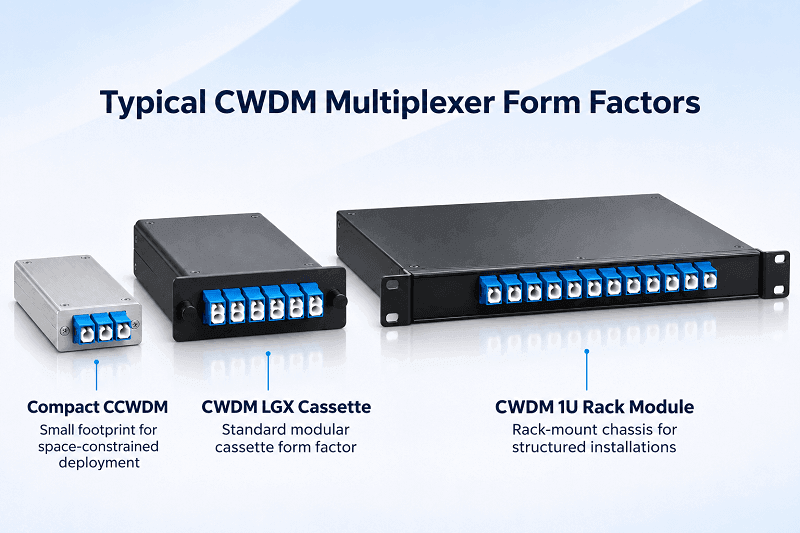
The smaller architecture also reduces the space needed for internal fiber routing. This allows compact modules to fit into smaller equipment enclosures, line cards, and field installations.
FiberMall’s 4-channel and 8-channel compact modules use an aluminum housing measuring approximately 8 × 35 × 55 mm.
One important consideration remains: external pigtails and patch cords still require appropriate bend-radius management and strain relief.
CCWDM vs CWDM: The Comparison That Matters
The most useful comparison is not simply compact versus conventional. It is the comparison between actual products with the same channel count and a clearly identified fiber topology.
The following specifications are taken from FiberMall’s listed product configurations.
Four-channel comparison
| Parameter | 4CH CCWDM | Single-Fiber CWDM LGX | Dual-Fiber CWDM LGX |
| Fiber configuration | Single fiber | Single fiber | Dual fiber |
| Maximum insertion loss | ≤1.4 dB | ≤2.4 dB | ≤1.2 dB |
| Listed price | $120 | $150 | $150 |
| Package | Aluminum box | LGX | LGX |
The 4-channel CCWDM has 1.0 dB lower specified insertion loss than the conventional single-fiber LGX alternative.
However, the dual-fiber LGX version specifies 1.2 dB, which is 0.2 dB lower than the compact module.
This is an important distinction: CCWDM is not automatically the lowest-loss option at every channel count and fiber configuration.
Eight-channel comparison
| Parameter | 8CH CCWDM | Single-Fiber CWDM 1U | Dual-Fiber CWDM LGX |
| Fiber configuration | Single fiber | Single fiber | Dual fiber |
| Maximum insertion loss | ≤1.8 dB | ≤4.8 dB | ≤2.4 dB |
| Listed price | $500 | $320 | $280 |
| Package | Aluminum box | 1U rack | LGX |
At eight channels, CCWDM offers a more noticeable insertion-loss advantage.
Compared with the single-fiber 1U module, the difference is 3.0 dB per module. Compared with the dual-fiber LGX module, the difference is 0.6 dB per module.
However, the compact module also costs more.
Important comparison notes:
- The insertion-loss values are maximum specifications for individual modules, not complete-link measurements.
- The listed prices are per product unit, not the price of a complete end-to-end MUX/DEMUX system.
- The wavelength allocations are not identical across all configurations. Buyers must verify the exact Tx/Rx wavelengths, fiber topology, connector configuration, and A/B side before comparing products.
- These specifications are product-specific examples, not universal performance limits for all CCWDM or CWDM manufacturers.
For a wider selection of conventional configurations, see FiberMall’s CWDM MUX/DEMUX range.
How the CCWDM Insertion-Loss Advantage Changes With Channel Count
Insertion loss is one of the most important factors when choosing a CCWDM module, especially when the optical link has limited power margin.
Based on FiberMall’s published specifications, the advantage depends on which conventional CWDM configuration is used as the baseline.
Four channels: The comparison depends on fiber topology
For a single-fiber design:
- Conventional CWDM: ≤2.4 dB.
- CCWDM: ≤1.4 dB.
- Difference: 1.0 dB per module.
For a dual-fiber design:
- Conventional CWDM: ≤1.2 dB.
- CCWDM: ≤1.4 dB.
- Difference: CCWDM has 0.2 dB higher specified loss per module.
The compact module therefore provides a clear loss advantage over the listed single-fiber conventional product, but not over the listed dual-fiber LGX product.
Eight channels: A larger difference against conventional single-fiber CWDM
For a single-fiber design:
- Conventional CWDM 1U: ≤4.8 dB.
- CCWDM: ≤1.8 dB.
- Difference: 3.0 dB per module.
For a dual-fiber design:
- Conventional CWDM LGX: ≤2.4 dB.
- CCWDM: ≤1.8 dB.
- Difference: 0.6 dB per module.
In these particular product comparisons, the gap against conventional single-fiber CWDM becomes larger at eight channels.
This does not establish a universal rule for every manufacturer or architecture. The actual result depends on the filter arrangement, number of optical interfaces, wavelength plan, and product design.
Why the MUX and DEMUX must both be counted
A common mistake is to compare only the insertion loss of one module.
In a complete point-to-point WDM link, the optical signal normally passes through a MUX at one end and a DEMUX at the other.
Therefore, both devices must be included in the link budget.
For example, using the eight-channel specifications above:
| Configuration | MUX Loss | DEMUX Loss | Combined Loss |
| CCWDM | 1.8 dB | 1.8 dB | 3.6 dB |
| Single-fiber CWDM 1U | 4.8 dB | 4.8 dB | 9.6 dB |
| Dual-fiber CWDM LGX | 2.4 dB | 2.4 dB | 4.8 dB |
These calculations assume the same maximum specification applies to both devices.
The potential end-to-end insertion-loss saving is therefore 6.0 dB against the single-fiber 1U configuration and 1.2 dB against the dual-fiber LGX configuration.
What the Loss Difference Means for a Link Budget
A lower-loss MUX/DEMUX provides more available optical power margin, but it does not automatically guarantee a longer transmission distance.
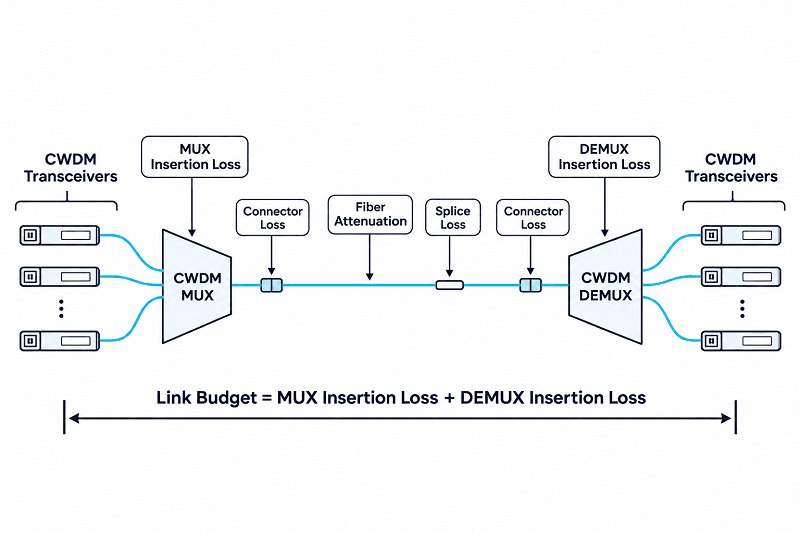
The complete optical link budget must account for:
- Fiber attenuation.
- MUX insertion loss.
- DEMUX insertion loss.
- Connector and patch-cord losses.
- Splice losses.
- Other passive optical components.
- Engineering margin.
The basic calculation is:
Total link loss = Fiber loss + MUX loss + DEMUX loss + Connector loss + Splice loss + Other passive losses.
The total must remain within the optical power budget of the selected transceivers.
Consider wavelength-dependent fiber attenuation
For CWDM systems, using one fiber attenuation figure for all channels can produce an inaccurate link budget.
Fiber attenuation varies with wavelength. This is particularly important when a module covers a broad wavelength range such as 1270–1610 nm.
The ITU-T G.652 recommendation provides different representative link attenuation values for different wavelength regions. For example, its representative values include approximately 0.5 dB/km in the 1260–1360 nm region, 0.275 dB/km in the 1530–1565 nm region, and 0.35 dB/km in the 1565–1625 nm region.
Actual installed fiber performance should be checked using measurement data and the appropriate fiber specification.
Older G.652 fiber also requires attention around the 1383 nm water-peak region. This can affect channels near that wavelength, depending on the fiber type and condition.
Refer to the ITU-T G.652 recommendation when preparing a wavelength-specific link budget.
Does a lower-loss MUX extend transmission distance?
It can improve the available link margin, but the distance benefit depends on the fiber attenuation at the operating wavelength and the complete optical system.
A 3 dB improvement in MUX/DEMUX loss may be valuable on a marginal link. However, it does not automatically turn an 80 km system into a 120 km system.
The selected transceiver must also support the required reach and wavelength. Chromatic dispersion, receiver sensitivity, transmitter power, and receiver overload limits must all be checked.
The correct approach is to calculate each CWDM channel separately and confirm that the complete link meets the transceiver specifications with sufficient engineering margin.
When Compact CWDM Is the Right Buy
CCWDM is most attractive when package size, fiber availability, and insertion-loss requirements justify its higher or comparable cost.
Choose CCWDM when space is the main constraint
Compact modules are particularly useful in:
- Street cabinets.
- Outdoor telecommunications enclosures.
- Pole-mounted equipment.
- Splice closures.
- Remote radio sites.
- Compact access network equipment.
- High-density equipment installations.
An 8 × 35 × 55 mm aluminum housing can be easier to accommodate in a small enclosure than a conventional LGX cassette or 1U rack module.
In these environments, installation space may matter more than conventional rack compatibility.
Choose CCWDM when insertion-loss margin matters
The eight-channel comparison is particularly relevant.
A 3 dB per-module difference against the listed single-fiber conventional CWDM product can provide meaningful additional link margin.
For an existing network with limited optical power margin, this may make a practical difference.
However, buyers should compare the complete MUX/DEMUX path rather than relying on a single module’s specification.
Choose standard LGX or 1U when maintenance matters more
Conventional CWDM modules are often easier to integrate into standard telecommunications racks.
An LGX cassette or 1U module provides a more familiar mounting arrangement, more structured cable management, and easier access to front-panel ports and labels.
For a network that requires frequent maintenance, rearrangement, or port identification, these practical benefits can outweigh the compact module’s size advantage.
Four channels: Which one makes more sense?
The four-channel comparison is straightforward:
- If the design uses single-fiber CWDM, the compact module has lower specified insertion loss and a $30 lower listed price.
- If the design uses dual-fiber CWDM, the LGX version has lower specified insertion loss at the same listed price.
The decision should therefore start with the available fiber topology rather than package size alone.
Eight channels: Is the extra cost justified?
The eight-channel CCWDM costs more:
- $180 more than the single-fiber 1U alternative.
- $220 more than the dual-fiber LGX alternative.
In return, it offers lower specified insertion loss and a much smaller package.
Whether the additional cost is justified depends on how much the improved optical margin and smaller footprint matter to the actual deployment.
The Operational Cost of Compact Modules
A smaller module is not necessarily easier to maintain.
An aluminum-box CCWDM module may provide less space for front-panel identification and structured cable management than an LGX cassette.
If it is installed loosely inside an enclosure, cable movement can put stress on the fiber connections or make the module difficult to identify during maintenance.
Before deployment, plan for:
- Secure mechanical mounting.
- Proper fiber strain relief.
- Clearly marked A-side and B-side modules.
- Consistent port identification.
- A documented wavelength-to-port mapping.
- Sufficient clearance for fiber routing and bend radius.
These details are particularly important in outdoor cabinets and remote installations where technicians may not have frequent access to the equipment.
For a frequently maintained rack installation, a conventional LGX module may be operationally simpler even when a compact module could technically fit.
What FiberMall Lists and How to Specify It
FiberMall’s currently listed compact CWDM product configurations include 4-channel and 8-channel single-fiber bidirectional modules in aluminum housings.
The 4-channel version supports four wavelength pairs, or eight wavelengths in total. The 8-channel version supports eight wavelength pairs, or sixteen wavelengths in total.
Both require the correct A/B pairing for single-fiber bidirectional transmission.
Current product and price comparison
The following are the prices displayed on the product pages when this article was reviewed.
| Product | Maximum Insertion Loss | Listed Price |
| 4CH CCWDM | ≤1.4 dB | $120 |
| 8CH CCWDM | ≤1.8 dB | $500 |
| 4CH single-fiber CWDM LGX | ≤2.4 dB | $150 |
| 8CH single-fiber CWDM 1U | ≤4.8 dB | $320 |
| 4CH dual-fiber CWDM LGX | ≤1.2 dB | $150 |
| 8CH dual-fiber CWDM LGX | ≤2.4 dB | $280 |
Prices are indicative and subject to change. They represent individual listed products, not complete end-to-end systems. Confirm the required MUX/DEMUX units and A/B configurations when requesting a quotation.
Browse the FiberMall Compact CWDM Module range or the standard CWDM MUX/DEMUX range.
What should you specify when ordering?
For a CCWDM MUX/DEMUX system, provide the following information:
- Channel count: 4, 8, or another required configuration.
- Wavelength plan: Exact wavelengths for each channel, including Tx/Rx assignments.
- Fiber topology: Single-fiber bidirectional or dual-fiber.
- A/B configuration: Whether matched A-side and B-side modules are required.
- Connector type and polish: LC, SC, or FC, with UPC or APC.
- Fiber type: Such as G.652.D or G.657.A1, depending on the application.
- Package and mounting: Aluminum box, LGX, 1U, or a custom enclosure.
- Special ports: Whether a monitor, express, upgrade, or 1310 nm port is required.
The required insertion-loss limit and operating-temperature range should also be specified.
A quotation based only on channel count may not provide the correct optical configuration.
Frequently Asked Questions
What does CCWDM stand for?
CCWDM stands for Compact Coarse Wavelength Division Multiplexing. It refers to a miniaturized CWDM MUX/DEMUX implementation that commonly uses thin-film filters and a compact free-space optical architecture.
Is CCWDM better than conventional CWDM?
It depends on the application.
CCWDM offers a smaller package and can provide lower insertion loss than conventional cascaded CWDM designs.
However, FiberMall’s 4-channel dual-fiber LGX product specifies 1.2 dB insertion loss, compared with 1.4 dB for its 4-channel CCWDM.
The correct choice depends on fiber topology, channel count, optical budget, price, and installation requirements.
Does CCWDM work with regular CWDM transceivers?
Yes. CCWDM uses the same nominal 20 nm ITU-T G.694.2 wavelength grid.
Compatible CWDM transceivers can be used, provided their wavelengths match the MUX/DEMUX channel plan.
For single-fiber bidirectional systems, matched A/B modules and complementary Tx/Rx wavelengths are required.
Does CCWDM really have lower insertion loss?
Not in every comparison.
Based on FiberMall’s listed specifications:
- At four channels, CCWDM is 1.0 dB lower than single-fiber conventional CWDM but 0.2 dB higher than dual-fiber LGX.
- At eight channels, CCWDM is 3.0 dB lower than single-fiber 1U CWDM and 0.6 dB lower than dual-fiber LGX.
Always compare the actual product datasheets and account for both MUX and DEMUX insertion loss.
Can I get a 16-channel or 18-channel CCWDM?
Compact CWDM products with 16 or 18 channels are available from the wider market.
FiberMall’s currently listed standard compact product selections focus on 4-channel and 8-channel configurations. For higher channel counts or customized wavelength combinations, contact FiberMall to confirm availability.
The standard CWDM MUX/DEMUX range also supports higher channel-count configurations.
Is CCWDM single-fiber or dual-fiber?
Both compact and conventional CWDM architectures can be designed for different fiber topologies.
FiberMall’s currently listed compact CCWDM products are single-fiber bidirectional modules supplied in matched A/B configurations.
The standard CWDM range includes both single-fiber and dual-fiber options.
Do I need a special installation enclosure for CCWDM?
Not necessarily.
The compact aluminum housing can be integrated into a suitable equipment enclosure, field tray, or other mounting arrangement.
However, secure mounting, strain relief, fiber bend radius, and clear port identification should be planned before installation.
How do I know whether CCWDM will improve my link budget?
Compare the maximum insertion loss of the complete MUX/DEMUX path with the selected transceiver’s optical budget.
Include fiber attenuation, connector losses, splice losses, other passive components, and engineering margin.
For multi-channel CWDM systems, calculate the link budget separately for each operating wavelength.
Choosing the Right Module
CCWDM is both a packaging improvement and a potential optical-performance improvement.
Its free-space architecture reduces internal fiber interconnections and collimator-pair losses, helping to achieve a smaller package and lower insertion loss in many configurations.
However, the size and loss advantages do not always point in the same direction.
At four channels, the compact module performs better than the listed single-fiber conventional CWDM product but has slightly higher insertion loss than the dual-fiber LGX version.
At eight channels, it provides a more substantial insertion-loss advantage over conventional single-fiber CWDM, although the compact module costs more than either listed LGX or 1U alternative.
The practical decision comes down to three questions:
- How many wavelength channels do you need?
- Which fiber topology and wavelength allocation does your network require?
- Does the smaller package or lower insertion loss justify the additional cost?
If rack space is readily available and maintenance simplicity is the priority, a conventional LGX or 1U module may be the better investment.
If installation space is limited or the optical link has a tight loss budget, CCWDM deserves closer consideration.
Before placing an order, compare the exact product specifications, calculate the complete MUX/DEMUX link loss, and confirm the A/B wavelength pairing.
For help selecting the appropriate configuration, contact FiberMall’s optical engineering team with your channel plan and link-budget requirements.
Related Products:
-
 Passive CCWDM Single Fiber Wavelengths Mux Aluminum Box Module 4CH 8 Wavelengths (TX: 1470/1510/1550/1590nm RX: 1490/1530/1570/1610nm)
$120.00
-
Passive CCWDM Single Fiber Wavelengths Mux Aluminum Box Module 4CH 8 Wavelengths (TX: 1xx0/1xx0/1xx0/1xx0nm RX: 1xx0/1xx0/1xx0/1xx0nm)
$250.00
-
Passive CCWDM Single Fiber Wavelengths Mux Aluminum Box Module 4CH 8 Wavelengths (TX: 1490/1530/1570/1610nm RX: 1470/1510/1550/1590nm )
$120.00
-
Passive CCWDM Single Fiber Wavelengths Mux Aluminum Box Module 4CH 8 Wavelengths (TX: 1xx0/1xx0/1xx0/1xx0nm RX: 1xx0/1xx0/1xx0/1xx0nm)
$250.00
-
Passive CCWDM Single Fiber Wavelengths Mux Aluminum Box Module 8CH 16 Wavelengths (TX: 1290/1330/1370/1430/1470/1510/1550/1590nm RX: 1270/1310/1350/1450/1490/1530/1570/1610nm)
$500.00
-
Passive CCWDM Single Fiber Wavelengths Mux Aluminum Box Module 8CH 16 Wavelengths (TX: 1270/1310/1350/1450/1490/1530/1570/1610nmnm RX: 1290/1330/1370/1430/1470/1510/1550/1590nm)
$500.00
-
Passive CWDM Double Fiber Mux & Demux Module 18 CH (1270-1610nm) LC/UPC 1U Rack
$630.00
-
Passive CWDM Double Fiber Mux & Demux Module 16 CH (1310-1610nm) 1U Rack
$570.00
-
CWDM MUX 8CH 16 Wavelengths (TX: 1310/1330/1390/1410/1470/1490/1550/1570nm RX: 1350/1370/1430/1450/1510/1530/1590/1610nm) LC/UPC Single Fiber 1U Rack
$320.00
-
Passive CWDM Double Fiber Mux & Demux Module 8CH (1470-1610nm) LC/UPC LGX BOX
$280.00
-
CWDM MUX 4CH 8 Wavelengths (TX: 1470/1490/1510/1530nm RX: 1550/1570/1590/1610nm) with Express Port LC/UPC Single Fiber LGX BOX
$150.00
-
Passive CWDM Double Fiber Mux & Demux Module 4 CH (1470-1530nm) LC/UPC LGX BOX
$150.00
-
Passive CWDM Single Fiber 1 Channel OADM LGX BOX
$70.00
-
Passive CWDM Double Fiber 2 Channels OADM LGX BOX
$130.00
-
Passive CWDM Double Fiber 4 Channels OADM LGX BOX
$250.00
-
SFP-CW10G27-40C 10G CWDM SFP+ 1270nm 40km LC SMF DDM Transceiver Module
$95.00
-
SFP-CW10G27-10C 10G CWDM SFP+ 1270nm 10km LC SMF DDM Transceiver Module
$60.00
-
SFP-CW10G59-05C 10G CWDM SFP+ 1590nm 5km LC SMF DDM Transceiver Module
$60.00
-
SFP-CW10G27-20C 10G CWDM SFP+ 1270nm 20km LC SMF DDM Transceiver Module
$75.00
-
SFP-CW10G47-100C 10G CWDM SFP+ 1470nm 100km LC SMF DDM Transceiver Module
$280.00