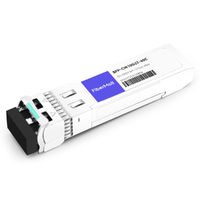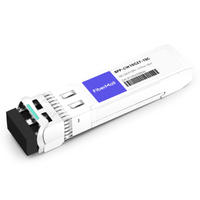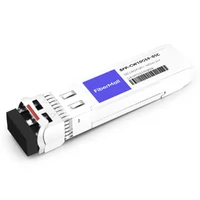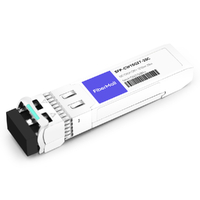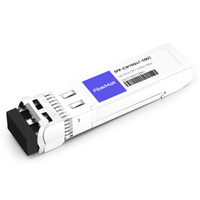

5G fronthaul CWDM can carry six independent 25G channels over a single fiber pair at distances of up to 10 km with suitable transceivers and a properly engineered optical budget. FiberMall’s 25G CWDM SFP28 1270 nm module is listed at $50, only $5 more than a standard 25G LR module. In a six-sector deployment, six dedicated fiber pairs can be replaced by one fiber pair. Whether that trade makes financial sense comes down to a question most design guides overlook: how many spare fiber strands do you actually have, and what would installing new ones cost?
That question often determines fronthaul architecture more than any individual optical specification. Radio sites are built where fiber infrastructure already exists, not necessarily where bandwidth would be most convenient. When a site has only two spare strands and three sectors to serve, fiber availability can become a bigger challenge than the optical equipment itself.
This guide explains which WDM technologies fit a 25G fronthaul link, why six low-cost O-band CWDM channels are a practical design choice, how higher wavelengths and alternative WDM technologies expand capacity, and what a realistic bill of materials looks like using FiberMall’s listed prices. If you need more information about module selection, the SFP28 5G fronthaul guide covers CPRI, eCPRI, and link-budget calculations in detail.
Key Takeaways
- A low-cost 25G CWDM fronthaul design can use six wavelengths from 1271 to 1371 nm over one fiber pair at up to 10 km, subject to the selected transceiver specifications and optical link budget.
- FiberMall’s 1270 nm 25G CWDM SFP28 module is listed at $50, compared with $45 for a standard 25G LR module. This represents an approximately 11% module-price premium.
- The upper CWDM wavelengths are not universally unusable at 25G. Their feasibility depends on laser type, chromatic dispersion tolerance, receiver sensitivity, and transmission distance. EML-based modules can support higher-wavelength applications at a higher cost.
- MWDM provides a denser O-band wavelength plan using alternating 7 nm and 13 nm channel spacing. ITU-T G.698.6 defines 25 Gbit/s WDM applications optimized for 5 km transmission distances.
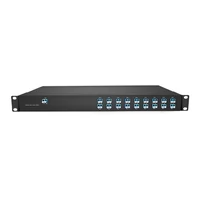
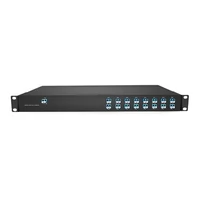
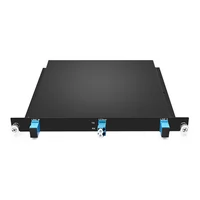
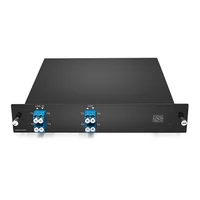
- FiberMall’s standard passive CWDM MUX/DEMUX lineup does not include a standard six-channel dual-fiber model. A customizable 8-channel dual-fiber MUX/DEMUX is an available alternative, subject to confirmation of the required wavelength configuration.
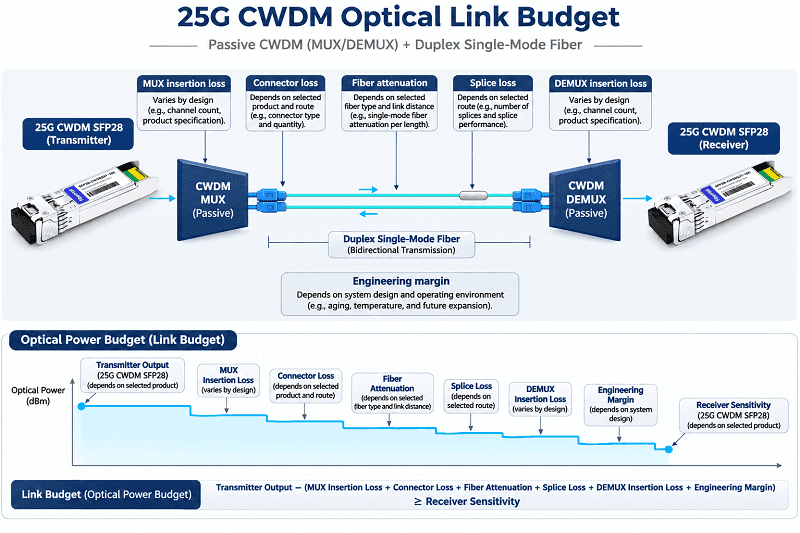
- MUX insertion loss must be included in the optical budget. An 8-channel dual-fiber MUX/DEMUX listing specifies insertion loss of up to 2.4 dB per device, meaning a pair can contribute up to 4.8 dB.
What 5G Fronthaul CWDM Actually Solves
Fronthaul transports digitized radio signals between the radio unit (RU) at a tower and the distributed unit (DU) at a centralized baseband location. It differs from backhaul, which carries aggregated traffic from the baseband network toward the core network. In C-RAN and O-RAN architectures, fronthaul endpoints can be several kilometers apart, and the traffic between them is typically transported over optical fiber.
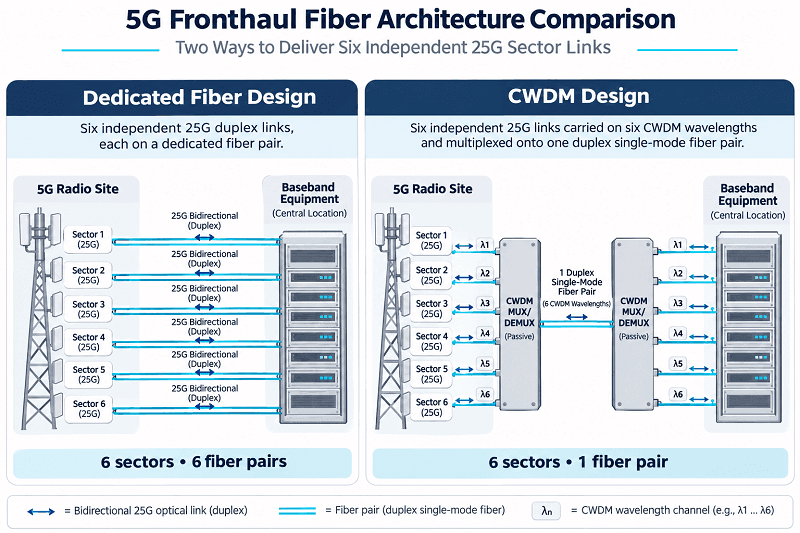
The per-site bandwidth is not always the main problem. Consider a modern 5G macro site with three sectors. If each sector requires one dedicated duplex 25G fronthaul link, the site needs three fiber pairs, or six strands. If each sector requires two independent duplex links, that requirement increases to six fiber pairs, or twelve strands.
The number of fiber strands is determined by the RU configuration, the number of optical links, and the network architecture. MIMO configurations such as 2×2 or 4×4 do not directly determine fiber-core requirements.
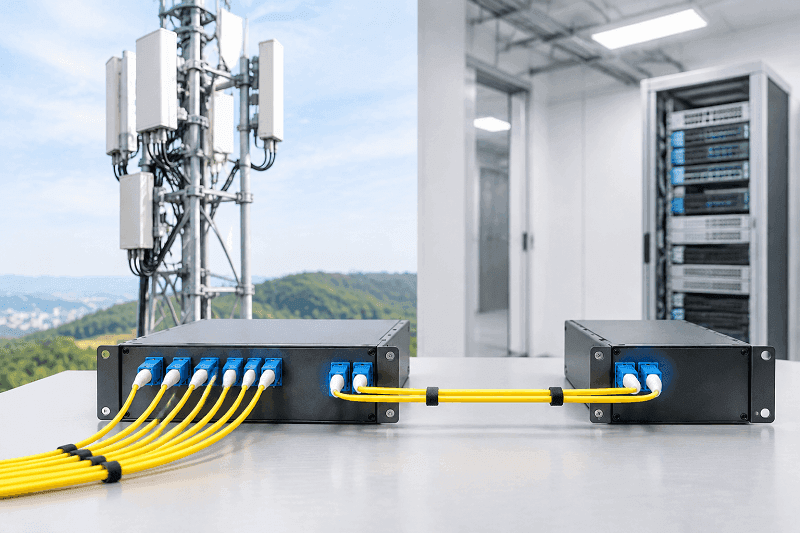
CWDM addresses this fiber-capacity challenge. Instead of assigning a separate fiber pair to every radio link, each link is assigned a different wavelength. A passive MUX at one end combines the wavelengths, while a DEMUX at the other end separates them. In a dual-fiber configuration, a second fiber carries traffic in the opposite direction.
The passive MUX/DEMUX requires no external power, cooling, or active network management. This makes it attractive for sites where adding active transport equipment would increase deployment and maintenance costs.
What has changed is the economics. As 25G CWDM optics have become more affordable, the savings from using fewer fiber strands can justify a passive WDM architecture without requiring a more expensive active transport platform.
Planning a rollout? FiberMall’s engineers can help map each site to a suitable channel plan, evaluate the optical budget, and check product availability. Request a fronthaul quotation.
The Six-Channel O-Band Plan and Its Practical Limits
The fronthaul channel plan is one of the most important parts of this topic and is often overlooked in general product descriptions.
The ITU-T G.694.2 recommendation defines the CWDM wavelength grid, but it does not limit 25G CWDM systems to six channels. The six-channel arrangement discussed here is a practical low-cost design based on selected O-band 25G CWDM optics.
The 1271 to 1371 nm Plan
A common low-cost 25G fronthaul design uses the first six CWDM wavelengths on the ITU-T G.694.2 grid:
1271, 1291, 1311, 1331, 1351, and 1371 nm.
The grid uses fixed 20 nm spacing and extends from 1271 nm to 1611 nm, providing 18 nominal wavelengths in total.
Note that commercial product descriptions often label these wavelengths as 1270, 1290, 1310, 1330, 1350, and 1370 nm. This is a common industry labeling convention. When selecting modules and MUX ports, always confirm the actual nominal center wavelength and filter specifications.
The CPRI specification defines Option 10 at 24.33024 Gbit/s, which is close to the capacity of a single 25G optical lane. However, matching the optical line rate alone does not guarantee CPRI or eCPRI interoperability. The host interface, transport mapping, and timing requirements must also be supported by the connected equipment.
In a six-sector dual-fiber build, each of the six wavelengths is assigned to one sector’s bidirectional link. One fiber carries the signals in one direction, and the second fiber carries signals in the opposite direction. The same wavelength plan can be used on both fibers because the two transmission directions are physically separated.
This provides six bidirectional sector links over one fiber pair, requiring twelve transceiver modules across both endpoints.
A three-sector deployment uses only three of the available wavelengths. It does not need to pair different wavelengths for bidirectional transmission when using a dual-fiber MUX/DEMUX architecture.
Single-fiber bidirectional CWDM is a different design. It uses different transmit and receive wavelengths on the same fiber, requiring correctly matched A-side and B-side optical modules and a compatible single-fiber MUX/DEMUX.
| Channel | ITU-T Nominal Wavelength | Common Product Label | Six-Sector Use | Three-Sector Use |
| 1 | 1271 nm | 1270 nm | Sector 1 | Sector 1 |
| 2 | 1291 nm | 1290 nm | Sector 2 | Sector 2 |
| 3 | 1311 nm | 1310 nm | Sector 3 | Sector 3 |
| 4 | 1331 nm | 1330 nm | Sector 4 | Unused |
| 5 | 1351 nm | 1350 nm | Sector 5 | Unused |
| 6 | 1371 nm | 1370 nm | Sector 6 | Unused |
For procurement planning, the number of usable wavelengths determines the maximum number of independent links in this particular one-wavelength-per-sector design. A seventh sector requires additional usable wavelengths, another MUX system, or a different WDM architecture.
The full CWDM grid extends to 1611 nm. So why does the low-cost six-channel plan focus on the first six wavelengths? The answer is the performance and cost of the optical transceivers, particularly their chromatic dispersion tolerance.
The Dispersion Challenge at 1471 to 1571 nm
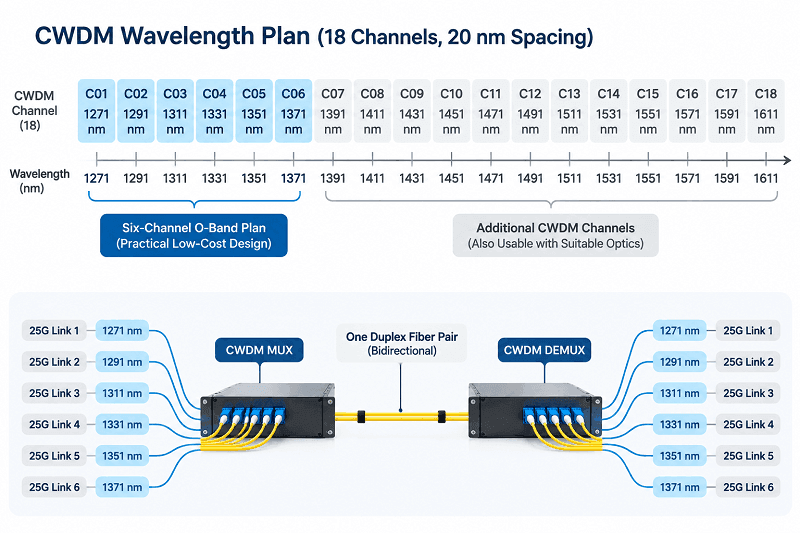
Chromatic dispersion is an important consideration when selecting higher CWDM wavelengths for 25G transmission.
Standard single-mode fiber, including ITU-T G.652 fiber, has its zero-dispersion wavelength near 1310 nm. Around this wavelength, chromatic dispersion is relatively low. As the operating wavelength moves farther away from the zero-dispersion region, dispersion generally increases.
The upper CWDM channels, including 1471, 1491, 1511, 1531, 1551, and 1571 nm, therefore require careful evaluation when used for 25G transmission.
At 25 Gbps, the signal’s relatively high symbol rate makes chromatic dispersion an important design factor. An inexpensive uncooled DFB transmitter may not provide sufficient dispersion tolerance for every wavelength and transmission distance.
However, it would be incorrect to conclude that all upper CWDM wavelengths are unsuitable for 25G.
Different transmitter and receiver technologies can support different performance levels. For example, FiberMall lists a 25G CWDM SFP28 1270 nm module using a CWDM DFB transmitter at $50. It also lists a 25G CWDM SFP28 1510 nm module using an EML transmitter and PIN receiver at $350, with a stated reach of 10 km.
These products illustrate the difference in optical design and cost between wavelength options.
The practical conclusion is that the six-channel O-band plan is an economical starting point, not a universal technical ceiling. Higher wavelengths can also be used when the selected optical modules, receiver performance, fiber characteristics, and link budget support them.
For a 25G CWDM deployment, the correct approach is to evaluate each wavelength and transceiver combination against its specified dispersion tolerance and optical budget.
That is also why MWDM became an important alternative for high-density 5G fronthaul applications.
If you need a complete view of the wavelength grid, the CWDM wavelength chart shows all 18 nominal channels and their corresponding wavelength ranges.
25G CWDM vs. LWDM vs. MWDM vs. DWDM at a 10 km Budget
Four WDM technologies can be considered for the same fronthaul network. They differ in channel spacing, optical design, supported reach, and overall deployment cost.
| Technology | Channel Capacity at 25G | Typical Reach in This Comparison | FiberMall Indicative Module Price | Best Fit |
| CWDM | 18-grid wavelength options; six low-cost O-band channels in this design | 10 km for the cited 25G modules | $50 for 1270 nm | Cost-sensitive sites, moderate distances |
| LWDM | 9 listed wavelengths, C02–C10 | 40 km | Approximately $500–$700 | Longer spans requiring higher optical performance |
| MWDM | 12 x 25G wavelength channels | 5 km under ITU-T G.698.6 | Not currently listed | Dense 5G fronthaul and limited fiber resources |
| DWDM | 40+ channels, depending on grid and configuration | 10–80 km or more, depending on optics and amplification | Varies | High-capacity aggregation and metro networks |
The numbers in this table are indicative rather than universal technology limits. Actual channel capacity and reach depend on the optical interface, fiber characteristics, MUX/DEMUX specifications, and system architecture.
Two cost considerations matter most. A low-wavelength 25G CWDM module is available for approximately $50, while 25G LWDM modules are significantly more expensive but offer a much longer specified reach.
When MWDM Is the Answer
MWDM was developed to address the increasing demand for 5G fronthaul capacity when available fiber resources are limited.
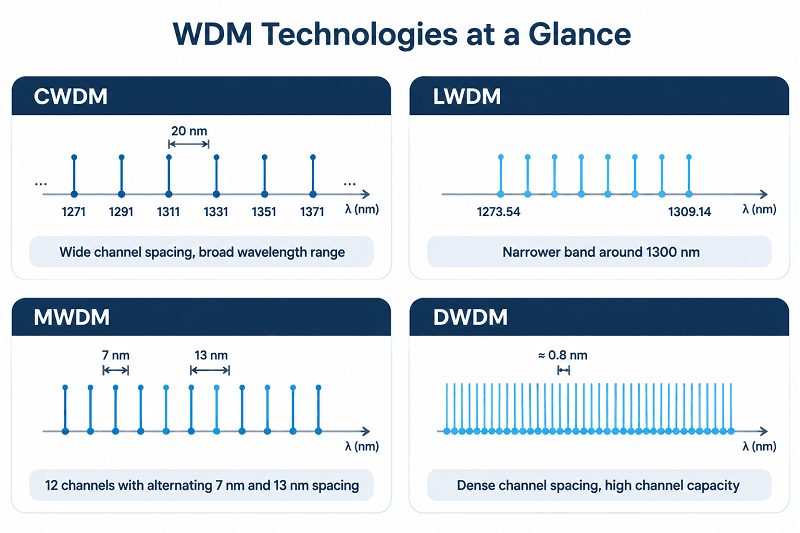
It uses a denser O-band wavelength plan with alternating 7 nm and 13 nm channel spacing. This provides twelve 25G wavelength channels within a relatively narrow wavelength range.
The important distinction is that twelve wavelength channels do not automatically mean twelve bidirectional sector links. The number of bidirectional links depends on whether the system uses separate unidirectional fibers or a single bidirectional fiber and how its wavelengths are assigned.
The relevant international recommendation is ITU-T G.698.6, approved in January 2024. It defines optical parameters for 25 Gbit/s-per-channel WDM applications in the O-band, including unidirectional and bidirectional configurations, optimized for 5 km transmission distances.
Some MWDM implementations use thermoelectric cooling to stabilize or control transmitter wavelengths. However, the specific laser-control mechanism depends on the module design and is not a universal requirement of the ITU-T recommendation.
The alternating wavelength spacing is part of the defined channel plan and must be matched by the corresponding MUX/DEMUX filters.
MWDM can also support more advanced network management in semi-active architectures. Some implementations use an out-of-band pilot tone to support remote monitoring and fault management. This is a system-level feature rather than a feature that should be assumed for every MWDM transceiver.
Our semi-active MWDM system overview covers the OAM and network-management architecture in more detail.
The main challenges are cost, availability, and system complexity. MWDM modules and filters require a more specialized design than conventional CWDM products. FiberMall does not currently list a standard MWDM transceiver in its catalog, so an MWDM deployment would require a sourcing and engineering discussion.
Volume also provides useful market context.
China Mobile’s 2022–2023 base-station fronthaul procurement included planned quantities of 178,763 CWDM sets and 9,638 MWDM sets, according to C114. This demonstrated the much larger procurement scale of CWDM during that purchasing cycle.
The 2024–2026 public procurement program subsequently focused on a large-scale CWDM deployment. This indicates continued demand for CWDM, but it should not be interpreted as evidence that MWDM has disappeared from the market.
For most cost-sensitive sites, CWDM remains attractive. MWDM becomes more relevant when greater wavelength density is required and the project can justify the additional optical and system costs.
When LWDM Is Worth the Premium
LWDM, or LAN WDM, occupies a narrower wavelength range than CWDM. Its channels are clustered around 1300 nm, where standard single-mode fiber has relatively low chromatic dispersion.
FiberMall’s 25G LWDM SFP28 product lineup includes nine listed wavelength options from 1273.54 nm to 1309.14 nm, identified by product channel codes C02 through C10.
These modules use EML transmitters and APD receivers and are specified for transmission distances of up to 40 km.
The product channel codes C02–C10 are FiberMall’s product identifiers and should not be confused with the nominal channel numbering of the CWDM grid.
FiberMall’s listed 25G LWDM SFP28 prices are approximately $500–$700 per module, depending on the specific wavelength, compatibility coding, and configuration. Confirm the exact SKU and current quotation before using these prices in a procurement comparison.
At approximately 10–14 times the price of a $50 low-cost CWDM module, LWDM is a long-span solution rather than a general replacement for CWDM.
It makes sense when the actual transmission distance exceeds the supported reach of the selected CWDM modules, or when the required dispersion and optical performance cannot be achieved economically with the CWDM design.
For a fronthaul link within 10 km, LWDM may provide reach that the deployment does not need.
A common mistake is standardizing on one optical module type across an entire metro ring. When individual spans range from 3 km to 22 km, short links may pay for reach they never use, while longer links may still fail their optical budget.
Matching the module to each individual span usually costs less than upgrading every site to a long-reach optical module.
Design per span, not per project.
What a Six-Sector Fronthaul Build Costs
Prices are what separate a practical recommendation from a simple datasheet comparison.
Here is an illustrative six-sector deployment built two ways, using FiberMall’s listed prices for 25G CWDM SFP28 10 km modules, standard 25G SFP28 LR modules, and a customizable 8-channel dual-fiber CWDM MUX/DEMUX.
Design A: Dedicated Fiber per Sector
| Item | Quantity | Unit Price | Subtotal |
| 25G SFP28 LR, 10 km | 12 | $45 | $540 |
| Fiber pairs required | 6 | N/A | 12 strands |
Design B: 25G CWDM Over One Fiber Pair
| Item | Quantity | Unit Price | Subtotal |
| 25G CWDM SFP28, 10 km | 12 | $50 | $600 |
| 8-channel CWDM MUX/DEMUX, dual-fiber LGX | 2 | $280 | $560 |
| Fiber pairs required | 1 | N/A | 2 strands |
| Total optics and MUX/DEMUX | $1,160 |
The $280 MUX/DEMUX price is based on FiberMall’s listed customizable 8-channel dual-fiber LGX product. Its standard 1470–1610 nm configuration does not match the six lower O-band wavelengths in this design. The required 1270–1370 nm wavelength configuration must therefore be specified and confirmed before ordering. The displayed price should be treated as a reference price rather than a confirmed quotation for the customized wavelength plan.
Based on these reference prices, Design B costs $620 more in hardware but saves ten fiber strands.
Design A looks cheaper until the cost of obtaining additional fiber is included.
The Fiber-Strand Trade-Off
That is the entire economic argument in one comparison.
The CWDM premium is approximately $620 in additional hardware against the cost of installing ten additional fiber strands.
New fiber installation can involve trenching, permits, duct access, cable pulling, splicing, testing, and project delays. On a dense urban site, these costs can reach several thousand dollars or more before the network carries its first signal.
When existing fiber resources are limited, paying more for CWDM optics and passive MUX/DEMUX equipment can be considerably more economical than constructing additional fiber infrastructure.
The comparison changes at lower sector counts.
A two-sector site using one duplex link per sector needs four strands for dedicated LR links. The CWDM solution still requires four transceivers and a pair of MUX/DEMUX devices. The $560 MUX/DEMUX hardware cost is difficult to justify when only two channels are being used.
Below three sectors, dedicated fiber will often win on hardware cost alone, assuming spare fiber is available.
There is also a catalog consideration.
FiberMall’s standard passive dual-fiber CWDM MUX/DEMUX lineup includes 4-, 8-, 16-, and 18-channel configurations, with no standard six-channel dual-fiber model listed.
For a six-sector deployment, an 8-channel customized MUX/DEMUX can be used with two channels left unused. The wavelength configuration must match the selected transceivers.
The listed insertion loss for FiberMall’s customized 8-channel dual-fiber MUX/DEMUX is up to 2.4 dB per device. With one MUX/DEMUX at each end, the pair can contribute up to 4.8 dB of insertion loss.
This is a significant part of the optical budget and must be considered before assuming that a 10 km transceiver will still support a 10 km link after MUX/DEMUX insertion loss is added.
The exact per-channel insertion loss should be confirmed against the final product datasheet.
Note: Confirm current stock, wavelength availability, customized MUX specifications, and list prices before quoting. FiberMall’s cited 25G CWDM SFP28 1270 nm module is specified for 10 km. Higher-wavelength products have different transmitter designs and pricing. The product catalog provides multiple wavelength options, but their prices and specifications are not interchangeable.
Deploying CWDM Fronthaul Without Surprises
A passive fronthaul design is simple in principle but requires careful engineering in practice.
A passive WDM node does not have an active management plane to identify problems automatically. Diagnosis therefore depends on accurate design records, correct wavelength assignments, and optical measurements.
Three issues cause most deployment problems:
- Insertion loss at each MUX/DEMUX, including both ends of the link.
- Temperature conditions in outdoor radio cabinets and equipment enclosures.
- Wavelength mismatches between transceiver modules and MUX/DEMUX ports.
Each issue is inexpensive to plan for but can become expensive to discover during commissioning.
Insertion Loss Across a Six-Channel Node
A passive MUX/DEMUX adds insertion loss to the optical link. The actual loss depends on the device’s channel count, filter design, connector configuration, and optional ports.
For the customized 8-channel dual-fiber MUX/DEMUX listed by FiberMall, the specified insertion loss is up to 2.4 dB per device.
With a MUX at one end and a DEMUX at the other, the maximum combined insertion loss can therefore reach 4.8 dB before accounting for fiber attenuation, connectors, or splices.
Consider the cited 25G CWDM SFP28 1270 nm module. Its product specifications list a minimum transmit power of -4.0 dBm and receiver sensitivity of -13.3 dBm, giving an approximate optical power budget of 9.3 dB.
After allocating up to 4.8 dB for the MUX/DEMUX pair, approximately 4.5 dB remains for fiber attenuation, connector loss, splice loss, and engineering margin.
This example shows why the stated 10 km transceiver reach cannot automatically be assumed when two passive MUX/DEMUX devices are added.
The actual available margin must be calculated using the minimum transmitter output, receiver sensitivity, and maximum insertion loss for the selected wavelength and product.
Do not substitute the optical budget of a standard 25GBASE-LR module for the CWDM module’s own specifications. The IEEE 25GBASE-LR interface has its own optical channel requirements, including a maximum channel insertion loss of 6.3 dB, but those values apply to the standardized 1310 nm LR interface rather than automatically to every CWDM transceiver.
Measure the actual fiber span, verify connector and splice losses, and include an appropriate engineering margin in the design record.
The CWDM MUX/DEMUX insertion loss guide covers per-channel specifications and how to interpret the relevant parameters.
Temperature at the Outdoor Radio
If the MUX/DEMUX is installed in an outdoor radio cabinet, temperature becomes another important consideration.
Outdoor equipment enclosures are not always climate-controlled. During winter, temperatures may fall below the operating range of standard commercial-temperature optical modules.
The cited FiberMall 25G CWDM SFP28 1270 nm module is specified for an operating temperature range of 0°C to 70°C. It should not automatically be treated as an industrial-temperature transceiver.
For outdoor deployment, select industrial-temperature optical modules when required and confirm the operating-temperature range of the exact MUX/DEMUX model.
FiberMall offers selected industrial-grade optical configurations, but temperature specifications must be verified against the individual product datasheet rather than assumed across the entire product family.
Our SFP28 5G fronthaul guide covers optical module selection and other fronthaul design considerations.
Wavelength Mismatch and Port Labeling
A CWDM link can fail when the MUX/DEMUX port wavelength does not match the connected transceiver.
The wrong wavelength may experience excessive filter loss, resulting in low received optical power or a link that fails to establish. The equipment error message may not explicitly identify a wavelength mismatch.
Label every MUX/DEMUX port with its nominal wavelength during commissioning, and record the wavelength assigned to each radio.
Pay particular attention to the distinction between nominal ITU-T wavelengths and common commercial product labels. For example, a product labeled 1310 nm may correspond to the 1311 nm nominal CWDM grid channel.
A 1310 nm module connected to a 1330 nm port is not a valid wavelength match. The 20 nm channel difference is outside the normal passband expected for that channel and can cause substantial signal loss.
Do not rely on the physical port position or similar-looking labels. Confirm the actual wavelength assignment at both ends of the link.
Accurate labeling and a documented channel plan can prevent unnecessary site visits and lengthy troubleshooting sessions.
Frequently Asked Questions
How many 25G channels can CWDM carry?
The ITU-T G.694.2 CWDM grid defines 18 nominal wavelengths, from 1271 nm to 1611 nm, with 20 nm channel spacing.
The number of channels that can be used at 25G depends on the transceiver technology, wavelength-specific dispersion tolerance, receiver performance, transmission distance, and optical budget.
For a cost-sensitive 10 km fronthaul deployment, six low-cost O-band wavelengths from 1271 nm to 1371 nm are a practical starting point.
Additional wavelengths can be used with suitable optical modules and a compatible MUX/DEMUX design. The six-channel arrangement is not a universal technical limit.
Is CWDM or MWDM better for 5G fronthaul?
CWDM is generally more attractive for cost-sensitive deployments because it is widely available, relatively simple to deploy, and does not require active wavelength management.
MWDM is more suitable when a site needs denser O-band wavelength utilization and available fiber resources are limited.
ITU-T G.698.6 defines 25 Gbit/s-per-channel WDM applications using alternating 7 nm and 13 nm wavelength spacing, optimized for 5 km transmission distances.
The best choice depends on the required number of channels, actual transmission distance, optical budget, equipment availability, and total deployment cost.
China Mobile’s 2022–2023 procurement figures also show the much larger planned CWDM deployment volume during that purchasing cycle.
What is the maximum distance for 5G fronthaul CWDM?
The cited FiberMall 25G CWDM SFP28 1270 nm module is specified for distances of up to 10 km over single-mode fiber.
However, this is the transceiver’s stated reach, not a guarantee that every 10 km link will work after adding two passive MUX/DEMUX devices.
The actual transmission distance must be verified against the complete optical link budget, including MUX/DEMUX insertion loss, fiber attenuation, connector loss, splice loss, and engineering margin.
For longer spans, FiberMall’s 25G LWDM SFP28 modules offer specified transmission distances of up to 40 km, depending on the selected wavelength and configuration.
Do I need a 6-channel CWDM MUX for a six-sector site?
No. A six-channel MUX is not mandatory.
FiberMall’s standard passive dual-fiber CWDM MUX/DEMUX lineup does not list a standard six-channel model. A customizable 8-channel dual-fiber model can be used, with two channels left unused.
However, the customized wavelength configuration must match the selected 25G CWDM transceivers.
The 8-channel model has a specified insertion loss of up to 2.4 dB per device, so the combined loss of the two ends must be included in the link budget.
Can I run 4G and 5G on the same CWDM fronthaul fiber?
Yes. A CWDM system can carry different generations of mobile traffic over the same fiber infrastructure by assigning separate wavelengths to different services.
For example, a deployment may allocate lower O-band wavelengths to 25G 5G fronthaul links and other CWDM wavelengths to legacy 10G 4G services.
A possible design could use 25G optics in the lower wavelength group and 10G optics in the upper wavelength group.
However, there is no universal wavelength assignment for every mixed 4G/5G deployment. The transceiver specifications, channel spacing, MUX/DEMUX passbands, transmission distances, and optical budgets must all be checked before implementation.
What does a 25G CWDM SFP28 cost?
At the time of this review, FiberMall lists its 25G CWDM SFP28 1270 nm, 10 km module at approximately $50, compared with approximately $45 for a standard 25G LR SFP28 module.
Higher-wavelength CWDM products can cost considerably more. For example, the 1510 nm 25G CWDM SFP28 module using an EML transmitter is listed at approximately $350.
The price difference reflects the different optical components and performance requirements of the selected wavelength.
Prices may vary according to wavelength, compatibility coding, order quantity, and availability. Always confirm the exact product specification and quotation before purchasing.
The Fiber-Strand Test Decides the Design
5G fronthaul CWDM is fundamentally a fiber-resource decision supported by optical technology.
The price difference between a low-cost CWDM module and a standard LR module is only $5 in the example above. The larger financial difference comes from the ten fiber strands that can be saved in a six-sector deployment.
Before specifying any equipment, evaluate four things:
- Count the available spare fiber strands at the site.
- Estimate the cost of installing additional fiber if the existing strands are insufficient.
- Compare that cost with the approximately $620 hardware premium in the illustrative six-sector CWDM build, allowing for any customized MUX/DEMUX price adjustment.
- If the available fiber can support every sector using dedicated links, compare the simpler LR solution against the complete CWDM solution. If fiber resources are limited, evaluate CWDM and its full optical budget.
When the strands are not available, CWDM can turn one fiber pair into six independent 25G bidirectional links for approximately $620 in additional reference hardware costs. The final decision depends on the value of the fiber resources and the actual link budget.
Two constraints should be carried into every design review.
First, the cited low-cost 25G CWDM SFP28 modules are specified for 10 km. A longer span requires a different optical design or another suitable WDM technology. FiberMall’s 25G LWDM SFP28 lineup offers modules with up to 40 km of specified reach, but at a considerably higher price.
Second, FiberMall’s standard dual-fiber CWDM MUX/DEMUX lineup does not include a standard six-channel model. A customized 8-channel device can be used, but the wavelength configuration and additional insertion loss must be confirmed before deployment.
For optical module selection, the CWDM SFP guide explains data rates, wavelengths, and transmission reach.
If you are new to wavelength division multiplexing, the CWDM complete guide introduces the technology and its practical applications.
When the design is finalized, talk to FiberMall’s engineers about a suitable channel plan, customized MUX/DEMUX configuration, optical link budget, and stock availability for your site list.
Related Products:
-
 Passive CWDM Double Fiber Mux & Demux Module 18 CH (1270-1610nm) LC/UPC 1U Rack
$630.00
-
Passive CWDM Double Fiber Mux & Demux Module 16 CH (1310-1610nm) 1U Rack
$570.00
-
CWDM MUX 8CH 16 Wavelengths (TX: 1310/1330/1390/1410/1470/1490/1550/1570nm RX: 1350/1370/1430/1450/1510/1530/1590/1610nm) LC/UPC Single Fiber 1U Rack
$320.00
-
Passive CWDM Double Fiber Mux & Demux Module 8CH (1470-1610nm) LC/UPC LGX BOX
$280.00
-
CWDM MUX 4CH 8 Wavelengths (TX: 1470/1490/1510/1530nm RX: 1550/1570/1590/1610nm) with Express Port LC/UPC Single Fiber LGX BOX
$150.00
-
Passive CWDM Double Fiber Mux & Demux Module 4 CH (1470-1530nm) LC/UPC LGX BOX
$150.00
-
Passive CWDM Single Fiber 1 Channel OADM LGX BOX
$70.00
-
Passive CWDM Double Fiber 2 Channels OADM LGX BOX
$130.00
-
Passive CWDM Double Fiber 4 Channels OADM LGX BOX
$250.00
-
SFP-CW10G27-40C 10G CWDM SFP+ 1270nm 40km LC SMF DDM Transceiver Module
$95.00
-
SFP-CW10G27-10C 10G CWDM SFP+ 1270nm 10km LC SMF DDM Transceiver Module
$60.00
-
SFP-CW10G59-05C 10G CWDM SFP+ 1590nm 5km LC SMF DDM Transceiver Module
$60.00
-
SFP-CW10G27-20C 10G CWDM SFP+ 1270nm 20km LC SMF DDM Transceiver Module
$75.00
-
SFP-CW10G47-100C 10G CWDM SFP+ 1470nm 100km LC SMF DDM Transceiver Module
$280.00